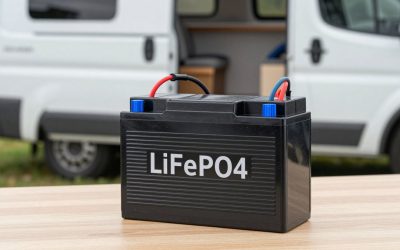
TL;DR: A lithium starter battery for your RV or tow vehicle delivers faster cranking, lighter weight, and dramatically longer service life than AGM or lead-acid alternatives. The upfront cost is higher, but the math works out over a 5–10 year ownership period. This guide covers what to look for, key specs, and whether it’s right for your rig.
Lithium Starter Battery for RV and Vehicle: What to Know Before You Buy
Most vanlifers and RVers obsess over their house battery system and treat the starter battery as an afterthought. That’s understandable — the house bank is where the interesting engineering happens. But a failed starter battery strands you as effectively as any other mechanical failure, and the lithium starter battery RV upgrade is one worth understanding before your stock lead-acid inevitably dies.
As an Amazon Associate we earn from qualifying purchases.

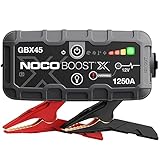
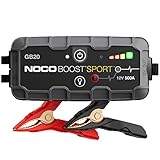
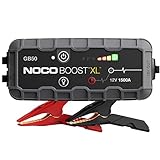
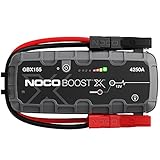

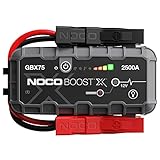
Lithium starter batteries (lithium iron phosphate or LiFePO4, and lithium titanate or LTO in some applications) offer genuine advantages over AGM and flooded lead-acid. They also come with important caveats specific to RV and van use that most product pages gloss over.
🛒 Best Price Today on Amazon
Prime members get fast, free shipping on everything above, plus member-only deals. New members get a 30-day free trial — cancel anytime.
Start 30-Day Prime Free Trial →See Today’s Amazon Deals- Top Lithium Starter Batteries for RV and Van Use
- Lithium vs. AGM vs. Lead-Acid Starter Battery Comparison
- Why Lithium Starter Batteries Excel for Van and RV Applications
- Important Caveats for RV and Van Use
- Starter Battery vs. House Battery: Understanding the Distinction
- Installation Notes for Van and RV Builders
- FAQ: Lithium Starter Battery RV
- Frequently Asked Questions
- Related Articles
- Related Guides
Top Lithium Starter Batteries for RV and Van Use


As an Amazon Associate we earn from qualifying purchases. Product prices and availability are accurate as of the date/time indicated.

WAYSKA Diesel Heater 12V, 5L Tank, Diesel Heater 2KW, Muffler, Diesel Parking Heater with LCD Monitor & Remote Control for Trucks, Trailer, Boat and Motor-Home


As an Amazon Associate we earn from qualifying purchases. Product prices and availability are accurate as of the date/time indicated.

Ivation Portable Camping Shower | Compact Handheld & Hands-Free Rechargeable Outdoor Shower Head & Cleaning System w/ 3.7V Pump, 6-Ft Hose, Bidet Head, Removable Filter, Multiuse Hook & USB Cable


As an Amazon Associate we earn from qualifying purchases. Product prices and availability are accurate as of the date/time indicated.
Lithium vs. AGM vs. Lead-Acid Starter Battery Comparison
See also: How Long Will a 100Ah Battery Last in a Van? Runtime Math Explained • Best Level 2 EV Chargers for Home
| Feature | Flooded Lead-Acid | AGM | Lithium (LiFePO4) |
|---|---|---|---|
| Cold cranking amps (CCA) | Good | Very Good | Excellent |
| Weight | Heavy (~40–50 lbs) | Heavy (~35–45 lbs) | Light (~15–25 lbs) |
| Cycle life | 200–400 cycles | 400–600 cycles | 2,000–5,000 cycles |
| Self-discharge rate | High (~5%/month) | Medium (~3%/month) | Very Low (~1–2%/month) |
| Charge speed | Slow | Moderate | Fast |
| Maintenance | Watering required | Maintenance-free | Maintenance-free |
| Cold weather performance | Degrades significantly | Moderate degradation | Moderate (better than LA) |
| Typical lifespan | 3–5 years | 4–7 years | 8–15 years |
| Price range (group 24–31) | $80–$150 | $150–$300 | $250–$600 |
Why Lithium Starter Batteries Excel for Van and RV Applications
The weight savings alone justify serious consideration for builds where every pound counts. Swapping a 45 lb AGM for a 20 lb lithium unit shaves 25 lbs from the front of the vehicle — meaningful for handling on a top-heavy van conversion, and genuinely significant weight reduction for lightweight trailer builds.
Cold cranking performance is exceptional. Lithium batteries maintain their CCA rating far better in cold temperatures than lead-acid chemistry does. Where a lead-acid battery might deliver 50–60% of its rated CCA at 0°F, a quality lithium starter battery maintains 80–90% or better. For vanlifers and RVers in cold climates — essential.
The self-discharge advantage matters for seasonal or part-time RV use. A lead-acid battery sitting unused over a 3-month winter will self-discharge enough to sulfate and permanently lose capacity. A lithium battery stored at partial charge will still have usable charge when you return in spring. This alone saves one dead-battery service call per year for many seasonal users.
Important Caveats for RV and Van Use
Not all lithium starter batteries are equal, and the RV application has specific demands that expose lower-quality units. The biggest concern is the battery management system (BMS). Lithium batteries require a BMS to prevent overcharge, over-discharge, and over-temperature conditions. A BMS that cuts out at the wrong moment — say, when you’re cranking a diesel engine in cold weather — is worse than the AGM it replaced.
Verify compatibility with your vehicle’s charging system. Some older vehicles and RV converters use charging profiles optimized for lead-acid that can overcharge a lithium battery or, more commonly, fail to fully charge it (leading to long-term capacity degradation). Many modern lithium starter batteries include internal circuitry that makes them compatible with standard alternators, but confirm this before purchasing.
Cold-weather charging is a real limitation. Lithium chemistry cannot safely accept a charge below approximately 32°F (0°C). Quality BMS units include low-temperature charge protection that prevents damage, but this means your battery won’t charge from the alternator until it warms up on a very cold morning start. For most van and RV use cases this is acceptable — the battery discharges some starting energy, the engine runs, the battery warms up, and charging resumes. In extreme cold applications, low-temperature self-heating lithium batteries (containing heating elements) are available at a premium.
Starter Battery vs. House Battery: Understanding the Distinction
Your van or RV has two separate battery systems that serve completely different functions. The starter battery (also called the chassis battery or cranking battery) provides a massive short burst of current to start the engine — typically 400–800+ cold cranking amps for a fraction of a second. It’s immediately recharged by the alternator and should never be deeply discharged.
The house battery (or auxiliary battery bank) powers your 12V loads — lights, fridge, fan, electronics — over hours. It’s designed for deep cycling: repeatedly discharging to 50–80% and recharging. These are fundamentally different battery designs even when using the same chemistry.
For your house bank, see our comprehensive guides on LiFePO4 house batteries and lithium vs AGM deep cycle comparison. For your solar charging system that keeps both batteries topped up, our MPPT controller guide covers dual-battery charging setups and split charge relay configurations.
Installation Notes for Van and RV Builders
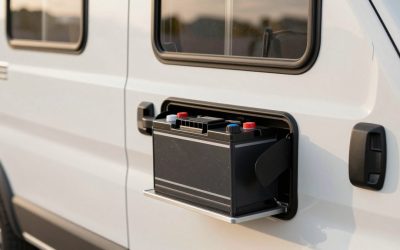
Physical fitment matters. Battery group sizes (Group 24, 27, 31, 35, etc.) correspond to physical dimensions. Lithium starter batteries are available in standard group sizes, but confirm measurements before ordering — some lithium units are slightly shorter than their lead-acid equivalents and may need a battery hold-down adapter.
Terminal type and orientation should match your existing setup or you’ll need cable extensions. Lithium batteries for starting use the same terminal posts as conventional batteries — this is a straightforward swap in most applications.
Disposal and recycling: lithium batteries require proper recycling — they cannot go in regular trash or recycling bins. Most auto parts retailers (AutoZone, O’Reilly, Advance Auto Parts) accept lithium batteries for recycling. Plan your disposal before purchase, especially if you’re a full-timer without a fixed address for mail-in recycling programs.
For a complete look at how your starter battery, house battery, alternator, and solar interact as an integrated system, our power system overview and solar panel guide connect all the pieces.
FAQ: Lithium Starter Battery RV
Can I use a lithium house battery as a starter battery?
Generally no. Deep-cycle LiFePO4 house batteries are not optimized for the high-burst cranking current that starting an engine requires. Some high-capacity units can technically start an engine in an emergency, but using a deep-cycle battery for regular starting duty will shorten its life and may void the warranty. Use batteries designed for their intended purpose.
How long does a lithium starter battery last in an RV?
Quality lithium starter batteries rated for 2,000+ charge cycles will outlast the vehicle in most use cases. Real-world RV starter batteries rarely cycle more than once per day even during active travel seasons, meaning a 2,000-cycle battery offers well over 5 years of daily use. Most users report 8–12 years of service life, versus 3–5 years for conventional lead-acid.
Will a lithium starter battery work with my RV’s stock alternator?
In most cases yes, with caveats. Standard automotive alternators charge at 13.8–14.4V, which is compatible with most lithium starter batteries. However, some older RV-specific alternators or combined charging systems may use profiles that aren’t ideal. Check the manufacturer’s compatibility notes for your specific vehicle make and model year before purchasing.
Is a lithium starter battery worth the extra cost for a van?
For full-time vanlifers and frequent travelers: yes. The weight savings, extended service life, and cold-weather reliability justify the premium over the ownership period. For weekend warriors replacing a battery that died and planning to sell the van within 2–3 years, a quality AGM is more cost-effective.
Do lithium starter batteries require a special charger?
For standard starting use, no — your alternator charges it automatically during driving. If you’re charging a dead lithium starter battery with an external charger, use one with a lithium-compatible mode. Many modern smart chargers (NOCO Genius, Battery Tender) include lithium charging profiles. Using a standard lead-acid charger on a lithium battery is not recommended and may damage the BMS over time.
Frequently Asked Questions
Can I replace my van starter battery with lithium?
Only with a battery specifically built for cranking, meaning a high-current BMS rated for several hundred cold cranking amps in a short burst. A standard 100Ah deep cycle LiFePO4 has a BMS limited to around 100-200A continuous and will trip or be damaged when the starter draws 600A.
What is the real benefit over a lead-acid starter battery?
Weight is the headline: a lithium cranking battery weighs about a third of an equivalent lead-acid, saving 30-40 pounds. It also holds voltage under load better, self-discharges slowly during storage, and lasts far longer in deep-discharge situations where a lead-acid would be permanently damaged after a few flat episodes.
Will my alternator charge a lithium starter battery properly?
Most alternators charge to around 14.2-14.4V, which suits LiFePO4, but smart alternators on newer vans vary voltage and may undercharge. Some lithium starter batteries include internal regulation. Check compatibility with your specific vehicle, especially anything with regenerative charging or a stop-start system.
What happens in freezing weather?
This is the biggest weakness. LiFePO4 must not charge below 32F, so a lithium starter battery in a cold engine bay may refuse alternator charge on a winter morning. Buy a self-heating model with an internal warmer if you camp in real cold, and expect reduced cranking capacity in deep freeze.
Is installation just a straight swap?
Physically often yes, but check terminal polarity, hold-down fitment and whether the case size matches the tray, since lithium units are smaller and may need a spacer. Also confirm your vehicle does not require a battery registration or BMS reset procedure, which some newer European vans do.