- Top Pick: 12V 100Ah LiFePO4 Battery, 1280Wh Lithium Battery Group 31 Smart 100A BMS, 15000+ Deep Cycles 10-Year Lifespan Low Temp Protection Lightweight Max 4P4S 1280Wh for Trolling Motor, RVs, Marine, Off-Grid
- Best Value: HumsiENK 12V 100Ah LiFePO4 Lithium Battery with Bluetooth (Group 24) 1280Wh
- Premium Choice: HQST 12V 100Ah LiFePO4 Battery, Group 22NF Mini, BMS, LED Meter, 1280Wh

Best LiFePO4 Battery 100Ah for Van & RV Builds 2026
TL;DR Quick Answer
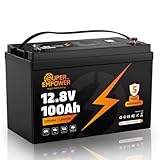
The SUPEREMPOWER 12V 100Ah LiFePO4 (B0FN3TVVD8) is our top pick at $142.39 — 4,000+ cycle life, built-in 100A BMS, and 1,280Wh usable capacity. For most vanlifers replacing a 100Ah AGM, this is a direct drop-in with zero regrets. Skip AGM entirely. LiFePO4 pays for itself within 18 months in weight savings, runtime, and fewer replacements.
Switching to a 12V lithium battery for your RV or van build is the single highest-ROI upgrade you can make in 2026. Weight drops by 60%, usable capacity doubles versus AGM, and charge times cut in half. This guide breaks down LiFePO4 chemistry, what the BMS actually does, cycle life math, and exactly which 100Ah battery to buy — with real wiring guidance.
As an Amazon Associate we earn from qualifying purchases.


🛒 Best Price Today on Amazon
Prime members get fast, free shipping on everything above, plus member-only deals. New members get a 30-day free trial — cancel anytime.
Start 30-Day Prime Free Trial →See Today’s Amazon Deals- Top Picks at a Glance
- Why LiFePO4 Beats AGM in Every Vanlife Metric
- Understanding the BMS: Your Battery’s Brain
- SUPEREMPOWER 12V 100Ah — Full Spec Breakdown
- Van Install Guide: Wiring a 100Ah LiFePO4
- LiFePO4 Pros & Cons for Vanlife
- How Many Batteries Does Your Van Need?
- Related Vanlife Power Guides
- Frequently Asked Questions
- Related Guides
- Related Articles
- Related Guides
Top Picks at a Glance
BEST OVERALL
SUPEREMPOWER 12V 100Ah LiFePO4


As an Amazon Associate we earn from qualifying purchases. Product prices and availability are accurate as of the date/time indicated.
RUNNER-UP
Renogy 12V 100Ah Smart LiFePO4
Compare on Amazon for current price
BEST BUDGET
Ampere Time 12V 100Ah LiFePO4
Compare on Amazon for current price
Why LiFePO4 Beats AGM in Every Vanlife Metric
See also: MaxxFan Deluxe vs Fantastic Fan for Vans: Which to Choose? • Can I Lay LVP in a Van? Van Flooring Guide
Lithium Iron Phosphate (LiFePO4) chemistry has been around since the 1990s but became price-competitive for DIY van builds around 2021. By 2026, a quality 100Ah LiFePO4 costs less than a comparable AGM — and outperforms it in every category that matters on the road.
Here is what the chemistry actually means for your build:
- Flat discharge curve — AGM voltage sags under load. LiFePO4 holds 13.2–12.8V until roughly 90% depth of discharge. Your inverter, fridge, and heater run at consistent power throughout the discharge cycle.
- True 100Ah usable capacity — AGM gives you ~50Ah before damaging the battery. LiFePO4 gives 95–100Ah. That 100Ah battery is actually a 200Ah AGM equivalent in real-world use.
- 4,000+ cycles vs. 400–500 cycles — At one cycle per day boondocking, a quality LiFePO4 lasts 10+ years. AGM lasts 1–2 years under the same conditions.
- Weight — The SUPEREMPOWER 100Ah weighs approximately 26 lbs. A comparable AGM runs 60–65 lbs. For roof-mounted solar + battery setups, that 35 lb difference matters for handling and safety.
- Charge acceptance — LiFePO4 accepts charge at up to 1C (100A for a 100Ah battery). AGM tops out around 25A efficiently. Shorter generator runs, faster solar recovery.
Understanding the BMS: Your Battery’s Brain
Every quality LiFePO4 battery ships with a Battery Management System (BMS). The SUPEREMPOWER 100Ah includes a 100A continuous BMS — here is what each protection layer does:
- Over-voltage protection — Disconnects charge above 14.6V. Prevents cell damage from faulty chargers or solar charge controllers not set to LiFePO4 profile.
- Under-voltage cutoff — Disconnects load at ~10V. Protects against deep discharge that kills cells permanently.
- Over-current / short-circuit protection — 100A BMS handles typical van loads. Running a 2,000W inverter? You are pulling ~170A peak. Wire a second battery in parallel, not through the BMS limit.
- Temperature protection — Most LiFePO4 cells stop accepting charge below 32°F (0°C). The BMS disconnects charge input to protect cells. Note: you can still discharge down to -4°F in most units, just cannot charge when frozen. This matters for winter vanlife — more on this below.
- Cell balancing — The BMS equalizes the four cell groups (cells wired in series to achieve 12V nominal). Unbalanced cells reduce capacity and lifespan.
SUPEREMPOWER 12V 100Ah — Full Spec Breakdown
As an Amazon Associate we earn from qualifying purchases. Product prices and availability are accurate as of the date/time indicated.
| Spec | Value | What It Means for Your Build |
|---|---|---|
| Nominal Voltage | 12.8V | Drop-in for 12V AGM systems |
| Capacity | 100Ah / 1,280Wh | Runs a 50W fridge ~25 hours |
| Usable Capacity | ~95–100Ah (95% DoD) | vs. ~50Ah for AGM |
| Cycle Life | 4,000+ cycles @ 80% DoD | 10+ years daily use |
| BMS Rating | 100A continuous | Handles most van loads directly |
| Max Charge Current | 50A recommended | Use LiFePO4-profile charger/controller |
| Weight | ~26 lbs (12 kg) | ~40 lbs lighter than equivalent AGM |
| Dimensions | 12.95 × 6.77 × 8.43 in | Group 31 footprint — fits most battery boxes |
| Operating Temp (Discharge) | -4°F to 140°F | Safe for cold-weather vanlife |
| Operating Temp (Charge) | 32°F to 113°F | Add battery heating pad for winter camping |
| Price | $142.39 | Best value per Wh in this class |
Van Install Guide: Wiring a 100Ah LiFePO4
Installing a LiFePO4 is straightforward but requires specific adjustments versus AGM. Here is the component-by-component checklist:
1. Solar Charge Controller — Set LiFePO4 Profile
If you are running a PWM or MPPT controller, set the charge profile to LiFePO4: bulk/absorption 14.4–14.6V, float 13.6V. Do not use AGM or wet lead-acid profile — the higher float voltage (13.8V+) on AGM profiles will trickle charge LiFePO4 unnecessarily and may cause balancing issues over time. Victron, Renogy, and EPever MPPT controllers all have dedicated LiFePO4 presets.
2. DC-DC Charger from Alternator
Do not wire LiFePO4 directly to your vehicle’s alternator with a simple isolator. LiFePO4 batteries will pull maximum current from the alternator when depleted, potentially burning out the alternator on a 2-3 hour drive. Use a DC-DC (B2B) charger — Renogy 40A DCC50S or Victron Orion-Tr Smart are the standard choices. Limits charge current to a safe rate and handles the voltage step-up properly.
3. Inverter Sizing and Wire Gauge
A 1,000W inverter draws ~83A at full load from a 12V battery. Wire sizing: 4 AWG for runs under 3 feet, 2 AWG for 3–5 feet, 1/0 AWG for 5–8 feet. Always fuse within 18 inches of the battery positive terminal. A 125A ANL fuse protects a 100A BMS battery for a single-battery setup.
4. Winter Charging — Battery Heating
The SUPEREMPOWER BMS cuts charge input below 32°F. In winter builds, add a self-regulating battery heating pad (12V, 20–40W) wired to a thermostat. Kicks in when battery temp drops below 40°F, keeps cells in chargeable range without wasting significant power.
LiFePO4 Pros & Cons for Vanlife
- 4,000+ cycles — 10x AGM lifespan
- True 95% depth of discharge usable
- 60% lighter than comparable AGM
- Flat voltage discharge curve — stable appliance performance
- Fast charge acceptance (up to 1C)
- No off-gassing — safe in enclosed spaces
- Built-in BMS protection at $142.39 price point
- Cannot charge below 32°F without heating solution
- Requires LiFePO4 charger profile (not a big deal — most modern gear supports it)
- Higher upfront cost vs. AGM (pays back within 18 months for most vanlifers)
- Parallel wiring requires matched state-of-charge batteries
How Many Batteries Does Your Van Need?
Quick math: add up your daily Wh consumption, then size your battery bank to 1.5–2x that number for comfortable boondocking without running the bank below 20%.
| Appliance | Watts | Hours/Day | Daily Wh |
|---|---|---|---|
| 12V Fridge (50W avg) | 50W | 24h | 1,200Wh |
| Diesel Heater | 10–30W | 8h | 80–240Wh |
| Lighting (LED) | 20W | 4h | 80Wh |
| Phone/Laptop Charging | 60W | 2h | 120Wh |
| Fan (MaxxAir) | 25W | 8h | 200Wh |
| TOTAL | ~1,680–1,840Wh |
At 1,280Wh per 100Ah battery and 95% usable (1,216Wh real), you need two 100Ah batteries minimum for this typical vanlife setup — three for comfortable 2-day cloudy-day reserves. Two SUPEREMPOWER units at $284.78 total is still a fraction of what a comparable AGM bank costs over 3 years.
Related Vanlife Power Guides
- diesel heater 12v vanlife guide
- see best 12v portable fridge camping
- this rv accessories must have article
Frequently Asked Questions
Can I replace my AGM battery with LiFePO4 without changing anything else?
Almost. The battery itself drops in physically (same terminal layout, same Group 31 footprint for most 100Ah units). You do need to update your charger or solar charge controller to a LiFePO4 voltage profile — using an AGM profile overcharges or undercharges the cells. If you have an alternator charge setup with a direct isolator, add a DC-DC charger to prevent alternator overload.
What does a 100A BMS mean for my van build?
The BMS handles 100A continuous load — enough for a 1,200W inverter, a 12V fridge, a diesel heater, and lights simultaneously without tripping. If you are running a larger inverter (2,000W+), wire two batteries in parallel so load is split between two BMS units rather than exceeding one.
Will a LiFePO4 battery work in freezing temperatures?
Discharge works fine down to -4°F. Charging is the limitation — the BMS cuts charge input below 32°F to prevent lithium plating that permanently damages cells. For winter vanlife, add a self-regulating 12V heating pad to the battery box. Pairs well with a diesel heater that keeps the living space (and battery box) above freezing anyway.
How long does a 12V 100Ah LiFePO4 battery last?
The SUPEREMPOWER is rated 4,000 cycles at 80% depth of discharge. At one full cycle per day (realistic for full-time vanlife with solar), that is 10+ years. Most vanlifers will get 8–12 years from quality LiFePO4 before capacity drops below 80% — compared to 1–2 years for AGM under similar use.
Is the SUPEREMPOWER 100Ah good enough for a full-time vanlife setup?
Yes, as part of a properly sized bank. Two units in parallel gives you 2,560Wh usable — enough for a typical vanlife setup (fridge, heater, lighting, device charging) with 2+ days of autonomy. The 100A BMS per unit is solid for the price, and the $142.39 price point makes building a proper bank genuinely affordable.
Prices verified May 2026. Check Amazon link for current pricing — these fluctuate.
Related Guides
- Van Solar Wire MC4 Connectors
- Quick Picks: Best Van Door Latch and Lock Security Options
- Van Exterior Outdoor Shower Faucet Review