Last updated: October 8, 2026
The best portable inverter generators for van life and home backup are the Honda EU2200i for dependable compact power, the Champion 2500-Watt Dual Fuel for value and propane flexibility, the Westinghouse iGen2800 for more running capacity without a major weight penalty, and the Honda EU7000iS when a home backup load justifies a much larger machine.
Quick comparison: portable inverter generators
| Model | Rated / peak output | Approx. weight | Fuel and runtime | Noise | Best fit |
|---|---|---|---|---|---|
| Honda EU2200i | 1,800 / 2,200 watts | 47 lb | Gasoline; up to about 8.1 hours at 25% load | 48–57 dBA | Premium van and camping choice |
| Yamaha EF2200iS | 1,800 / 2,200 watts | 55.2 lb | Gasoline; up to about 10.5 hours at 25% load | 57 dBA at rated load | Longer light-load operation |
| Champion 2500-Watt Dual Fuel | 1,850 / 2,500 watts on gasoline | About 40 lb | Gasoline or propane; roughly 11–14 hours depending on fuel and load | About 53 dBA at 25% load | Budget buyers and emergency fuel flexibility |
| Westinghouse iGen2800 | 2,500 / 2,800 watts | About 46 lb | Gasoline; up to about 12.5 hours at 25% load | About 52 dBA at low load | More van capacity without stepping up to a large generator |
| Honda EU7000iS | 5,500 / 7,000 watts | About 261 lb | Gasoline; up to about 18 hours at 25% load | About 52–58 dBA | Home backup and high-demand equipment |
Manufacturer specifications can vary slightly by model revision, measurement method, altitude, temperature, and load. “Peak” or “starting” watts are temporary; the rated or running-watt figure is the number that matters for sustained use.

WEN Super Quiet 2350-Watt Portable Inverter Generator with Fuel Shut Off, Gasoline Power, Ultra Lightweight (56235i), Black
Included for 'Best Portable Inverter Generators for Van & Home' because the listing specifies Gasoline Power and Ultra Lightweight (56235i), details this guide uses to compare options.
View on Amazon
WEN 3600-Watt Portable Inverter Generator, RV-Ready, Quiet and Lightweight with Fuel Shut Off (56360i)
Included for 'Best Portable Inverter Generators for Van & Home' because the listing specifies RV-Ready and Quiet and Lightweight with Fuel Shut Off (56360i), details this guide uses to compare options.
View on Amazon
Oxseryn Power Equipment 4400 Watts Inverter Generator Gas Powered, Portable Open Frame Generator, Low Noise with ECO Mode, RV Ready, Emergency Home Backup
Included for 'Best Portable Inverter Generators for Van & Home' because the listing specifies Portable Open Frame Generator and Low Noise with ECO Mode, details this guide uses to compare options.
View on Amazon
Oxseryn 4400-Watts Inverter Generator, Open Frame Generator Gas Powered, Emergency Home Backup, RV Ready 30A Outlet, EPA Compliment
Included for 'Best Portable Inverter Generators for Van & Home' because the listing specifies Open Frame Generator Gas Powered and Emergency Home Backup, details this guide uses to compare options.
View on AmazonOur picks by situation
See also: How Long Will a 100Ah Battery Last in a Van? Runtime Math Explained • Best Level 2 EV Chargers for Home
Best overall for a van: Honda EU2200i
The Honda EU2200i is a strong all-round choice when reliability, manageable size, and clean power matter more than the lowest purchase price. Its 1,800-watt continuous output can run a refrigerator, laptop chargers, induction cooker, or small appliance, provided high-draw devices are not used simultaneously.
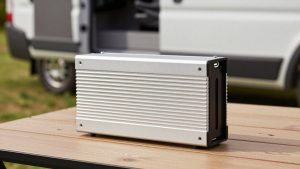
It weighs 47 pounds and has a compact footprint, making it substantially easier to load than a 3,000-watt or larger generator. The Eco-Throttle system reduces fuel use at light loads, while the inverter output is suitable for sensitive electronics. Honda’s parallel capability also allows two compatible units to operate together when 1,800 watts is eventually insufficient.
The drawbacks are price and gasoline-only operation. Expect a general market price in the premium compact-generator range, often around $1,000 or more depending on the exact version and sales period. It is also not a substitute for a built-in van electrical system: it still requires outdoor operation, fuel storage, and careful cable management.
Best value and fuel flexibility: Champion 2500-Watt Dual Fuel
The Champion 2500-Watt Dual Fuel inverter generator is appealing for occasional camping and emergency use because it can run on gasoline or a propane cylinder. Propane generally stores more conveniently than gasoline and does not degrade in the same way, although it produces less power and may reduce performance in cold weather.
With approximately 1,850 running watts on gasoline and a weight near 40 pounds, it offers a useful output-to-weight ratio. The limitation is that a 2,500-watt peak rating does not mean it can continuously supply 2,500 watts. A 1,500-watt heater, for example, leaves relatively little headroom for a refrigerator, battery charger, or microwave starting surge.
This is the sensible pick when the generator may sit unused for months, when propane is already part of your camping setup, or when the price of a premium Honda or Yamaha is difficult to justify. Confirm the exact fuel-output figures on the current label before purchase because dual-fuel performance differs between gasoline and propane.
Best extra capacity for a van: Westinghouse iGen2800
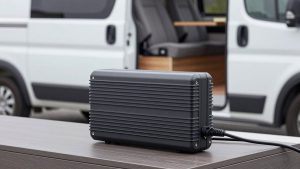
The Westinghouse iGen2800 provides roughly 2,500 watts of continuous gasoline output and weighs about 46 pounds. That extra capacity can be valuable for a van with a microwave, portable air conditioner, induction cooktop, or larger battery charger.
Compared with a 2,000-watt-class generator, the iGen2800 gives more room for startup surges and simultaneous loads without becoming a heavy, wheeled home-backup unit. Its low-load noise specification is also competitive for a gasoline generator.
The trade-off is ownership confidence and service access. Honda and Yamaha have long-established small-engine ecosystems, while service availability for other brands can vary by region. Check whether replacement air filters, spark plugs, carburetor parts, and authorized service are available near your usual travel routes.
Best for home backup loads: Honda EU7000iS
The EU7000iS is a different category from the compact van generators. Its 5,500-watt rated output and 7,000-watt peak capacity can support substantially larger loads, including a refrigerator, freezer, sump pump, selected lighting, and some heating or cooking equipment when the combined load is managed carefully.
Its fuel tank and long light-load runtime make it practical for extended outages. However, at approximately 261 pounds, it is not realistic for routine van loading unless it stays permanently in a purpose-built trailer or cargo system. A generator this size should be treated as home equipment, not a portable camping accessory.
For home connection, use an electrician-installed transfer switch or an approved inlet and interlock system. Never energize household wiring by plugging a generator into a wall outlet; backfeeding can injure utility workers and damage equipment.
How much generator capacity do you actually need?
Start with running watts, then account for starting watts. Add the continuous wattage of devices likely to operate together and leave at least 20% headroom. For example:
- Portable refrigerator: 100 watts running, possibly 600 watts starting
- Battery charger: 300 watts
- Laptop and lighting: 100 watts
- Microwave: 1,000 watts
The running total is 1,500 watts, but the refrigerator and microwave can create a short surge. A 1,800-watt generator may work if the microwave is started after the refrigerator is running, but a 2,500-watt-rated model provides a safer margin. An electric kettle, space heater, or induction cooktop can consume 1,200–1,800 watts by itself, so avoid assuming that a compact generator can run every van appliance at once.
A simple runtime estimate is:
Approximate runtime = fuel consumed at your load × available fuel ÷ hourly consumption.
In practice, a 2,000-watt-class generator may run most of a workday at a light 25% load but only a few hours near its rated output. Eco mode improves runtime when the load changes, but it does not create additional power. Heavy appliances cause the engine to accelerate and fuel consumption to rise.
Decision matrix for van, camping, and backup use
| Your priority | Recommended type | Why | Watch out for |
|---|---|---|---|
| Small van, occasional use, low noise | 1,800–2,200-watt gasoline inverter | Compact and adequate for charging, refrigeration, and modest cooking | Cannot run several high-wattage appliances together |
| Lowest practical price | 2,000–2,500-watt inverter from a mainstream value brand | Good output per dollar | Check parts and service availability first |
| Long storage between uses | Dual-fuel inverter | Propane is convenient for emergency storage | Lower propane output and possible cold-weather limitations |
| Air conditioner or larger charger in a van | 2,500 watts or more continuous output | More starting-surge and simultaneous-load headroom | Greater fuel use, weight, and heat |
| Refrigerator, freezer, pump, and lights during an outage | 5,000 watts or more, with proper transfer equipment | Better coverage for household starting surges | Too heavy and bulky for ordinary van travel |
Noise, placement, and safety matter as much as wattage
Inverter generators are quieter than conventional open-frame generators because their engines can slow at light loads and their enclosures reduce mechanical noise. Even a generator rated around 50–60 dBA is not silent. Nearby campground users may hear it, especially at night when ambient sound falls.
Run the generator outdoors, well away from doors, windows, roof vents, and awnings. Carbon monoxide can accumulate even when a generator appears to be in an open area. Never operate one inside a van, garage, tent, storage compartment, or partially enclosed porch. Use a carbon-monoxide alarm inside the living space, but do not treat the alarm as permission to place the generator closer.
Keep the exhaust side clear, protect the unit from rain according to the manufacturer’s instructions, and allow it to cool before refueling. Store gasoline only in an approved container, and secure both fuel and generator against movement while driving.
Ownership realities: maintenance and common mistakes
- Old fuel causes many failures. Use fresh fuel, follow the manual’s storage instructions, and drain or stabilize the fuel system before extended storage.
- Air filters and spark plugs wear first. Dusty roads and frequent short trips can require more frequent inspection than the calendar interval suggests.
- Oil level is critical. Check it on level ground before operation. Low-oil shutdown protects the engine but is not a substitute for regular checks.
- Do not permanently run at the limit. Sustained operation near maximum output increases heat, fuel consumption, and stress. Leave headroom for starting surges.
- Grounding and extension cords matter. Use outdoor-rated cords sized for the current and keep connections dry. Avoid thin household cords for high-wattage appliances.
- Parallel kits must match. Only parallel compatible models using the manufacturer’s approved kit; improvised connections are unsafe.
For most van owners, the decision is between a premium 2,000-watt-class unit such as the Honda EU2200i, a value dual-fuel model such as the Champion 2500-Watt Dual Fuel, and a higher-capacity compact model such as the Westinghouse iGen2800. Choose the EU7000iS only when your priority is household backup and you have a practical way to move and store a 260-pound generator. The right generator is the smallest one that covers your measured loads with reserve capacity, not the one with the largest peak number on its label.