Last updated: October 17, 2026
The best battery monitor for an RV is the Victron SmartShunt 500A for most lithium and lead-acid house banks: it delivers dependable state-of-charge readings, a clear app, simple installation, and excellent compatibility with solar systems—provided you are happy using a phone instead of a permanently mounted display.
Best RV battery monitors at a glance
| Monitor | Current rating | Display and app | Typical Bluetooth range | Best for | Approximate market range |
|---|---|---|---|---|---|
| Victron SmartShunt 500A | 500A continuous; 1000A for 1 minute | Phone app; no built-in screen | About 10–20 m unobstructed | Most RV lithium banks | $100–$150 |
| Victron BMV-712 Smart | 500A standard shunt | 2.7-inch round display plus Bluetooth | About 10–20 m unobstructed | RVs needing a permanent display | $180–$250 |
| Victron SmartShunt 2000A | 2000A continuous | Phone app; no built-in screen | About 10–20 m unobstructed | Large inverter banks and high surge loads | $180–$260 |
| Renogy 500A Battery Monitor | 500A nominal measurement capacity | Dedicated LCD display; model-dependent app support | Usually shorter than Victron’s open-air range | Budget installations with a visible screen | $50–$100 |
| Simarine Pico system | Depends on the selected shunt module | Large color display and system monitoring | Depends on the system layout | Complex solar, tank, alternator and battery systems | $400–$900+ |
These are general market ranges rather than fixed prices. The key distinction is that every useful option above measures current through a battery shunt, rather than estimating battery level from voltage alone.
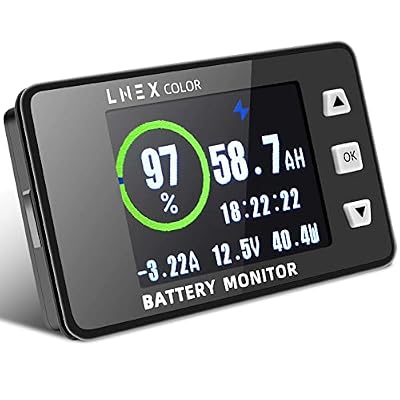
LNEX 500A Shunt Battery Monitor, 2.4" Color Screen RV Monitor with 16ft Shielded Wire, Support High Low Voltage Programmable Alarm for 8-100V Lifepo4, Lithium Sealed, Gel, Flooded Battery
Included for 'Best Battery Monitors for RVs' because the listing specifies 2.4" Color Screen RV Monitor with 16ft Shielded Wire and Lithium Sealed, details this guide uses to compare options.
View on Amazon
BINTA Battery Monitor with Shunt 8-120V 0-500A Voltmeter Ammeter Backlight | Voltage Current Meter, Waterproof Battery Monitor for Auto Car Motor RV Motorhome Golf Cart trucks Boat Solar Panel
Included for 'Best Battery Monitors for RVs' because the listing specifies Voltage Current Meter, details this guide uses to compare options.
View on Amazon
ANCEL BM200 Battery Monitor Bluetooth, 12V Automotive Car Battery Tester | Auto Battery Load Tester with Cranking Charging Test Alarm Record Voltage History Voltmeter for Car/RV/Motorcycle/Truck/Boat
Included for 'Best Battery Monitors for RVs' because the listing specifies 12V Automotive Car Battery Tester, details this guide uses to compare options.
View on Amazon
DROK 48v Golf Cart Battery Meter - LCD Display Lithium Battery Monitor 10-100v Volt Meter Temperature Gauge for Marine RV Car DIY Project
Included for 'Best Battery Monitors for RVs' as a relevant option in this category; details come from the product listing.
View on Amazon
Renogy 500A Battery Monitor, Tester with Shunt, Battery Meter Power System
Included for 'Best Battery Monitors for RVs' because the listing specifies Tester with Shunt and Battery Meter Power System, details this guide uses to compare options.
View on Amazon
LiTime 500A Bluetooth Battery Monitor, 8V-120V Batteries Smart Shunt M8
Included for 'Best Battery Monitors for RVs' because the listing specifies 8V-120V Batteries Smart Shunt M8, details this guide uses to compare options.
View on Amazon
NINTE Victron BMV-712 Battery Monitor with Bluetooth – Track Voltage Current and State of Charge for 6.5-70V Systems
Included for 'Best Battery Monitors for RVs' as a relevant option in this category; details come from the product listing.
View on AmazonWhy a shunt-based battery monitor is worth installing
See also: How Long Will a 100Ah Battery Last in a Van? Runtime Math Explained • Best Level 2 EV Chargers for Home
A voltage-only meter can show a charging voltage while solar is producing power, but that does not tell you how much energy remains. A shunt measures current flowing into and out of the battery, then totals those amp-hours over time. After it is configured with the bank’s usable capacity and charged-voltage parameters, it can estimate state of charge far more usefully.
The shunt must sit in the negative path so that every meaningful load and charging source passes through it. The battery negative terminal connects to the battery side of the shunt. The RV’s negative bus, inverter, solar controller, DC-DC charger, and chassis-bond connection attach to the system side. If even one substantial negative cable bypasses the shunt, the displayed percentage will gradually become wrong.
Our picks by RV situation
Best overall: Victron SmartShunt 500A
The SmartShunt 500A is the strongest choice for a typical camper van or travel trailer with a 100–400Ah house bank and an inverter up to roughly 2,000W. Its VictronConnect app shows voltage, current, consumed amp-hours, state of charge, time remaining, historical minimum and maximum values, and alarm settings. It also records useful history, such as the deepest discharge and the number of charge cycles.
Installation is relatively uncomplicated: mount the shunt close to the battery, connect the large negative cables, connect its small power lead, and configure the bank in the app. The absence of a built-in screen keeps the unit compact—approximately 120 × 44 × 31 mm for the 500A model—but means you need a phone to check it. Bluetooth works well inside most vans, although a metal battery compartment, foil insulation, or a battery box outside the living area can reduce range.
It works particularly well with solar because it can distinguish charging current from consumption when the wiring is correct. It is also well suited to LiFePO4 batteries, whose voltage remains relatively flat across much of their usable capacity.
Best with a permanent display: Victron BMV-712 Smart
Choose the BMV-712 when you want to glance at battery percentage without unlocking a phone. Its round 63 mm panel display fits a standard dashboard-style cutout and shows state of charge, voltage, current, power, consumed amp-hours, and time remaining. Bluetooth adds the same kind of configuration and historical data available through Victron’s app.
The BMV-712 requires more installation work than a SmartShunt because you must route the thin data cable between the shunt and the display, make a panel cutout, and plan the display’s mounting location. That extra effort is worthwhile in a full-time van where battery information is checked several times daily. For an occasional-use RV, the cheaper and smaller SmartShunt is usually better value.
Best for high-power banks: Victron SmartShunt 2000A
An ordinary 500A shunt is adequate for most vans, but a large inverter can create short-duration currents that justify more headroom. The SmartShunt 2000A is appropriate for large motorhomes, multiple lithium batteries, and inverter systems where peak current may approach or exceed the smaller shunt’s limits.
Do not select it merely because “bigger is better.” Its higher cost and larger physical size are unnecessary for a 200Ah bank with a modest inverter. Size the shunt around the maximum expected continuous and surge current, while also checking the battery manufacturer’s discharge limit and the inverter’s fuse requirements.
Best lower-cost screen: Renogy 500A Battery Monitor
A Renogy 500A monitor is attractive when a dedicated LCD matters and the budget is tight. It can display voltage, amperage, consumed capacity, and an estimated percentage, and its included display makes basic checks easy for family members who do not want to use an app.
The compromise is usually less refined history, configuration, documentation, or remote monitoring than the Victron ecosystem. Treat its percentage as only as accurate as its initial capacity setting and wiring. If your RV has several charging sources, a large solar array, or a premium lithium bank, paying more for better diagnostics can prevent frustrating troubleshooting later.
Best for a complex electrical system: Simarine Pico
The Simarine Pico is a system-monitoring platform rather than just a battery gauge. With suitable modules, it can combine battery shunts, solar data, tank levels, temperature sensors, and multiple battery banks on a color display. It makes sense in a large motorhome or an advanced van conversion where one screen should replace several separate gauges.
It is overkill for a single house battery. Installation also requires more planning because modules, communication wiring, sensors, and screen locations must be designed as a system.
Decision matrix: which battery monitor fits?
| Your situation | Recommended choice | Reason |
|---|---|---|
| 100–400Ah lithium bank, phone available | Victron SmartShunt 500A | Good accuracy, compact size, useful app, simple wiring |
| Frequent full-time use, display wanted at a glance | Victron BMV-712 Smart | Permanent screen plus Bluetooth configuration |
| Large inverter or multiple parallel batteries | Victron SmartShunt 2000A | More current capacity and headroom |
| Occasional camping and limited budget | Renogy 500A monitor | Low entry cost and dedicated display |
| Battery, solar, tanks and temperatures on one screen | Simarine Pico | Expandable system monitoring |
Installation: the mistakes that ruin accuracy
- Disconnect charging and loads. Turn off solar input, shore power, alternator charging, and the inverter before moving battery cables.
- Place the shunt near the battery. Keep the battery-to-shunt cable short and protect the positive side with an appropriately rated fuse.
- Put every negative connection on the system side. This includes the solar charge controller, DC-DC charger, inverter, fuse-bus negative, chassis bond, and battery heater.
- Enter the real usable capacity. A “200Ah” LiFePO4 bank may not deliver exactly 200Ah in real conditions. Start with the manufacturer’s rated usable capacity and refine it after observing a complete charge and discharge cycle.
- Synchronize at full charge. Fully charge the bank according to the battery maker’s instructions, allow the monitor to meet its charged-voltage and tail-current conditions, then set the monitor to 100%.
- Verify with a known load. A 120W appliance on a 12V system draws approximately 10A before inverter losses. If the monitor reports zero or a wildly different direction, a cable is probably bypassing the shunt.
Accuracy, lithium compatibility, and solar use
A good shunt monitor can measure current accurately, but its state-of-charge percentage is still a calculated estimate. Incorrect capacity settings, missed charging sources, battery self-discharge, temperature, and lithium battery-management-system cutoffs can all cause drift. Lithium banks are especially sensitive to poor synchronization because their voltage gives little warning before the usable capacity is nearly exhausted.
For solar systems, the monitor does not replace the solar controller’s own data. The controller tells you what the panels are producing; the shunt tells you whether the battery bank is receiving a net charge after the refrigerator, inverter, fans, and other loads consume power. Comparing both readings is an effective way to find wiring problems.
Ownership realities and support
The shunt itself has no moving parts and normally needs no cleaning or consumables. The connections are the items that wear first: loose terminals create heat and inaccurate readings, while undersized cables cause voltage drop. Inspect high-current connections at least annually, and sooner after the first few trips because copper lugs can settle.
Victron has the clearest long-term advantage for troubleshooting: the SmartShunt, BMV-712, solar controllers, chargers, and inverter products share a mature app and extensive documentation. Renogy is appealing on price, while Simarine is stronger when you need a larger integrated monitoring system. Whichever brand you choose, buy or build the correct fuse protection and cable sizes separately if the kit does not include them.
Final verdict
For most RV owners, buy the Victron SmartShunt 500A. Select the BMV-712 Smart if a permanent display is important, the SmartShunt 2000A for genuinely high-current banks, Renogy for a basic budget installation, and Simarine Pico for a multi-system motorhome dashboard. The most expensive monitor cannot compensate for a negative cable that bypasses the battery shunt, so correct installation matters as much as the product choice.