Last updated: October 17, 2026
To charge a LiFePO4 battery safely, use a charger with a lithium profile, set the correct voltage for the battery’s series configuration, stay within its permitted charge current, and prevent charging below 0°C unless the battery specifically includes low-temperature protection or heating.
Correct charging voltage for a LiFePO4 battery
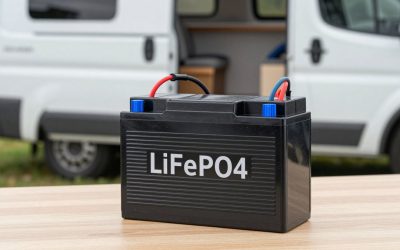
Most batteries sold for vans and RVs as “12V LiFePO4” are actually four 3.2V cells connected in series, giving a nominal voltage of 12.8V. Their charging voltage is higher than their nominal voltage.

14.6V 2A LiFePO4 Battery Charger for 4S 12V Lithium Iron Phosphate Pack | with Dual Alligator Clips Connector
Included for 'How to Charge a LiFePO4 Battery Safely and Correctly' because the listing specifies with Dual Alligator Clips Connector, details this guide uses to compare options.
View on Amazon
YILEIDE 12V 20A Lithium Battery Charger for 14.6V LiFePO4 Batteries
Included for 'How to Charge a LiFePO4 Battery Safely and Correctly' as a relevant option in this category; details come from the product listing.
View on Amazon
14.6V 10A LiFePO4 Battery Charger Designed for 12V Lithium Battery, AC-DC Smart Charger, Battery Maintainer, Built-in Safety Protections, Support 0V Charging Function
Included for 'How to Charge a LiFePO4 Battery Safely and Correctly' because the listing specifies AC-DC Smart Charger and Battery Maintainer, details this guide uses to compare options.
View on Amazon
ERYY 12V 20AH(22Ah) LiFePO4 Lithium Battery with 30A BMS and LCD Voltmeter | Grade A Cells, 5000+ Deep Cycles, Lightweight Rechargeable Lithium Iron Phosphate Battery for Fish Finder, Lights, Solar
Included for 'How to Charge a LiFePO4 Battery Safely and Correctly' because the listing specifies Grade A Cells and 5000+ Deep Cycles, details this guide uses to compare options.
View on Amazon
BROODAY 14.6V 10A LiFePO4 Battery Charger for 12V Lithium Iron Phosphate Batteries – Fast Charging, High Efficiency, LED Indicator, Durable Design with Overheat Protection
Included for 'How to Charge a LiFePO4 Battery Safely and Correctly' because the listing specifies Fast Charging and High Efficiency, details this guide uses to compare options.
View on Amazon
LiTime 12V 20A Lithium Battery Charger, 14.6V Output AC-DC, 0V Activation | For LiFePO4 Batteries, Anderson Connector & LED Indicator, 6 Safety Protections, Deep Cycle Charging for RVs, Homes, Off-Grid
Included for 'How to Charge a LiFePO4 Battery Safely and Correctly' because the listing specifies 14.6V Output AC-DC and 0V Activation, details this guide uses to compare options.
View on Amazon14.6V 10A LiFePO4 Battery Charger Designed for 12V Lithium Battery, AC-DC Smart Charger, Battery Maintainer, Built-in Safety Protections, Support 0V Charging Function
Included for 'How to Charge a LiFePO4 Battery Safely and Correctly' because the listing specifies AC-DC Smart Charger and Battery Maintainer, details this guide uses to compare options.
View on Amazon
Victron Energy Blue Smart IP65 Smart Car Battery Charger 12V 10A | For Motorcycle, ATV, RV, Lithium and Deep Cycle Batteries, Certified to UL1236
Included for 'How to Charge a LiFePO4 Battery Safely and Correctly' because the listing specifies For Motorcycle and ATV, details this guide uses to compare options.
View on Amazon| Battery system | Nominal voltage | Typical absorption/bulk charge voltage | Recommended float setting |
|---|---|---|---|
| 12V LiFePO4, 4 cells | 12.8V | 14.0–14.6V | 13.4–13.6V, or disabled |
| 24V LiFePO4, 8 cells | 25.6V | 28.0–29.2V | 26.8–27.2V, or disabled |
| 48V LiFePO4, 16 cells | 51.2V | 56.0–58.4V | 53.6–54.4V, or disabled |
For a typical 12.8V battery, 14.4V is a useful general-purpose setting when the manufacturer does not specify another value. Some batteries permit 14.6V, but selecting the highest possible voltage is not automatically better. It can cause the battery management system (BMS) to disconnect more often and may increase stress on the cells.
The exact values in the battery manual take priority, particularly for batteries with internal heating, Bluetooth monitoring, or a manufacturer-specific BMS.
How much charging current is safe?
See also: How Long Will a 100Ah Battery Last in a Van? Runtime Math Explained • Best Level 2 EV Chargers for Home
Charging current is normally expressed as a fraction of battery capacity, called the C-rate. A 100Ah battery charged at 0.5C receives 50A; at 0.2C it receives 20A.
| Battery capacity | Gentle 0.2C charge | Common 0.5C charge | Approximate time at 0.5C* |
|---|---|---|---|
| 50Ah | 10A | 25A | About 2–2.5 hours |
| 100Ah | 20A | 50A | About 2–2.5 hours |
| 200Ah | 40A | 100A | About 2–2.5 hours |
*Actual time is longer because charging current tapers near full and the charger, wiring, temperature, and BMS may limit output.
Many LiFePO4 batteries allow a maximum charge rate of 0.5C, while some are rated for 1C. Do not infer the limit from battery capacity alone: a 100Ah battery with a 50A maximum charge current should not be connected to a 100A charger. The charge-current rating on the battery label or datasheet is the controlling specification.
Also check the wiring, fuse, connectors, and charger output. A 50A charging circuit usually needs substantially heavier cable and protection than a 10A circuit. Follow the cable manufacturer’s ampacity guidance and keep high-current cables short to reduce voltage drop.
Choose the charger type for your van
AC shore-power charger
Use a lithium-compatible mains charger or inverter-charger with a 14.0–14.6V absorption stage for a 12V battery. A 20–30A charger is a practical size for many 100Ah batteries and is easier on a modest electrical system than a very high-output unit.
The charger should either disable equalization and temperature-compensation functions or provide a lithium setting that does this automatically. Lead-acid equalization voltages are unsuitable for LiFePO4 batteries.
Solar charge controller
For solar panels, use an MPPT controller sized for the panel wattage and battery voltage. A 400W solar array connected to a 12V battery could theoretically produce about 28–30A after conversion losses, so a 30A or larger controller may be appropriate. Configure the controller for LiFePO4 rather than AGM, gel, or flooded lead-acid.
Solar controllers should not be allowed to charge a frozen battery. If the battery’s internal BMS cannot communicate with the controller, use a controller with a temperature sensor or a system-level low-temperature charging cutoff.
Alternator charging
Use a lithium-compatible DC-to-DC charger between the vehicle starter battery and the house battery. It limits current, protects the alternator from an excessive sustained load, and provides a suitable charging profile. Connecting a large LiFePO4 bank directly to a modern alternator can result in high current, voltage instability, or alternator overheating.
A 30A DC-to-DC charger is often suitable for a 100Ah house battery, while a 50A unit may suit a larger bank if the alternator, cable size, fusing, and vehicle manufacturer’s limits support it.
Step-by-step: charging a LiFePO4 battery correctly
- Confirm the battery configuration. Check whether it is a 12.8V, 25.6V, or 51.2V battery, and read its maximum charge voltage and current.
- Inspect the installation. Look for loose terminals, damaged insulation, corrosion, undersized cables, and an incorrectly rated fuse. Turn off unnecessary loads where practical.
- Check the temperature. Do not charge below 0°C unless the battery is specifically designed to do so. Some batteries have a low-temperature cutoff; others include self-heating. Neither feature should be assumed without confirmation.
- Select the lithium profile. Set the charger to the battery manufacturer’s absorption voltage. Disable equalization and avoid an aggressive lead-acid temperature-compensation profile.
- Set the current limit. Keep the charger at or below the battery’s stated maximum. If several chargers operate at once, add their possible outputs together.
- Start charging and monitor the system. Check that voltage rises normally, current is within limits, cables remain cool, and the BMS does not repeatedly disconnect.
- Allow the absorption stage to finish. Near full charge, the charger holds the target voltage while current falls. Do not repeatedly interrupt the process if the battery’s balancing procedure requires time near the top of charge.
- Stop or float appropriately. For storage, a LiFePO4 battery generally does not need to remain on a high float voltage. Follow the manufacturer’s storage recommendation; many systems can float at approximately 13.4–13.6V or switch off after charging.
Low-temperature charging precautions
Discharging a LiFePO4 battery below freezing is usually less problematic than charging it, but charging cold cells can cause permanent damage through lithium plating. A battery may show a normal voltage while still being too cold to accept charge safely.
- Install the battery inside the heated living area when possible, rather than in an uninsulated exterior compartment.
- Use a battery with a verified low-temperature charge cutoff for winter travel.
- For regular cold-weather use, consider an internal heating system, but confirm its power draw and whether heating is allowed before charging begins.
- Do not bypass the BMS temperature sensor or force a charger to continue after a low-temperature fault.
How to tell when the battery is full
The full-charge voltage of a 12V LiFePO4 battery is commonly around 14.2–14.6V while the charger is in its absorption stage. That reading alone does not prove the battery is full, because a charger can produce that voltage before the cells have completed charging.
A better verification method is to observe both voltage and current:
- The charger reaches its configured absorption voltage.
- Charging current falls substantially as the battery fills.
- The charger changes to its finished or float state, or terminates according to its lithium profile.
- A shunt-based battery monitor reports close to 100% after it has been correctly configured.
After removing the charger and allowing the battery to rest with no significant load for several hours, a 12.8V LiFePO4 battery may settle near 13.3–13.4V. Resting voltage is useful as a broad check, but it is a poor state-of-charge gauge across the middle of the battery’s range. A calibrated shunt measuring current in and out is more informative than voltage alone.
Common mistakes and ownership realities
- Using a lead-acid charger blindly: Some chargers work if their equalization and temperature compensation can be disabled; others do not. Verify the settings rather than relying on the label.
- Leaving a high float voltage permanently applied: It may be permitted, but it is often unnecessary. A lower float setting or charge termination is usually preferable for long-term storage.
- Ignoring combined charger output: A solar controller, alternator charger, and AC charger can exceed the battery’s maximum current when operating together.
- Treating a BMS as a daily switch: Frequent BMS shutdowns usually indicate incorrect voltage, excessive current, cold temperatures, cell imbalance, or a wiring problem.
- Checking only the display: Bluetooth state-of-charge estimates can drift unless the monitor is synchronized correctly. Compare the display with charger voltage, current, and operating history.
- Storing at 100% for months: For extended storage, remove charging sources and follow the manufacturer’s recommended storage state, commonly a partial charge rather than completely full.
For most van installations, the dependable formula is a lithium-programmable charger, a conservative current limit, correct fusing and cable sizing, and a reliable low-temperature cutoff. If those four elements are correct, charging a LiFePO4 battery is usually simpler and faster than charging a comparable lead-acid bank.