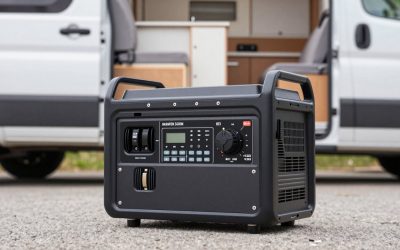
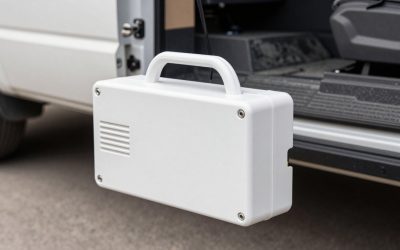
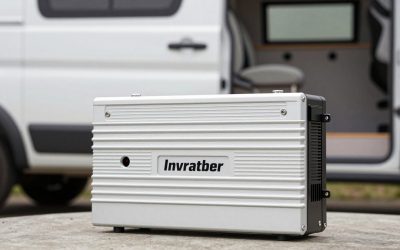
Portable power stations have transformed what’s possible in a van — not just for van lifers who haven’t yet built a permanent electrical system, but for experienced builders who want a flexible supplemental power source for tools, remote work, or extended off-grid stretches. The best units combine significant battery capacity, fast solar and AC recharging, and enough output ports to run a meaningful load — all in a package that doesn’t require permanent installation. But “portable power station” covers everything from glorified USB battery banks to serious LiFePO4 units that rival built-in van systems. Here’s how to tell the difference.
🛒 Best Price Today on Amazon
Prime members get fast, free shipping on everything above, plus member-only deals. New members get a 30-day free trial — cancel anytime.
As an Amazon Associate we earn from qualifying purchases.





Quick Picks
EcoFlow Delta 2 Max
- 2048Wh LiFePO4 with 10-year cycle life
- X-Stream AC charging: 0–80% in 50 min
- 2400W AC output handles most appliances


As an Amazon Associate we earn from qualifying purchases. Product prices and availability are accurate as of the date/time indicated.
Jackery Explorer 2000 Pro
- 2160Wh with fast solar recharge
- Quiet fan operation — under 30dB
- Reliable brand with strong warranty support


As an Amazon Associate we earn from qualifying purchases. Product prices and availability are accurate as of the date/time indicated.
Bluetti AC200P
- 2000Wh at a competitive price point
- 17 output ports — extremely versatile
- 700W solar input for fast off-grid charging


As an Amazon Associate we earn from qualifying purchases. Product prices and availability are accurate as of the date/time indicated.
Why Trust Our Picks
See also: How Long Will a 100Ah Battery Last in a Van? Runtime Math Explained • Best Level 2 EV Chargers for Home
We evaluate portable power stations specifically for van-life and camping use cases — which differ meaningfully from home backup power applications. Our criteria: usable capacity vs. rated capacity (some units are more conservative in real-world output than spec sheets suggest), solar input flexibility and speed, AC output waveform quality (pure sine wave is required for sensitive electronics), weight and portability relative to capacity, battery chemistry longevity (LiFePO4 vs. NMC), and the quality of the companion app and charging management. We draw on extensive community testing data from van-life forums and off-grid communities to validate real-world performance claims.
Best Portable Power Stations for Van Life and Camping — Reviewed
1. EcoFlow Delta 2 Max — Best Overall
EcoFlow has established itself as the most innovative brand in the portable power station space, and the Delta 2 Max is their most compelling van-life unit. The 2048Wh LiFePO4 battery is rated for 3,000 cycles to 80% capacity — essentially a decade of daily use — which is a meaningful distinction from NMC battery competitors that typically offer 500–1000 cycles. The X-Stream AC charging technology is genuinely remarkable: a full charge from an AC outlet takes under two hours, and 0 to 80% happens in roughly 50 minutes — fast enough to top up at a campground power hookup in an afternoon and depart with a full unit. The 2400W AC output (with X-Boost technology that can power some 3000W appliances) covers induction cooktops, power tools, and anything else a van lifer is likely to run. Solar input accepts up to 1000W — pair it with EcoFlow’s 220W portable panels for fast off-grid recharging. The EcoFlow app is the most polished in the category, with real-time data and charge/discharge scheduling.
- Pros: LiFePO4 longevity (3,000 cycles), extremely fast AC charging, high solar input, 2400W output, excellent app, expandable with extra battery
- Cons: Premium price, heavier at 48 lbs, fan audible under high loads, app requires account creation
2. Jackery Explorer 2000 Pro — Runner-Up
Jackery was the brand that popularized portable power stations for the camping market, and the Explorer 2000 Pro represents the company at its most refined. The 2160Wh capacity is among the highest in the class, and Jackery’s focus on quiet operation pays dividends in a van environment — the fan runs at under 30dB in typical use, which is genuinely unobtrusive. Solar recharging via six Jackery SolarSaga 200W panels (sold separately) achieves a full charge in around 2.5 hours — competitive for off-grid van life. The pure sine wave inverter and 2200W output cover most van appliances cleanly. Jackery’s customer support and warranty reputation are among the strongest in the category — an underrated factor for a piece of equipment you’re depending on in remote locations.
- Pros: Large capacity, notably quiet operation, strong brand support and warranty, reliable real-world performance
- Cons: NMC battery (fewer cycles than LiFePO4), slower AC charging than EcoFlow, heavier solar panels required for fast charging sold separately
3. Goal Zero Yeti 1500X — Best for Expandability
Goal Zero’s Yeti line has a devoted following among overlanders and van lifers who’ve been in the space long enough to remember when Goal Zero pioneered portable solar for outdoor use. The Yeti 1500X offers 1516Wh capacity — slightly smaller than the 2000Wh-class competitors — but distinguishes itself with an expansion battery port that allows adding a 1000Wh or 2000Wh battery, effectively building a modular system that grows with your needs. It also offers genuine USB-C PD at 60W, regulated 12V output (critical for sensitive 12V equipment that can’t tolerate voltage variations), and a WiFi module for app monitoring. Build quality is characteristically robust. For van lifers who want a system that can expand without replacing the core unit, the Yeti 1500X’s architecture is genuinely forward-thinking.
- Pros: Expandable battery architecture, regulated 12V output, robust build, strong brand reputation, WiFi monitoring
- Cons: Base capacity smaller than competitors at same price, expansion batteries add significant additional cost, heavier than spec suggests
4. Bluetti AC200P — Best Value at 2000Wh
The Bluetti AC200P consistently appears in best-value discussions for good reason: it packs 2000Wh of capacity, 17 output ports (including six AC outlets, four USB-A, two USB-C, two DC5525, one 12V car port, and wireless charging), and 700W of solar input at a price that regularly undercuts NMC competitors of similar capacity. The 2000W inverter handles the majority of van-life appliances — compressor fridges, laptops, CPAP machines, blenders — and the dual MPPT inputs allow two solar arrays to charge simultaneously. It uses LiFePO4 chemistry (rated 3,500 cycles), which is exceptional for its price point. The main trade-offs are a noisy fan under load and slower AC charging than EcoFlow — but for van lifers whose primary recharging strategy is solar, AC charge speed is less critical.
- Pros: Excellent value, LiFePO4 (3,500 cycles), 17 ports, 700W solar input, dual MPPT inputs
- Cons: Fan is loud under heavy load, slower AC charging, heavier at 60 lbs, app less polished than competitors
Buyer’s Guide: Choosing a Portable Power Station for Van Life
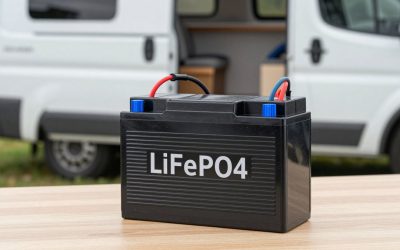
LiFePO4 vs. NMC battery chemistry. LiFePO4 (lithium iron phosphate) batteries offer 2,000–3,500 charge cycles compared to NMC’s 500–1,000 — meaning a LiFePO4 unit used daily lasts 5–10 years vs. 1–3 years for NMC. LiFePO4 is also more thermally stable (safer) and maintains capacity better in cold weather. The premium is narrowing rapidly; at the 2000Wh class, LiFePO4 options are now widely available.
Capacity reality check. A 2000Wh station doesn’t deliver 2000Wh of usable power — inverter losses, depth-of-discharge limits (some units don’t allow full discharge), and conversion inefficiencies mean realistic usable capacity is typically 80–90% of rated capacity. Budget accordingly.
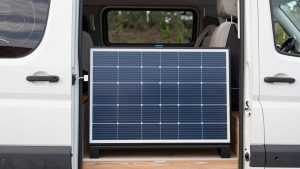
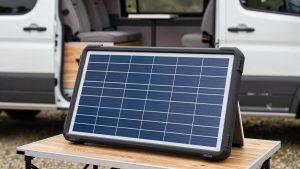
Solar input specifications. For van life, solar recharging is often the primary input source. Higher wattage input limits (700W+) allow faster recharging and compatibility with larger panel arrays. Dual MPPT inputs enable connecting two panel strings independently for maximum flexibility.
Portable station vs. built-in system. A portable power station is genuinely plug-and-play and moves between vehicles or into accommodations with you — flexibility that a built-in system can’t match. For full-time van life with high power demands, a built-in system with larger battery banks often makes more sense economically over time. Many van lifers use both: a built-in system as the primary electrical backbone plus a portable station for supplemental capacity or as a generator-free shore-power alternative.
Frequently Asked Questions
Can a portable power station run a van refrigerator?
Yes — a quality 12V compressor fridge (like a BougeRV, Alpicool, or Iceco unit) draws 30–60W average, meaning a 2000Wh station could theoretically run it for 30–60 hours. In practice, with solar input supplementing during daylight hours, a 2000Wh station comfortably keeps a fridge running indefinitely in decent sun conditions.
How do I charge a portable power station while driving?
Most portable stations include a 12V car charging input — though at 120–200W, it’s slow for 2000Wh units (10+ hours). A better approach is a DC-DC charger (B2B charger) wired from the van’s alternator to the station’s DC input — if the station supports high-wattage DC input. Alternatively, EcoFlow and Bluetti offer AC charging from a van-mounted inverter, though this creates a conversion efficiency chain (alternator → battery → inverter → AC charger) with associated losses.
What’s the maximum solar input I need for a 2000Wh station?
To recharge 2000Wh in one day of good sun (approximately 5 peak sun hours), you need 400W of panels minimum. For cloudy conditions or partial shade, 600–800W gives meaningful headroom. Match your panel wattage to the station’s maximum solar input rating — exceeding it provides no additional benefit and can cause issues with some controllers.
Are portable power stations safe to use inside a van?
Yes — unlike gasoline generators, portable power stations produce no fumes or carbon monoxide and are completely safe for enclosed use. They do generate some heat under heavy load, so ensure adequate airflow around the unit. Store upright as specified by the manufacturer, and avoid exposing to extreme heat (direct sun in a parked van in summer can cause thermal issues in some units).
Should I discharge a portable power station fully or keep it topped up?
For LiFePO4 units, both deep discharge and constant 100% storage are acceptable — the chemistry is more tolerant than NMC. For NMC units, keeping charge between 20–80% extends cycle life significantly. For storage longer than a few weeks, manufacturers typically recommend 50–60% charge regardless of chemistry.
Final Verdict
For van lifers who want the best combination of capacity, charge speed, longevity, and smart features, the EcoFlow Delta 2 Max is the clear leader — its LiFePO4 chemistry, ultra-fast AC charging, and 1000W solar input set it apart from every competitor at the 2000Wh class. The Jackery Explorer 2000 Pro earns its runner-up spot through exceptional quietness and class-leading customer support — critical factors when you’re dependent on a unit in remote locations. For builders who anticipate growing power needs, the Goal Zero Yeti 1500X’s expandable architecture is uniquely future-proof. And for value-first buyers who want LiFePO4 longevity and high solar input without the EcoFlow premium, the Bluetti AC200P remains one of the best-value 2000Wh stations on the market. Whatever your power needs on the road, a quality portable station delivers freedom — and freedom is the whole point.