- Top Pick: ELEGRP GFCI Outlet Outdoor, 15 Amp Self-Test GFI Electrical Outlet with Thinner Design, Weather & Tamper Resistant GFCI Receptacle, Ground Fault Receptacle w/Wall Plate, UL Listed, Matte White, 1 Pack
- Best Value: POWAWINI GFCI Outlet 20 Amp, Thinner Design, Self-Test GFI Receptacle, LED Indicator, UL Listed, Tamper Resistant, Weather Resistant, with Wall Plates and Screws, Indoor Outdoor Use, White
- Premium Choice: Amico GFCI Outlet 15 Amp, 12 Pack, White, Weather Resistant(WR)
Vanlife GFCI Outlet: 12V, Shore Power & Safe Electrical Wiring Guide
TL;DR Quick Answer
A vanlife GFCI outlet is a ground fault circuit interrupter receptacle that cuts power instantly when it detects a current leak — mandatory near any water source in your van (sink, shower area, or wet bath). If you’re adding shore power (120V AC from a campground hookup or inverter), every outlet in a potentially wet location needs GFCI protection. Budget $15–$35 per outlet. This is not optional — it’s the difference between a safe van build and an electrocution risk.
Van electrical builds range from simple 12V USB charging setups to full 120V AC systems with inverters, shore power hookups, and appliances. Wherever 120V AC power exists near water in a van — near a sink, in a wet bath, or within reach of a shower — a vanlife GFCI outlet is required by the same logic (and in many cases the same code) that applies to residential bathrooms and kitchens. This guide covers what GFCI protection means, where it’s required, and how to integrate it correctly into a 12V and shore power van electrical system.
As an Amazon Associate we earn from qualifying purchases.



🛒 Best Price Today on Amazon
Prime members get fast, free shipping on everything above, plus member-only deals. New members get a 30-day free trial — cancel anytime.
Start 30-Day Prime Free Trial →See Today’s Amazon Deals- Top Picks: GFCI Outlets & Shore Power Components
- What Is a GFCI Outlet and Why Does Your Van Need One?
- Understanding Van Electrical Systems: 12V vs. 120V
- Installing GFCI Outlets in a Van
- Van Electrical Safety: GFCI vs. AFCI vs. Standard Breakers
- Common Van Electrical Mistakes to Avoid
- FAQ: Vanlife GFCI Outlet Questions
- Frequently Asked Questions
- Related Articles
Top Picks: GFCI Outlets & Shore Power Components
BEST OVERALL — TAMPER-RESISTANT GFCI
15A Tamper-Resistant GFCI Outlet with LED Indicator


As an Amazon Associate we earn from qualifying purchases. Product prices and availability are accurate as of the date/time indicated.
BEST SHORE POWER INLET
30A RV Shore Power Inlet with Weatherproof Cover

WAYSKA Diesel Heater 12V, 5L Tank, Diesel Heater 2KW, Muffler, Diesel Parking Heater with LCD Monitor & Remote Control for Trucks, Trailer, Boat and Motor-Home


As an Amazon Associate we earn from qualifying purchases. Product prices and availability are accurate as of the date/time indicated.
BEST COMBO — GFCI WITH USB
GFCI Outlet with Dual USB-A Ports, 20A


As an Amazon Associate we earn from qualifying purchases. Product prices and availability are accurate as of the date/time indicated.
What Is a GFCI Outlet and Why Does Your Van Need One?
See also: How Long Will a 100Ah Battery Last in a Van? Runtime Math Explained • Best Level 2 EV Chargers for Home
A GFCI (Ground Fault Circuit Interrupter) outlet monitors the current flowing in and out of the hot and neutral wires. If even a small imbalance occurs — as little as 4–6 milliamps, which happens when current finds an unintended path through a person — the GFCI trips and cuts power within 1/40th of a second. That response speed is fast enough to prevent electrocution in most scenarios.
In a van, water and electricity are closer together than in any home. A van sink sits within feet of your electrical panel. A shower, if you have one, is built into the same 70-square-foot space as your outlets, appliances, and battery bank. The risk of ground faults — current leaking through wet walls, damp wood, standing water, or a person — is significantly higher than in a fixed building.
GFCI protection is the minimum standard for any 120V AC circuit in a van. It’s not optional for wet locations, and it’s good practice everywhere in the van even in dry locations.
Understanding Van Electrical Systems: 12V vs. 120V
12V DC Systems
Most van appliances — lights, fans, water pumps, USB chargers, 12V refrigerators — run on 12V DC power directly from your battery bank. A 12V system does not require GFCI protection because the voltage is too low to deliver a lethal shock in normal conditions. Your 12V outlets (cigarette lighter style, Anderson Powerpole connectors, or USB outlets) do not need GFCI receptacles.
However, 12V systems still need proper fusing and circuit protection. Every 12V circuit should be fused as close to the battery as practical, sized to the wire gauge, not the appliance draw. See our full guide on van 12V breaker panel and circuit design for the complete wiring layout.
120V AC Systems (Inverter or Shore Power)
When you add a pure sine wave inverter or connect to shore power at a campground, you now have 120V AC in your van — the same voltage that will kill you if something goes wrong. Every 120V outlet in a van should be GFCI protected. Full stop.
The two sources of 120V AC in a van build:
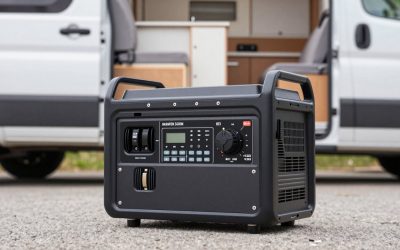
- Inverter: Converts 12V DC battery power to 120V AC. Powers laptops, monitors, coffee makers, blenders, and other household appliances. Output is limited by inverter wattage and battery capacity. A 2000W inverter running from a 200Ah lithium battery bank gives you roughly 1–2 hours of heavy load before significant battery draw.
- Shore power: A direct 120V AC connection from an RV park or campground pedestal. Unlimited power while connected, but requires an inlet port on the van exterior and wiring to an onboard AC distribution panel. Also used to charge your battery bank via a battery charger while plugged in.
Installing GFCI Outlets in a Van
Location Requirements
Install GFCI outlets at every 120V receptacle that is:
- Within 6 feet of a water source (sink, shower drain area)
- In a wet bath or near a toilet
- On the van exterior (if you add an exterior outlet for tools)
- In any location where the outlet could get wet
For a simple van build with a single inverter circuit, the most efficient approach is to install one GFCI outlet as the first outlet in the circuit — the “line” side gets power from the inverter, the “load” side feeds all downstream outlets. All downstream outlets are then protected by the single GFCI without needing individual GFCI receptacles at each location.
Wiring a GFCI Outlet: The Basics
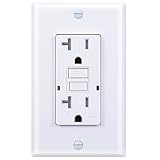
A GFCI outlet has four screw terminals: LINE hot (brass), LINE neutral (silver), LOAD hot (brass), LOAD neutral (silver). The LINE terminals connect to the power source (inverter output or shore power feed). The LOAD terminals connect to any downstream outlets you want to protect through this GFCI.
Use 12 AWG wire for 20A circuits and 14 AWG for 15A circuits. In a van, 12 AWG is recommended throughout the 120V system for margin — vans run wire through walls and floors that can get warm, and heavier wire runs cooler. Use appropriate wire nuts or lever connectors (Wago-style) for all splices. Never use electrical tape alone on 120V connections in a vehicle — use proper connectors rated for the voltage and current.
Shore Power Integration
A shore power system adds an inlet port (typically a 30A TT-30 or 50A NEMA 14-50 connector) mounted on the van exterior. A shore power cord connects this inlet to the campground pedestal. Inside the van, the shore power feed goes to a small AC distribution panel (a residential mini breaker panel or an RV-specific distribution block) which distributes power to your outlets and to a battery charger.
A transfer switch or automatic transfer relay (ATR) switches the AC bus between the inverter output and shore power input — so your outlets work seamlessly whether you’re plugged in or running off batteries. This is standard in most RV systems and increasingly common in custom van builds with full 120V systems.
Van Electrical Safety: GFCI vs. AFCI vs. Standard Breakers
| Protection Type | What It Detects | Response | Required In | Van Application |
|---|---|---|---|---|
| GFCI Outlet | Ground fault (current leak) | <1/40 sec | Wet locations | All 120V near water |
| AFCI Breaker | Arc fault (wiring damage) | Milliseconds | Bedrooms, living areas | Optional but recommended |
| Standard Breaker | Overload/short circuit | Seconds | All circuits | Required on all circuits |
| Fuse | Overload/short circuit | Milliseconds | 12V DC circuits | Required near battery |
Common Van Electrical Mistakes to Avoid
Skipping the ground wire on 120V circuits. The ground (green or bare wire) is what makes GFCI protection work correctly. Every 120V outlet in your van needs a proper ground connection back to the van chassis or inverter ground. A floating ground defeats the GFCI’s ability to detect a fault.
Running 120V wire without conduit through metal van walls. Van sheet metal has sharp edges that can cut through wire insulation over time from vibration. Use wire loom, split conduit, or grommets at every panel penetration point. This applies to both 12V and 120V wiring.
Undersizing the inverter for the load. A 1000W inverter running a 900W hair dryer is operating near its limit constantly — this shortens inverter life and creates heat. Size your inverter for 150% of your highest expected single-appliance load.
Not testing GFCI function after installation. Every GFCI outlet has a TEST button. Press it — the outlet should go dead. Press RESET — power returns. Test every GFCI outlet after installation and monthly during van use. A GFCI that doesn’t trip on the test button has failed and must be replaced immediately.
For a complete overview of 12V circuit layout, fusing strategy, and battery connections that feed your inverter, read our van 12V breaker panel wiring guide. And for solar input that charges the battery bank powering your inverter, see our deep-dive on RV roof solar panel mounting systems.
FAQ: Vanlife GFCI Outlet Questions
Do I need GFCI outlets if I only use 12V power in my van?
No. GFCI protection is specific to 120V AC circuits. A 12V DC system (lights, fans, USB chargers, 12V refrigerators) operates at too low a voltage to pose the electrocution risk that GFCI protection is designed to prevent. However, 12V circuits still need proper fusing to prevent fire from short circuits and overloads. If you later add an inverter and 120V outlets, add GFCI protection to those circuits at that time.
Can I use a GFCI breaker instead of GFCI outlets?
Yes. A GFCI circuit breaker in your AC distribution panel protects every outlet on that circuit — you don’t need individual GFCI receptacles at each outlet location. This is a cleaner solution if you have a dedicated AC panel. GFCI breakers cost $25–$50 each, compared to $15–$25 for individual GFCI outlets, but reduce the total number of components. For a van with 2–4 AC circuits, GFCI breakers at the panel are often the tidiest approach.
What amp rating should van GFCI outlets be?
Most van 120V outlets are on 15A or 20A circuits. A 15A GFCI outlet handles standard household loads (phone chargers, laptops, small appliances). A 20A GFCI outlet (which has a T-shaped neutral slot in addition to the straight neutral) is required if you’re running higher-draw appliances like a portable induction cooktop or space heater. Use 20A rated outlets throughout your van 120V system — they accept both 15A and 20A plugs and give you more headroom for appliance loads.
Will GFCI outlets work with a modified sine wave inverter?
GFCI outlets can have nuisance tripping issues with modified sine wave inverters due to the distorted AC waveform. The GFCI’s ground fault detection circuitry sometimes misinterprets the waveform harmonics as a fault condition. A pure sine wave inverter eliminates this problem entirely and is strongly recommended for any van build with GFCI outlets, sensitive electronics, or appliances with variable speed motors. The price difference between modified and pure sine wave inverters has narrowed significantly — pure sine wave is worth the extra cost.
How do I run shore power in my van without permanent wiring?
The simplest shore power approach for occasional use: a 30A RV extension cord run through a cracked window or door seal, connected to a power strip with a built-in GFCI at the end. This requires no permanent wiring, costs under $50, and works at any 30A RV pedestal. The downside is the cord must be routed through a window (security and weather concern) and the setup isn’t clean for regular use. For any van that regularly uses campground hookups, a proper inlet port with interior wiring is worth the one-time installation effort.
Frequently Asked Questions
Do I need a GFCI outlet if I only use an inverter?
Yes if the inverter feeds standard 120V receptacles, especially near a sink or shower. Note that many inverters output a floating neutral, which can prevent a standard GFCI from tripping correctly. Use an inverter with neutral-ground bonding in inverter mode, or install a bonding plug on the dedicated circuit.
Can I put a 12V socket and a 120V GFCI in the same box?
No. Mixing voltage systems in one enclosure violates electrical code and creates a shock risk if insulation fails. Keep 12V and 120V in separate boxes with separate wire runs, and label each clearly. Combination units sold as 12V USB plus 120V receptacle have internal barriers and are the safe exception.
How do I wire shore power and inverter power to the same outlets?
Use an automatic transfer switch or a manual changeover so the two sources can never connect at once. Backfeeding an inverter into a live shore line is dangerous and will destroy the inverter. Shore power should land on a proper inlet, then a main breaker, then the transfer switch.
Where should the GFCI go and how many do I need?
One GFCI at the first outlet in the circuit protects everything downstream, which is the cheapest compliant approach. Put it somewhere you can reach the test and reset buttons easily, not buried behind the bed. Any receptacle within six feet of a sink or in a wet bay must be protected.
Will humidity and cold cause nuisance tripping?
Yes, condensation inside an outlet box in a cold damp van is a classic nuisance-trip cause. Use weather-resistant outlets with in-use covers in the shower and galley, seal the box against moisture, and test the GFCI monthly. A device that will not reset when dry has genuinely failed and needs replacing.