Last updated: October 7, 2026
Best RV Inverters for Reliable Off-Grid Power
The best RV inverter for your setup is a pure sine wave model sized for the largest loads you’ll run at the same time, with enough surge capacity to start motors and wiring matched to your battery bank; a modified sine wave model can save money for simple resistive loads, but is a poor fit for many modern appliances and electronics.
For most RV owners who want to run a laptop, TV, microwave, or refrigerator from batteries, choose pure sine wave. Before buying, check four things together: continuous and surge watts, battery voltage and current, room for the unit and its cables, and whether its cooling system can handle your expected use.

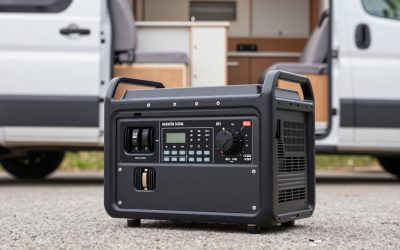
Renogy Inverter PUH, 2000W Pure Sine Wave Power Inverter with UPS Transfer Switch & Bluetooth, 12V DC to 120V AC Converter for RV, Truck, Home,Camping - 4000W Surge Power, Remote Monitoring
Included for 'Best RV Inverters for Reliable Off-Grid Power' because the listing specifies 12V DC to 120V AC Converter for RV and Truck, details this guide uses to compare options.
View on Amazon
BELTTT 2000W Pure Sine Wave Inverter 12V DC to 120V AC, 4000W Surge
Included for 'Best RV Inverters for Reliable Off-Grid Power' because the listing specifies 4000W Surge, details this guide uses to compare options.
View on Amazon
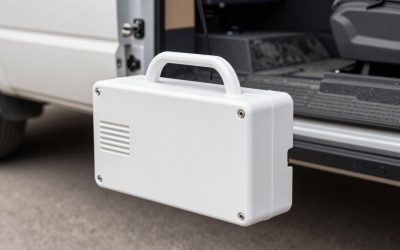
2500W Pure Sine Wave Inverter 12V DC to 120V AC with Built-in ATS for RVs
Included for 'Best RV Inverters for Reliable Off-Grid Power' as a relevant option in this category; details come from the product listing.
View on AmazonChoose by the job, not the biggest wattage on the box
See also: How Long Will a 100Ah Battery Last in a Van? Runtime Math Explained • Best Level 2 EV Chargers for Home
| RV use case | Useful inverter range | Waveform and key checks |
|---|---|---|
| Phones, laptop, TV, chargers | 300–1,000 W continuous | Pure sine wave is the safer all-purpose choice for electronics. Confirm the inverter’s idle draw if it will stay on for long periods. |
| Small kitchen appliances or a microwave | 1,000–2,000 W continuous | Pure sine wave; compare the appliance’s input watts—not just its advertised cooking output—with inverter capacity. |
| Microwave plus other modest loads | 2,000–3,000 W continuous | Pure sine wave; verify battery-bank and cable capacity. Avoid running several high-draw appliances together unless the system is sized for them. |
| Air conditioner or other motor starting loads | Often 2,000–3,000 W or more continuous | Pure sine wave with documented surge capacity. Check the appliance’s locked-rotor or startup demand; a soft starter may reduce air-conditioner startup current. |
| Occasional resistive loads, such as a basic heating element | Size to the load, commonly 300–1,500 W | Modified sine wave may work if the appliance manufacturer permits it. Heating is battery-intensive, so inverter size does not solve short runtime. |
These ranges are starting points, not guarantees. A device’s label, manual, or measured input takes precedence. “Surge” is not a single standardized promise of motor-starting ability: check both the stated peak wattage and how long the inverter can sustain it.
Pure sine wave or modified sine wave?
Pure sine wave: the flexible choice
Pure sine wave output closely resembles utility power and is compatible with the broadest range of RV appliances. It is generally the sensible choice for variable-speed motors, refrigerators, CPAP machines, audio equipment, and electronics with power supplies that may behave unpredictably on rougher waveforms. Compatibility still depends on the specific device, so consult its manufacturer’s guidance.
Pure sine wave models usually cost more, but the price difference can be smaller than the cost of replacing an appliance that runs hot, buzzes, or fails to operate correctly. For a frequently used inverter or a mixed load list, the added compatibility is often worth it.
Modified sine wave: only for confirmed-compatible loads
Modified sine wave inverters can be a budget option for uncomplicated loads such as some incandescent lamps or resistive heating elements. They may cause motors to run hotter or noisier, and some chargers, microwaves, and electronic controls may run inefficiently or not work. Don’t assume a device is compatible just because it turns on; check its manual and watch for unusual heat or noise.
Size the inverter and battery bank together
Start with the largest loads you expect to run at the same time. Add their running watts, then compare that total with the inverter’s continuous rating. For any motor or compressor, check startup demand separately. If the inverter’s surge rating is brief, it may not cover a load that needs a longer startup burst.
Battery-side current is a common surprise. At full load, approximate DC current as:
DC amps = AC watts ÷ (battery voltage × inverter efficiency)
For example, a 1,500 W load on a 12 V battery bank through an inverter operating at an assumed 90% efficiency draws about 139 A: 1,500 ÷ (12 × 0.90). At 24 V, the same load draws about 69 A. Actual current varies with battery voltage, load, and inverter efficiency. A large inverter on a small 12 V bank can demand more current than its batteries, busbars, or cables can safely supply.
Estimate runtime from usable battery energy, not the battery’s nameplate alone. A 12 V, 200 Ah bank stores about 2,400 Wh nominally. If you allow 80% of that energy to be used and assume 90% inverter efficiency, roughly 1,728 Wh reaches AC loads. A steady 600 W load would therefore run for about 2.9 hours in idealized arithmetic; real runtime can be lower because of battery limits, temperature, voltage sag, and changing load. Follow the battery manufacturer’s discharge limits.
Match the installation to the RV
- Space and airflow: Measure the inverter body, cable-bend clearance, and access needed for service. Leave the manufacturer’s specified ventilation gaps. A cramped cabinet can cause thermal shutdown even when the inverter is correctly sized.
- Cables and protection: Use the cable gauge and maximum cable length specified in the inverter manual, with a correctly rated fuse or breaker close to the battery. High-current DC wiring is not a place to substitute thinner cable or extend a run casually; voltage drop creates heat and can trigger low-voltage shutdown.
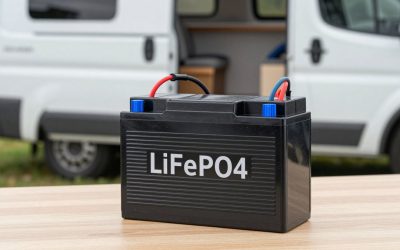
- Battery compatibility: Confirm the inverter’s DC input voltage matches the bank. If it includes a charger, verify its charging profile supports your battery chemistry and settings.
- AC connections: Decide whether the unit will power individual outlets or connect to the RV’s AC distribution system. Transfer switches, neutral-ground bonding, and shore-power integration need to follow the inverter manual and applicable electrical requirements.
If you’re not qualified to design or install high-current DC and RV AC wiring, have a licensed RV or electrical professional handle the installation. Incorrect grounding, overcurrent protection, or transfer-switch wiring can create fire or shock hazards.
Which type fits your situation?
| Your situation | Better starting choice | Why |
|---|---|---|
| Occasional use, tight budget, only confirmed-compatible simple loads | Modified sine wave, sized to the load | Lower initial cost; avoid it if any appliance’s compatibility is uncertain. |
| Frequent off-grid travel with mixed electronics and appliances | Pure sine wave, with adequate surge headroom | Broader compatibility matters more when the load list changes from trip to trip. |
| Small battery bank or limited installation space | Smaller pure sine wave inverter—or no inverter for low-power DC devices | A large inverter can draw significant idle and operating current, while cable and ventilation needs consume space. |
| Planning to run air conditioning or multiple kitchen loads | Pure sine wave system sized as a complete power system | Inverter rating alone is not enough; battery discharge capability, wiring, surge demand, and recharge capacity must all match. |
Ownership details that affect reliability
Fan noise and cycling are normal on many inverter designs, but constant high-speed operation can point to inadequate ventilation, heavy loads, or a hot mounting location. Dust can restrict vents and coat fans; inspect and clean the unit according to the manual, with power isolated as directed. Keep it away from water, road spray, and battery gases unless its rating and installation instructions explicitly allow that environment.
Heat is a major wear factor. Repeated overloads, loose high-current connections, undersized cables, and blocked airflow can shorten component life or cause nuisance shutdowns. Check terminals for looseness, corrosion, or discoloration during scheduled electrical-system inspections, following manufacturer guidance. Do not open or repair an energized inverter.
When comparing models, look beyond the headline wattage: check continuous rating at your expected temperature, surge duration, idle consumption, low-voltage cutoff, cooling method, protection features, and warranty terms. For most RVers, a properly installed pure sine wave inverter that matches the battery system is the most versatile pick; modified sine wave is a narrower budget choice for loads you have confirmed it can run safely.