Last updated: October 4, 2026
The Short Answer
For van induction cooking, choose a pure sine wave inverter rated at 2,000 to 3,000 watts if you want to run a typical single- or double-burner induction cooktop. A compact 1,000-watt inverter can handle a small 500- to 800-watt cooker, but it leaves little room for another appliance.
Start with the cooktop’s maximum wattage, not its average setting. A portable induction burner commonly draws 1,300 to 1,800 watts. A two-burner model may draw 1,800 to 3,400 watts when both zones are active. Add at least 20% overhead for startup fluctuations and other small loads:
As an Amazon Associate we earn from qualifying purchases at no extra cost to you.

- 500- to 800-watt hot plate: 1,000- to 1,200-watt pure sine inverter
- 1,300- to 1,800-watt induction burner: 2,000-watt pure sine inverter
- Two-burner induction cooktop: 3,000- to 4,000-watt inverter, depending on the cooktop’s limit
- Cooktop plus microwave, toaster, or coffee maker: 3,000 watts or more
At 12 volts, high wattage requires substantial battery current. A 1,500-watt cooktop can draw about 125 amps before inverter losses, and roughly 140 amps in real-world use. A 3,000-watt inverter can demand approximately 280 amps from a 12-volt battery bank. That means the inverter size, battery capacity, cables, fuse, ventilation, and charging system all need to match.
Standard Sizes
See also: Spanish Cuisine: Classic Dishes and Ingredients • Sugar Free Cocktail Recipes That Actually Taste Good
Inverter wattage is only one part of sizing. The physical case must fit your electrical compartment, and the cables need enough room for safe routing. The dimensions below are typical size categories for 12-volt vehicle inverters; always check the manufacturer’s specification sheet before building a mounting panel.
| Inverter rating | Typical case dimensions (in.) | Typical case dimensions (cm) | Approx. weight | Suitable cooking load |
|---|---|---|---|---|
| 600- to 1,000 watts | 8.0 × 5.0 × 2.5 | 20.3 × 12.7 × 6.4 | 3-5 lb (1.4-2.3 kg) | Small 500- to 800-watt hot plate |
| 1,500 watts | 12.0 × 7.0 × 3.0 | 30.5 × 17.8 × 7.6 | 6-9 lb (2.7-4.1 kg) | One modest induction burner at reduced settings |
| 2,000 watts | 14.0 × 8.0 × 3.5 | 35.6 × 20.3 × 8.9 | 10-15 lb (4.5-6.8 kg) | Most single-burner induction cooktops |
| 3,000 watts | 17.0 × 9.0 × 4.0 | 43.2 × 22.9 × 10.2 | 15-25 lb (6.8-11.3 kg) | Large single burner or two-burner cooking |
| 4,000 watts | 20.0 × 10.0 × 5.0 | 50.8 × 25.4 × 12.7 | 20-32 lb (9.1-14.5 kg) | Two burners plus additional high-draw appliances |
These are planning dimensions rather than guaranteed dimensions. Leave at least 2 inches (5 cm) of open space around ventilation openings, unless the installation manual specifies more. Do not place an inverter inside a sealed storage box, directly above a hot engine component, or where condensation can collect.
A modified sine wave unit may cost less, but pure sine output is the safer choice for induction cooktops and other electronic appliances. The Cummins 3000 Watts Inverter Modified Sine Wave Truck Inverter, listed at about $400, offers substantial capacity, but its modified sine output is not the ideal match for every induction cooker. A comparable 2,000- to 3,000-watt pure sine inverter commonly costs about $250 to $700, depending on battery voltage, controls, and installation features.
How to Measure Your Space
- Measure the appliance bay. Record the available width, height, and depth in inches. Convert to centimeters by multiplying each measurement by 2.54.
- Mark ventilation clearance. Subtract at least 2 inches (5 cm) from the usable dimensions wherever the inverter has cooling vents. Some high-output units require 4 inches (10 cm) or more.
- Measure cable routes. The shortest route is not always the safest. Measure from the battery to the inverter, including bends, and keep positive and negative cables similar in length.
- Check terminal access. Allow room for lugs, protective boots, a fuse holder, and a wrench. A compact compartment may fit the case but leave no room to make secure connections.
- Measure the cooktop counter. A portable single burner is often about 12 to 14 inches wide by 14 to 16 inches deep (30.5 to 35.6 cm wide by 35.6 to 40.6 cm deep). Confirm that its feet sit fully on the surface.
- Check storage height. If the cooktop will be stored in a drawer, measure its thickness plus the power cord and controls. Many portable units are 2.5 to 4 inches (6.4 to 10.2 cm) tall.
- Confirm battery and charging capacity. A large inverter does not create energy. For frequent induction cooking, a 12-volt lithium battery bank of at least 200 amp-hours is more practical than a small starter battery, but the battery manufacturer’s continuous discharge rating must support the expected load.
By Room or Use Case
Compact van galley
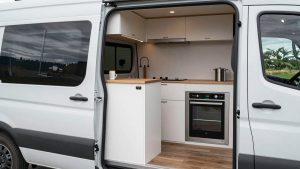
For a small galley with one burner, a 2,000-watt pure sine inverter is the most balanced choice. It can run a 1,300- to 1,800-watt induction cooktop without operating continuously at its limit. It also leaves some capacity for a refrigerator, laptop charger, or small blender, although simultaneous use still requires a wattage check.
Expect roughly $300 to $600 for a suitable pure sine inverter, plus heavy-gauge cables, a fuse, and professional installation if you are not comfortable working with high-current DC wiring.
Occasional coffee, water, or light meals
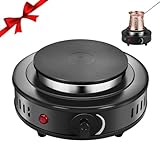
If your main goal is heating a moka pot, soup, or a small pan, a 500- to 1,000-watt setup may be enough. The Artilife 500W Mini Hot Plate, listed at approximately $20, is an example of a low-wattage compact hot plate. It is a conventional electric hot plate rather than an induction cooker, so it will not heat as quickly or efficiently as induction, but it places a much smaller demand on the inverter.
Use a 1,000- to 1,200-watt pure sine inverter for this category. A 100-amp-hour 12-volt battery may handle occasional short sessions, but repeated cooking can consume energy quickly once inverter losses are included.
Full-time cooking and two burners
Full-time van cooking generally calls for a 3,000-watt pure sine inverter and a battery system designed for high continuous discharge. Before choosing this size, check whether the cooktop actually draws 3,000 watts. Some two-burner models limit total output to 1,800 or 2,000 watts, making a 2,000- to 2,500-watt inverter sufficient.
A 3,000-watt system may weigh 15 to 25 pounds (6.8 to 11.3 kg), and installation can cost $600 to $1,500 or more when cables, fusing, a battery monitor, and labor are included. Do not assume a 3,000-watt label means the unit can sustain that output indefinitely; distinguish continuous power from short-term surge power.
Van with shore power or a generator
If you cook mostly at campgrounds with shore power, a 1,000- to 2,000-watt inverter may cover off-grid meals while shore power handles longer cooking sessions. An inverter-charger can simplify the system, but it costs more—often $700 to $1,500—and requires careful AC wiring. Have permanent AC installations inspected or completed by a qualified professional.
Common Sizing Mistakes
- Choosing the inverter from the average wattage: Use the cooktop’s maximum input rating, not a low simmer setting.
- Ignoring 12-volt current: High wattage means high battery current. Undersized cables can overheat and cause voltage drop.
- Using a starter battery: Starter batteries are designed for brief engine cranking, not repeated deep discharge.
- Buying modified sine output to save money: It may work, but it can cause noise, excess heat, or poor performance with some electronic controls.
- Forgetting other appliances: Add the refrigerator, microwave, coffee maker, and chargers that may run at the same time.
- Mounting without airflow: An inverter needs ventilation and protection from water, dust, and accidental contact with metal objects.
- Assuming more watts solves everything: A larger inverter cannot compensate for an undersized battery, alternator, fuse, or cable.
FAQ
Can a 1,000-watt inverter run an induction cooktop?
Only if the cooktop’s maximum draw is comfortably below 1,000 watts. Most full-size portable induction burners draw 1,300 to 1,800 watts, so they need a larger inverter. A 500- to 800-watt cooker is a better match for a 1,000-watt unit.
What size inverter is best for a 1,800-watt induction burner?
Choose a 2,000-watt pure sine inverter at minimum. A 2,500-watt model gives more breathing room for chargers and small appliances, provided the battery and wiring can support the added capacity.
How many amps does induction cooking use from a 12-volt battery?
Estimate watts divided by 12, then allow for inverter losses. A 1,500-watt cooktop may draw around 140 amps in operation, while a 3,000-watt load may approach 280 amps. Actual current varies with battery voltage, temperature, and inverter efficiency.
Is a 3,000-watt inverter too large for a van?
Not necessarily, but it is excessive for a small single burner and can add cost, weight, and installation complexity. It makes sense when you need two burners or several high-draw appliances and have a battery bank, cables, fuse, and charging system rated for the load.