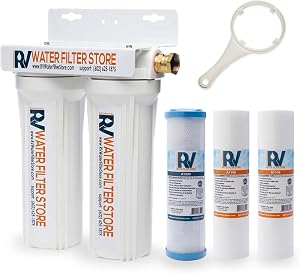
- Top Pick: Hourleey 2 Pack RV Inline Water Filter, Reduce Bad Taste, Odors, Rust, Fluoride, Chlorine and Sediment in Drinking Water, Dedicated for RVs Campers
- Best Value: 2 Pack Flow-Pur 8 Carbon Block Filter Compatible Cartridge WCBCS-975-RV by American Water Solutions
- Premium Choice: Rv Water Filter Replacement Cartridge, 0.01 Micron Replacement Cartridge for Universal 2.5" X 10" Rv Water Filter System, Compatible With WLSINJL Ultra Rv Water Filters, 3 Pack
 Vanlife Portable Water Filter” style=”max-width:100%;height:auto;margin-bottom:1rem” loading=”lazy”>
Vanlife Water Filter: Best Portable Filtration Options for Life on the Road
TL;DR Quick Answer
The best vanlife water filter depends on your water sources: city/campground spigots need a basic carbon inline filter ($20–$40); backcountry streams and unknown sources need a 0.1-micron hollow fiber filter like the Sawyer Squeeze or LifeStraw Mission; full-time vanlifers filling from varied municipal sources do best with an under-counter carbon block filter + separate UV purifier. For most vanlifers, a $30 inline carbon filter on the tank fill + a $40 countertop gravity filter covers 95% of use cases cleanly.
Water is the resource that shapes your vanlife more than any other. How you source it, store it, and filter it determines where you can go, how long you can stay, and whether you’re drinking healthy water or something that’ll knock you out for three days in the middle of nowhere.
As an Amazon Associate we earn from qualifying purchases.


This vanlife water filter guide covers every filtration technology, which sources require what level of treatment, inline vs gravity vs UV systems, and the exact products worth buying for each scenario.
🛒 Best Price Today on Amazon
Prime members get fast, free shipping on everything above, plus member-only deals. New members get a 30-day free trial — cancel anytime.
Start 30-Day Prime Free Trial →See Today’s Amazon Deals- Best Vanlife Water Filter Options: Top Picks
- Water Sources in Vanlife: What Each Requires
- Filtration Technologies: What Each Actually Removes
- Inline Filter Setup: The Vanlife Standard
- Gravity Filter Systems: For Off-Grid Water Sources
- Water Filter Maintenance: What Most Vanlifers Skip
- FAQ: Vanlife Water Filter
- Frequently Asked Questions
- Related Articles
- Related Guides
Best Vanlife Water Filter Options: Top Picks
BEST INLINE FILTER
Camco TastePURE Carbon Water Filter w/ Flexible Hose

Ivation Portable Camping Shower | Compact Handheld & Hands-Free Rechargeable Outdoor Shower Head & Cleaning System w/ 3.7V Pump, 6-Ft Hose, Bidet Head, Removable Filter, Multiuse Hook & USB Cable


As an Amazon Associate we earn from qualifying purchases. Product prices and availability are accurate as of the date/time indicated.
BEST GRAVITY FILTER
Sawyer Products Squeeze Water Filter System


As an Amazon Associate we earn from qualifying purchases. Product prices and availability are accurate as of the date/time indicated.
BEST UV PURIFIER
SteriPen Ultralight UV Water Purifier


As an Amazon Associate we earn from qualifying purchases. Product prices and availability are accurate as of the date/time indicated.
Water Sources in Vanlife: What Each Requires
See also: Spanish Cuisine: Classic Dishes and Ingredients • Sugar Free Cocktail Recipes That Actually Taste Good
Not all water sources carry the same risk profile. Match your filtration to your actual sources:
| Water Source | Common Contaminants | Minimum Filtration | Ideal Filtration |
|---|---|---|---|
| Municipal tap / campground spigot | Chlorine, taste/odor, sediment | Carbon inline filter | Carbon block + activated carbon |
| RV park hookup | Old hoses, sediment, chlorine | Carbon inline filter | Carbon inline + pre-sediment filter |
| Gym/truck stop fill | Variable — mostly safe municipal | Carbon inline filter | Carbon inline sufficient |
| Natural spring (marked potable) | Sediment, possible coliform | 0.1-micron hollow fiber | Hollow fiber + UV |
| Stream / river / lake | Giardia, cryptosporidium, bacteria, viruses | 0.1-micron + UV or iodine | Hollow fiber + UV purifier |
| Collected rainwater | Sediment, possible bird/animal contamination | Sediment pre-filter + carbon | Carbon block + UV |
Most full-time vanlifers stick to municipal sources 90% of the time. For that use case, a $25–$40 carbon inline filter connected to your tank fill hose is sufficient and cost-effective. Add a UV purifier if you ever fill from natural sources or water of unknown provenance.
Filtration Technologies: What Each Actually Removes
Carbon Block / Activated Carbon
Removes: chlorine, chloramines, VOCs, taste, odor, some heavy metals. Does not remove: bacteria, viruses, protozoa, nitrates, fluoride. Best for: municipal water treatment of taste and chemical contaminants. Lifetime: typically 500–1,000 gallons before replacement.
Hollow Fiber (0.1 Micron) Filters
Removes: bacteria (E. coli, salmonella), protozoa (Giardia, Cryptosporidium), microplastics. Does not remove: viruses (too small at 0.02–0.03 microns), dissolved chemicals. Best for: backcountry water sources in North America where viruses are low risk. Lifetime: 100,000+ gallons when backflushed regularly (Sawyer-style).
UV Purification
Removes/neutralizes: bacteria, viruses, protozoa (all biological contaminants). Does not remove: chemical contaminants, heavy metals, sediment (water must be clear for UV to work). Best for: water that may contain viruses — international travel, questionable municipal sources. Requires pre-filtration to remove turbidity if water is cloudy.
Reverse Osmosis (RO)
Removes: virtually everything — bacteria, viruses, heavy metals, nitrates, fluoride, dissolved solids. Downsides: slow (1–4 gallons/hour), wastes 2–4 gallons for every gallon produced, requires 40–80 PSI water pressure, expensive ($150–$500). Best for: vanlifers with plumbed water systems who fill primarily from municipal sources with known heavy metal or nitrate issues. Overkill for most builds.
Inline Filter Setup: The Vanlife Standard
The simplest and most common vanlife filtration setup is an inline carbon filter on the fill hose. Here’s how it works:
- Connect your standard RV fill hose to the spigot.
- Attach an inline carbon filter between the hose and your tank fill port.
- Fill your freshwater tank — all incoming water passes through the carbon filter.
- At the countertop, optionally add a second point-of-use filter on the faucet output for drinking water.
This two-stage approach (fill filter + drinking filter) is effective and inexpensive. Replace the inline filter every 3–4 months or 500 gallons, whichever comes first. Keep a spare filter in the van — filters don’t fail gradually; they become breeding grounds for bacteria when overused.
Integrate your water filtration with your broader van plumbing system — the filter installs inline between tank fill and tank inlet. If you’re using a 12V water pump, the filter can also sit on the outlet side between pump and faucet, though flow rate may reduce slightly depending on filter design.
Gravity Filter Systems: For Off-Grid Water Sources
If you collect water from streams, springs, or other natural sources, a gravity filter gives you safe drinking water without pumping or electricity. The Sawyer Squeeze system is the benchmark: 0.1 micron hollow fiber removes 99.99999% of bacteria and 99.9999% of protozoa, weighs 3 ounces, and lasts the lifetime of the filter (100,000+ gallons with proper backflushing).
Setup in a van: hang the dirty water bag from a cabinet hook, run the filter inline, and collect clean water in a dedicated container. Flow rate is 0.5–1 liter per minute — not fast, but gravity-fed means zero electricity consumption.
Water Filter Maintenance: What Most Vanlifers Skip
A neglected water filter is worse than no filter. Bacteria colonize carbon media that’s past its service life. Key maintenance:
- Inline carbon filters: replace every 3–4 months or 500 gallons. Mark the installation date with permanent marker on the filter housing.
- Hollow fiber filters (Sawyer): backflush after every use by forcing clean water backward through the filter. This prevents clogging and extends lifespan dramatically. Never let a hollow fiber filter freeze — ice crystals crack the membrane and ruin the filter with no visible damage.
- UV purifiers (SteriPen): replace the battery or recharge before field use. A weak battery produces less UV intensity — the unit may process water without adequate disinfection. Clean the quartz sleeve with a soft cloth regularly.
Store your van’s water tank clean between long fill intervals. Adding a few drops of food-grade hydrogen peroxide (3% solution, 1 tablespoon per 5 gallons) to a full tank before long storage prevents bacterial growth in the tank itself — no filter handles tank-level contamination once bacteria colonize the tank walls.
For vanlifers building out a complete water system, review the van shower drain and plumbing setup guide for integration points where filtration fits in the system.
FAQ: Vanlife Water Filter
Do I need a water filter for vanlife if I only use campground spigots?
Campground spigots supply potable municipal water — technically safe to drink unfiltered. However, older campground infrastructure, rubber hose connections, and occasional water quality variation mean a basic carbon inline filter significantly improves taste, removes chlorine, and provides a buffer against sediment or minor contamination. At $25–$35 and 5 minutes to install, it’s a straightforward quality-of-life upgrade worth doing.
What is the best water filter system for a van with a built-in plumbing setup?
For a van with a freshwater tank and 12V pump, the ideal setup is: (1) an inline sediment pre-filter on the tank fill hose to protect the tank from debris, (2) an activated carbon block filter between pump and faucet for taste and chlorine removal, and (3) a UV purifier wand for drinking water drawn from unknown sources. This three-stage system handles 99% of vanlife water scenarios without adding complexity or significant cost (total $60–$120).
Can I drink water from natural springs in my van without filtering?
No — “natural spring” does not mean safe to drink unfiltered. Even designated natural springs can be contaminated by animal activity, upstream runoff, or surface water infiltration. Giardia contamination in particular produces no visible signs in water but causes severe gastrointestinal illness within 1–3 weeks of ingestion. Always run natural spring water through at least a 0.1-micron hollow fiber filter; add UV treatment if you’re in an area with known viral contamination risk.
How long do inline van water filters last?
Most inline carbon filters are rated for 500–1,000 gallons or 3–6 months, whichever comes first. Full-time vanlifers filling a 20-gallon tank twice a week use roughly 40 gallons/week — that’s about 500 gallons in 3 months, so quarterly replacement is the right schedule. Weekend vanlifers might stretch a filter to 6 months. When in doubt, replace it — filters are $15–$30, and the cost of foodborne illness from contaminated water is measured in lost days, not dollars.
Will a vanlife water filter remove fluoride from tap water?
Standard activated carbon and hollow fiber filters do not remove fluoride. Fluoride removal requires reverse osmosis, activated alumina, or bone char carbon filters specifically rated for fluoride reduction. For most vanlifers, fluoride removal is not a practical concern — municipal fluoride levels are set at safe concentrations. If fluoride removal is a priority, a countertop RO unit or a specialized carbon block rated for fluoride is the right tool, accepting the trade-off of slower flow and more waste water.
Frequently Asked Questions
What filtration do I actually need for van water?
For municipal spigot fill, a sediment plus carbon block filter at 0.5 micron removes grit, chlorine, taste and most cysts, which is enough. For creek, lake or questionable well sources add a 0.2 micron hollow fibre or a UV purifier to handle bacteria, and consider a virus-rated element abroad.
Do I filter at the inlet or at the tap?
Both, ideally. An inline sediment and carbon filter at the fill hose protects the tank and pump from grit, and a finer point-of-use filter at the drinking tap handles anything that grew in the tank. Filtering only at the inlet leaves the tank itself as a contamination point.
Does a filter reduce water pressure or pump life?
Yes, every filter adds restriction. A clogged element makes a diaphragm pump cycle hard and short-cycle, which wears it out. Fit the filter after the pump on the pressure side for better flow, use an accumulator tank to smooth pulsing, and change elements before flow noticeably drops.
How often do I replace the cartridge?
Carbon blocks are usually rated a few hundred to a few thousand gallons, but in practice van filters need replacing every three to six months because biofilm grows in a warm damp cartridge whether you use it or not. Note the install date on the housing with a marker.
Will the filter freeze and split in winter?
A wet cartridge freezing will crack the housing and ruin the media. Before a hard freeze, drain the housing, remove the element and store it in a sealed bag inside the cabin, or blow the line out with compressed air. Never thaw a frozen filter and assume it still works.