Last updated: October 7, 2026
The best RV coffee makers are usually a low-wattage drip machine for two or more people, an AeroPress Go or French press for minimal power use, and a compact espresso maker only if you value concentrated coffee more than capacity and simplicity.
Best RV coffee makers by camping situation
| Best for | Recommended type | Typical footprint | Power requirement | Typical capacity |
|---|---|---|---|---|
| One person, smallest galley | AeroPress Go or compact French press | About 5–7 in wide | None | 237–350 ml |
| Two people using shore power | Compact drip brewer | About 6–9 in wide | 650–1,000 watts | 4–5 cups |
| Single-serve convenience | Pod brewer | About 5–7 in wide | 1,000–1,500 watts | 237–355 ml per brew |
| Espresso drinks off-grid | Manual espresso maker | About 2.5–3 in wide | None, apart from heating water | 50–80 ml per shot |
| Several large mugs | Drip coffee maker or stovetop brewer | About 7–10 in wide | 650–1,200 watts, or none | 600–1,200 ml |
These dimensions and electrical figures are useful planning ranges rather than universal specifications. Check the label on the exact model before connecting it to an inverter, portable power station, or RV outlet.

Keurig K-Express Single Serve K-Cup Pod Coffee Maker, Black
Included for 'Best RV Coffee Makers for Compact Campers' because the listing specifies Black, details this guide uses to compare options.
View on Amazon
BLACK+DECKER 12-Cup Drip Coffee Maker with Vortex Brewing
Included for 'Best RV Coffee Makers for Compact Campers' as a relevant option in this category; details come from the product listing.
View on Amazon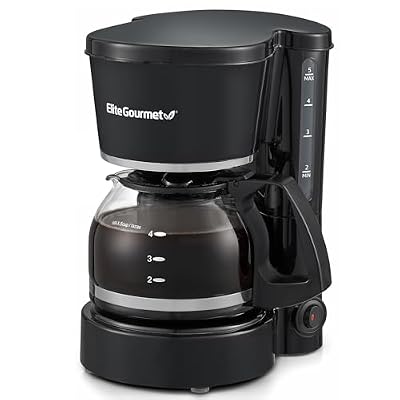
Elite Gourmet EHC-5055 Automatic 5-Cup Brew & Drip Coffee Maker with Pause N Serve Reusable Filter, On/Off Switch, Water Level Indicator
Included for 'Best RV Coffee Makers for Compact Campers' because the listing specifies On/Off Switch and Water Level Indicator, details this guide uses to compare options.
View on Amazon
Keurig K-Mini Mate Single Serve K-Cup Pod Coffee Maker, Glamping Green
Included for 'Best RV Coffee Makers for Compact Campers' because the listing specifies Glamping Green, details this guide uses to compare options.
View on AmazonHead-to-head: drip, pod, espresso, and French press
See also: Spanish Cuisine: Classic Dishes and Ingredients • Sugar Free Cocktail Recipes That Actually Taste Good
Compact drip coffee makers: the practical choice for two or more
A small drip brewer is the best RV coffee maker for people who want familiar, filter-brewed coffee and enough volume for more than one mug. A four- or five-cup machine generally makes roughly 590–740 ml, depending on the manufacturer’s definition of a “cup.” That is usually enough for two moderate servings, but not necessarily two large travel mugs.
Look for a narrow machine with a removable reservoir, a reusable filter option, and a heating element below 1,000 watts if you regularly use an inverter. A compact five-cup brewer may occupy approximately 6–9 inches of counter width and 8–12 inches of depth. Measure with the lid open, not just the machine’s base: overhead cabinets and a fixed shelf can make refilling awkward.
The drawback is startup wattage. Brewing uses power for several minutes, and the heating plate can continue drawing electricity after the coffee is ready. Turn the machine off promptly unless you are connected to shore power. Paper filters are clean and light to pack, while reusable mesh filters reduce consumables but leave more fine sediment and require rinsing.
Pod machines: fastest cleanup, highest electrical demand
Pod brewers are attractive in an RV because they deliver one cup with almost no measuring. Many compact models brew 8–12 ounces, or about 237–355 ml, and take up less counter space than a full-size coffee maker. The Keurig K-Mini is a familiar example of a compact pod format, while the Nespresso Essenza Mini represents the smaller capsule-based espresso format.
The trade-off is electrical compatibility. A pod machine commonly draws around 1,000–1,500 watts while heating water. That is a substantial load for a 12-volt electrical system and can exceed the continuous rating of a small inverter. Pods also take up storage space and create more waste than ground coffee, although reusable-compatible systems exist for some formats.
Choose a pod brewer when you have reliable shore power, a sufficiently large inverter, or a portable power station designed for the machine’s running wattage. It is a poor match for casual battery-only use unless you have calculated the energy budget first.
Manual espresso makers: concentrated coffee without a high-wattage appliance
Manual espresso makers such as the Wacaco Nanopresso or Minipresso use hand pressure rather than an electric pump. They are compact, typically weighing well under 1 pound before accessories, and produce a small concentrated shot. You still need a way to heat water, but a kettle, saucepan, or camp stove can handle that separately.
This category suits van travelers who drink espresso, americanos, or milk-based drinks and do not mind a more involved routine. It is not the best choice for quickly making several full mugs. The water chamber and basket are small, and repeated shots mean repeated loading, pumping, and rinsing.
Capsule adapters can make some manual espresso makers faster and more consistent, but they add cost, storage needs, and model-specific consumables. Ground coffee offers greater flexibility but requires a fine espresso grind and careful dose control.
French presses: simple, quiet, and nearly inverter-proof
A French press needs no electricity, has no heating element to fail, and can brew directly into a serving vessel. A 350 ml press is compact for one person; a 700–1,000 ml press is more useful for couples. Bodum Chambord presses are a common example, but any borosilicate-glass, stainless-steel, or double-wall insulated model can work.
Glass is easy to inspect and does not retain odors, but it is vulnerable to vibration and knocks in a moving vehicle. Stainless steel or durable plastic is safer for storage while driving. The plunger screen is the part most likely to bend or clog, while glass carafes and replacement screens are the ownership issues to consider.
French press coffee requires more cleanup than a pod machine: grounds must be emptied rather than washed down an RV sink, where they can contribute to clogs. A small grounds container or compostable bag makes the routine easier.
How much battery power does an RV coffee maker use?
Use this calculation before buying an electric brewer:
Watt-hours used = watts × minutes of operation ÷ 60.
For example, a 900-watt drip machine that runs its heater for 8 minutes uses approximately 120 watt-hours before inverter losses. Allowing about 15% for inefficiency gives roughly 138 watt-hours from the battery. A 1,200-watt pod machine running for 4 minutes uses about 80 watt-hours; with inverter losses, plan on approximately 92 watt-hours.
At 12 volts, 138 watt-hours is about 11.5 amp-hours in an ideal calculation. Real battery systems have conversion losses and usable-capacity limits, so leave a margin rather than sizing the system to the arithmetic minimum. A 300-watt inverter cannot safely run a 900-watt coffee maker, regardless of how large the battery is. The inverter’s continuous rating must exceed the appliance’s running draw, and its surge rating should also be checked.
A manual brewer avoids the appliance load, but heating water still consumes fuel or electricity. If you already boil water for breakfast, an AeroPress Go, French press, or manual espresso maker can use that same heating step.
Decision matrix for choosing the right brewer
| Your situation | Best fit | Why | Watch out for |
|---|---|---|---|
| Under 10 inches of usable counter space | AeroPress Go or small French press | Stores easily and needs no permanent appliance space | Requires a separate kettle or hot-water method |
| Daily coffee for one person | AeroPress Go or compact pod brewer | Small batches avoid wasted coffee | Pods cost more per serving; AeroPress needs manual rinsing |
| Daily coffee for two people | Four- or five-cup drip brewer | Better volume with one brew cycle | Usually needs shore power or a robust inverter |
| Limited battery capacity | French press or manual espresso maker | No coffee-maker heating element | Water heating still needs fuel or another appliance |
| Fastest, least-messy morning routine | Pod brewer | Pre-portioned coffee and minimal grounds handling | High wattage and pod storage waste |
| Espresso drinks several times a week | Manual espresso maker | Compact and independent of shore power | Small output and more technique than a pod system |
Setup and maintenance details that matter in a van
- Measure the complete operating space. Record width, depth, height, lid clearance, outlet location, and the space needed to remove the water reservoir.
- Match the brewer to the electrical system. Compare the appliance’s rated watts with the inverter’s continuous output, not only its advertised peak output.
- Secure it while driving. Store glass presses and loose carafes in padded bins. Do not leave water in a removable reservoir during travel, where it can spill into cabinets or onto electronics.
- Use filtered water when practical. Mineral buildup slows heating and changes flow. In hard-water areas, descale electric machines according to the manufacturer’s instructions.
- Keep grounds out of the sink. Empty filters and French press sediment into a trash or compost container, then wipe or rinse the brewer.
- Dry removable parts completely. Damp pod holders, rubber seals, and French press screens can develop odors when packed immediately after use.
The parts that commonly wear first are silicone seals, plunger screens, pod needles, carafe lids, and reusable filters. Replacement parts are easier to find for established brands, but a simple manual brewer generally has fewer components to replace. For an RV that moves frequently, impact resistance and storage security can matter more than a small difference in brewing speed.
Final recommendation
For most compact campers, the best RV coffee maker is a manual brewer unless shore power is part of the daily routine. Choose a compact drip machine for shared coffee, a pod brewer for convenience with dependable electricity, a manual espresso maker for concentrated drinks, and a French press for the lowest purchase complexity and zero appliance wattage. The winning choice is the one that fits both your counter and your electrical system—not merely the one with the smallest advertised footprint.