- Top Pick: KDUJKSO Mounting Rails Compatible with EcoFlow Portable Powerstation,Secure Bracket for Van Life,Overland and Outdoor Setup,Quick Setup and Organized Storage,2 pick
- Best Value: Magnetic Outdoor Projector Screen – Portable HD Projector Screen, 16:9 Aspect Ratio, 1080 Compatible, Foldable Camping White Screen for Van, SUV, Car – Outdoor Movies
- Premium Choice: TIMVIEA 6-in-1 Starlink Mini Case with 4 Suction Cups & 2 Carabiners | Hail-Proof Silicone Protective Cover & Mount Kit for Starlink Mini Satellite Dish | Shockproof RV Van Life Off-Road Gear (White)
Power independence is the backbone of van life freedom. Whether you’re running a laptop for remote work, keeping a refrigerator cold through a desert night, or charging camera gear after a long day of shooting, your power system determines how long you can stay off-grid. The choice between a portable generator and a solar power setup — or a combination of both — is one of the most consequential gear decisions any van dweller makes.
Solar is silent, maintenance-free, and indefinitely renewable. Generators provide on-demand power regardless of weather but require fuel, produce noise and exhaust, and come with maintenance obligations. The best van life setups use both strategically. Here’s what actually works out on the road.
As an Amazon Associate we earn from qualifying purchases at no extra cost to you.


🛒 Best Price Today on Amazon
Prime members get fast, free shipping on everything above, plus member-only deals. New members get a 30-day free trial — cancel anytime.
Start 30-Day Prime Free Trial →See Today’s Amazon DealsQuick Picks: Best Van Life Portable Generator and Solar Power Solutions
Why Trust Our Picks
See also: How Long Will a 100Ah Battery Last in a Van? Runtime Math Explained • Best Level 2 EV Chargers for Home
We evaluated these power solutions against the specific demands of van life — not home backup or camping trips. That means testing sustained loads from 12V compressor fridges, inverter charging behavior when running a laptop plus USB devices simultaneously, solar recharge rates in partial cloud cover, and how each unit handles the vibration and temperature swings of being in a vehicle daily.
We also looked at long-term ownership factors that matter for full-time van lifers: battery chemistry longevity (LiFePO4 vs. NMC), warranty support when you’re not near an address, and whether firmware updates can be delivered remotely. These factors separate gear built for occasional campers from equipment that holds up for years of daily van life use.
Best Van Life Power Solutions: Reviews
1. Jackery Explorer 1000 Pro — Best Overall
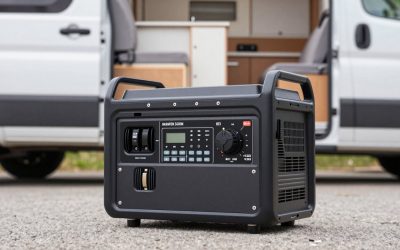
The Jackery Explorer 1000 Pro has become something of a van life standard, and for good reason: it hits a sweet spot between capacity, weight, solar compatibility, and price that competing units struggle to match simultaneously. The 1002Wh capacity is the practical minimum for running a 12V compressor fridge (roughly 40–50Wh per hour) alongside laptop charging and lighting through a full off-grid day.
The solar charging compatibility is well-implemented. Using two Jackery SolarSaga 100W panels connected in parallel, you can realistically achieve 150–180W of actual input power in good sunlight — enough to fully recharge the Explorer 1000 Pro in about six hours of solid solar exposure. The MPPT charge controller is properly optimized for the panel pairing, which matters more than raw watt ratings suggest.
Silent operation is the single most important generator feature for van life. The Explorer 1000 Pro produces zero noise — no engine, no fuel, no exhaust. You can camp in no-generator-permitted sites, run power through the night without disturbing neighbors or alerting campsite hosts, and operate stealth-camping in urban areas without revealing your presence. This alone makes it preferable to traditional gas generators for van life regardless of other specs.
At 25 pounds, it’s manageable to move between the van’s interior and an outdoor setup when maximizing solar exposure. The pure sine wave 1000W AC output handles sensitive electronics cleanly — no CPAP machine interference, no laptop charger whine.
Pros: Ideal capacity for van life essentials, excellent solar pairing ecosystem, completely silent, pure sine wave AC output, 25-lb weight manageable for daily use.
Cons: NMC battery chemistry (fewer cycles than LiFePO4), wall charging speed slower than EcoFlow, no expandable capacity option.
2. EcoFlow DELTA 2 — Runner-Up
The EcoFlow DELTA 2 earns its runner-up position through two features that matter enormously for van life: its extraordinary charging speed and its expandable capacity system. The X-Stream 1200W AC charging technology fills the DELTA 2 from zero to 80% in under 50 minutes — critical when you find a free charging outlet at a campground, library, or friend’s house and only have limited dwell time.
The expandable battery system (adding the DELTA 2 Extra Battery module) brings total capacity to 2048Wh — enough for two to three days of full van life use without any solar input. For winter van life where solar production drops significantly, this expandability provides a meaningful buffer that fixed-capacity units can’t match.
The 1800W AC output handles appliances that the Jackery 1000 Pro can’t — a full-size electric kettle, a small hair dryer, or a microwave. For van lifers who want more kitchen flexibility, this extra headroom is valuable. The EcoFlow app provides detailed consumption monitoring that helps you understand and optimize your power budget over time.
Pros: Fastest charging speed in category, expandable to 2kWh+, 1800W AC output, excellent app monitoring, LFP battery chemistry for longer cycle life.
Cons: Heavier than Jackery at 27 lbs before expansion, higher base price, expansion battery is an additional significant investment.
3. Bluetti EB70S — Best Budget
The Bluetti EB70S stands out in the budget segment for one critical reason: its LiFePO4 (lithium iron phosphate) battery chemistry is rated for 2,500+ charge cycles before reaching 80% capacity — roughly 3–5 times the cycle life of NMC batteries in similarly priced units. For full-time van lifers cycling their battery daily, this difference translates to years of additional service life, making the EB70S’s total cost of ownership significantly lower than cheaper-looking alternatives.
The 716Wh capacity covers van life essentials: a 12V fridge running 24 hours with solar supplement, laptop charging, phone charging, and lighting. It won’t power high-draw appliances, but for the core van life power budget — connectivity and refrigeration — it’s sufficient. The 200W solar input limit is the key constraint; heavy solar days won’t recharge it as fast as larger MPPT systems, so this unit works best when combined with shore power opportunistically.
At 21 pounds, it’s the lightest of the three picks, and its compact size fits easily under a van bed platform without requiring dedicated mounting. The build quality is excellent for the price — Bluetti’s manufacturing consistency has improved significantly, and the EB70S shows it.
Pros: LiFePO4 chemistry for 2,500+ cycles, lightest of the group, solid build quality, sufficient for van life essentials, best value per usable Wh over its lifespan.
Cons: 716Wh limits multi-day off-grid stays, 200W solar input cap, 800W AC output won’t run high-draw appliances, no expansion options.
Buyer’s Guide: Van Life Power Systems
Calculating Your Daily Power Budget
Before choosing capacity, calculate your actual daily consumption. A 12V compressor fridge uses roughly 30–50Wh per hour depending on ambient temperature — call it 720–1200Wh per day. Add laptop charging (45–100Wh per charge cycle), phone charging (15–20Wh), LED lighting (5–15Wh for a van interior), and any other devices. Most van setups land between 500Wh and 1500Wh of daily consumption. Size your battery to cover 1.5–2 days of your calculated daily budget without solar input as your baseline.
Solar Panel Sizing
A general rule: expect 4–5 peak sun hours per day in most of North America and Europe outside of winter. A 200W panel array produces roughly 800–1000Wh on a good day. If your daily consumption is 800Wh, a 200W panel can theoretically keep you indefinitely off-grid in good conditions. Add 50% overcapacity to your solar array to account for clouds, seasonal variation, and panel angle limitations in a parked van.
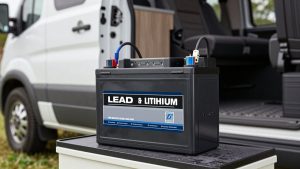
Battery Chemistry: LiFePO4 vs. NMC
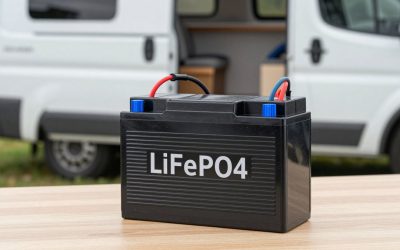
LiFePO4 (lithium iron phosphate) batteries offer 2,000–3,000+ charge cycles, better thermal stability, and longer lifespan but are heavier per Wh. NMC (nickel manganese cobalt) batteries pack more energy per pound but degrade faster (500–1,000 cycles). For van life with daily charging, LiFePO4 is almost always the better long-term choice despite the higher upfront weight.
FAQ
Can I run a portable power station while driving to recharge it?
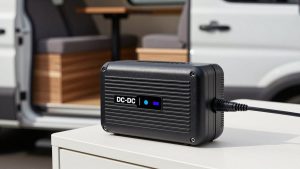
Most portable power stations can be charged via a 12V car outlet (cigarette lighter), though the charging rate is limited to 100–120W by standard 12V sockets. This is enough to maintain or slowly recharge a moderately-used power station during driving but won’t fully recharge a depleted 1000Wh unit in a typical driving day. Some vans add a dedicated DC-DC charger wired directly to the alternator for faster vehicle charging — a worthwhile upgrade for road-heavy van life styles.
Are gas generators worth it for van life?
Traditional gas generators are increasingly unsuitable for van life. They require carrying fuel, produce carbon monoxide (dangerous in enclosed spaces), create noise that violates campsite rules and breaks stealth camping, and require regular maintenance. Solar power stations have made gas generators unnecessary for the vast majority of van life power needs. The only scenario where gas generators remain useful is extended power demand in prolonged cloudy weather when alternative charging sources aren’t available.
How do I keep my power station safe from heat in a van?
Lithium batteries degrade significantly faster when stored or operated above 95°F (35°C). In a van parked in direct sun, interior temperatures can reach 140°F or higher. Keep power stations in an insulated compartment or cover them with a reflective blanket during hot days. Don’t charge at full rate in extreme heat — most units have built-in thermal throttling, but they’ll still degrade faster at high temperatures. Ventilation under your bed platform where the unit is stored makes a meaningful difference.
Final Verdict
For most van lifers building their first or primary power system, the Jackery Explorer 1000 Pro is the right starting point — it covers essential loads, pairs well with solar, and operates silently in any camping situation. Van lifers who prioritize fast recharging at shore power and want future expandability should step up to the EcoFlow DELTA 2. And for budget-focused builds where longevity matters more than maximum capacity, the Bluetti EB70S‘s LiFePO4 chemistry delivers years of reliable daily cycling at a lower entry cost.
Your power system is your van’s lifeline. Invest in it thoughtfully and it will support every other aspect of your van life for years to come.
Frequently Asked Questions
Should I get a gas generator or a solar power station?
A solar power station is silent, legal in every campground, and needs no fuel, which suits most van dwellers. A small inverter generator makes sense only if you regularly run high-draw tools, air conditioning, or camp for weeks in poor sun. Many people carry a generator for winter and rely on solar the rest of the year.
How much solar can realistically recharge a battery each day?
A 200-watt roof array produces roughly 600 to 900 watt-hours on a clear summer day and as little as 150 to 300 in overcast winter conditions at northern latitudes. Size the array for your worst expected month, not your best, or you will be driving to charge every few days.
Can a portable generator run an air conditioner?
A 12V rooftop unit or a small 5,000 BTU window-style AC needs 400 to 700 running watts but can surge to 1,500 or more on startup. A 2,000-watt inverter generator handles it. Anything under 1,000 watts will stall on the compressor start regardless of the running figure on the box.
How do generators and solar perform in cold weather?
Panels actually produce more efficiently in the cold but the sun sits low and days are short, so winter output falls sharply. Gas generators start harder in deep cold and need fresh fuel with stabilizer. Lithium batteries must not be charged below freezing, so keep them in the heated cabin.
Where do I safely run and store a gas generator?
Always outside and well away from windows and the roof vent, never in the van, a tent, or under an awning, because carbon monoxide kills in enclosed spaces. Store gasoline in an approved sealed can, secured upright outside the living area, and never inside the cabin overnight.