Last updated: October 17, 2026
The best RV battery charger for most campers is a three-stage, temperature-aware 12-volt charger matched to your battery chemistry: choose a 40–60A RV converter charger for a permanently installed bank, or a 15–30A smart charger for occasional shore-power charging.
Quick picks by RV situation
| Situation | Best charger type | Useful output | Why it fits |
|---|---|---|---|
| Replacing a factory converter in a lead-acid RV | Progressive Dynamics PD9200 series | 30–100A models; 12V nominal | Selectable or chemistry-specific charging options, established RV installation format |
| Modern RV with lead-acid or lithium batteries | WFCO Auto-Detect converter, including 8955-series variants | Typically 55A in the 8955 size | Designed for RV distribution panels and can detect compatible battery profiles |
| Premium standalone charger for a 12V battery bank | Victron Energy Blue Smart IP22 | 15A or 30A versions, depending on model | Bluetooth monitoring, configurable profiles, and useful long-term storage behavior |
| Portable maintenance or emergency charging | NOCO Genius10 | 10A maximum | Compact automatic charger for 6V/12V batteries, including supported lithium batteries |
For a permanent camper installation, the “best RV battery charger” is usually an RV converter charger rather than a portable automotive charger. A converter both charges the battery and supplies the 12-volt distribution system when connected to shore power. A standalone camper battery charger is more flexible, but it normally needs separate wiring, fusing, and a reliable connection to the battery.

NOCO GENIUS1 1A 6/12V Smart Battery Charger, Trickle Charger & Maintainer | Overcharge Protection, Desulfator, Temperature Compensation, Force Mode, For Lead-Acid (Wet, Gel, AGM) & Lithium (LiFePO4)
Included for 'Best RV Battery Chargers for Lead-Acid and Lithium Batteries' because the listing specifies Trickle Charger & Maintainer and Overcharge Protection, details this guide uses to compare options.
View on Amazon
WAVLINK 55 Amp RV Power Converter, 120V AC to 12V DC Battery Charger | 3 Smart Charging Modes, 13V-16.5V Adjustable Range, Multi-Stage Charging
Included for 'Best RV Battery Chargers for Lead-Acid and Lithium Batteries' because the listing specifies 120V AC to 12V DC Battery Charger and 3 Smart Charging Modes, details this guide uses to compare options.
View on Amazon
E-FAST 25A Smart Car Battery Charger, 12V/24V Automatic Automotive Battery Maintainer & Desulfator with 200s Booster Mode - Adjustable Amp Trickle Charger for Lead-Acid, AGM, Gel, LiFePO4
Included for 'Best RV Battery Chargers for Lead-Acid and Lithium Batteries' because the listing specifies Adjustable Amp Trickle Charger for Lead-Acid and AGM, details this guide uses to compare options.
View on Amazon
2026 Upgraded 12V/24V 0-20A Heavy Duty Battery Charger/Maintainer with Auto Shutoff, Repair & Winter Mode, 10 Modes & Color Screen for Car, Truck, Motorcycle, RV, Boat, Lawn Mower, Deep Cycle Chargers
Included for 'Best RV Battery Chargers for Lead-Acid and Lithium Batteries' because the listing specifies Repair & Winter Mode and 10 Modes & Color Screen for Car, details this guide uses to compare options.
View on Amazon
PD9260C 60Amp RV Inverter Charger, Intelligent Lead Acid Battery Charger
Included for 'Best RV Battery Chargers for Lead-Acid and Lithium Batteries' because the listing specifies Intelligent Lead Acid Battery Charger, details this guide uses to compare options.
View on Amazon
PD9260C 60 Amp RV Power Converter with Charge Wizard Replacement for Progressive Dynamics PD9260CV & Inteli-Power 9200 Series Converter/Charger, 120v to 12v Converter for RV Caravans Camper
Included for 'Best RV Battery Chargers for Lead-Acid and Lithium Batteries' because the listing specifies 120v to 12v Converter for RV Caravans Camper, details this guide uses to compare options.
View on Amazon
PD9260 RV Power Converter/Inverter/Charger 12V 60 Amp
Included for 'Best RV Battery Chargers for Lead-Acid and Lithium Batteries' as a relevant option in this category; details come from the product listing.
View on Amazon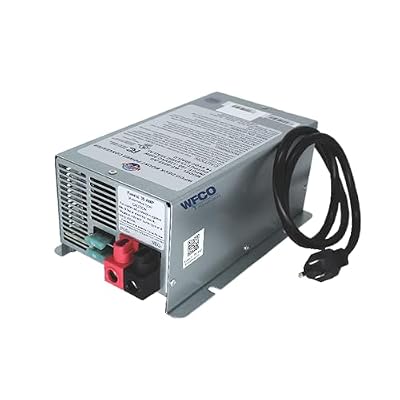
WFCO Genuine WF-9855-AD-CB RV Converter/Charger Deckmount 55Amp DC Output with Patented Auto Detect™ Technology Lead Acid Lithium Multi-Stage Charging
Included for 'Best RV Battery Chargers for Lead-Acid and Lithium Batteries' as a relevant option in this category; details come from the product listing.
View on Amazon
WFCO Arterra WF-9865-AD-CB Converter/Charger - Deckmount - 65 Amp DC Output (20 Amp AC Power Cord) , Gray
Included for 'Best RV Battery Chargers for Lead-Acid and Lithium Batteries' because the listing specifies Deckmount and 65 Amp DC Output (20 Amp AC Power Cord), details this guide uses to compare options.
View on AmazonWhat separates a good RV charger from a basic one?
See also: How Long Will a 100Ah Battery Last in a Van? Runtime Math Explained • Best Level 2 EV Chargers for Home
Charging stages
A suitable charger should provide bulk, absorption, and float charging. During bulk, it delivers its rated current until the battery reaches the target voltage. Absorption then holds that voltage while current gradually falls. Float reduces the voltage to a maintenance level once the battery is full.
Lead-acid batteries benefit from this sequence because holding them at too low a state of charge encourages sulfation, while excessive voltage can cause gassing and water loss. A flooded battery may also need an occasional equalization cycle, but that should be deliberate and manufacturer-approved rather than permanently enabled.
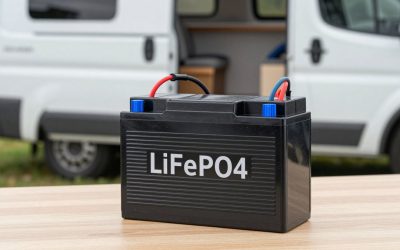
Lithium iron phosphate batteries, commonly called LiFePO4, use a different profile. They generally need a higher charging voltage, do not require a traditional float stage, and should not be equalized. Some lithium chargers finish charging and remain at a lower standby voltage; others periodically reapply a maintenance voltage. Follow the battery maker’s instructions instead of assuming that a lead-acid “smart” setting is safe for lithium.
Battery chemistry support
Do not select a charger solely by its amp rating. Confirm that it has a proper setting for your exact chemistry:
- Flooded lead-acid: Look for adjustable absorption and float voltages, plus an optional equalization function.
- AGM: Use an AGM profile with controlled voltage and no unnecessary equalization.
- Gel: Gel batteries usually need lower charging voltage than flooded batteries. The wrong setting can permanently damage them.
- LiFePO4: Choose a lithium profile, typically around 14.2–14.6V for a 12V nominal battery, subject to the battery manufacturer’s specification. The battery’s built-in management system is a safety layer, not a substitute for a correct charger.
Progressive Dynamics sells lead-acid and lithium-oriented versions across its PD9200 family. WFCO’s Auto-Detect products are intended to identify compatible battery types, while Victron’s Blue Smart range allows profile selection and monitoring through its app. With any automatically detecting converter, verify the selected mode after installation; a misidentified battery can still charge incorrectly.
Head-to-head comparison
| Product or family | Output examples | Battery support | Shore-power role | Temperature compensation | Maintenance behavior |
|---|---|---|---|---|---|
| Progressive Dynamics PD9200 series | 30, 45, 60, 80, and 100A versions are available within the family | Depends on model; lead-acid and lithium versions are offered | Permanent RV converter installation; commonly used with 120V AC shore systems | Check the exact model and accessory configuration; not every version has the same temperature feature | Multi-stage charging; lithium models use a lithium-appropriate profile |
| WFCO Auto-Detect 8955-series converter | 55A class output | Lead-acid and compatible lithium profiles through automatic detection | Designed to replace or integrate with an RV power distribution center | Confirm the specific revision; temperature features vary by product | Automatically transitions between charging modes rather than continuously forcing high voltage |
| Victron Blue Smart IP22 | 15A or 30A, with one- or three-output configurations depending on model | Flooded, AGM, gel, and lithium-ion profiles | Standalone 120V AC charger; not a direct replacement for an RV distribution-panel converter | Temperature compensation is built into the charging system, with limits depending on battery mode | Storage mode lowers the maintenance voltage after prolonged inactivity |
| NOCO Genius10 | 10A maximum | 6V/12V lead-acid types and supported 12V lithium batteries | Portable shore-powered charger, not an RV converter | Automatic adjustment is included, but it is not a substitute for a battery-mounted temperature sensor | Automatic maintenance charging for connected batteries |
How much charging current do you need?
A practical starting point is 10–20% of a lead-acid bank’s amp-hour capacity. For a 200Ah bank, that means roughly 20–40A. Lithium batteries can often accept 20–50% or more, but the battery’s maximum charge-current specification and the wiring must govern the final choice.
Here is a useful sizing calculation. Suppose your 200Ah lead-acid bank is at 50% state of charge and you want to replace approximately 100Ah. A 40A charger cannot deliver 100Ah in exactly 2.5 hours because charging slows during absorption. Allow roughly 3–4 hours under favorable conditions, plus longer if the batteries are cold, aged, or heavily sulfated.
With a 200Ah LiFePO4 bank and a 60A charger, the theoretical bulk time for 100Ah is about 1.7 hours. Real charging time may be close to that because lithium spends less time tapering, but the battery’s BMS, cable size, fuse, and charger profile must all support 60A.
Shore-power compatibility and installation checks
Most permanently installed RV converters are designed for the RV’s 120V AC shore-power system. Verify the input-voltage and frequency rating before connecting a charger. A 30A DC charger does not necessarily draw only 30A from the AC supply; conversion losses and the charger’s efficiency affect the input current.
- Install a correctly sized DC fuse or breaker close to the battery positive terminal.
- Size cable for both current and cable length. A long 40A run may need substantially larger cable than a short run to limit voltage drop.
- Connect the charger negative to the approved battery-bus or shunt location so a battery monitor measures current correctly.
- Keep charger ventilation openings clear and protect connections from moisture, road spray, and battery fumes.
- Check whether the replacement converter physically matches your RV power-center cutout and mounting hardware.
A 55A converter is not automatically an upgrade. If the existing wiring, fuse, distribution panel, or battery bank is designed for 30A, installing a larger converter can create nuisance trips, overheating, or disappointing voltage at the battery.
Temperature compensation and cold-weather lithium charging
Temperature compensation is especially valuable for lead-acid batteries because their ideal charging voltage changes with temperature. A remote sensor mounted at the battery gives a charger better information than a sensor inside a warm electrical cabinet.
LiFePO4 batteries have a different cold-weather concern: many must not be charged below 32°F (0°C), unless they include internal heating or the manufacturer specifies a lower limit. A charger with temperature compensation does not necessarily prevent every cold lithium-charging problem. Use a battery with a suitable low-temperature cutoff or install the battery where it remains within the permitted range.
Ownership realities and common mistakes
The part most likely to cause trouble is often not the charger itself but a loose crimp, corroded ground, undersized cable, or failed cooling fan. Inspect terminals periodically, remove oxidation, and check for heat discoloration after the first long charging session. Keep flooded lead-acid batteries topped up with distilled water as specified by the manufacturer; AGM, gel, and lithium batteries are sealed and should not be opened.
Do not leave a flooded-battery charger on an aggressive equalization setting for weeks. Do not use a lead-acid desulfation or repair mode on lithium. Also avoid relying on a converter’s built-in charge display as proof that the battery is healthy: a battery can reach normal voltage while having greatly reduced capacity.
For occasional storage, a quality float or storage mode is useful, but disconnect parasitic loads such as propane detectors, stereos, and inverter standby circuits when practical. If the RV is stored where shore power is unreliable, periodic voltage checks or a properly sized solar maintainer may be safer than assuming the charger is always operating.
Bottom line
Choose a 40–60A RV converter charger when you need dependable shore-power charging for a medium-sized camper bank. Choose a Progressive Dynamics or WFCO unit when compatibility with an RV power center matters most. Choose a Victron Blue Smart IP22 when you want a configurable, app-monitored standalone charger with strong storage behavior. Choose a 10A portable charger such as the NOCO Genius10 for maintenance and occasional recovery, not for rapidly charging a large off-grid bank.
The winning specification is the combination of correct chemistry, suitable current, safe wiring, and an appropriate long-term maintenance mode—not the highest advertised amperage.