TL;DR: A 200Ah deep cycle battery is the sweet spot for most vanlife builds — enough to run a fridge, fan, lighting, and devices overnight without going below 50% on AGM or 20% on lithium. Go lithium (LiFePO4) if budget allows. AGM works fine for part-time builds. This guide covers everything you need to choose, size, and install correctly.
RV Deep Cycle Battery 200Ah: The Complete Vanlife Buyer’s Guide
Your battery bank is the foundation of every vanlife electrical system. Everything else — solar panels, inverter, charge controller, all your 12V loads — flows through it. Get this decision wrong and you’ll spend months chasing undersized capacity, premature failure, or worse, a dead battery at the wrong moment.
As an Amazon Associate we earn from qualifying purchases.


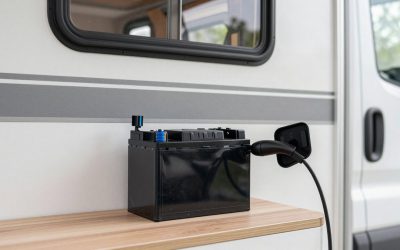
The 200Ah deep cycle battery is the most common starting point for solo or couple builds, and for good reason. At lithium efficiency levels, 200Ah gets you through most nights on a moderate load without anxiety.
🛒 Best Price Today on Amazon
Prime members get fast, free shipping on everything above, plus member-only deals. New members get a 30-day free trial — cancel anytime.
Start 30-Day Prime Free Trial →See Today’s Amazon Deals- Top RV Deep Cycle 200Ah Battery Picks
- AGM vs Lithium: Which 200Ah Deep Cycle Battery Is Right for You?
- Understanding the 200Ah Rating
- Wiring a 200Ah Battery Bank Correctly
- Spec Comparison: 200Ah Battery Types
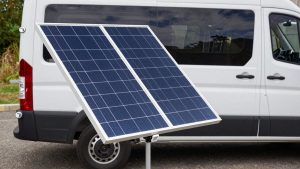
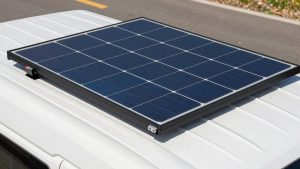
- How Much Solar Do You Need for a 200Ah Bank?
- FAQ: RV Deep Cycle Battery 200Ah
- Bottom Line
- Frequently Asked Questions
- Related Articles
- Related Guides
Top RV Deep Cycle 200Ah Battery Picks


As an Amazon Associate we earn from qualifying purchases. Product prices and availability are accurate as of the date/time indicated.


As an Amazon Associate we earn from qualifying purchases. Product prices and availability are accurate as of the date/time indicated.

Ivation Portable Camping Shower | Compact Handheld & Hands-Free Rechargeable Outdoor Shower Head & Cleaning System w/ 3.7V Pump, 6-Ft Hose, Bidet Head, Removable Filter, Multiuse Hook & USB Cable


As an Amazon Associate we earn from qualifying purchases. Product prices and availability are accurate as of the date/time indicated.
AGM vs Lithium: Which 200Ah Deep Cycle Battery Is Right for You?
See also: How Long Will a 100Ah Battery Last in a Van? Runtime Math Explained • Best Level 2 EV Chargers for Home
This is the most important decision you’ll make in your electrical build. The battery chemistry determines usable capacity, weight, lifespan, charge behavior, and cost — everything downstream adjusts around this choice.
AGM (Absorbed Glass Mat)
AGM is the traditional choice for RV and van builds. It’s been the standard for decades, widely available, and genuinely reliable when used correctly. The critical caveat: you can only use 50% of rated capacity without degrading the battery prematurely. A 200Ah AGM gives you 100Ah usable.
AGM also requires a full recharge regularly — chronic partial state of charge (PSOC) causes sulfation and dramatically shortens lifespan. If you’re parked in the shade for days without solar input, you need shore power to bring it back up.
Expected cycle life at 50% DoD: 400–600 cycles. At 30% DoD: 800–1200 cycles.
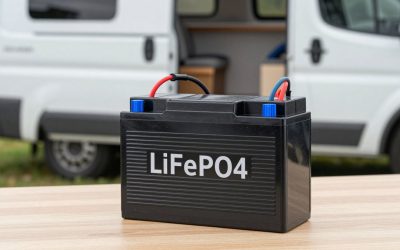
LiFePO4 (Lithium Iron Phosphate)
LiFePO4 delivers 80–100% of rated capacity usably, doesn’t sulfate, handles PSOC without damage, and lasts 2000–4000+ cycles. A 200Ah lithium gives you 160–200Ah usable — nearly double the effective capacity of an equivalent AGM.
The downsides: significantly higher upfront cost (3–5x AGM), requires a lithium-compatible charger and charge controller (different voltage profiles), and won’t charge below freezing without internal heating protection. Most quality LiFePO4 batteries include a low-temperature cutoff BMS, but verify before buying.
If you’re building a full-time vanlife rig, lithium pays for itself within 2–3 years compared to replacing AGM banks. For occasional weekend use, AGM is more cost-effective.
Understanding the 200Ah Rating
Battery capacity is rated at C20 — meaning discharge over 20 hours. A 200Ah battery delivers 10A continuously for 20 hours. If you draw faster (C10, C5, or higher), the effective capacity drops due to Peukert’s effect. AGM is more sensitive to this than lithium.
What this means practically: if you’re pulling 50A from an AGM 200Ah battery (like running a 600W inverter at load), your effective capacity might be 150Ah or less. Size for peak draw rates, not just average loads.
Lithium batteries are far less sensitive to discharge rate — a 200Ah LiFePO4 delivers close to its rated capacity even at high discharge rates.
Wiring a 200Ah Battery Bank Correctly
Single 200Ah battery: relatively simple. Run your positive through a fuse (as close to the battery as possible), then to a bus bar or fuse block. Negative to a bus bar. Never skip the fuse on the positive terminal.
Two 200Ah batteries in parallel: connect positive-to-positive, negative-to-negative. Use identical cable lengths to ensure balanced charging. Total capacity doubles to 400Ah, voltage stays at 12V.
Two 200Ah batteries in series: connects to give 24V at 200Ah. Used for 24V systems with higher efficiency inverters. Requires a 24V-compatible charge controller and inverter.
Never mix AGM and lithium batteries in the same bank. Never mix batteries of different ages or capacities. Use a proper battery monitoring system to track state of charge accurately.
Spec Comparison: 200Ah Battery Types
| Spec | AGM 200Ah | LiFePO4 200Ah | Gel 200Ah |
|---|---|---|---|
| Usable Capacity | ~100Ah (50% DoD) | ~160–200Ah (80–100% DoD) | ~100Ah (50% DoD) |
| Cycle Life (to 80%) | 400–600 @ 50% DoD | 2000–4000+ | 500–800 @ 50% DoD |
| Weight (typical) | 55–65 lbs | 50–60 lbs | 55–65 lbs |
| Self-Discharge/Month | 3–5% | 1–3% | 2–4% |
| Charge Voltage | 14.4–14.8V bulk | 14.2–14.6V bulk | 14.0–14.4V bulk |
| Relative Cost | Baseline | 3–5x AGM | 1.2–1.5x AGM |
| Cold Temp Performance | Degrades below 32°F | Requires heated BMS | Poor below freezing |
How Much Solar Do You Need for a 200Ah Bank?
Rule of thumb: match solar input to expected daily consumption. For a 200Ah lithium bank used to 80% DoD (160Ah), you’d need to replenish up to 160Ah per day in worst case. At 12V, that’s 1920Wh.
With 400W of panels in decent sun (4 peak sun hours), you generate roughly 1600Wh daily after efficiency losses — close enough for most setups. For a 200Ah AGM bank with 100Ah usable, 200W of solar is often sufficient for moderate loads.
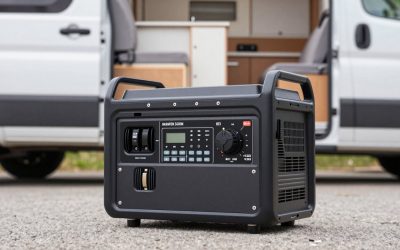
Winter vanlife in northern latitudes gets fewer peak sun hours (2–3 instead of 4–5). Size for your worst-case location, not your summer sweet spot. Pair with a quality portable backup power station or shore power hookup for extended overcast periods.
FAQ: RV Deep Cycle Battery 200Ah
How long will a 200Ah deep cycle battery last with a 12V fridge?
A 12V compressor fridge draws 40–60W average (not continuous — the compressor cycles). At 50W average, that’s 4.17A at 12V. A 200Ah lithium at 80% DoD gives you 160Ah, meaning roughly 38 hours of runtime before hitting the DoD limit. Realistically, with other loads (fan, lighting, phone charging) expect 18–24 hours on a 200Ah lithium, 12–16 hours on AGM at 50% DoD.
Can I use a car alternator to charge a 200Ah LiFePO4 battery?
Yes, but use a DC-DC charger (also called a battery-to-battery charger) between the alternator and your lithium bank. Direct alternator charging can damage lithium batteries and may overload your alternator. A DC-DC charger limits current, handles voltage conversion properly, and protects both the alternator and battery. This is non-optional for lithium — don’t skip it.
What BMS specs should I look for in a 200Ah lithium battery?
Minimum specs for vanlife use: 200A continuous discharge, 200A charge current, over-voltage protection, under-voltage cutoff, short circuit protection, and low-temperature cutoff. Built-in Bluetooth monitoring is a strong bonus — knowing your exact state of charge and cell balance without a separate monitor saves installation complexity.
Is a 200Ah battery enough for full-time vanlife?
It depends on your load. For one or two people without air conditioning or induction cooking, 200Ah LiFePO4 is sufficient for most days with adequate solar. If you work remotely with multiple devices, run a CPAP, and want 24/7 fridge operation, 300–400Ah is more comfortable. Start with 200Ah and expand in parallel later if needed — lithium banks are easy to expand by adding identical batteries.
Can I store a deep cycle battery in my van during cold winters?
AGM tolerates storage at low temperatures but shouldn’t be charged below 32°F. LiFePO4 should not be charged below 32°F without a built-in heating system — many quality batteries include low-temperature charge protection that suspends charging until the cells warm up. In extreme cold (below -4°F), capacity decreases for all battery types regardless. Insulating your battery compartment helps significantly.
Bottom Line
The 200Ah deep cycle battery is the right foundation for most van builds. Choose lithium for full-time or frequent use — the usable capacity advantage and cycle life make it worth the premium. AGM works well for weekend and part-time setups where cost is the priority. Size your solar input to match, wire it correctly with proper fusing, and monitor your state of charge. A good battery bank, properly managed, will outlast the van itself.
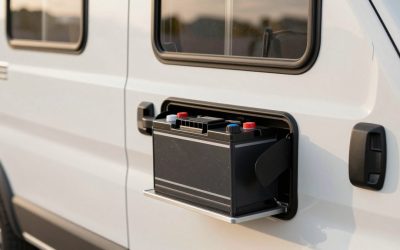
See our full guide on vented battery enclosures to safely house your bank in the build.
Frequently Asked Questions
How long will a 200Ah deep cycle battery run my van?
A 200Ah lithium bank gives roughly 2,560 usable watt-hours at 12V, since LiFePO4 allows near-full depth of discharge. A typical van drawing 100-150Ah per day for a fridge, fan, lights and laptop charging will run about 1.5 days without solar, or indefinitely with 300-400W of panels in decent sun.
Is lithium worth the extra cost over AGM at 200Ah?
Yes for most full-timers. A 200Ah AGM only gives about 100Ah usable before damaging the cells, so you need 400Ah of AGM to match one 200Ah LiFePO4. Lithium also weighs roughly half, charges three times faster, and lasts 3,000-5,000 cycles versus 400-600 for AGM.
What size charge wire and fuse does a 200Ah battery need?
Match the wire to the load, not the battery. A 2,000W inverter pulls around 200 amps, requiring 2/0 AWG cable within a few feet and a 250-300A Class T fuse at the positive terminal. Alternator charging through a 40-60A DC-DC charger needs 6 AWG with a matching 60A fuse.
Can I charge a 200Ah lithium battery in freezing weather?
Not below 32F without protection. Charging cold LiFePO4 causes permanent lithium plating. Buy a battery with built-in low-temperature cutoff and an internal self-heating pad, or keep the bank inside the insulated cabin where residual heat and your diesel heater hold it above freezing. Discharging down to about minus 4F is fine.
Do I have to mount a 200Ah battery in a vented box?
Sealed LiFePO4 and AGM emit no hydrogen in normal use, so a sealed cabin location is legal and common. Flooded lead-acid must go in a vented box exhausting outside. Regardless of chemistry, bolt the battery down with a strap or bracket, since a 50-pound unit becomes a projectile in a crash.