Last updated: October 4, 2026
The best van solar panel kits for most builds are 300 to 400 W rigid monocrystalline kits paired with a true MPPT charge controller, such as Renogy’s 400 W premium kits with a Rover MPPT controller or a mix-and-match setup using quality panels and a Victron SmartSolar MPPT 100/30 or 100/50. Flexible panels make sense only where weight, roof shape or stealth is the deciding factor. What matters most is not the wattage on the box but how many watt-hours a kit actually puts into your battery on an average day where you travel.
What a Solar Kit for Camper Van Use Actually Delivers
A simple rule of thumb for daily energy: panel watts x peak sun hours x 0.75. The 0.75 factor accounts for heat, panel angle (flat on a roof), wiring and controller losses, and partial shading.

Renogy 400W RV Solar Power Kit, 7.68kWh LiFePO4 Battery System Solar Solution with 2 x 200W N-Type Anti-Shading Solar Panels, 3000W Pure Sine Wave Inverter, 50A DC-DC MPPT Charger for RV Camping
Included for 'Best Van Solar Panel Kits: What 200W, 400W and 600W Really Deliver Each Day' because the listing specifies 3000W Pure Sine Wave Inverter and 50A DC-DC MPPT Charger for RV Camping, details this guide uses to compare options.
View on Amazon| Kit size | Summer, 6 sun hours | Spring/fall, 4 sun hours | Winter, 2 sun hours | Equivalent Ah at 12.8 V (spring/fall) |
|---|---|---|---|---|
| 200 W | about 900 Wh | about 600 Wh | about 300 Wh | about 47 Ah |
| 300 W | about 1,350 Wh | about 900 Wh | about 450 Wh | about 70 Ah |
| 400W solar kit | about 1,800 Wh | about 1,200 Wh | about 600 Wh | about 94 Ah |
| 600 W | about 2,700 Wh | about 1,800 Wh | about 900 Wh | about 140 Ah |
Panels mounted flat on a van roof produce noticeably less in winter at higher latitudes because the sun sits low. That is why many full-time van owners who winter in cold regions either add a DC-DC charger from the alternator or carry a portable panel they can angle toward the sun.
Match the Kit to Your Daily Use
See also: How Long Will a 100Ah Battery Last in a Van? Runtime Math Explained • Best Level 2 EV Chargers for Home
Worked example: remote worker with a 12 V fridge
- 12 V compressor fridge: about 450 Wh per day
- Laptop, 6 hours at 60 W: 360 Wh
- Roof fan, lights, phone, water pump: about 200 Wh
- Total: about 1,010 Wh per day
A 400 W kit covers this on an average spring or fall day (about 1,200 Wh) and fully covers it in summer. In winter, you would rely on driving with a DC-DC charger or occasional shore power. Pair it with at least 200 Ah of lithium for two days of cloudy-weather buffer.
Panel and Controller Options Compared
| Component | Weight | Typical lifespan / warranty | Best for | Typical price range |
|---|---|---|---|---|
| 100 W rigid mono panel (about 41 x 21 in) | about 13 – 16 lb | 25-year output warranty common | Most roof racks | $80 – $150 each |
| 200 W rigid mono panel (about 58 x 27 in) | about 23 – 27 lb | 25-year output warranty common | Fewer mounts, cleaner layout | $150 – $280 each |
| 100 W flexible panels for van roofs | about 4 – 5 lb | typically 1 – 5 years warranty | Curved roofs, low profile, light builds | $100 – $200 each |
| Victron SmartSolar MPPT 100/30 | about 3 lb | 5-year warranty | Up to about 440 W at 12 V | $150 – $220 |
| Victron SmartSolar MPPT 100/50 | about 3 lb | 5-year warranty | Up to about 700 W at 12 V | $250 – $350 |
| Renogy Rover 40 A MPPT | about 4 lb | multi-year warranty | Up to about 520 W at 12 V | $150 – $250 |
Controller capacity in watts at 12 V is roughly controller amps x 14 V. A 30 A controller handles about 420 to 440 W, so a 400 W solar kit should not be paired with anything smaller than a 30 A MPPT.
Picks by Van Type
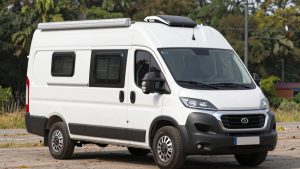
High-roof Sprinter, Transit or ProMaster: 400 to 600 W rigid
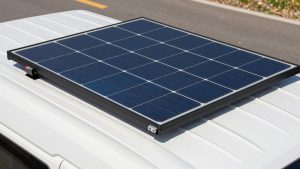
These roofs have room for four 100 W panels or two to three 200 W panels with a fan opening. Rigid panels on a roof rack or low-profile brackets leave an air gap underneath, which keeps them cooler and more efficient. A Renogy 400 W premium kit or an equivalent mix of quality rigid panels with a Victron MPPT 100/50 is a common, proven choice.
Low-roof or stealth vans: flexible panels
Flexible panels for vans weigh about a third as much as rigid panels and sit nearly flush. The tradeoff is heat: glued directly to a hot steel roof, they run hotter and tend to degrade faster. If you go flexible, mount them on a thin backing or with spacers that allow some airflow, and expect a shorter service life than glass panels.
Minimalist weekend vans: 200 W plus a portable panel
For lights, phones and a fan, a 200 W kit is enough. A 100 to 200 W portable folding panel you can aim at the sun adds winter capacity without drilling more holes.
Wiring: Series or Parallel?
Series wiring raises voltage and lowers current, allowing thinner cable and letting an MPPT controller start charging earlier in the morning. Parallel wiring tolerates shade better, because one shaded panel does not drag down the whole string. Many van builds use 2S2P (two strings of two panels) as a balance. Check the controller’s maximum PV voltage, especially in cold weather when panel voltage rises.
Safety and Installation Notes
- Fuse or breaker on both sides of the controller. Place overcurrent protection between the controller and battery close to the battery, and add a PV breaker or fuses on the panel side as the manual requires.
- Seal every roof penetration. Use a cable entry gland and a compatible sealant. A leaky gland is one of the most common causes of hidden water damage.
- Secure mounts properly. Panels must survive highway speeds and crosswinds. Use rated brackets or a roof rack rather than adhesive alone for rigid panels.
- Use a battery monitor. A shunt-based monitor tells you whether your solar keeps up, which is far more useful than guessing from panel wattage.
Ownership Realities
- Dust and pollen can reduce output noticeably; rinse panels with plain water every few weeks.
- Connectors loosen over time from vibration; check MC4 connections each season.
- Flexible panels can delaminate or develop hot spots after a few years on a hot roof.
- Controllers often outlive panels, so buying a slightly larger MPPT now leaves room to expand later.
Quick Decision Guide
| Daily use | Recommended solar | Controller |
|---|---|---|
| Under 500 Wh | 200 W | 20 A MPPT |
| 500 – 1,000 Wh | 300 – 400 W | 30 – 40 A MPPT |
| 1,000 – 1,800 Wh | 400 – 600 W | 40 – 50 A MPPT |
| Over 1,800 Wh | 600 W+ plus DC-DC charging | 50 A+ MPPT or two controllers |
Size the kit from your actual daily watt-hours, assume flat-roof losses, and plan a second charging source for winter. Do that and almost any reputable 400 W kit will serve a van well.