Last updated: October 4, 2026
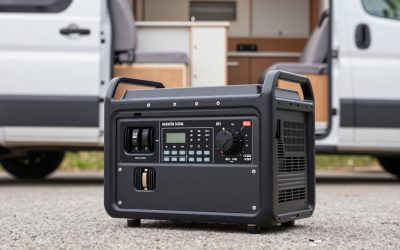
For off-grid van life, the best portable power stations combine at least 1,000 Wh of LiFePO4 capacity with high solar input, so you can recover each day’s usage from the roof. In 2026, the EcoFlow DELTA 3 Plus is the strongest all-rounder because it accepts up to 1,000 W of solar and can be expanded later. The Anker SOLIX C1000 Gen 2 has the most output for its size. The Bluetti Elite 200 V2 suits full-time travelers who need about 2 kWh, the Bluetti AC180 is the value pick, and the Jackery Explorer 1000 v2 is the lightest option. The right choice depends on your daily watt-hours and how much solar you can fit, not just battery size.
Start with your daily energy budget
Off-grid, the real question is whether the unit can recharge what you use each day. Add up your loads in watt-hours (watts multiplied by hours), then add 10–15 percent for inverter losses on AC devices.

Jackery Solar Generator 300 and 40W Solar Panel,292Wh,300W AC
Included for 'Best Portable Power Stations for Off-Grid Van Life: Solar Input and Runtime Math' because the listing specifies 292Wh and 300W AC, details this guide uses to compare options.
View on Amazon
Jackery Solar Generator 1000 v2 and 200W Solar Panel,1070Wh,1500W AC
Included for 'Best Portable Power Stations for Off-Grid Van Life: Solar Input and Runtime Math' because the listing specifies 1070Wh and 1500W AC, details this guide uses to compare options.
View on Amazon
Jackery Explorer 2000 v2 Portable Power Station, 2042Wh, 2200W AC Output
Included for 'Best Portable Power Stations for Off-Grid Van Life: Solar Input and Runtime Math' because the listing specifies 2042Wh and 2200W AC Output, details this guide uses to compare options.
View on Amazon
Jackery Portable Power Station Explorer 300, 293Wh Backup Battery, Solar Generator (Solar Panel Not Included) for RV Outdoors Camping Hunting Blackout(Renewed)
Included for 'Best Portable Power Stations for Off-Grid Van Life: Solar Input and Runtime Math' because the listing specifies 293Wh Backup Battery, details this guide uses to compare options.
View on Amazon| Load | Typical draw | Hours per day | Watt-hours per day |
|---|---|---|---|
| 12V compressor fridge (about 40–50 L) | ~45 W while running | ~8 (cycling) | ~360 |
| Laptop for remote work | ~60 W | 5 | ~300 |
| Roof vent fan on medium | ~25 W | 8 | ~200 |
| LED lights | ~10 W | 4 | ~40 |
| Phones, headlamps, camera | ~15 W | 3 | ~45 |
| Total | ~945 Wh |
A typical full-time remote worker uses roughly 900–1,000 Wh a day. With a 1,000 Wh unit and no input, that’s about one day of autonomy. That’s why solar input and alternator charging matter as much as capacity.
How much solar recovers that?
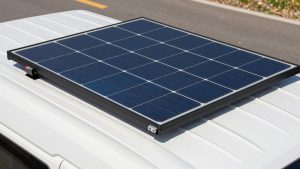
A practical estimate is panel watts × peak sun hours × 0.75, which accounts for heat, angle, and controller losses. A 200 W roof panel in a summer location with 5 peak sun hours gives about 750 Wh. A 400 W array gives about 1,500 Wh. In winter or under trees, plan on half that. So a 945 Wh daily budget calls for around 400 W of solar to stay balanced through mixed weather.
The five units compared
See also: How Long Will a 100Ah Battery Last in a Van? Runtime Math Explained • Best Level 2 EV Chargers for Home
Specs are manufacturer figures as of 2026. Prices are broad market ranges and change frequently with sales.
| Model | Capacity | AC output | Max solar input | Weight | Expandable | Price range |
|---|---|---|---|---|---|---|
| EcoFlow DELTA 3 Plus | 1,024 Wh | 1,800 W | 1,000 W | ~27.6 lb | Yes, to ~5 kWh | $600–$900 |
| Anker SOLIX C1000 Gen 2 | 1,024 Wh | 2,000 W | 600 W | ~24.9 lb | No | $500–$800 |
| Jackery Explorer 1000 v2 | 1,070 Wh | 1,500 W | 400 W | ~23.8 lb | No | $450–$800 |
| Bluetti AC180 | 1,152 Wh | 1,800 W | 500 W | ~35.3 lb | No | $450–$700 |
| Bluetti Elite 200 V2 | 2,073.6 Wh | 2,600 W | 1,000 W | ~53.4 lb | No | $1,000–$1,500 |
All five use LiFePO4 chemistry, which is rated for thousands of cycles. That matters because a full-timer may cycle the battery more than 300 times a year.
Which one fits your van
EcoFlow DELTA 3 Plus: best for solar-heavy builds
With up to 1,000 W of solar input, the DELTA 3 Plus can refill most of its capacity in a single good solar day, as long as your roof can hold that much panel. You can add an expansion battery later instead of replacing the unit, and EcoFlow’s 800 W Alternator Charger is an option if you drive most days. That combination makes it the most flexible starting point for a growing build.
Anker SOLIX C1000 Gen 2: best for high-draw appliances
At 2,000 W continuous output, the C1000 Gen 2 can run an induction cooktop, a kettle, or a small hair dryer, which is unusual for a unit of this size. It recharges from a wall outlet in under an hour, which helps if you plug in at campgrounds or cafes. Its 600 W solar limit is fine for most van roofs, but there’s no expansion path.
Jackery Explorer 1000 v2: best for small vans and weekend rigs
It’s the lightest unit here and easy to carry from the van to a picnic table. At 400 W, its solar input is the lowest, so it suits weekend trips, part-time travel, or vans with only one or two panels. It’s a good fit if your loads are mainly a fridge, lights, and phones.
Bluetti AC180: best value per watt-hour
The AC180 offers slightly more capacity than the 1 kWh competitors, 1,800 W output, and fast AC charging, usually at a lower price. It’s the heaviest of the 1 kWh class, so plan a secure mounting spot instead of moving it around.
Bluetti Elite 200 V2: best for full-time remote workers
About 2 kWh of storage covers two days of the energy budget above without any sun. The 1,000 W solar input can refill it on long summer days. At over 50 pounds, it should be strapped into a fixed spot, and you’ll want to run DC loads directly from its ports.
Decision matrix
| Your setup | Daily use | Roof solar | Best match |
|---|---|---|---|
| Weekend warrior, fridge and lights | Under 500 Wh | 100–200 W | Jackery Explorer 1000 v2 |
| Budget build, part-time travel | 500–900 Wh | 200–400 W | Bluetti AC180 |
| Full-time, growing system | 800–1,200 Wh | 400–800 W | EcoFlow DELTA 3 Plus |
| Induction cooking, frequent campground charging | 800–1,200 Wh | 200–600 W | Anker SOLIX C1000 Gen 2 |
| Full-time remote work, cloudy regions | 1,200–2,000 Wh | 600–1,000 W | Bluetti Elite 200 V2 |
Installation realities in a van
- Ventilation: these units have cooling fans. Don’t bury them in a sealed cabinet. Leave several inches of clearance at the vents.
- Secure mounting: a 25–50 lb box becomes a projectile in a hard stop. Use a bolted tray or ratchet straps to anchor points.
- Solar connectors and voltage: check each unit’s maximum solar voltage before wiring panels in series. Exceeding the input voltage can damage the controller.
- Run DC loads on DC: powering a 12V fridge from the 12V port instead of through the inverter saves 10–15 percent of its energy use.
- Cold weather: LiFePO4 cells shouldn’t be charged below freezing unless the unit has battery heating. Keep the unit inside the insulated cabin in winter.
FAQ
Can a portable power station replace a built-in house battery?
For many solo travelers and couples using under about 1.5 kWh a day, yes. A built-in lithium bank with a DC-DC charger becomes more cost-effective once you need 3 kWh or more, or heavy alternator charging every day.
Will it run a roof air conditioner?
Not for long. A 12V or 120V van air conditioner can draw 500–1,000 W, which would drain a 1 kWh unit in about one to two hours.