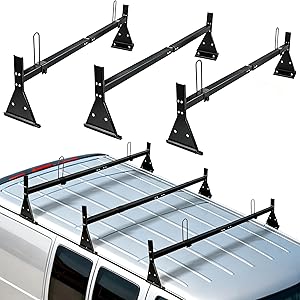
Sprinter’s rain gutter profile is one of the strongest in the segment, making it excellent for heavy expedition racks. The NCV3 (2007–2018) and VS30 (2019+) have identical gutter dimensions, so most racks fit both generations. High-roof Sprinter builds are the most common van conversion platform, and the aftermarket is extensive. Note: some Sprinter insulation kits (including Thinsulate installs) affect how rack feet contact the gutter — check our vanlife insulation guide for details on gutter seal management.
Ram Promaster Roof Rack
Promaster has no factory roof rails, making it more dependent on gutter-mount or drilled solutions. The roof is also more curved than Sprinter or Transit, which affects how flat platforms sit. Promaster-specific racks include curvature compensation in the mounting feet. Avoid universal racks on Promasters — the fit is poor and lateral stability suffers. High-roof Promaster builds are excellent for solar because the roof area is large, but fewer premium rack options exist compared to Sprinter/Transit.
Quick answer: For most people in 2026, the best roof rack for camper van is the Height Added — our #1 rated choice. See the full ranked comparison, alternatives and buying advice below.
- Solar Panel Integration: The Real Reason Most Vanlifers Buy Racks
- Roof Rack Comparison: Full Spec Table
- Installation: Key Steps and Failure Points
- Frequently Asked Questions
- Bottom Line
- Steel vs. Aluminum: Which Material Wins?
- Van-Specific Compatibility Guide
- Solar Panel Integration: The Real Reason Most Vanlifers Buy Racks
- Roof Rack Comparison: Full Spec Table
- Installation: Key Steps and Failure Points
- Frequently Asked Questions
- Bottom Line
- Steel vs. Aluminum: Which Material Wins?
- Van-Specific Compatibility Guide
- Solar Panel Integration: The Real Reason Most Vanlifers Buy Racks
- Roof Rack Comparison: Full Spec Table
- Installation: Key Steps and Failure Points
- Frequently Asked Questions
- Bottom Line
- Solar Panel Integration: The Real Reason Most Vanlifers Buy Racks
- Roof Rack Comparison: Full Spec Table
- Installation: Key Steps and Failure Points
- Frequently Asked Questions
- Bottom Line
- Steel vs. Aluminum: Which Material Wins?
- Van-Specific Compatibility Guide
- Solar Panel Integration: The Real Reason Most Vanlifers Buy Racks
- Roof Rack Comparison: Full Spec Table
- Installation: Key Steps and Failure Points
- Frequently Asked Questions
- Bottom Line
- Steel vs. Aluminum: Which Material Wins?
- Van-Specific Compatibility Guide
- Solar Panel Integration: The Real Reason Most Vanlifers Buy Racks
- Roof Rack Comparison: Full Spec Table
- Installation: Key Steps and Failure Points
- Frequently Asked Questions
- Bottom Line
- Solar Panel Integration: The Real Reason Most Vanlifers Buy Racks
- Roof Rack Comparison: Full Spec Table
- Installation: Key Steps and Failure Points
- Frequently Asked Questions
- Bottom Line
- Steel vs. Aluminum: Which Material Wins?
- Van-Specific Compatibility Guide
- Solar Panel Integration: The Real Reason Most Vanlifers Buy Racks
- Roof Rack Comparison: Full Spec Table
- Installation: Key Steps and Failure Points
- Frequently Asked Questions
- Bottom Line
- Solar Panel Integration: The Real Reason Most Vanlifers Buy Racks
- Roof Rack Comparison: Full Spec Table
- Installation: Key Steps and Failure Points
- Frequently Asked Questions
- Bottom Line
- Steel vs. Aluminum: Which Material Wins?
- Van-Specific Compatibility Guide
- Solar Panel Integration: The Real Reason Most Vanlifers Buy Racks
- Roof Rack Comparison: Full Spec Table
- Installation: Key Steps and Failure Points
- Frequently Asked Questions
- Bottom Line
- Steel vs. Aluminum: Which Material Wins?
- Van-Specific Compatibility Guide
- Solar Panel Integration: The Real Reason Most Vanlifers Buy Racks
- Roof Rack Comparison: Full Spec Table
- Installation: Key Steps and Failure Points
- Frequently Asked Questions
- Bottom Line
- Solar Panel Integration: The Real Reason Most Vanlifers Buy Racks
- Roof Rack Comparison: Full Spec Table
- Installation: Key Steps and Failure Points
- Frequently Asked Questions
- Bottom Line
- Steel vs. Aluminum: Which Material Wins?
- Van-Specific Compatibility Guide
- Solar Panel Integration: The Real Reason Most Vanlifers Buy Racks
- Roof Rack Comparison: Full Spec Table
- Installation: Key Steps and Failure Points
- Frequently Asked Questions
- Bottom Line
- Top Picks at a Glance
- Van Roof Rack Categories
- Solar Panel Integration: The Real Reason Most Vanlifers Buy Racks
- Roof Rack Comparison: Full Spec Table
- Installation: Key Steps and Failure Points
- Frequently Asked Questions
- Bottom Line
- Solar Panel Integration: The Real Reason Most Vanlifers Buy Racks
- Roof Rack Comparison: Full Spec Table
- Installation: Key Steps and Failure Points
- Frequently Asked Questions
- Bottom Line
- Steel vs. Aluminum: Which Material Wins?
- Van-Specific Compatibility Guide
- Solar Panel Integration: The Real Reason Most Vanlifers Buy Racks
- Roof Rack Comparison: Full Spec Table
- Installation: Key Steps and Failure Points
- Frequently Asked Questions
- Bottom Line
- Solar Panel Integration: The Real Reason Most Vanlifers Buy Racks
- Roof Rack Comparison: Full Spec Table
- Installation: Key Steps and Failure Points
- Frequently Asked Questions
- Bottom Line
- Steel vs. Aluminum: Which Material Wins?
- Van-Specific Compatibility Guide
- Solar Panel Integration: The Real Reason Most Vanlifers Buy Racks
- Roof Rack Comparison: Full Spec Table
- Installation: Key Steps and Failure Points
- Frequently Asked Questions
- Bottom Line
- Steel vs. Aluminum: Which Material Wins?
- Van-Specific Compatibility Guide
- Solar Panel Integration: The Real Reason Most Vanlifers Buy Racks
- Roof Rack Comparison: Full Spec Table
- Installation: Key Steps and Failure Points
- Frequently Asked Questions
- Bottom Line
- Solar Panel Integration: The Real Reason Most Vanlifers Buy Racks
- Roof Rack Comparison: Full Spec Table
- Installation: Key Steps and Failure Points
- Frequently Asked Questions
- Bottom Line
- Steel vs. Aluminum: Which Material Wins?
- Van-Specific Compatibility Guide
- Solar Panel Integration: The Real Reason Most Vanlifers Buy Racks
- Roof Rack Comparison: Full Spec Table
- Installation: Key Steps and Failure Points
- Frequently Asked Questions
- Bottom Line
- Solar Panel Integration: The Real Reason Most Vanlifers Buy Racks
- Roof Rack Comparison: Full Spec Table
- Installation: Key Steps and Failure Points
- Frequently Asked Questions
- Bottom Line
- Steel vs. Aluminum: Which Material Wins?
- Van-Specific Compatibility Guide
- Solar Panel Integration: The Real Reason Most Vanlifers Buy Racks
- Roof Rack Comparison: Full Spec Table
- Installation: Key Steps and Failure Points
- Frequently Asked Questions
- Bottom Line
- Steel vs. Aluminum: Which Material Wins?
- Van-Specific Compatibility Guide
- Solar Panel Integration: The Real Reason Most Vanlifers Buy Racks
- Roof Rack Comparison: Full Spec Table
- Installation: Key Steps and Failure Points
- Frequently Asked Questions
- Bottom Line
- Solar Panel Integration: The Real Reason Most Vanlifers Buy Racks
- Roof Rack Comparison: Full Spec Table
- Installation: Key Steps and Failure Points
- Frequently Asked Questions
- Bottom Line
- Steel vs. Aluminum: Which Material Wins?
- Van-Specific Compatibility Guide
- Solar Panel Integration: The Real Reason Most Vanlifers Buy Racks
- Roof Rack Comparison: Full Spec Table
- Installation: Key Steps and Failure Points
- Frequently Asked Questions
- Bottom Line
Solar Panel Integration: The Real Reason Most Vanlifers Buy Racks
If solar is the primary rack driver, the rack spec changes significantly. You need:
- Panel mounting channels — T-slot aluminum extrusion built into the rack deck lets you bolt panels at any position without drilling. Non-channel racks require separate brackets.
- Cable routing — look for racks with pre-drilled or grommetted cable pass-through holes so you can route wiring cleanly to the interior without exposed runs.
- Tilt compatibility — some racks include or accept tilt kits that angle panels toward the sun in low-angle winter light. Worth the $50–$80 add-on cost in northern climates.
- Adequate deck coverage — 4x 200W rigid panels need approximately 100″×56″ of deck space. Verify your chosen rack’s deck dimensions before ordering panels.
Pair your rack with a proper MPPT solar charge controller — undersized controllers waste 10–20% of panel output, negating some of your rack investment. And for the battery side, see our our pick for 12v lifepo4 battery 100ah for sizing recommendations based on panel wattage.
Roof Rack Comparison: Full Spec Table
See also: Van Bluetooth Speaker Waterproof Outdoor • Van Magnetic Window Insulation Kit Review
| Spec | Slimline Platform | Standard Platform | Crossbar System | Expedition Rack |
|---|---|---|---|---|
| Height Added | 1.5–2.5″ | 3–5″ | 2–3″ | 4–6″ |
| Weight (aluminum) | 25–40 lbs | 45–70 lbs | 15–25 lbs | 80–150 lbs |
| Dynamic Load Rating | 100–165 lbs | 150–250 lbs | 100–165 lbs | 250–400 lbs |
| Solar Panel Fitment | Good | Excellent | Requires adapter | Excellent |
| Rooftop Tent Ready | No | Some models | No | Yes |
| Aerodynamic Drag | Low | Moderate | Low (unloaded) | High |
| Price Range (aluminum) | $350–$700 | $500–$1,200 | $200–$500 | $600–$1,500+ |
Installation: Key Steps and Failure Points
Roof rack installation failure modes are almost always at the mounting feet. Vibration loosens bolts; water intrusion corrodes contact points; incorrect torque strips gutter lips. Prevent all three:
- Use thread-locking compound on all rack mounting bolts
- Apply butyl tape under mounting feet before tightening — seals against water and dampens vibration
- Re-torque all bolts after the first 500 miles; expansion/contraction settles the joint
- Inspect every 6 months for rust streaks from foot contact points (early warning of corrosion under powder coat)
Frequently Asked Questions
How much weight can a van roof hold?
The van roof structure itself typically supports 150–300 lbs static load depending on model. The rack’s own dynamic (driving) load rating is the number that matters most — this accounts for road shock and vibration. Most standard aluminum platform racks are rated 165–200 lbs dynamic. Expedition steel racks can go to 300+ lbs dynamic. Never exceed the rack’s dynamic rating, even if the roof structure could theoretically support more.
Will a roof rack affect my van’s gas mileage?
Yes, measurably. An empty platform rack adds 1–2 mpg drag at highway speeds. A loaded rack (solar panels, cargo) can add 2–4 mpg reduction. Slimline racks minimize this. A full expedition rack with rooftop tent and gear in the 200+ lb range realistically costs 3–5 mpg at 65+ mph. For full-time vanlife, the functional tradeoff is usually worth it — but budget for the fuel cost increase.
Can I install a roof rack on a high-roof van?
Yes, but height clearance becomes critical. A high-roof Transit is already approximately 9’2″ tall. Add a 3″ rack and standard cargo, and you’re at or over 9’6″ — the limit for most parking garages. Measure your specific build height before buying and keep a note of your total height for garage clearance decisions. Many high-roof vanlifers use 1.5″ slimline racks specifically for this reason.
Do I need to drill into my van roof to install a rack?
Not necessarily. Gutter-mount racks clamp to the rain gutters without drilling — valid on most pre-2019 vans with pronounced gutters. Rail-mount systems bolt to factory roof rails. Drilling is required for vans without gutters or rails, or for maximum payload capacity where gutter clamping isn’t sufficient. If you drill, use stainless hardware, seal every hole with butyl tape and a stainless backing plate inside the roof cavity, and inspect seals annually.
What rack should I buy for a full solar setup on a Sprinter?
A full-length aluminum platform rack with T-slot channels is the ideal Sprinter solar setup. Aim for a platform covering at least 100″ of the roof length to fit 4x 200W panels in landscape orientation. Ensure cable routing holes are included or drillable. Budget $600–$1,000 for a quality aluminum platform for a Sprinter. Pair with our MPPT controller guide and Best 12V Lifepo4 Battery 100Ah for a complete system design.
Bottom Line
For most full-time van conversions prioritizing solar, a mid-range aluminum platform rack with T-slot channels hits the best balance of weight, corrosion resistance, and solar integration. If budget is tight, a quality powder-coated steel rack does the job — just plan for repainting at the 3–5 year mark. Skip expedition racks unless you genuinely need the rooftop tent or extreme payload capacity; the weight and mpg penalty isn’t worth it for primarily road-based builds. Whatever rack you choose, complete your electrical system — see our our rv accessories must have write-up for a checklist of what rounds out a capable van build.
Heavy-duty steel or thick-wall aluminum platforms built for serious overland use. These carry 300–500 lbs static, support rooftop tents (40–120 lbs alone), and mount hi-lift jacks, water tanks, and fuel cans. Weight penalty is significant — a full expedition rack on a Sprinter adds 80–150 lbs before you load anything. This mass directly affects fuel economy (expect 1–3 mpg reduction at highway speeds). For van conversions that double as overland rigs, the capability justifies it. For primarily road-based vanlife, it’s often overkill.
Steel vs. Aluminum: Which Material Wins?
| Factor | Steel Rack | Aluminum Rack |
|---|---|---|
| Weight (typical platform) | 80–130 lbs | 35–65 lbs |
| Static Load Rating | 300–500 lbs | 150–300 lbs |
| Corrosion Resistance | Powder coat (degrades) | Excellent (no treatment needed) |
| Weldability / Repair | Easy, cheap | Requires aluminum welder |
| Cost | $200–$600 | $350–$1,200+ |
| Noise at Speed | Moderate | Low (less mass vibration) |
| Best For | Budget, heavy loads | Long-term use, coastal/wet climates |
For coastal or humid climates, aluminum is the long-term winner — steel racks in salt air develop rust under the powder coat within 2–3 years even with maintenance. For dry climates and heavy payload needs (rooftop tent + solar + bikes), a quality powder-coated steel rack offers the best load-to-cost ratio.
Van-Specific Compatibility Guide
Ford Transit Roof Rack
Transit comes in three roof heights (low, medium, high) with factory-raised roof rails on most trims. The raised rails add approximately 1″ clearance but provide excellent lateral rack stability. Most rack manufacturers offer Transit-specific mounting feet that bolt to the raised rails without drilling. High-roof Transit builds gain the most from low-profile slimline racks — they’re already at or near 9′ tall and any additional height creates parking garage challenges.
Mercedes Sprinter Roof Rack
Sprinter’s rain gutter profile is one of the strongest in the segment, making it excellent for heavy expedition racks. The NCV3 (2007–2018) and VS30 (2019+) have identical gutter dimensions, so most racks fit both generations. High-roof Sprinter builds are the most common van conversion platform, and the aftermarket is extensive. Note: some Sprinter insulation kits (including Thinsulate installs) affect how rack feet contact the gutter — check our vanlife insulation guide for details on gutter seal management.
Ram Promaster Roof Rack
Promaster has no factory roof rails, making it more dependent on gutter-mount or drilled solutions. The roof is also more curved than Sprinter or Transit, which affects how flat platforms sit. Promaster-specific racks include curvature compensation in the mounting feet. Avoid universal racks on Promasters — the fit is poor and lateral stability suffers. High-roof Promaster builds are excellent for solar because the roof area is large, but fewer premium rack options exist compared to Sprinter/Transit.
Solar Panel Integration: The Real Reason Most Vanlifers Buy Racks
If solar is the primary rack driver, the rack spec changes significantly. You need:
- Panel mounting channels — T-slot aluminum extrusion built into the rack deck lets you bolt panels at any position without drilling. Non-channel racks require separate brackets.
- Cable routing — look for racks with pre-drilled or grommetted cable pass-through holes so you can route wiring cleanly to the interior without exposed runs.
- Tilt compatibility — some racks include or accept tilt kits that angle panels toward the sun in low-angle winter light. Worth the $50–$80 add-on cost in northern climates.
- Adequate deck coverage — 4x 200W rigid panels need approximately 100″×56″ of deck space. Verify your chosen rack’s deck dimensions before ordering panels.
Pair your rack with a proper MPPT solar charge controller — undersized controllers waste 10–20% of panel output, negating some of your rack investment. And for the battery side, see our top-ranked 12v lifepo4 battery 100ah for sizing recommendations based on panel wattage.
Roof Rack Comparison: Full Spec Table
| Spec | Slimline Platform | Standard Platform | Crossbar System | Expedition Rack |
|---|---|---|---|---|
| Height Added | 1.5–2.5″ | 3–5″ | 2–3″ | 4–6″ |
| Weight (aluminum) | 25–40 lbs | 45–70 lbs | 15–25 lbs | 80–150 lbs |
| Dynamic Load Rating | 100–165 lbs | 150–250 lbs | 100–165 lbs | 250–400 lbs |
| Solar Panel Fitment | Good | Excellent | Requires adapter | Excellent |
| Rooftop Tent Ready | No | Some models | No | Yes |
| Aerodynamic Drag | Low | Moderate | Low (unloaded) | High |
| Price Range (aluminum) | $350–$700 | $500–$1,200 | $200–$500 | $600–$1,500+ |
Installation: Key Steps and Failure Points
Roof rack installation failure modes are almost always at the mounting feet. Vibration loosens bolts; water intrusion corrodes contact points; incorrect torque strips gutter lips. Prevent all three:
- Use thread-locking compound on all rack mounting bolts
- Apply butyl tape under mounting feet before tightening — seals against water and dampens vibration
- Re-torque all bolts after the first 500 miles; expansion/contraction settles the joint
- Inspect every 6 months for rust streaks from foot contact points (early warning of corrosion under powder coat)
Frequently Asked Questions
How much weight can a van roof hold?
The van roof structure itself typically supports 150–300 lbs static load depending on model. The rack’s own dynamic (driving) load rating is the number that matters most — this accounts for road shock and vibration. Most standard aluminum platform racks are rated 165–200 lbs dynamic. Expedition steel racks can go to 300+ lbs dynamic. Never exceed the rack’s dynamic rating, even if the roof structure could theoretically support more.
Will a roof rack affect my van’s gas mileage?
Yes, measurably. An empty platform rack adds 1–2 mpg drag at highway speeds. A loaded rack (solar panels, cargo) can add 2–4 mpg reduction. Slimline racks minimize this. A full expedition rack with rooftop tent and gear in the 200+ lb range realistically costs 3–5 mpg at 65+ mph. For full-time vanlife, the functional tradeoff is usually worth it — but budget for the fuel cost increase.
Can I install a roof rack on a high-roof van?
Yes, but height clearance becomes critical. A high-roof Transit is already approximately 9’2″ tall. Add a 3″ rack and standard cargo, and you’re at or over 9’6″ — the limit for most parking garages. Measure your specific build height before buying and keep a note of your total height for garage clearance decisions. Many high-roof vanlifers use 1.5″ slimline racks specifically for this reason.
Do I need to drill into my van roof to install a rack?
Not necessarily. Gutter-mount racks clamp to the rain gutters without drilling — valid on most pre-2019 vans with pronounced gutters. Rail-mount systems bolt to factory roof rails. Drilling is required for vans without gutters or rails, or for maximum payload capacity where gutter clamping isn’t sufficient. If you drill, use stainless hardware, seal every hole with butyl tape and a stainless backing plate inside the roof cavity, and inspect seals annually.
What rack should I buy for a full solar setup on a Sprinter?
A full-length aluminum platform rack with T-slot channels is the ideal Sprinter solar setup. Aim for a platform covering at least 100″ of the roof length to fit 4x 200W panels in landscape orientation. Ensure cable routing holes are included or drillable. Budget $600–$1,000 for a quality aluminum platform for a Sprinter. Pair with our MPPT controller guide and best-in-class 12v lifepo4 battery 100ah for a complete system design.
Bottom Line
For most full-time van conversions prioritizing solar, a mid-range aluminum platform rack with T-slot channels hits the best balance of weight, corrosion resistance, and solar integration. If budget is tight, a quality powder-coated steel rack does the job — just plan for repainting at the 3–5 year mark. Skip expedition racks unless you genuinely need the rooftop tent or extreme payload capacity; the weight and mpg penalty isn’t worth it for primarily road-based builds. Whatever rack you choose, complete your electrical system — see our more on rv accessories must have for a checklist of what rounds out a capable van build.
Heavy-duty steel or thick-wall aluminum platforms built for serious overland use. These carry 300–500 lbs static, support rooftop tents (40–120 lbs alone), and mount hi-lift jacks, water tanks, and fuel cans. Weight penalty is significant — a full expedition rack on a Sprinter adds 80–150 lbs before you load anything. This mass directly affects fuel economy (expect 1–3 mpg reduction at highway speeds). For van conversions that double as overland rigs, the capability justifies it. For primarily road-based vanlife, it’s often overkill.
Steel vs. Aluminum: Which Material Wins?
| Factor | Steel Rack | Aluminum Rack |
|---|---|---|
| Weight (typical platform) | 80–130 lbs | 35–65 lbs |
| Static Load Rating | 300–500 lbs | 150–300 lbs |
| Corrosion Resistance | Powder coat (degrades) | Excellent (no treatment needed) |
| Weldability / Repair | Easy, cheap | Requires aluminum welder |
| Cost | $200–$600 | $350–$1,200+ |
| Noise at Speed | Moderate | Low (less mass vibration) |
| Best For | Budget, heavy loads | Long-term use, coastal/wet climates |
For coastal or humid climates, aluminum is the long-term winner — steel racks in salt air develop rust under the powder coat within 2–3 years even with maintenance. For dry climates and heavy payload needs (rooftop tent + solar + bikes), a quality powder-coated steel rack offers the best load-to-cost ratio.
Van-Specific Compatibility Guide
Ford Transit Roof Rack
Transit comes in three roof heights (low, medium, high) with factory-raised roof rails on most trims. The raised rails add approximately 1″ clearance but provide excellent lateral rack stability. Most rack manufacturers offer Transit-specific mounting feet that bolt to the raised rails without drilling. High-roof Transit builds gain the most from low-profile slimline racks — they’re already at or near 9′ tall and any additional height creates parking garage challenges.
Mercedes Sprinter Roof Rack
Sprinter’s rain gutter profile is one of the strongest in the segment, making it excellent for heavy expedition racks. The NCV3 (2007–2018) and VS30 (2019+) have identical gutter dimensions, so most racks fit both generations. High-roof Sprinter builds are the most common van conversion platform, and the aftermarket is extensive. Note: some Sprinter insulation kits (including Thinsulate installs) affect how rack feet contact the gutter — check our vanlife insulation guide for details on gutter seal management.
Ram Promaster Roof Rack
Promaster has no factory roof rails, making it more dependent on gutter-mount or drilled solutions. The roof is also more curved than Sprinter or Transit, which affects how flat platforms sit. Promaster-specific racks include curvature compensation in the mounting feet. Avoid universal racks on Promasters — the fit is poor and lateral stability suffers. High-roof Promaster builds are excellent for solar because the roof area is large, but fewer premium rack options exist compared to Sprinter/Transit.
Solar Panel Integration: The Real Reason Most Vanlifers Buy Racks
If solar is the primary rack driver, the rack spec changes significantly. You need:
- Panel mounting channels — T-slot aluminum extrusion built into the rack deck lets you bolt panels at any position without drilling. Non-channel racks require separate brackets.
- Cable routing — look for racks with pre-drilled or grommetted cable pass-through holes so you can route wiring cleanly to the interior without exposed runs.
- Tilt compatibility — some racks include or accept tilt kits that angle panels toward the sun in low-angle winter light. Worth the $50–$80 add-on cost in northern climates.
- Adequate deck coverage — 4x 200W rigid panels need approximately 100″×56″ of deck space. Verify your chosen rack’s deck dimensions before ordering panels.
Pair your rack with a proper MPPT solar charge controller — undersized controllers waste 10–20% of panel output, negating some of your rack investment. And for the battery side, see our top-ranked 12v lifepo4 battery 100ah for sizing recommendations based on panel wattage.
Roof Rack Comparison: Full Spec Table
| Spec | Slimline Platform | Standard Platform | Crossbar System | Expedition Rack |
|---|---|---|---|---|
| Height Added | 1.5–2.5″ | 3–5″ | 2–3″ | 4–6″ |
| Weight (aluminum) | 25–40 lbs | 45–70 lbs | 15–25 lbs | 80–150 lbs |
| Dynamic Load Rating | 100–165 lbs | 150–250 lbs | 100–165 lbs | 250–400 lbs |
| Solar Panel Fitment | Good | Excellent | Requires adapter | Excellent |
| Rooftop Tent Ready | No | Some models | No | Yes |
| Aerodynamic Drag | Low | Moderate | Low (unloaded) | High |
| Price Range (aluminum) | $350–$700 | $500–$1,200 | $200–$500 | $600–$1,500+ |
Installation: Key Steps and Failure Points
Roof rack installation failure modes are almost always at the mounting feet. Vibration loosens bolts; water intrusion corrodes contact points; incorrect torque strips gutter lips. Prevent all three:
- Use thread-locking compound on all rack mounting bolts
- Apply butyl tape under mounting feet before tightening — seals against water and dampens vibration
- Re-torque all bolts after the first 500 miles; expansion/contraction settles the joint
- Inspect every 6 months for rust streaks from foot contact points (early warning of corrosion under powder coat)
Frequently Asked Questions
How much weight can a van roof hold?
The van roof structure itself typically supports 150–300 lbs static load depending on model. The rack’s own dynamic (driving) load rating is the number that matters most — this accounts for road shock and vibration. Most standard aluminum platform racks are rated 165–200 lbs dynamic. Expedition steel racks can go to 300+ lbs dynamic. Never exceed the rack’s dynamic rating, even if the roof structure could theoretically support more.
Will a roof rack affect my van’s gas mileage?
Yes, measurably. An empty platform rack adds 1–2 mpg drag at highway speeds. A loaded rack (solar panels, cargo) can add 2–4 mpg reduction. Slimline racks minimize this. A full expedition rack with rooftop tent and gear in the 200+ lb range realistically costs 3–5 mpg at 65+ mph. For full-time vanlife, the functional tradeoff is usually worth it — but budget for the fuel cost increase.
Can I install a roof rack on a high-roof van?
Yes, but height clearance becomes critical. A high-roof Transit is already approximately 9’2″ tall. Add a 3″ rack and standard cargo, and you’re at or over 9’6″ — the limit for most parking garages. Measure your specific build height before buying and keep a note of your total height for garage clearance decisions. Many high-roof vanlifers use 1.5″ slimline racks specifically for this reason.
Do I need to drill into my van roof to install a rack?
Not necessarily. Gutter-mount racks clamp to the rain gutters without drilling — valid on most pre-2019 vans with pronounced gutters. Rail-mount systems bolt to factory roof rails. Drilling is required for vans without gutters or rails, or for maximum payload capacity where gutter clamping isn’t sufficient. If you drill, use stainless hardware, seal every hole with butyl tape and a stainless backing plate inside the roof cavity, and inspect seals annually.
What rack should I buy for a full solar setup on a Sprinter?
A full-length aluminum platform rack with T-slot channels is the ideal Sprinter solar setup. Aim for a platform covering at least 100″ of the roof length to fit 4x 200W panels in landscape orientation. Ensure cable routing holes are included or drillable. Budget $600–$1,000 for a quality aluminum platform for a Sprinter. Pair with our MPPT controller guide and best-in-class 12v lifepo4 battery 100ah for a complete system design.
Bottom Line
For most full-time van conversions prioritizing solar, a mid-range aluminum platform rack with T-slot channels hits the best balance of weight, corrosion resistance, and solar integration. If budget is tight, a quality powder-coated steel rack does the job — just plan for repainting at the 3–5 year mark. Skip expedition racks unless you genuinely need the rooftop tent or extreme payload capacity; the weight and mpg penalty isn’t worth it for primarily road-based builds. Whatever rack you choose, complete your electrical system — see our learn about rv accessories must have for a checklist of what rounds out a capable van build.
Sprinter’s rain gutter profile is one of the strongest in the segment, making it excellent for heavy expedition racks. The NCV3 (2007–2018) and VS30 (2019+) have identical gutter dimensions, so most racks fit both generations. High-roof Sprinter builds are the most common van conversion platform, and the aftermarket is extensive. Note: some Sprinter insulation kits (including Thinsulate installs) affect how rack feet contact the gutter — check our vanlife insulation guide for details on gutter seal management.
Ram Promaster Roof Rack
Promaster has no factory roof rails, making it more dependent on gutter-mount or drilled solutions. The roof is also more curved than Sprinter or Transit, which affects how flat platforms sit. Promaster-specific racks include curvature compensation in the mounting feet. Avoid universal racks on Promasters — the fit is poor and lateral stability suffers. High-roof Promaster builds are excellent for solar because the roof area is large, but fewer premium rack options exist compared to Sprinter/Transit.
Solar Panel Integration: The Real Reason Most Vanlifers Buy Racks
If solar is the primary rack driver, the rack spec changes significantly. You need:
- Panel mounting channels — T-slot aluminum extrusion built into the rack deck lets you bolt panels at any position without drilling. Non-channel racks require separate brackets.
- Cable routing — look for racks with pre-drilled or grommetted cable pass-through holes so you can route wiring cleanly to the interior without exposed runs.
- Tilt compatibility — some racks include or accept tilt kits that angle panels toward the sun in low-angle winter light. Worth the $50–$80 add-on cost in northern climates.
- Adequate deck coverage — 4x 200W rigid panels need approximately 100″×56″ of deck space. Verify your chosen rack’s deck dimensions before ordering panels.
Pair your rack with a proper MPPT solar charge controller — undersized controllers waste 10–20% of panel output, negating some of your rack investment. And for the battery side, see our our pick for 12v lifepo4 battery 100ah for sizing recommendations based on panel wattage.
Roof Rack Comparison: Full Spec Table
| Spec | Slimline Platform | Standard Platform | Crossbar System | Expedition Rack |
|---|---|---|---|---|
| Height Added | 1.5–2.5″ | 3–5″ | 2–3″ | 4–6″ |
| Weight (aluminum) | 25–40 lbs | 45–70 lbs | 15–25 lbs | 80–150 lbs |
| Dynamic Load Rating | 100–165 lbs | 150–250 lbs | 100–165 lbs | 250–400 lbs |
| Solar Panel Fitment | Good | Excellent | Requires adapter | Excellent |
| Rooftop Tent Ready | No | Some models | No | Yes |
| Aerodynamic Drag | Low | Moderate | Low (unloaded) | High |
| Price Range (aluminum) | $350–$700 | $500–$1,200 | $200–$500 | $600–$1,500+ |
Installation: Key Steps and Failure Points
Roof rack installation failure modes are almost always at the mounting feet. Vibration loosens bolts; water intrusion corrodes contact points; incorrect torque strips gutter lips. Prevent all three:
- Use thread-locking compound on all rack mounting bolts
- Apply butyl tape under mounting feet before tightening — seals against water and dampens vibration
- Re-torque all bolts after the first 500 miles; expansion/contraction settles the joint
- Inspect every 6 months for rust streaks from foot contact points (early warning of corrosion under powder coat)
Frequently Asked Questions
How much weight can a van roof hold?
The van roof structure itself typically supports 150–300 lbs static load depending on model. The rack’s own dynamic (driving) load rating is the number that matters most — this accounts for road shock and vibration. Most standard aluminum platform racks are rated 165–200 lbs dynamic. Expedition steel racks can go to 300+ lbs dynamic. Never exceed the rack’s dynamic rating, even if the roof structure could theoretically support more.
Will a roof rack affect my van’s gas mileage?
Yes, measurably. An empty platform rack adds 1–2 mpg drag at highway speeds. A loaded rack (solar panels, cargo) can add 2–4 mpg reduction. Slimline racks minimize this. A full expedition rack with rooftop tent and gear in the 200+ lb range realistically costs 3–5 mpg at 65+ mph. For full-time vanlife, the functional tradeoff is usually worth it — but budget for the fuel cost increase.
Can I install a roof rack on a high-roof van?
Yes, but height clearance becomes critical. A high-roof Transit is already approximately 9’2″ tall. Add a 3″ rack and standard cargo, and you’re at or over 9’6″ — the limit for most parking garages. Measure your specific build height before buying and keep a note of your total height for garage clearance decisions. Many high-roof vanlifers use 1.5″ slimline racks specifically for this reason.
Do I need to drill into my van roof to install a rack?
Not necessarily. Gutter-mount racks clamp to the rain gutters without drilling — valid on most pre-2019 vans with pronounced gutters. Rail-mount systems bolt to factory roof rails. Drilling is required for vans without gutters or rails, or for maximum payload capacity where gutter clamping isn’t sufficient. If you drill, use stainless hardware, seal every hole with butyl tape and a stainless backing plate inside the roof cavity, and inspect seals annually.
What rack should I buy for a full solar setup on a Sprinter?
A full-length aluminum platform rack with T-slot channels is the ideal Sprinter solar setup. Aim for a platform covering at least 100″ of the roof length to fit 4x 200W panels in landscape orientation. Ensure cable routing holes are included or drillable. Budget $600–$1,000 for a quality aluminum platform for a Sprinter. Pair with our MPPT controller guide and Best 12V Lifepo4 Battery 100Ah for a complete system design.
Bottom Line
For most full-time van conversions prioritizing solar, a mid-range aluminum platform rack with T-slot channels hits the best balance of weight, corrosion resistance, and solar integration. If budget is tight, a quality powder-coated steel rack does the job — just plan for repainting at the 3–5 year mark. Skip expedition racks unless you genuinely need the rooftop tent or extreme payload capacity; the weight and mpg penalty isn’t worth it for primarily road-based builds. Whatever rack you choose, complete your electrical system — see our our rv accessories must have write-up for a checklist of what rounds out a capable van build.
Heavy-duty steel or thick-wall aluminum platforms built for serious overland use. These carry 300–500 lbs static, support rooftop tents (40–120 lbs alone), and mount hi-lift jacks, water tanks, and fuel cans. Weight penalty is significant — a full expedition rack on a Sprinter adds 80–150 lbs before you load anything. This mass directly affects fuel economy (expect 1–3 mpg reduction at highway speeds). For van conversions that double as overland rigs, the capability justifies it. For primarily road-based vanlife, it’s often overkill.
Steel vs. Aluminum: Which Material Wins?
| Factor | Steel Rack | Aluminum Rack |
|---|---|---|
| Weight (typical platform) | 80–130 lbs | 35–65 lbs |
| Static Load Rating | 300–500 lbs | 150–300 lbs |
| Corrosion Resistance | Powder coat (degrades) | Excellent (no treatment needed) |
| Weldability / Repair | Easy, cheap | Requires aluminum welder |
| Cost | $200–$600 | $350–$1,200+ |
| Noise at Speed | Moderate | Low (less mass vibration) |
| Best For | Budget, heavy loads | Long-term use, coastal/wet climates |
For coastal or humid climates, aluminum is the long-term winner — steel racks in salt air develop rust under the powder coat within 2–3 years even with maintenance. For dry climates and heavy payload needs (rooftop tent + solar + bikes), a quality powder-coated steel rack offers the best load-to-cost ratio.
Van-Specific Compatibility Guide
Ford Transit Roof Rack
Transit comes in three roof heights (low, medium, high) with factory-raised roof rails on most trims. The raised rails add approximately 1″ clearance but provide excellent lateral rack stability. Most rack manufacturers offer Transit-specific mounting feet that bolt to the raised rails without drilling. High-roof Transit builds gain the most from low-profile slimline racks — they’re already at or near 9′ tall and any additional height creates parking garage challenges.
Mercedes Sprinter Roof Rack
Sprinter’s rain gutter profile is one of the strongest in the segment, making it excellent for heavy expedition racks. The NCV3 (2007–2018) and VS30 (2019+) have identical gutter dimensions, so most racks fit both generations. High-roof Sprinter builds are the most common van conversion platform, and the aftermarket is extensive. Note: some Sprinter insulation kits (including Thinsulate installs) affect how rack feet contact the gutter — check our vanlife insulation guide for details on gutter seal management.
Ram Promaster Roof Rack
Promaster has no factory roof rails, making it more dependent on gutter-mount or drilled solutions. The roof is also more curved than Sprinter or Transit, which affects how flat platforms sit. Promaster-specific racks include curvature compensation in the mounting feet. Avoid universal racks on Promasters — the fit is poor and lateral stability suffers. High-roof Promaster builds are excellent for solar because the roof area is large, but fewer premium rack options exist compared to Sprinter/Transit.
Solar Panel Integration: The Real Reason Most Vanlifers Buy Racks
If solar is the primary rack driver, the rack spec changes significantly. You need:
- Panel mounting channels — T-slot aluminum extrusion built into the rack deck lets you bolt panels at any position without drilling. Non-channel racks require separate brackets.
- Cable routing — look for racks with pre-drilled or grommetted cable pass-through holes so you can route wiring cleanly to the interior without exposed runs.
- Tilt compatibility — some racks include or accept tilt kits that angle panels toward the sun in low-angle winter light. Worth the $50–$80 add-on cost in northern climates.
- Adequate deck coverage — 4x 200W rigid panels need approximately 100″×56″ of deck space. Verify your chosen rack’s deck dimensions before ordering panels.
Pair your rack with a proper MPPT solar charge controller — undersized controllers waste 10–20% of panel output, negating some of your rack investment. And for the battery side, see our top-ranked 12v lifepo4 battery 100ah for sizing recommendations based on panel wattage.
Roof Rack Comparison: Full Spec Table
| Spec | Slimline Platform | Standard Platform | Crossbar System | Expedition Rack |
|---|---|---|---|---|
| Height Added | 1.5–2.5″ | 3–5″ | 2–3″ | 4–6″ |
| Weight (aluminum) | 25–40 lbs | 45–70 lbs | 15–25 lbs | 80–150 lbs |
| Dynamic Load Rating | 100–165 lbs | 150–250 lbs | 100–165 lbs | 250–400 lbs |
| Solar Panel Fitment | Good | Excellent | Requires adapter | Excellent |
| Rooftop Tent Ready | No | Some models | No | Yes |
| Aerodynamic Drag | Low | Moderate | Low (unloaded) | High |
| Price Range (aluminum) | $350–$700 | $500–$1,200 | $200–$500 | $600–$1,500+ |
Installation: Key Steps and Failure Points
Roof rack installation failure modes are almost always at the mounting feet. Vibration loosens bolts; water intrusion corrodes contact points; incorrect torque strips gutter lips. Prevent all three:
- Use thread-locking compound on all rack mounting bolts
- Apply butyl tape under mounting feet before tightening — seals against water and dampens vibration
- Re-torque all bolts after the first 500 miles; expansion/contraction settles the joint
- Inspect every 6 months for rust streaks from foot contact points (early warning of corrosion under powder coat)
Frequently Asked Questions
How much weight can a van roof hold?
The van roof structure itself typically supports 150–300 lbs static load depending on model. The rack’s own dynamic (driving) load rating is the number that matters most — this accounts for road shock and vibration. Most standard aluminum platform racks are rated 165–200 lbs dynamic. Expedition steel racks can go to 300+ lbs dynamic. Never exceed the rack’s dynamic rating, even if the roof structure could theoretically support more.
Will a roof rack affect my van’s gas mileage?
Yes, measurably. An empty platform rack adds 1–2 mpg drag at highway speeds. A loaded rack (solar panels, cargo) can add 2–4 mpg reduction. Slimline racks minimize this. A full expedition rack with rooftop tent and gear in the 200+ lb range realistically costs 3–5 mpg at 65+ mph. For full-time vanlife, the functional tradeoff is usually worth it — but budget for the fuel cost increase.
Can I install a roof rack on a high-roof van?
Yes, but height clearance becomes critical. A high-roof Transit is already approximately 9’2″ tall. Add a 3″ rack and standard cargo, and you’re at or over 9’6″ — the limit for most parking garages. Measure your specific build height before buying and keep a note of your total height for garage clearance decisions. Many high-roof vanlifers use 1.5″ slimline racks specifically for this reason.
Do I need to drill into my van roof to install a rack?
Not necessarily. Gutter-mount racks clamp to the rain gutters without drilling — valid on most pre-2019 vans with pronounced gutters. Rail-mount systems bolt to factory roof rails. Drilling is required for vans without gutters or rails, or for maximum payload capacity where gutter clamping isn’t sufficient. If you drill, use stainless hardware, seal every hole with butyl tape and a stainless backing plate inside the roof cavity, and inspect seals annually.
What rack should I buy for a full solar setup on a Sprinter?
A full-length aluminum platform rack with T-slot channels is the ideal Sprinter solar setup. Aim for a platform covering at least 100″ of the roof length to fit 4x 200W panels in landscape orientation. Ensure cable routing holes are included or drillable. Budget $600–$1,000 for a quality aluminum platform for a Sprinter. Pair with our MPPT controller guide and best-in-class 12v lifepo4 battery 100ah for a complete system design.
Bottom Line
For most full-time van conversions prioritizing solar, a mid-range aluminum platform rack with T-slot channels hits the best balance of weight, corrosion resistance, and solar integration. If budget is tight, a quality powder-coated steel rack does the job — just plan for repainting at the 3–5 year mark. Skip expedition racks unless you genuinely need the rooftop tent or extreme payload capacity; the weight and mpg penalty isn’t worth it for primarily road-based builds. Whatever rack you choose, complete your electrical system — see our more on rv accessories must have for a checklist of what rounds out a capable van build.
Heavy-duty steel or thick-wall aluminum platforms built for serious overland use. These carry 300–500 lbs static, support rooftop tents (40–120 lbs alone), and mount hi-lift jacks, water tanks, and fuel cans. Weight penalty is significant — a full expedition rack on a Sprinter adds 80–150 lbs before you load anything. This mass directly affects fuel economy (expect 1–3 mpg reduction at highway speeds). For van conversions that double as overland rigs, the capability justifies it. For primarily road-based vanlife, it’s often overkill.
Steel vs. Aluminum: Which Material Wins?
| Factor | Steel Rack | Aluminum Rack |
|---|---|---|
| Weight (typical platform) | 80–130 lbs | 35–65 lbs |
| Static Load Rating | 300–500 lbs | 150–300 lbs |
| Corrosion Resistance | Powder coat (degrades) | Excellent (no treatment needed) |
| Weldability / Repair | Easy, cheap | Requires aluminum welder |
| Cost | $200–$600 | $350–$1,200+ |
| Noise at Speed | Moderate | Low (less mass vibration) |
| Best For | Budget, heavy loads | Long-term use, coastal/wet climates |
For coastal or humid climates, aluminum is the long-term winner — steel racks in salt air develop rust under the powder coat within 2–3 years even with maintenance. For dry climates and heavy payload needs (rooftop tent + solar + bikes), a quality powder-coated steel rack offers the best load-to-cost ratio.
Van-Specific Compatibility Guide
Ford Transit Roof Rack
Transit comes in three roof heights (low, medium, high) with factory-raised roof rails on most trims. The raised rails add approximately 1″ clearance but provide excellent lateral rack stability. Most rack manufacturers offer Transit-specific mounting feet that bolt to the raised rails without drilling. High-roof Transit builds gain the most from low-profile slimline racks — they’re already at or near 9′ tall and any additional height creates parking garage challenges.
Mercedes Sprinter Roof Rack
Sprinter’s rain gutter profile is one of the strongest in the segment, making it excellent for heavy expedition racks. The NCV3 (2007–2018) and VS30 (2019+) have identical gutter dimensions, so most racks fit both generations. High-roof Sprinter builds are the most common van conversion platform, and the aftermarket is extensive. Note: some Sprinter insulation kits (including Thinsulate installs) affect how rack feet contact the gutter — check our vanlife insulation guide for details on gutter seal management.
Ram Promaster Roof Rack
Promaster has no factory roof rails, making it more dependent on gutter-mount or drilled solutions. The roof is also more curved than Sprinter or Transit, which affects how flat platforms sit. Promaster-specific racks include curvature compensation in the mounting feet. Avoid universal racks on Promasters — the fit is poor and lateral stability suffers. High-roof Promaster builds are excellent for solar because the roof area is large, but fewer premium rack options exist compared to Sprinter/Transit.
Solar Panel Integration: The Real Reason Most Vanlifers Buy Racks
If solar is the primary rack driver, the rack spec changes significantly. You need:
- Panel mounting channels — T-slot aluminum extrusion built into the rack deck lets you bolt panels at any position without drilling. Non-channel racks require separate brackets.
- Cable routing — look for racks with pre-drilled or grommetted cable pass-through holes so you can route wiring cleanly to the interior without exposed runs.
- Tilt compatibility — some racks include or accept tilt kits that angle panels toward the sun in low-angle winter light. Worth the $50–$80 add-on cost in northern climates.
- Adequate deck coverage — 4x 200W rigid panels need approximately 100″×56″ of deck space. Verify your chosen rack’s deck dimensions before ordering panels.
Pair your rack with a proper MPPT solar charge controller — undersized controllers waste 10–20% of panel output, negating some of your rack investment. And for the battery side, see our top-ranked 12v lifepo4 battery 100ah for sizing recommendations based on panel wattage.
Roof Rack Comparison: Full Spec Table
| Spec | Slimline Platform | Standard Platform | Crossbar System | Expedition Rack |
|---|---|---|---|---|
| Height Added | 1.5–2.5″ | 3–5″ | 2–3″ | 4–6″ |
| Weight (aluminum) | 25–40 lbs | 45–70 lbs | 15–25 lbs | 80–150 lbs |
| Dynamic Load Rating | 100–165 lbs | 150–250 lbs | 100–165 lbs | 250–400 lbs |
| Solar Panel Fitment | Good | Excellent | Requires adapter | Excellent |
| Rooftop Tent Ready | No | Some models | No | Yes |
| Aerodynamic Drag | Low | Moderate | Low (unloaded) | High |
| Price Range (aluminum) | $350–$700 | $500–$1,200 | $200–$500 | $600–$1,500+ |
Installation: Key Steps and Failure Points
Roof rack installation failure modes are almost always at the mounting feet. Vibration loosens bolts; water intrusion corrodes contact points; incorrect torque strips gutter lips. Prevent all three:
- Use thread-locking compound on all rack mounting bolts
- Apply butyl tape under mounting feet before tightening — seals against water and dampens vibration
- Re-torque all bolts after the first 500 miles; expansion/contraction settles the joint
- Inspect every 6 months for rust streaks from foot contact points (early warning of corrosion under powder coat)
Frequently Asked Questions
How much weight can a van roof hold?
The van roof structure itself typically supports 150–300 lbs static load depending on model. The rack’s own dynamic (driving) load rating is the number that matters most — this accounts for road shock and vibration. Most standard aluminum platform racks are rated 165–200 lbs dynamic. Expedition steel racks can go to 300+ lbs dynamic. Never exceed the rack’s dynamic rating, even if the roof structure could theoretically support more.
Will a roof rack affect my van’s gas mileage?
Yes, measurably. An empty platform rack adds 1–2 mpg drag at highway speeds. A loaded rack (solar panels, cargo) can add 2–4 mpg reduction. Slimline racks minimize this. A full expedition rack with rooftop tent and gear in the 200+ lb range realistically costs 3–5 mpg at 65+ mph. For full-time vanlife, the functional tradeoff is usually worth it — but budget for the fuel cost increase.
Can I install a roof rack on a high-roof van?
Yes, but height clearance becomes critical. A high-roof Transit is already approximately 9’2″ tall. Add a 3″ rack and standard cargo, and you’re at or over 9’6″ — the limit for most parking garages. Measure your specific build height before buying and keep a note of your total height for garage clearance decisions. Many high-roof vanlifers use 1.5″ slimline racks specifically for this reason.
Do I need to drill into my van roof to install a rack?
Not necessarily. Gutter-mount racks clamp to the rain gutters without drilling — valid on most pre-2019 vans with pronounced gutters. Rail-mount systems bolt to factory roof rails. Drilling is required for vans without gutters or rails, or for maximum payload capacity where gutter clamping isn’t sufficient. If you drill, use stainless hardware, seal every hole with butyl tape and a stainless backing plate inside the roof cavity, and inspect seals annually.
What rack should I buy for a full solar setup on a Sprinter?
A full-length aluminum platform rack with T-slot channels is the ideal Sprinter solar setup. Aim for a platform covering at least 100″ of the roof length to fit 4x 200W panels in landscape orientation. Ensure cable routing holes are included or drillable. Budget $600–$1,000 for a quality aluminum platform for a Sprinter. Pair with our MPPT controller guide and best-in-class 12v lifepo4 battery 100ah for a complete system design.
Bottom Line
For most full-time van conversions prioritizing solar, a mid-range aluminum platform rack with T-slot channels hits the best balance of weight, corrosion resistance, and solar integration. If budget is tight, a quality powder-coated steel rack does the job — just plan for repainting at the 3–5 year mark. Skip expedition racks unless you genuinely need the rooftop tent or extreme payload capacity; the weight and mpg penalty isn’t worth it for primarily road-based builds. Whatever rack you choose, complete your electrical system — see our learn about rv accessories must have for a checklist of what rounds out a capable van build.
Sprinter’s rain gutter profile is one of the strongest in the segment, making it excellent for heavy expedition racks. The NCV3 (2007–2018) and VS30 (2019+) have identical gutter dimensions, so most racks fit both generations. High-roof Sprinter builds are the most common van conversion platform, and the aftermarket is extensive. Note: some Sprinter insulation kits (including Thinsulate installs) affect how rack feet contact the gutter — check our vanlife insulation guide for details on gutter seal management.
Ram Promaster Roof Rack
Promaster has no factory roof rails, making it more dependent on gutter-mount or drilled solutions. The roof is also more curved than Sprinter or Transit, which affects how flat platforms sit. Promaster-specific racks include curvature compensation in the mounting feet. Avoid universal racks on Promasters — the fit is poor and lateral stability suffers. High-roof Promaster builds are excellent for solar because the roof area is large, but fewer premium rack options exist compared to Sprinter/Transit.
Solar Panel Integration: The Real Reason Most Vanlifers Buy Racks
If solar is the primary rack driver, the rack spec changes significantly. You need:
- Panel mounting channels — T-slot aluminum extrusion built into the rack deck lets you bolt panels at any position without drilling. Non-channel racks require separate brackets.
- Cable routing — look for racks with pre-drilled or grommetted cable pass-through holes so you can route wiring cleanly to the interior without exposed runs.
- Tilt compatibility — some racks include or accept tilt kits that angle panels toward the sun in low-angle winter light. Worth the $50–$80 add-on cost in northern climates.
- Adequate deck coverage — 4x 200W rigid panels need approximately 100″×56″ of deck space. Verify your chosen rack’s deck dimensions before ordering panels.
Pair your rack with a proper MPPT solar charge controller — undersized controllers waste 10–20% of panel output, negating some of your rack investment. And for the battery side, see our our pick for 12v lifepo4 battery 100ah for sizing recommendations based on panel wattage.
Roof Rack Comparison: Full Spec Table
| Spec | Slimline Platform | Standard Platform | Crossbar System | Expedition Rack |
|---|---|---|---|---|
| Height Added | 1.5–2.5″ | 3–5″ | 2–3″ | 4–6″ |
| Weight (aluminum) | 25–40 lbs | 45–70 lbs | 15–25 lbs | 80–150 lbs |
| Dynamic Load Rating | 100–165 lbs | 150–250 lbs | 100–165 lbs | 250–400 lbs |
| Solar Panel Fitment | Good | Excellent | Requires adapter | Excellent |
| Rooftop Tent Ready | No | Some models | No | Yes |
| Aerodynamic Drag | Low | Moderate | Low (unloaded) | High |
| Price Range (aluminum) | $350–$700 | $500–$1,200 | $200–$500 | $600–$1,500+ |
Installation: Key Steps and Failure Points
Roof rack installation failure modes are almost always at the mounting feet. Vibration loosens bolts; water intrusion corrodes contact points; incorrect torque strips gutter lips. Prevent all three:
- Use thread-locking compound on all rack mounting bolts
- Apply butyl tape under mounting feet before tightening — seals against water and dampens vibration
- Re-torque all bolts after the first 500 miles; expansion/contraction settles the joint
- Inspect every 6 months for rust streaks from foot contact points (early warning of corrosion under powder coat)
Frequently Asked Questions
How much weight can a van roof hold?
The van roof structure itself typically supports 150–300 lbs static load depending on model. The rack’s own dynamic (driving) load rating is the number that matters most — this accounts for road shock and vibration. Most standard aluminum platform racks are rated 165–200 lbs dynamic. Expedition steel racks can go to 300+ lbs dynamic. Never exceed the rack’s dynamic rating, even if the roof structure could theoretically support more.
Will a roof rack affect my van’s gas mileage?
Yes, measurably. An empty platform rack adds 1–2 mpg drag at highway speeds. A loaded rack (solar panels, cargo) can add 2–4 mpg reduction. Slimline racks minimize this. A full expedition rack with rooftop tent and gear in the 200+ lb range realistically costs 3–5 mpg at 65+ mph. For full-time vanlife, the functional tradeoff is usually worth it — but budget for the fuel cost increase.
Can I install a roof rack on a high-roof van?
Yes, but height clearance becomes critical. A high-roof Transit is already approximately 9’2″ tall. Add a 3″ rack and standard cargo, and you’re at or over 9’6″ — the limit for most parking garages. Measure your specific build height before buying and keep a note of your total height for garage clearance decisions. Many high-roof vanlifers use 1.5″ slimline racks specifically for this reason.
Do I need to drill into my van roof to install a rack?
Not necessarily. Gutter-mount racks clamp to the rain gutters without drilling — valid on most pre-2019 vans with pronounced gutters. Rail-mount systems bolt to factory roof rails. Drilling is required for vans without gutters or rails, or for maximum payload capacity where gutter clamping isn’t sufficient. If you drill, use stainless hardware, seal every hole with butyl tape and a stainless backing plate inside the roof cavity, and inspect seals annually.
What rack should I buy for a full solar setup on a Sprinter?
A full-length aluminum platform rack with T-slot channels is the ideal Sprinter solar setup. Aim for a platform covering at least 100″ of the roof length to fit 4x 200W panels in landscape orientation. Ensure cable routing holes are included or drillable. Budget $600–$1,000 for a quality aluminum platform for a Sprinter. Pair with our MPPT controller guide and Best 12V Lifepo4 Battery 100Ah for a complete system design.
Bottom Line
For most full-time van conversions prioritizing solar, a mid-range aluminum platform rack with T-slot channels hits the best balance of weight, corrosion resistance, and solar integration. If budget is tight, a quality powder-coated steel rack does the job — just plan for repainting at the 3–5 year mark. Skip expedition racks unless you genuinely need the rooftop tent or extreme payload capacity; the weight and mpg penalty isn’t worth it for primarily road-based builds. Whatever rack you choose, complete your electrical system — see our our rv accessories must have write-up for a checklist of what rounds out a capable van build.
Heavy-duty steel or thick-wall aluminum platforms built for serious overland use. These carry 300–500 lbs static, support rooftop tents (40–120 lbs alone), and mount hi-lift jacks, water tanks, and fuel cans. Weight penalty is significant — a full expedition rack on a Sprinter adds 80–150 lbs before you load anything. This mass directly affects fuel economy (expect 1–3 mpg reduction at highway speeds). For van conversions that double as overland rigs, the capability justifies it. For primarily road-based vanlife, it’s often overkill.
Steel vs. Aluminum: Which Material Wins?
| Factor | Steel Rack | Aluminum Rack |
|---|---|---|
| Weight (typical platform) | 80–130 lbs | 35–65 lbs |
| Static Load Rating | 300–500 lbs | 150–300 lbs |
| Corrosion Resistance | Powder coat (degrades) | Excellent (no treatment needed) |
| Weldability / Repair | Easy, cheap | Requires aluminum welder |
| Cost | $200–$600 | $350–$1,200+ |
| Noise at Speed | Moderate | Low (less mass vibration) |
| Best For | Budget, heavy loads | Long-term use, coastal/wet climates |
For coastal or humid climates, aluminum is the long-term winner — steel racks in salt air develop rust under the powder coat within 2–3 years even with maintenance. For dry climates and heavy payload needs (rooftop tent + solar + bikes), a quality powder-coated steel rack offers the best load-to-cost ratio.
Van-Specific Compatibility Guide
Ford Transit Roof Rack
Transit comes in three roof heights (low, medium, high) with factory-raised roof rails on most trims. The raised rails add approximately 1″ clearance but provide excellent lateral rack stability. Most rack manufacturers offer Transit-specific mounting feet that bolt to the raised rails without drilling. High-roof Transit builds gain the most from low-profile slimline racks — they’re already at or near 9′ tall and any additional height creates parking garage challenges.
Mercedes Sprinter Roof Rack
Sprinter’s rain gutter profile is one of the strongest in the segment, making it excellent for heavy expedition racks. The NCV3 (2007–2018) and VS30 (2019+) have identical gutter dimensions, so most racks fit both generations. High-roof Sprinter builds are the most common van conversion platform, and the aftermarket is extensive. Note: some Sprinter insulation kits (including Thinsulate installs) affect how rack feet contact the gutter — check our vanlife insulation guide for details on gutter seal management.
Ram Promaster Roof Rack
Promaster has no factory roof rails, making it more dependent on gutter-mount or drilled solutions. The roof is also more curved than Sprinter or Transit, which affects how flat platforms sit. Promaster-specific racks include curvature compensation in the mounting feet. Avoid universal racks on Promasters — the fit is poor and lateral stability suffers. High-roof Promaster builds are excellent for solar because the roof area is large, but fewer premium rack options exist compared to Sprinter/Transit.
Solar Panel Integration: The Real Reason Most Vanlifers Buy Racks
If solar is the primary rack driver, the rack spec changes significantly. You need:
- Panel mounting channels — T-slot aluminum extrusion built into the rack deck lets you bolt panels at any position without drilling. Non-channel racks require separate brackets.
- Cable routing — look for racks with pre-drilled or grommetted cable pass-through holes so you can route wiring cleanly to the interior without exposed runs.
- Tilt compatibility — some racks include or accept tilt kits that angle panels toward the sun in low-angle winter light. Worth the $50–$80 add-on cost in northern climates.
- Adequate deck coverage — 4x 200W rigid panels need approximately 100″×56″ of deck space. Verify your chosen rack’s deck dimensions before ordering panels.
Pair your rack with a proper MPPT solar charge controller — undersized controllers waste 10–20% of panel output, negating some of your rack investment. And for the battery side, see our top-ranked 12v lifepo4 battery 100ah for sizing recommendations based on panel wattage.
Roof Rack Comparison: Full Spec Table
| Spec | Slimline Platform | Standard Platform | Crossbar System | Expedition Rack |
|---|---|---|---|---|
| Height Added | 1.5–2.5″ | 3–5″ | 2–3″ | 4–6″ |
| Weight (aluminum) | 25–40 lbs | 45–70 lbs | 15–25 lbs | 80–150 lbs |
| Dynamic Load Rating | 100–165 lbs | 150–250 lbs | 100–165 lbs | 250–400 lbs |
| Solar Panel Fitment | Good | Excellent | Requires adapter | Excellent |
| Rooftop Tent Ready | No | Some models | No | Yes |
| Aerodynamic Drag | Low | Moderate | Low (unloaded) | High |
| Price Range (aluminum) | $350–$700 | $500–$1,200 | $200–$500 | $600–$1,500+ |
Installation: Key Steps and Failure Points
Roof rack installation failure modes are almost always at the mounting feet. Vibration loosens bolts; water intrusion corrodes contact points; incorrect torque strips gutter lips. Prevent all three:
- Use thread-locking compound on all rack mounting bolts
- Apply butyl tape under mounting feet before tightening — seals against water and dampens vibration
- Re-torque all bolts after the first 500 miles; expansion/contraction settles the joint
- Inspect every 6 months for rust streaks from foot contact points (early warning of corrosion under powder coat)
Frequently Asked Questions
How much weight can a van roof hold?
The van roof structure itself typically supports 150–300 lbs static load depending on model. The rack’s own dynamic (driving) load rating is the number that matters most — this accounts for road shock and vibration. Most standard aluminum platform racks are rated 165–200 lbs dynamic. Expedition steel racks can go to 300+ lbs dynamic. Never exceed the rack’s dynamic rating, even if the roof structure could theoretically support more.
Will a roof rack affect my van’s gas mileage?
Yes, measurably. An empty platform rack adds 1–2 mpg drag at highway speeds. A loaded rack (solar panels, cargo) can add 2–4 mpg reduction. Slimline racks minimize this. A full expedition rack with rooftop tent and gear in the 200+ lb range realistically costs 3–5 mpg at 65+ mph. For full-time vanlife, the functional tradeoff is usually worth it — but budget for the fuel cost increase.
Can I install a roof rack on a high-roof van?
Yes, but height clearance becomes critical. A high-roof Transit is already approximately 9’2″ tall. Add a 3″ rack and standard cargo, and you’re at or over 9’6″ — the limit for most parking garages. Measure your specific build height before buying and keep a note of your total height for garage clearance decisions. Many high-roof vanlifers use 1.5″ slimline racks specifically for this reason.
Do I need to drill into my van roof to install a rack?
Not necessarily. Gutter-mount racks clamp to the rain gutters without drilling — valid on most pre-2019 vans with pronounced gutters. Rail-mount systems bolt to factory roof rails. Drilling is required for vans without gutters or rails, or for maximum payload capacity where gutter clamping isn’t sufficient. If you drill, use stainless hardware, seal every hole with butyl tape and a stainless backing plate inside the roof cavity, and inspect seals annually.
What rack should I buy for a full solar setup on a Sprinter?
A full-length aluminum platform rack with T-slot channels is the ideal Sprinter solar setup. Aim for a platform covering at least 100″ of the roof length to fit 4x 200W panels in landscape orientation. Ensure cable routing holes are included or drillable. Budget $600–$1,000 for a quality aluminum platform for a Sprinter. Pair with our MPPT controller guide and best-in-class 12v lifepo4 battery 100ah for a complete system design.
Bottom Line
For most full-time van conversions prioritizing solar, a mid-range aluminum platform rack with T-slot channels hits the best balance of weight, corrosion resistance, and solar integration. If budget is tight, a quality powder-coated steel rack does the job — just plan for repainting at the 3–5 year mark. Skip expedition racks unless you genuinely need the rooftop tent or extreme payload capacity; the weight and mpg penalty isn’t worth it for primarily road-based builds. Whatever rack you choose, complete your electrical system — see our more on rv accessories must have for a checklist of what rounds out a capable van build.
Sprinter’s rain gutter profile is one of the strongest in the segment, making it excellent for heavy expedition racks. The NCV3 (2007–2018) and VS30 (2019+) have identical gutter dimensions, so most racks fit both generations. High-roof Sprinter builds are the most common van conversion platform, and the aftermarket is extensive. Note: some Sprinter insulation kits (including Thinsulate installs) affect how rack feet contact the gutter — check our vanlife insulation guide for details on gutter seal management.
Ram Promaster Roof Rack
Promaster has no factory roof rails, making it more dependent on gutter-mount or drilled solutions. The roof is also more curved than Sprinter or Transit, which affects how flat platforms sit. Promaster-specific racks include curvature compensation in the mounting feet. Avoid universal racks on Promasters — the fit is poor and lateral stability suffers. High-roof Promaster builds are excellent for solar because the roof area is large, but fewer premium rack options exist compared to Sprinter/Transit.
Solar Panel Integration: The Real Reason Most Vanlifers Buy Racks
If solar is the primary rack driver, the rack spec changes significantly. You need:
- Panel mounting channels — T-slot aluminum extrusion built into the rack deck lets you bolt panels at any position without drilling. Non-channel racks require separate brackets.
- Cable routing — look for racks with pre-drilled or grommetted cable pass-through holes so you can route wiring cleanly to the interior without exposed runs.
- Tilt compatibility — some racks include or accept tilt kits that angle panels toward the sun in low-angle winter light. Worth the $50–$80 add-on cost in northern climates.
- Adequate deck coverage — 4x 200W rigid panels need approximately 100″×56″ of deck space. Verify your chosen rack’s deck dimensions before ordering panels.
Pair your rack with a proper MPPT solar charge controller — undersized controllers waste 10–20% of panel output, negating some of your rack investment. And for the battery side, see our our pick for 12v lifepo4 battery 100ah for sizing recommendations based on panel wattage.
Roof Rack Comparison: Full Spec Table
| Spec | Slimline Platform | Standard Platform | Crossbar System | Expedition Rack |
|---|---|---|---|---|
| Height Added | 1.5–2.5″ | 3–5″ | 2–3″ | 4–6″ |
| Weight (aluminum) | 25–40 lbs | 45–70 lbs | 15–25 lbs | 80–150 lbs |
| Dynamic Load Rating | 100–165 lbs | 150–250 lbs | 100–165 lbs | 250–400 lbs |
| Solar Panel Fitment | Good | Excellent | Requires adapter | Excellent |
| Rooftop Tent Ready | No | Some models | No | Yes |
| Aerodynamic Drag | Low | Moderate | Low (unloaded) | High |
| Price Range (aluminum) | $350–$700 | $500–$1,200 | $200–$500 | $600–$1,500+ |
Installation: Key Steps and Failure Points
Roof rack installation failure modes are almost always at the mounting feet. Vibration loosens bolts; water intrusion corrodes contact points; incorrect torque strips gutter lips. Prevent all three:
- Use thread-locking compound on all rack mounting bolts
- Apply butyl tape under mounting feet before tightening — seals against water and dampens vibration
- Re-torque all bolts after the first 500 miles; expansion/contraction settles the joint
- Inspect every 6 months for rust streaks from foot contact points (early warning of corrosion under powder coat)
Frequently Asked Questions
How much weight can a van roof hold?
The van roof structure itself typically supports 150–300 lbs static load depending on model. The rack’s own dynamic (driving) load rating is the number that matters most — this accounts for road shock and vibration. Most standard aluminum platform racks are rated 165–200 lbs dynamic. Expedition steel racks can go to 300+ lbs dynamic. Never exceed the rack’s dynamic rating, even if the roof structure could theoretically support more.
Will a roof rack affect my van’s gas mileage?
Yes, measurably. An empty platform rack adds 1–2 mpg drag at highway speeds. A loaded rack (solar panels, cargo) can add 2–4 mpg reduction. Slimline racks minimize this. A full expedition rack with rooftop tent and gear in the 200+ lb range realistically costs 3–5 mpg at 65+ mph. For full-time vanlife, the functional tradeoff is usually worth it — but budget for the fuel cost increase.
Can I install a roof rack on a high-roof van?
Yes, but height clearance becomes critical. A high-roof Transit is already approximately 9’2″ tall. Add a 3″ rack and standard cargo, and you’re at or over 9’6″ — the limit for most parking garages. Measure your specific build height before buying and keep a note of your total height for garage clearance decisions. Many high-roof vanlifers use 1.5″ slimline racks specifically for this reason.
Do I need to drill into my van roof to install a rack?
Not necessarily. Gutter-mount racks clamp to the rain gutters without drilling — valid on most pre-2019 vans with pronounced gutters. Rail-mount systems bolt to factory roof rails. Drilling is required for vans without gutters or rails, or for maximum payload capacity where gutter clamping isn’t sufficient. If you drill, use stainless hardware, seal every hole with butyl tape and a stainless backing plate inside the roof cavity, and inspect seals annually.
What rack should I buy for a full solar setup on a Sprinter?
A full-length aluminum platform rack with T-slot channels is the ideal Sprinter solar setup. Aim for a platform covering at least 100″ of the roof length to fit 4x 200W panels in landscape orientation. Ensure cable routing holes are included or drillable. Budget $600–$1,000 for a quality aluminum platform for a Sprinter. Pair with our MPPT controller guide and Best 12V Lifepo4 Battery 100Ah for a complete system design.
Bottom Line
For most full-time van conversions prioritizing solar, a mid-range aluminum platform rack with T-slot channels hits the best balance of weight, corrosion resistance, and solar integration. If budget is tight, a quality powder-coated steel rack does the job — just plan for repainting at the 3–5 year mark. Skip expedition racks unless you genuinely need the rooftop tent or extreme payload capacity; the weight and mpg penalty isn’t worth it for primarily road-based builds. Whatever rack you choose, complete your electrical system — see our our rv accessories must have write-up for a checklist of what rounds out a capable van build.
Heavy-duty steel or thick-wall aluminum platforms built for serious overland use. These carry 300–500 lbs static, support rooftop tents (40–120 lbs alone), and mount hi-lift jacks, water tanks, and fuel cans. Weight penalty is significant — a full expedition rack on a Sprinter adds 80–150 lbs before you load anything. This mass directly affects fuel economy (expect 1–3 mpg reduction at highway speeds). For van conversions that double as overland rigs, the capability justifies it. For primarily road-based vanlife, it’s often overkill.
Steel vs. Aluminum: Which Material Wins?
| Factor | Steel Rack | Aluminum Rack |
|---|---|---|
| Weight (typical platform) | 80–130 lbs | 35–65 lbs |
| Static Load Rating | 300–500 lbs | 150–300 lbs |
| Corrosion Resistance | Powder coat (degrades) | Excellent (no treatment needed) |
| Weldability / Repair | Easy, cheap | Requires aluminum welder |
| Cost | $200–$600 | $350–$1,200+ |
| Noise at Speed | Moderate | Low (less mass vibration) |
| Best For | Budget, heavy loads | Long-term use, coastal/wet climates |
For coastal or humid climates, aluminum is the long-term winner — steel racks in salt air develop rust under the powder coat within 2–3 years even with maintenance. For dry climates and heavy payload needs (rooftop tent + solar + bikes), a quality powder-coated steel rack offers the best load-to-cost ratio.
Van-Specific Compatibility Guide
Ford Transit Roof Rack
Transit comes in three roof heights (low, medium, high) with factory-raised roof rails on most trims. The raised rails add approximately 1″ clearance but provide excellent lateral rack stability. Most rack manufacturers offer Transit-specific mounting feet that bolt to the raised rails without drilling. High-roof Transit builds gain the most from low-profile slimline racks — they’re already at or near 9′ tall and any additional height creates parking garage challenges.
Mercedes Sprinter Roof Rack
Sprinter’s rain gutter profile is one of the strongest in the segment, making it excellent for heavy expedition racks. The NCV3 (2007–2018) and VS30 (2019+) have identical gutter dimensions, so most racks fit both generations. High-roof Sprinter builds are the most common van conversion platform, and the aftermarket is extensive. Note: some Sprinter insulation kits (including Thinsulate installs) affect how rack feet contact the gutter — check our vanlife insulation guide for details on gutter seal management.
Ram Promaster Roof Rack
Promaster has no factory roof rails, making it more dependent on gutter-mount or drilled solutions. The roof is also more curved than Sprinter or Transit, which affects how flat platforms sit. Promaster-specific racks include curvature compensation in the mounting feet. Avoid universal racks on Promasters — the fit is poor and lateral stability suffers. High-roof Promaster builds are excellent for solar because the roof area is large, but fewer premium rack options exist compared to Sprinter/Transit.
Solar Panel Integration: The Real Reason Most Vanlifers Buy Racks
If solar is the primary rack driver, the rack spec changes significantly. You need:
- Panel mounting channels — T-slot aluminum extrusion built into the rack deck lets you bolt panels at any position without drilling. Non-channel racks require separate brackets.
- Cable routing — look for racks with pre-drilled or grommetted cable pass-through holes so you can route wiring cleanly to the interior without exposed runs.
- Tilt compatibility — some racks include or accept tilt kits that angle panels toward the sun in low-angle winter light. Worth the $50–$80 add-on cost in northern climates.
- Adequate deck coverage — 4x 200W rigid panels need approximately 100″×56″ of deck space. Verify your chosen rack’s deck dimensions before ordering panels.
Pair your rack with a proper MPPT solar charge controller — undersized controllers waste 10–20% of panel output, negating some of your rack investment. And for the battery side, see our top-ranked 12v lifepo4 battery 100ah for sizing recommendations based on panel wattage.
Roof Rack Comparison: Full Spec Table
| Spec | Slimline Platform | Standard Platform | Crossbar System | Expedition Rack |
|---|---|---|---|---|
| Height Added | 1.5–2.5″ | 3–5″ | 2–3″ | 4–6″ |
| Weight (aluminum) | 25–40 lbs | 45–70 lbs | 15–25 lbs | 80–150 lbs |
| Dynamic Load Rating | 100–165 lbs | 150–250 lbs | 100–165 lbs | 250–400 lbs |
| Solar Panel Fitment | Good | Excellent | Requires adapter | Excellent |
| Rooftop Tent Ready | No | Some models | No | Yes |
| Aerodynamic Drag | Low | Moderate | Low (unloaded) | High |
| Price Range (aluminum) | $350–$700 | $500–$1,200 | $200–$500 | $600–$1,500+ |
Installation: Key Steps and Failure Points
Roof rack installation failure modes are almost always at the mounting feet. Vibration loosens bolts; water intrusion corrodes contact points; incorrect torque strips gutter lips. Prevent all three:
- Use thread-locking compound on all rack mounting bolts
- Apply butyl tape under mounting feet before tightening — seals against water and dampens vibration
- Re-torque all bolts after the first 500 miles; expansion/contraction settles the joint
- Inspect every 6 months for rust streaks from foot contact points (early warning of corrosion under powder coat)
Frequently Asked Questions
How much weight can a van roof hold?
The van roof structure itself typically supports 150–300 lbs static load depending on model. The rack’s own dynamic (driving) load rating is the number that matters most — this accounts for road shock and vibration. Most standard aluminum platform racks are rated 165–200 lbs dynamic. Expedition steel racks can go to 300+ lbs dynamic. Never exceed the rack’s dynamic rating, even if the roof structure could theoretically support more.
Will a roof rack affect my van’s gas mileage?
Yes, measurably. An empty platform rack adds 1–2 mpg drag at highway speeds. A loaded rack (solar panels, cargo) can add 2–4 mpg reduction. Slimline racks minimize this. A full expedition rack with rooftop tent and gear in the 200+ lb range realistically costs 3–5 mpg at 65+ mph. For full-time vanlife, the functional tradeoff is usually worth it — but budget for the fuel cost increase.
Can I install a roof rack on a high-roof van?
Yes, but height clearance becomes critical. A high-roof Transit is already approximately 9’2″ tall. Add a 3″ rack and standard cargo, and you’re at or over 9’6″ — the limit for most parking garages. Measure your specific build height before buying and keep a note of your total height for garage clearance decisions. Many high-roof vanlifers use 1.5″ slimline racks specifically for this reason.
Do I need to drill into my van roof to install a rack?
Not necessarily. Gutter-mount racks clamp to the rain gutters without drilling — valid on most pre-2019 vans with pronounced gutters. Rail-mount systems bolt to factory roof rails. Drilling is required for vans without gutters or rails, or for maximum payload capacity where gutter clamping isn’t sufficient. If you drill, use stainless hardware, seal every hole with butyl tape and a stainless backing plate inside the roof cavity, and inspect seals annually.
What rack should I buy for a full solar setup on a Sprinter?
A full-length aluminum platform rack with T-slot channels is the ideal Sprinter solar setup. Aim for a platform covering at least 100″ of the roof length to fit 4x 200W panels in landscape orientation. Ensure cable routing holes are included or drillable. Budget $600–$1,000 for a quality aluminum platform for a Sprinter. Pair with our MPPT controller guide and best-in-class 12v lifepo4 battery 100ah for a complete system design.
Bottom Line
For most full-time van conversions prioritizing solar, a mid-range aluminum platform rack with T-slot channels hits the best balance of weight, corrosion resistance, and solar integration. If budget is tight, a quality powder-coated steel rack does the job — just plan for repainting at the 3–5 year mark. Skip expedition racks unless you genuinely need the rooftop tent or extreme payload capacity; the weight and mpg penalty isn’t worth it for primarily road-based builds. Whatever rack you choose, complete your electrical system — see our more on rv accessories must have for a checklist of what rounds out a capable van build.
Heavy-duty steel or thick-wall aluminum platforms built for serious overland use. These carry 300–500 lbs static, support rooftop tents (40–120 lbs alone), and mount hi-lift jacks, water tanks, and fuel cans. Weight penalty is significant — a full expedition rack on a Sprinter adds 80–150 lbs before you load anything. This mass directly affects fuel economy (expect 1–3 mpg reduction at highway speeds). For van conversions that double as overland rigs, the capability justifies it. For primarily road-based vanlife, it’s often overkill.
Steel vs. Aluminum: Which Material Wins?
| Factor | Steel Rack | Aluminum Rack |
|---|---|---|
| Weight (typical platform) | 80–130 lbs | 35–65 lbs |
| Static Load Rating | 300–500 lbs | 150–300 lbs |
| Corrosion Resistance | Powder coat (degrades) | Excellent (no treatment needed) |
| Weldability / Repair | Easy, cheap | Requires aluminum welder |
| Cost | $200–$600 | $350–$1,200+ |
| Noise at Speed | Moderate | Low (less mass vibration) |
| Best For | Budget, heavy loads | Long-term use, coastal/wet climates |
For coastal or humid climates, aluminum is the long-term winner — steel racks in salt air develop rust under the powder coat within 2–3 years even with maintenance. For dry climates and heavy payload needs (rooftop tent + solar + bikes), a quality powder-coated steel rack offers the best load-to-cost ratio.
Van-Specific Compatibility Guide
Ford Transit Roof Rack
Transit comes in three roof heights (low, medium, high) with factory-raised roof rails on most trims. The raised rails add approximately 1″ clearance but provide excellent lateral rack stability. Most rack manufacturers offer Transit-specific mounting feet that bolt to the raised rails without drilling. High-roof Transit builds gain the most from low-profile slimline racks — they’re already at or near 9′ tall and any additional height creates parking garage challenges.
Mercedes Sprinter Roof Rack
Sprinter’s rain gutter profile is one of the strongest in the segment, making it excellent for heavy expedition racks. The NCV3 (2007–2018) and VS30 (2019+) have identical gutter dimensions, so most racks fit both generations. High-roof Sprinter builds are the most common van conversion platform, and the aftermarket is extensive. Note: some Sprinter insulation kits (including Thinsulate installs) affect how rack feet contact the gutter — check our vanlife insulation guide for details on gutter seal management.
Ram Promaster Roof Rack
Promaster has no factory roof rails, making it more dependent on gutter-mount or drilled solutions. The roof is also more curved than Sprinter or Transit, which affects how flat platforms sit. Promaster-specific racks include curvature compensation in the mounting feet. Avoid universal racks on Promasters — the fit is poor and lateral stability suffers. High-roof Promaster builds are excellent for solar because the roof area is large, but fewer premium rack options exist compared to Sprinter/Transit.
Solar Panel Integration: The Real Reason Most Vanlifers Buy Racks
If solar is the primary rack driver, the rack spec changes significantly. You need:
- Panel mounting channels — T-slot aluminum extrusion built into the rack deck lets you bolt panels at any position without drilling. Non-channel racks require separate brackets.
- Cable routing — look for racks with pre-drilled or grommetted cable pass-through holes so you can route wiring cleanly to the interior without exposed runs.
- Tilt compatibility — some racks include or accept tilt kits that angle panels toward the sun in low-angle winter light. Worth the $50–$80 add-on cost in northern climates.
- Adequate deck coverage — 4x 200W rigid panels need approximately 100″×56″ of deck space. Verify your chosen rack’s deck dimensions before ordering panels.
Pair your rack with a proper MPPT solar charge controller — undersized controllers waste 10–20% of panel output, negating some of your rack investment. And for the battery side, see our top-ranked 12v lifepo4 battery 100ah for sizing recommendations based on panel wattage.
Roof Rack Comparison: Full Spec Table
| Spec | Slimline Platform | Standard Platform | Crossbar System | Expedition Rack |
|---|---|---|---|---|
| Height Added | 1.5–2.5″ | 3–5″ | 2–3″ | 4–6″ |
| Weight (aluminum) | 25–40 lbs | 45–70 lbs | 15–25 lbs | 80–150 lbs |
| Dynamic Load Rating | 100–165 lbs | 150–250 lbs | 100–165 lbs | 250–400 lbs |
| Solar Panel Fitment | Good | Excellent | Requires adapter | Excellent |
| Rooftop Tent Ready | No | Some models | No | Yes |
| Aerodynamic Drag | Low | Moderate | Low (unloaded) | High |
| Price Range (aluminum) | $350–$700 | $500–$1,200 | $200–$500 | $600–$1,500+ |
Installation: Key Steps and Failure Points
Roof rack installation failure modes are almost always at the mounting feet. Vibration loosens bolts; water intrusion corrodes contact points; incorrect torque strips gutter lips. Prevent all three:
- Use thread-locking compound on all rack mounting bolts
- Apply butyl tape under mounting feet before tightening — seals against water and dampens vibration
- Re-torque all bolts after the first 500 miles; expansion/contraction settles the joint
- Inspect every 6 months for rust streaks from foot contact points (early warning of corrosion under powder coat)
Frequently Asked Questions
How much weight can a van roof hold?
The van roof structure itself typically supports 150–300 lbs static load depending on model. The rack’s own dynamic (driving) load rating is the number that matters most — this accounts for road shock and vibration. Most standard aluminum platform racks are rated 165–200 lbs dynamic. Expedition steel racks can go to 300+ lbs dynamic. Never exceed the rack’s dynamic rating, even if the roof structure could theoretically support more.
Will a roof rack affect my van’s gas mileage?
Yes, measurably. An empty platform rack adds 1–2 mpg drag at highway speeds. A loaded rack (solar panels, cargo) can add 2–4 mpg reduction. Slimline racks minimize this. A full expedition rack with rooftop tent and gear in the 200+ lb range realistically costs 3–5 mpg at 65+ mph. For full-time vanlife, the functional tradeoff is usually worth it — but budget for the fuel cost increase.
Can I install a roof rack on a high-roof van?
Yes, but height clearance becomes critical. A high-roof Transit is already approximately 9’2″ tall. Add a 3″ rack and standard cargo, and you’re at or over 9’6″ — the limit for most parking garages. Measure your specific build height before buying and keep a note of your total height for garage clearance decisions. Many high-roof vanlifers use 1.5″ slimline racks specifically for this reason.
Do I need to drill into my van roof to install a rack?
Not necessarily. Gutter-mount racks clamp to the rain gutters without drilling — valid on most pre-2019 vans with pronounced gutters. Rail-mount systems bolt to factory roof rails. Drilling is required for vans without gutters or rails, or for maximum payload capacity where gutter clamping isn’t sufficient. If you drill, use stainless hardware, seal every hole with butyl tape and a stainless backing plate inside the roof cavity, and inspect seals annually.
What rack should I buy for a full solar setup on a Sprinter?
A full-length aluminum platform rack with T-slot channels is the ideal Sprinter solar setup. Aim for a platform covering at least 100″ of the roof length to fit 4x 200W panels in landscape orientation. Ensure cable routing holes are included or drillable. Budget $600–$1,000 for a quality aluminum platform for a Sprinter. Pair with our MPPT controller guide and best-in-class 12v lifepo4 battery 100ah for a complete system design.
Bottom Line
For most full-time van conversions prioritizing solar, a mid-range aluminum platform rack with T-slot channels hits the best balance of weight, corrosion resistance, and solar integration. If budget is tight, a quality powder-coated steel rack does the job — just plan for repainting at the 3–5 year mark. Skip expedition racks unless you genuinely need the rooftop tent or extreme payload capacity; the weight and mpg penalty isn’t worth it for primarily road-based builds. Whatever rack you choose, complete your electrical system — see our learn about rv accessories must have for a checklist of what rounds out a capable van build.
Sprinter’s rain gutter profile is one of the strongest in the segment, making it excellent for heavy expedition racks. The NCV3 (2007–2018) and VS30 (2019+) have identical gutter dimensions, so most racks fit both generations. High-roof Sprinter builds are the most common van conversion platform, and the aftermarket is extensive. Note: some Sprinter insulation kits (including Thinsulate installs) affect how rack feet contact the gutter — check our vanlife insulation guide for details on gutter seal management.
Ram Promaster Roof Rack
Promaster has no factory roof rails, making it more dependent on gutter-mount or drilled solutions. The roof is also more curved than Sprinter or Transit, which affects how flat platforms sit. Promaster-specific racks include curvature compensation in the mounting feet. Avoid universal racks on Promasters — the fit is poor and lateral stability suffers. High-roof Promaster builds are excellent for solar because the roof area is large, but fewer premium rack options exist compared to Sprinter/Transit.
Solar Panel Integration: The Real Reason Most Vanlifers Buy Racks
If solar is the primary rack driver, the rack spec changes significantly. You need:
- Panel mounting channels — T-slot aluminum extrusion built into the rack deck lets you bolt panels at any position without drilling. Non-channel racks require separate brackets.
- Cable routing — look for racks with pre-drilled or grommetted cable pass-through holes so you can route wiring cleanly to the interior without exposed runs.
- Tilt compatibility — some racks include or accept tilt kits that angle panels toward the sun in low-angle winter light. Worth the $50–$80 add-on cost in northern climates.
- Adequate deck coverage — 4x 200W rigid panels need approximately 100″×56″ of deck space. Verify your chosen rack’s deck dimensions before ordering panels.
Pair your rack with a proper MPPT solar charge controller — undersized controllers waste 10–20% of panel output, negating some of your rack investment. And for the battery side, see our our pick for 12v lifepo4 battery 100ah for sizing recommendations based on panel wattage.
Roof Rack Comparison: Full Spec Table
| Spec | Slimline Platform | Standard Platform | Crossbar System | Expedition Rack |
|---|---|---|---|---|
| Height Added | 1.5–2.5″ | 3–5″ | 2–3″ | 4–6″ |
| Weight (aluminum) | 25–40 lbs | 45–70 lbs | 15–25 lbs | 80–150 lbs |
| Dynamic Load Rating | 100–165 lbs | 150–250 lbs | 100–165 lbs | 250–400 lbs |
| Solar Panel Fitment | Good | Excellent | Requires adapter | Excellent |
| Rooftop Tent Ready | No | Some models | No | Yes |
| Aerodynamic Drag | Low | Moderate | Low (unloaded) | High |
| Price Range (aluminum) | $350–$700 | $500–$1,200 | $200–$500 | $600–$1,500+ |
Installation: Key Steps and Failure Points
Roof rack installation failure modes are almost always at the mounting feet. Vibration loosens bolts; water intrusion corrodes contact points; incorrect torque strips gutter lips. Prevent all three:
- Use thread-locking compound on all rack mounting bolts
- Apply butyl tape under mounting feet before tightening — seals against water and dampens vibration
- Re-torque all bolts after the first 500 miles; expansion/contraction settles the joint
- Inspect every 6 months for rust streaks from foot contact points (early warning of corrosion under powder coat)
Frequently Asked Questions
How much weight can a van roof hold?
The van roof structure itself typically supports 150–300 lbs static load depending on model. The rack’s own dynamic (driving) load rating is the number that matters most — this accounts for road shock and vibration. Most standard aluminum platform racks are rated 165–200 lbs dynamic. Expedition steel racks can go to 300+ lbs dynamic. Never exceed the rack’s dynamic rating, even if the roof structure could theoretically support more.
Will a roof rack affect my van’s gas mileage?
Yes, measurably. An empty platform rack adds 1–2 mpg drag at highway speeds. A loaded rack (solar panels, cargo) can add 2–4 mpg reduction. Slimline racks minimize this. A full expedition rack with rooftop tent and gear in the 200+ lb range realistically costs 3–5 mpg at 65+ mph. For full-time vanlife, the functional tradeoff is usually worth it — but budget for the fuel cost increase.
Can I install a roof rack on a high-roof van?
Yes, but height clearance becomes critical. A high-roof Transit is already approximately 9’2″ tall. Add a 3″ rack and standard cargo, and you’re at or over 9’6″ — the limit for most parking garages. Measure your specific build height before buying and keep a note of your total height for garage clearance decisions. Many high-roof vanlifers use 1.5″ slimline racks specifically for this reason.
Do I need to drill into my van roof to install a rack?
Not necessarily. Gutter-mount racks clamp to the rain gutters without drilling — valid on most pre-2019 vans with pronounced gutters. Rail-mount systems bolt to factory roof rails. Drilling is required for vans without gutters or rails, or for maximum payload capacity where gutter clamping isn’t sufficient. If you drill, use stainless hardware, seal every hole with butyl tape and a stainless backing plate inside the roof cavity, and inspect seals annually.
What rack should I buy for a full solar setup on a Sprinter?
A full-length aluminum platform rack with T-slot channels is the ideal Sprinter solar setup. Aim for a platform covering at least 100″ of the roof length to fit 4x 200W panels in landscape orientation. Ensure cable routing holes are included or drillable. Budget $600–$1,000 for a quality aluminum platform for a Sprinter. Pair with our MPPT controller guide and Best 12V Lifepo4 Battery 100Ah for a complete system design.
Bottom Line
For most full-time van conversions prioritizing solar, a mid-range aluminum platform rack with T-slot channels hits the best balance of weight, corrosion resistance, and solar integration. If budget is tight, a quality powder-coated steel rack does the job — just plan for repainting at the 3–5 year mark. Skip expedition racks unless you genuinely need the rooftop tent or extreme payload capacity; the weight and mpg penalty isn’t worth it for primarily road-based builds. Whatever rack you choose, complete your electrical system — see our our rv accessories must have write-up for a checklist of what rounds out a capable van build.
Heavy-duty steel or thick-wall aluminum platforms built for serious overland use. These carry 300–500 lbs static, support rooftop tents (40–120 lbs alone), and mount hi-lift jacks, water tanks, and fuel cans. Weight penalty is significant — a full expedition rack on a Sprinter adds 80–150 lbs before you load anything. This mass directly affects fuel economy (expect 1–3 mpg reduction at highway speeds). For van conversions that double as overland rigs, the capability justifies it. For primarily road-based vanlife, it’s often overkill.
Steel vs. Aluminum: Which Material Wins?
| Factor | Steel Rack | Aluminum Rack |
|---|---|---|
| Weight (typical platform) | 80–130 lbs | 35–65 lbs |
| Static Load Rating | 300–500 lbs | 150–300 lbs |
| Corrosion Resistance | Powder coat (degrades) | Excellent (no treatment needed) |
| Weldability / Repair | Easy, cheap | Requires aluminum welder |
| Cost | $200–$600 | $350–$1,200+ |
| Noise at Speed | Moderate | Low (less mass vibration) |
| Best For | Budget, heavy loads | Long-term use, coastal/wet climates |
For coastal or humid climates, aluminum is the long-term winner — steel racks in salt air develop rust under the powder coat within 2–3 years even with maintenance. For dry climates and heavy payload needs (rooftop tent + solar + bikes), a quality powder-coated steel rack offers the best load-to-cost ratio.
Van-Specific Compatibility Guide
Ford Transit Roof Rack
Transit comes in three roof heights (low, medium, high) with factory-raised roof rails on most trims. The raised rails add approximately 1″ clearance but provide excellent lateral rack stability. Most rack manufacturers offer Transit-specific mounting feet that bolt to the raised rails without drilling. High-roof Transit builds gain the most from low-profile slimline racks — they’re already at or near 9′ tall and any additional height creates parking garage challenges.
Mercedes Sprinter Roof Rack
Sprinter’s rain gutter profile is one of the strongest in the segment, making it excellent for heavy expedition racks. The NCV3 (2007–2018) and VS30 (2019+) have identical gutter dimensions, so most racks fit both generations. High-roof Sprinter builds are the most common van conversion platform, and the aftermarket is extensive. Note: some Sprinter insulation kits (including Thinsulate installs) affect how rack feet contact the gutter — check our vanlife insulation guide for details on gutter seal management.
Ram Promaster Roof Rack
Promaster has no factory roof rails, making it more dependent on gutter-mount or drilled solutions. The roof is also more curved than Sprinter or Transit, which affects how flat platforms sit. Promaster-specific racks include curvature compensation in the mounting feet. Avoid universal racks on Promasters — the fit is poor and lateral stability suffers. High-roof Promaster builds are excellent for solar because the roof area is large, but fewer premium rack options exist compared to Sprinter/Transit.
Solar Panel Integration: The Real Reason Most Vanlifers Buy Racks
If solar is the primary rack driver, the rack spec changes significantly. You need:
- Panel mounting channels — T-slot aluminum extrusion built into the rack deck lets you bolt panels at any position without drilling. Non-channel racks require separate brackets.
- Cable routing — look for racks with pre-drilled or grommetted cable pass-through holes so you can route wiring cleanly to the interior without exposed runs.
- Tilt compatibility — some racks include or accept tilt kits that angle panels toward the sun in low-angle winter light. Worth the $50–$80 add-on cost in northern climates.
- Adequate deck coverage — 4x 200W rigid panels need approximately 100″×56″ of deck space. Verify your chosen rack’s deck dimensions before ordering panels.
Pair your rack with a proper MPPT solar charge controller — undersized controllers waste 10–20% of panel output, negating some of your rack investment. And for the battery side, see our top-ranked 12v lifepo4 battery 100ah for sizing recommendations based on panel wattage.
Roof Rack Comparison: Full Spec Table
| Spec | Slimline Platform | Standard Platform | Crossbar System | Expedition Rack |
|---|---|---|---|---|
| Height Added | 1.5–2.5″ | 3–5″ | 2–3″ | 4–6″ |
| Weight (aluminum) | 25–40 lbs | 45–70 lbs | 15–25 lbs | 80–150 lbs |
| Dynamic Load Rating | 100–165 lbs | 150–250 lbs | 100–165 lbs | 250–400 lbs |
| Solar Panel Fitment | Good | Excellent | Requires adapter | Excellent |
| Rooftop Tent Ready | No | Some models | No | Yes |
| Aerodynamic Drag | Low | Moderate | Low (unloaded) | High |
| Price Range (aluminum) | $350–$700 | $500–$1,200 | $200–$500 | $600–$1,500+ |
Installation: Key Steps and Failure Points
Roof rack installation failure modes are almost always at the mounting feet. Vibration loosens bolts; water intrusion corrodes contact points; incorrect torque strips gutter lips. Prevent all three:
- Use thread-locking compound on all rack mounting bolts
- Apply butyl tape under mounting feet before tightening — seals against water and dampens vibration
- Re-torque all bolts after the first 500 miles; expansion/contraction settles the joint
- Inspect every 6 months for rust streaks from foot contact points (early warning of corrosion under powder coat)
Frequently Asked Questions
How much weight can a van roof hold?
The van roof structure itself typically supports 150–300 lbs static load depending on model. The rack’s own dynamic (driving) load rating is the number that matters most — this accounts for road shock and vibration. Most standard aluminum platform racks are rated 165–200 lbs dynamic. Expedition steel racks can go to 300+ lbs dynamic. Never exceed the rack’s dynamic rating, even if the roof structure could theoretically support more.
Will a roof rack affect my van’s gas mileage?
Yes, measurably. An empty platform rack adds 1–2 mpg drag at highway speeds. A loaded rack (solar panels, cargo) can add 2–4 mpg reduction. Slimline racks minimize this. A full expedition rack with rooftop tent and gear in the 200+ lb range realistically costs 3–5 mpg at 65+ mph. For full-time vanlife, the functional tradeoff is usually worth it — but budget for the fuel cost increase.
Can I install a roof rack on a high-roof van?
Yes, but height clearance becomes critical. A high-roof Transit is already approximately 9’2″ tall. Add a 3″ rack and standard cargo, and you’re at or over 9’6″ — the limit for most parking garages. Measure your specific build height before buying and keep a note of your total height for garage clearance decisions. Many high-roof vanlifers use 1.5″ slimline racks specifically for this reason.
Do I need to drill into my van roof to install a rack?
Not necessarily. Gutter-mount racks clamp to the rain gutters without drilling — valid on most pre-2019 vans with pronounced gutters. Rail-mount systems bolt to factory roof rails. Drilling is required for vans without gutters or rails, or for maximum payload capacity where gutter clamping isn’t sufficient. If you drill, use stainless hardware, seal every hole with butyl tape and a stainless backing plate inside the roof cavity, and inspect seals annually.
What rack should I buy for a full solar setup on a Sprinter?
A full-length aluminum platform rack with T-slot channels is the ideal Sprinter solar setup. Aim for a platform covering at least 100″ of the roof length to fit 4x 200W panels in landscape orientation. Ensure cable routing holes are included or drillable. Budget $600–$1,000 for a quality aluminum platform for a Sprinter. Pair with our MPPT controller guide and best-in-class 12v lifepo4 battery 100ah for a complete system design.
Bottom Line
For most full-time van conversions prioritizing solar, a mid-range aluminum platform rack with T-slot channels hits the best balance of weight, corrosion resistance, and solar integration. If budget is tight, a quality powder-coated steel rack does the job — just plan for repainting at the 3–5 year mark. Skip expedition racks unless you genuinely need the rooftop tent or extreme payload capacity; the weight and mpg penalty isn’t worth it for primarily road-based builds. Whatever rack you choose, complete your electrical system — see our more on rv accessories must have for a checklist of what rounds out a capable van build.

TL;DR: The best roof rack for a camper van balances payload capacity, solar panel mounting, aerodynamic drag, and height clearance. Steel racks carry more but add weight and rust risk; aluminum is lighter and corrosion-proof but costs more. Match rack to van model — Sprinter, Transit, and Promaster all have different roof profiles and strength ratings.
Best Roof Rack for Camper Van: Comparison Guide 2026
Your van’s roof is prime real estate. Solar panels, kayaks, bikes, rooftop tents, lumber runs — the right rack makes all of it possible. The wrong rack rattles, leaks, and fails at highway speeds. This comparison covers every major category of van roof rack with real-world vanlife priorities front and center.
Top Picks at a Glance

12V 100Ah LiFePO4 Lithium Battery, BCI Group 24 Deep Cycle Solar Battery with Low-Temp Protection, 100A BMS, 1280Wh, 15000 Cycles, 10-Year Lifespan for RV, Marine, Trolling Motor, Marine, Solar Use


As an Amazon Associate we earn from qualifying purchases. Product prices and availability are accurate as of the date/time indicated.

Prime WAYSKA Diesel Heater 12V, 5L Tank, Diesel Heater 2KW, Muffler, Diesel Parking Heater with LCD Monitor & Remote Control for Trucks, Trailer, Boat and Motor-Home


As an Amazon Associate we earn from qualifying purchases. Product prices and availability are accurate as of the date/time indicated.

Prime Ivation Portable Camping Shower | Compact Handheld & Hands-Free Rechargeable Outdoor Shower Head & Cleaning System w/ 3.7V Pump, 6-Ft Hose, Bidet Head, Removable Filter, Multiuse Hook & USB Cable


As an Amazon Associate we earn from qualifying purchases. Product prices and availability are accurate as of the date/time indicated.
Van Roof Rack Categories
Flat Platform Racks
The most versatile option for full-time vanlifers. A flat platform spanning the full roof length (or a significant portion) gives maximum mounting area for solar panels, cargo, and gear. Typical van platform racks run 60″–130″ long and 48″–56″ wide depending on van model. They mount to rain gutters (older vans), raised roof rails, or drilled anchor points directly into the roof frame. Load ratings vary widely: 150–300 lbs static, often less dynamic (in-motion) rating. Always use the dynamic rating for cargo carried while driving.
The solar integration is the primary reason vanlifers choose platform racks. A full-length platform easily accommodates 2–4 panels in the 200W range. For a well-sized system, pair with our guide on 200W portable solar panels to understand whether a permanent rack mount or portable setup suits your travel style.
Crossbar Systems
Two or more crossbars spanning the van width, typically mounted to factory roof rails or gutter mounts. Lighter than full platforms (15–25 lbs for a 2-bar system vs. 60–120 lbs for a platform). More aerodynamic with less wind noise when unloaded. Better for bikes, ski racks, and kayak carriers that attach to crossbars. Downside: solar panels need an additional mounting kit since they can’t span bare crossbars without risers or adapter brackets.
Low-Profile Slimline Racks
Designed to minimize height addition and aerodynamic drag. Slimline racks typically add only 1.5″–2.5″ to roof height versus 3″–5″ for standard platforms. Critical for vanlifers in areas with parking garages, tree-lined campsites, or bridge clearances. The tradeoff is reduced stiffness — slimline racks have less lateral rigidity and lower max load ratings (typically 100–165 lbs dynamic). Fine for solar panels and lightweight gear, not suitable for heavy rooftop tents or lumber hauling.
Expedition/Overland Racks
Promaster has no factory roof rails, making it more dependent on gutter-mount or drilled solutions. The roof is also more curved than Sprinter or Transit, which affects how flat platforms sit. Promaster-specific racks include curvature compensation in the mounting feet. Avoid universal racks on Promasters — the fit is poor and lateral stability suffers. High-roof Promaster builds are excellent for solar because the roof area is large, but fewer premium rack options exist compared to Sprinter/Transit.
Solar Panel Integration: The Real Reason Most Vanlifers Buy Racks
If solar is the primary rack driver, the rack spec changes significantly. You need:
- Panel mounting channels — T-slot aluminum extrusion built into the rack deck lets you bolt panels at any position without drilling. Non-channel racks require separate brackets.
- Cable routing — look for racks with pre-drilled or grommetted cable pass-through holes so you can route wiring cleanly to the interior without exposed runs.
- Tilt compatibility — some racks include or accept tilt kits that angle panels toward the sun in low-angle winter light. Worth the $50–$80 add-on cost in northern climates.
- Adequate deck coverage — 4x 200W rigid panels need approximately 100″×56″ of deck space. Verify your chosen rack’s deck dimensions before ordering panels.
Pair your rack with a proper MPPT solar charge controller — undersized controllers waste 10–20% of panel output, negating some of your rack investment. And for the battery side, see our learn about best 12v lifepo4 battery 100ah for sizing recommendations based on panel wattage.
Roof Rack Comparison: Full Spec Table
| Spec | Slimline Platform | Standard Platform | Crossbar System | Expedition Rack |
|---|---|---|---|---|
| Height Added | 1.5–2.5″ | 3–5″ | 2–3″ | 4–6″ |
| Weight (aluminum) | 25–40 lbs | 45–70 lbs | 15–25 lbs | 80–150 lbs |
| Dynamic Load Rating | 100–165 lbs | 150–250 lbs | 100–165 lbs | 250–400 lbs |
| Solar Panel Fitment | Good | Excellent | Requires adapter | Excellent |
| Rooftop Tent Ready | No | Some models | No | Yes |
| Aerodynamic Drag | Low | Moderate | Low (unloaded) | High |
| Price Range (aluminum) | $350–$700 | $500–$1,200 | $200–$500 | $600–$1,500+ |
Installation: Key Steps and Failure Points
Roof rack installation failure modes are almost always at the mounting feet. Vibration loosens bolts; water intrusion corrodes contact points; incorrect torque strips gutter lips. Prevent all three:
- Use thread-locking compound on all rack mounting bolts
- Apply butyl tape under mounting feet before tightening — seals against water and dampens vibration
- Re-torque all bolts after the first 500 miles; expansion/contraction settles the joint
- Inspect every 6 months for rust streaks from foot contact points (early warning of corrosion under powder coat)
Frequently Asked Questions
How much weight can a van roof hold?
The van roof structure itself typically supports 150–300 lbs static load depending on model. The rack’s own dynamic (driving) load rating is the number that matters most — this accounts for road shock and vibration. Most standard aluminum platform racks are rated 165–200 lbs dynamic. Expedition steel racks can go to 300+ lbs dynamic. Never exceed the rack’s dynamic rating, even if the roof structure could theoretically support more.
Will a roof rack affect my van’s gas mileage?
Yes, measurably. An empty platform rack adds 1–2 mpg drag at highway speeds. A loaded rack (solar panels, cargo) can add 2–4 mpg reduction. Slimline racks minimize this. A full expedition rack with rooftop tent and gear in the 200+ lb range realistically costs 3–5 mpg at 65+ mph. For full-time vanlife, the functional tradeoff is usually worth it — but budget for the fuel cost increase.
Can I install a roof rack on a high-roof van?
Yes, but height clearance becomes critical. A high-roof Transit is already approximately 9’2″ tall. Add a 3″ rack and standard cargo, and you’re at or over 9’6″ — the limit for most parking garages. Measure your specific build height before buying and keep a note of your total height for garage clearance decisions. Many high-roof vanlifers use 1.5″ slimline racks specifically for this reason.
Do I need to drill into my van roof to install a rack?
Not necessarily. Gutter-mount racks clamp to the rain gutters without drilling — valid on most pre-2019 vans with pronounced gutters. Rail-mount systems bolt to factory roof rails. Drilling is required for vans without gutters or rails, or for maximum payload capacity where gutter clamping isn’t sufficient. If you drill, use stainless hardware, seal every hole with butyl tape and a stainless backing plate inside the roof cavity, and inspect seals annually.
What rack should I buy for a full solar setup on a Sprinter?
A full-length aluminum platform rack with T-slot channels is the ideal Sprinter solar setup. Aim for a platform covering at least 100″ of the roof length to fit 4x 200W panels in landscape orientation. Ensure cable routing holes are included or drillable. Budget $600–$1,000 for a quality aluminum platform for a Sprinter. Pair with our MPPT controller guide and our pick for 12v lifepo4 battery 100ah for a complete system design.
Bottom Line
For most full-time van conversions prioritizing solar, a mid-range aluminum platform rack with T-slot channels hits the best balance of weight, corrosion resistance, and solar integration. If budget is tight, a quality powder-coated steel rack does the job — just plan for repainting at the 3–5 year mark. Skip expedition racks unless you genuinely need the rooftop tent or extreme payload capacity; the weight and mpg penalty isn’t worth it for primarily road-based builds. Whatever rack you choose, complete your electrical system — see our more on rv accessories must have for a checklist of what rounds out a capable van build.
Sprinter’s rain gutter profile is one of the strongest in the segment, making it excellent for heavy expedition racks. The NCV3 (2007–2018) and VS30 (2019+) have identical gutter dimensions, so most racks fit both generations. High-roof Sprinter builds are the most common van conversion platform, and the aftermarket is extensive. Note: some Sprinter insulation kits (including Thinsulate installs) affect how rack feet contact the gutter — check our vanlife insulation guide for details on gutter seal management.
Ram Promaster Roof Rack
Promaster has no factory roof rails, making it more dependent on gutter-mount or drilled solutions. The roof is also more curved than Sprinter or Transit, which affects how flat platforms sit. Promaster-specific racks include curvature compensation in the mounting feet. Avoid universal racks on Promasters — the fit is poor and lateral stability suffers. High-roof Promaster builds are excellent for solar because the roof area is large, but fewer premium rack options exist compared to Sprinter/Transit.
Solar Panel Integration: The Real Reason Most Vanlifers Buy Racks
If solar is the primary rack driver, the rack spec changes significantly. You need:
- Panel mounting channels — T-slot aluminum extrusion built into the rack deck lets you bolt panels at any position without drilling. Non-channel racks require separate brackets.
- Cable routing — look for racks with pre-drilled or grommetted cable pass-through holes so you can route wiring cleanly to the interior without exposed runs.
- Tilt compatibility — some racks include or accept tilt kits that angle panels toward the sun in low-angle winter light. Worth the $50–$80 add-on cost in northern climates.
- Adequate deck coverage — 4x 200W rigid panels need approximately 100″×56″ of deck space. Verify your chosen rack’s deck dimensions before ordering panels.
Pair your rack with a proper MPPT solar charge controller — undersized controllers waste 10–20% of panel output, negating some of your rack investment. And for the battery side, see our top-ranked 12v lifepo4 battery 100ah for sizing recommendations based on panel wattage.
Roof Rack Comparison: Full Spec Table
| Spec | Slimline Platform | Standard Platform | Crossbar System | Expedition Rack |
|---|---|---|---|---|
| Height Added | 1.5–2.5″ | 3–5″ | 2–3″ | 4–6″ |
| Weight (aluminum) | 25–40 lbs | 45–70 lbs | 15–25 lbs | 80–150 lbs |
| Dynamic Load Rating | 100–165 lbs | 150–250 lbs | 100–165 lbs | 250–400 lbs |
| Solar Panel Fitment | Good | Excellent | Requires adapter | Excellent |
| Rooftop Tent Ready | No | Some models | No | Yes |
| Aerodynamic Drag | Low | Moderate | Low (unloaded) | High |
| Price Range (aluminum) | $350–$700 | $500–$1,200 | $200–$500 | $600–$1,500+ |
Installation: Key Steps and Failure Points
Roof rack installation failure modes are almost always at the mounting feet. Vibration loosens bolts; water intrusion corrodes contact points; incorrect torque strips gutter lips. Prevent all three:
- Use thread-locking compound on all rack mounting bolts
- Apply butyl tape under mounting feet before tightening — seals against water and dampens vibration
- Re-torque all bolts after the first 500 miles; expansion/contraction settles the joint
- Inspect every 6 months for rust streaks from foot contact points (early warning of corrosion under powder coat)
Frequently Asked Questions
How much weight can a van roof hold?
The van roof structure itself typically supports 150–300 lbs static load depending on model. The rack’s own dynamic (driving) load rating is the number that matters most — this accounts for road shock and vibration. Most standard aluminum platform racks are rated 165–200 lbs dynamic. Expedition steel racks can go to 300+ lbs dynamic. Never exceed the rack’s dynamic rating, even if the roof structure could theoretically support more.
Will a roof rack affect my van’s gas mileage?
Yes, measurably. An empty platform rack adds 1–2 mpg drag at highway speeds. A loaded rack (solar panels, cargo) can add 2–4 mpg reduction. Slimline racks minimize this. A full expedition rack with rooftop tent and gear in the 200+ lb range realistically costs 3–5 mpg at 65+ mph. For full-time vanlife, the functional tradeoff is usually worth it — but budget for the fuel cost increase.
Can I install a roof rack on a high-roof van?
Yes, but height clearance becomes critical. A high-roof Transit is already approximately 9’2″ tall. Add a 3″ rack and standard cargo, and you’re at or over 9’6″ — the limit for most parking garages. Measure your specific build height before buying and keep a note of your total height for garage clearance decisions. Many high-roof vanlifers use 1.5″ slimline racks specifically for this reason.
Do I need to drill into my van roof to install a rack?
Not necessarily. Gutter-mount racks clamp to the rain gutters without drilling — valid on most pre-2019 vans with pronounced gutters. Rail-mount systems bolt to factory roof rails. Drilling is required for vans without gutters or rails, or for maximum payload capacity where gutter clamping isn’t sufficient. If you drill, use stainless hardware, seal every hole with butyl tape and a stainless backing plate inside the roof cavity, and inspect seals annually.
What rack should I buy for a full solar setup on a Sprinter?
A full-length aluminum platform rack with T-slot channels is the ideal Sprinter solar setup. Aim for a platform covering at least 100″ of the roof length to fit 4x 200W panels in landscape orientation. Ensure cable routing holes are included or drillable. Budget $600–$1,000 for a quality aluminum platform for a Sprinter. Pair with our MPPT controller guide and best-in-class 12v lifepo4 battery 100ah for a complete system design.
Bottom Line
For most full-time van conversions prioritizing solar, a mid-range aluminum platform rack with T-slot channels hits the best balance of weight, corrosion resistance, and solar integration. If budget is tight, a quality powder-coated steel rack does the job — just plan for repainting at the 3–5 year mark. Skip expedition racks unless you genuinely need the rooftop tent or extreme payload capacity; the weight and mpg penalty isn’t worth it for primarily road-based builds. Whatever rack you choose, complete your electrical system — see our learn about rv accessories must have for a checklist of what rounds out a capable van build.
Heavy-duty steel or thick-wall aluminum platforms built for serious overland use. These carry 300–500 lbs static, support rooftop tents (40–120 lbs alone), and mount hi-lift jacks, water tanks, and fuel cans. Weight penalty is significant — a full expedition rack on a Sprinter adds 80–150 lbs before you load anything. This mass directly affects fuel economy (expect 1–3 mpg reduction at highway speeds). For van conversions that double as overland rigs, the capability justifies it. For primarily road-based vanlife, it’s often overkill.
Steel vs. Aluminum: Which Material Wins?
| Factor | Steel Rack | Aluminum Rack |
|---|---|---|
| Weight (typical platform) | 80–130 lbs | 35–65 lbs |
| Static Load Rating | 300–500 lbs | 150–300 lbs |
| Corrosion Resistance | Powder coat (degrades) | Excellent (no treatment needed) |
| Weldability / Repair | Easy, cheap | Requires aluminum welder |
| Cost | $200–$600 | $350–$1,200+ |
| Noise at Speed | Moderate | Low (less mass vibration) |
| Best For | Budget, heavy loads | Long-term use, coastal/wet climates |
For coastal or humid climates, aluminum is the long-term winner — steel racks in salt air develop rust under the powder coat within 2–3 years even with maintenance. For dry climates and heavy payload needs (rooftop tent + solar + bikes), a quality powder-coated steel rack offers the best load-to-cost ratio.
Van-Specific Compatibility Guide
Ford Transit Roof Rack
Transit comes in three roof heights (low, medium, high) with factory-raised roof rails on most trims. The raised rails add approximately 1″ clearance but provide excellent lateral rack stability. Most rack manufacturers offer Transit-specific mounting feet that bolt to the raised rails without drilling. High-roof Transit builds gain the most from low-profile slimline racks — they’re already at or near 9′ tall and any additional height creates parking garage challenges.
Mercedes Sprinter Roof Rack
Sprinter’s rain gutter profile is one of the strongest in the segment, making it excellent for heavy expedition racks. The NCV3 (2007–2018) and VS30 (2019+) have identical gutter dimensions, so most racks fit both generations. High-roof Sprinter builds are the most common van conversion platform, and the aftermarket is extensive. Note: some Sprinter insulation kits (including Thinsulate installs) affect how rack feet contact the gutter — check our vanlife insulation guide for details on gutter seal management.
Ram Promaster Roof Rack
Promaster has no factory roof rails, making it more dependent on gutter-mount or drilled solutions. The roof is also more curved than Sprinter or Transit, which affects how flat platforms sit. Promaster-specific racks include curvature compensation in the mounting feet. Avoid universal racks on Promasters — the fit is poor and lateral stability suffers. High-roof Promaster builds are excellent for solar because the roof area is large, but fewer premium rack options exist compared to Sprinter/Transit.
Solar Panel Integration: The Real Reason Most Vanlifers Buy Racks
If solar is the primary rack driver, the rack spec changes significantly. You need:
- Panel mounting channels — T-slot aluminum extrusion built into the rack deck lets you bolt panels at any position without drilling. Non-channel racks require separate brackets.
- Cable routing — look for racks with pre-drilled or grommetted cable pass-through holes so you can route wiring cleanly to the interior without exposed runs.
- Tilt compatibility — some racks include or accept tilt kits that angle panels toward the sun in low-angle winter light. Worth the $50–$80 add-on cost in northern climates.
- Adequate deck coverage — 4x 200W rigid panels need approximately 100″×56″ of deck space. Verify your chosen rack’s deck dimensions before ordering panels.
Pair your rack with a proper MPPT solar charge controller — undersized controllers waste 10–20% of panel output, negating some of your rack investment. And for the battery side, see our top-ranked 12v lifepo4 battery 100ah for sizing recommendations based on panel wattage.
Roof Rack Comparison: Full Spec Table
| Spec | Slimline Platform | Standard Platform | Crossbar System | Expedition Rack |
|---|---|---|---|---|
| Height Added | 1.5–2.5″ | 3–5″ | 2–3″ | 4–6″ |
| Weight (aluminum) | 25–40 lbs | 45–70 lbs | 15–25 lbs | 80–150 lbs |
| Dynamic Load Rating | 100–165 lbs | 150–250 lbs | 100–165 lbs | 250–400 lbs |
| Solar Panel Fitment | Good | Excellent | Requires adapter | Excellent |
| Rooftop Tent Ready | No | Some models | No | Yes |
| Aerodynamic Drag | Low | Moderate | Low (unloaded) | High |
| Price Range (aluminum) | $350–$700 | $500–$1,200 | $200–$500 | $600–$1,500+ |
Installation: Key Steps and Failure Points
Roof rack installation failure modes are almost always at the mounting feet. Vibration loosens bolts; water intrusion corrodes contact points; incorrect torque strips gutter lips. Prevent all three:
- Use thread-locking compound on all rack mounting bolts
- Apply butyl tape under mounting feet before tightening — seals against water and dampens vibration
- Re-torque all bolts after the first 500 miles; expansion/contraction settles the joint
- Inspect every 6 months for rust streaks from foot contact points (early warning of corrosion under powder coat)
Frequently Asked Questions
How much weight can a van roof hold?
The van roof structure itself typically supports 150–300 lbs static load depending on model. The rack’s own dynamic (driving) load rating is the number that matters most — this accounts for road shock and vibration. Most standard aluminum platform racks are rated 165–200 lbs dynamic. Expedition steel racks can go to 300+ lbs dynamic. Never exceed the rack’s dynamic rating, even if the roof structure could theoretically support more.
Will a roof rack affect my van’s gas mileage?
Yes, measurably. An empty platform rack adds 1–2 mpg drag at highway speeds. A loaded rack (solar panels, cargo) can add 2–4 mpg reduction. Slimline racks minimize this. A full expedition rack with rooftop tent and gear in the 200+ lb range realistically costs 3–5 mpg at 65+ mph. For full-time vanlife, the functional tradeoff is usually worth it — but budget for the fuel cost increase.
Can I install a roof rack on a high-roof van?
Yes, but height clearance becomes critical. A high-roof Transit is already approximately 9’2″ tall. Add a 3″ rack and standard cargo, and you’re at or over 9’6″ — the limit for most parking garages. Measure your specific build height before buying and keep a note of your total height for garage clearance decisions. Many high-roof vanlifers use 1.5″ slimline racks specifically for this reason.
Do I need to drill into my van roof to install a rack?
Not necessarily. Gutter-mount racks clamp to the rain gutters without drilling — valid on most pre-2019 vans with pronounced gutters. Rail-mount systems bolt to factory roof rails. Drilling is required for vans without gutters or rails, or for maximum payload capacity where gutter clamping isn’t sufficient. If you drill, use stainless hardware, seal every hole with butyl tape and a stainless backing plate inside the roof cavity, and inspect seals annually.
What rack should I buy for a full solar setup on a Sprinter?
A full-length aluminum platform rack with T-slot channels is the ideal Sprinter solar setup. Aim for a platform covering at least 100″ of the roof length to fit 4x 200W panels in landscape orientation. Ensure cable routing holes are included or drillable. Budget $600–$1,000 for a quality aluminum platform for a Sprinter. Pair with our MPPT controller guide and best-in-class 12v lifepo4 battery 100ah for a complete system design.
Bottom Line
For most full-time van conversions prioritizing solar, a mid-range aluminum platform rack with T-slot channels hits the best balance of weight, corrosion resistance, and solar integration. If budget is tight, a quality powder-coated steel rack does the job — just plan for repainting at the 3–5 year mark. Skip expedition racks unless you genuinely need the rooftop tent or extreme payload capacity; the weight and mpg penalty isn’t worth it for primarily road-based builds. Whatever rack you choose, complete your electrical system — see our more on rv accessories must have for a checklist of what rounds out a capable van build.
Sprinter’s rain gutter profile is one of the strongest in the segment, making it excellent for heavy expedition racks. The NCV3 (2007–2018) and VS30 (2019+) have identical gutter dimensions, so most racks fit both generations. High-roof Sprinter builds are the most common van conversion platform, and the aftermarket is extensive. Note: some Sprinter insulation kits (including Thinsulate installs) affect how rack feet contact the gutter — check our vanlife insulation guide for details on gutter seal management.
Ram Promaster Roof Rack
Promaster has no factory roof rails, making it more dependent on gutter-mount or drilled solutions. The roof is also more curved than Sprinter or Transit, which affects how flat platforms sit. Promaster-specific racks include curvature compensation in the mounting feet. Avoid universal racks on Promasters — the fit is poor and lateral stability suffers. High-roof Promaster builds are excellent for solar because the roof area is large, but fewer premium rack options exist compared to Sprinter/Transit.
Solar Panel Integration: The Real Reason Most Vanlifers Buy Racks
If solar is the primary rack driver, the rack spec changes significantly. You need:
- Panel mounting channels — T-slot aluminum extrusion built into the rack deck lets you bolt panels at any position without drilling. Non-channel racks require separate brackets.
- Cable routing — look for racks with pre-drilled or grommetted cable pass-through holes so you can route wiring cleanly to the interior without exposed runs.
- Tilt compatibility — some racks include or accept tilt kits that angle panels toward the sun in low-angle winter light. Worth the $50–$80 add-on cost in northern climates.
- Adequate deck coverage — 4x 200W rigid panels need approximately 100″×56″ of deck space. Verify your chosen rack’s deck dimensions before ordering panels.
Pair your rack with a proper MPPT solar charge controller — undersized controllers waste 10–20% of panel output, negating some of your rack investment. And for the battery side, see our our pick for 12v lifepo4 battery 100ah for sizing recommendations based on panel wattage.
Roof Rack Comparison: Full Spec Table
| Spec | Slimline Platform | Standard Platform | Crossbar System | Expedition Rack |
|---|---|---|---|---|
| Height Added | 1.5–2.5″ | 3–5″ | 2–3″ | 4–6″ |
| Weight (aluminum) | 25–40 lbs | 45–70 lbs | 15–25 lbs | 80–150 lbs |
| Dynamic Load Rating | 100–165 lbs | 150–250 lbs | 100–165 lbs | 250–400 lbs |
| Solar Panel Fitment | Good | Excellent | Requires adapter | Excellent |
| Rooftop Tent Ready | No | Some models | No | Yes |
| Aerodynamic Drag | Low | Moderate | Low (unloaded) | High |
| Price Range (aluminum) | $350–$700 | $500–$1,200 | $200–$500 | $600–$1,500+ |
Installation: Key Steps and Failure Points
Roof rack installation failure modes are almost always at the mounting feet. Vibration loosens bolts; water intrusion corrodes contact points; incorrect torque strips gutter lips. Prevent all three:
- Use thread-locking compound on all rack mounting bolts
- Apply butyl tape under mounting feet before tightening — seals against water and dampens vibration
- Re-torque all bolts after the first 500 miles; expansion/contraction settles the joint
- Inspect every 6 months for rust streaks from foot contact points (early warning of corrosion under powder coat)
Frequently Asked Questions
How much weight can a van roof hold?
The van roof structure itself typically supports 150–300 lbs static load depending on model. The rack’s own dynamic (driving) load rating is the number that matters most — this accounts for road shock and vibration. Most standard aluminum platform racks are rated 165–200 lbs dynamic. Expedition steel racks can go to 300+ lbs dynamic. Never exceed the rack’s dynamic rating, even if the roof structure could theoretically support more.
Will a roof rack affect my van’s gas mileage?
Yes, measurably. An empty platform rack adds 1–2 mpg drag at highway speeds. A loaded rack (solar panels, cargo) can add 2–4 mpg reduction. Slimline racks minimize this. A full expedition rack with rooftop tent and gear in the 200+ lb range realistically costs 3–5 mpg at 65+ mph. For full-time vanlife, the functional tradeoff is usually worth it — but budget for the fuel cost increase.
Can I install a roof rack on a high-roof van?
Yes, but height clearance becomes critical. A high-roof Transit is already approximately 9’2″ tall. Add a 3″ rack and standard cargo, and you’re at or over 9’6″ — the limit for most parking garages. Measure your specific build height before buying and keep a note of your total height for garage clearance decisions. Many high-roof vanlifers use 1.5″ slimline racks specifically for this reason.
Do I need to drill into my van roof to install a rack?
Not necessarily. Gutter-mount racks clamp to the rain gutters without drilling — valid on most pre-2019 vans with pronounced gutters. Rail-mount systems bolt to factory roof rails. Drilling is required for vans without gutters or rails, or for maximum payload capacity where gutter clamping isn’t sufficient. If you drill, use stainless hardware, seal every hole with butyl tape and a stainless backing plate inside the roof cavity, and inspect seals annually.
What rack should I buy for a full solar setup on a Sprinter?
A full-length aluminum platform rack with T-slot channels is the ideal Sprinter solar setup. Aim for a platform covering at least 100″ of the roof length to fit 4x 200W panels in landscape orientation. Ensure cable routing holes are included or drillable. Budget $600–$1,000 for a quality aluminum platform for a Sprinter. Pair with our MPPT controller guide and Best 12V Lifepo4 Battery 100Ah for a complete system design.
Bottom Line
For most full-time van conversions prioritizing solar, a mid-range aluminum platform rack with T-slot channels hits the best balance of weight, corrosion resistance, and solar integration. If budget is tight, a quality powder-coated steel rack does the job — just plan for repainting at the 3–5 year mark. Skip expedition racks unless you genuinely need the rooftop tent or extreme payload capacity; the weight and mpg penalty isn’t worth it for primarily road-based builds. Whatever rack you choose, complete your electrical system — see our our rv accessories must have write-up for a checklist of what rounds out a capable van build.
Heavy-duty steel or thick-wall aluminum platforms built for serious overland use. These carry 300–500 lbs static, support rooftop tents (40–120 lbs alone), and mount hi-lift jacks, water tanks, and fuel cans. Weight penalty is significant — a full expedition rack on a Sprinter adds 80–150 lbs before you load anything. This mass directly affects fuel economy (expect 1–3 mpg reduction at highway speeds). For van conversions that double as overland rigs, the capability justifies it. For primarily road-based vanlife, it’s often overkill.
Steel vs. Aluminum: Which Material Wins?
| Factor | Steel Rack | Aluminum Rack |
|---|---|---|
| Weight (typical platform) | 80–130 lbs | 35–65 lbs |
| Static Load Rating | 300–500 lbs | 150–300 lbs |
| Corrosion Resistance | Powder coat (degrades) | Excellent (no treatment needed) |
| Weldability / Repair | Easy, cheap | Requires aluminum welder |
| Cost | $200–$600 | $350–$1,200+ |
| Noise at Speed | Moderate | Low (less mass vibration) |
| Best For | Budget, heavy loads | Long-term use, coastal/wet climates |
For coastal or humid climates, aluminum is the long-term winner — steel racks in salt air develop rust under the powder coat within 2–3 years even with maintenance. For dry climates and heavy payload needs (rooftop tent + solar + bikes), a quality powder-coated steel rack offers the best load-to-cost ratio.
Van-Specific Compatibility Guide
Ford Transit Roof Rack
Transit comes in three roof heights (low, medium, high) with factory-raised roof rails on most trims. The raised rails add approximately 1″ clearance but provide excellent lateral rack stability. Most rack manufacturers offer Transit-specific mounting feet that bolt to the raised rails without drilling. High-roof Transit builds gain the most from low-profile slimline racks — they’re already at or near 9′ tall and any additional height creates parking garage challenges.
Mercedes Sprinter Roof Rack
Sprinter’s rain gutter profile is one of the strongest in the segment, making it excellent for heavy expedition racks. The NCV3 (2007–2018) and VS30 (2019+) have identical gutter dimensions, so most racks fit both generations. High-roof Sprinter builds are the most common van conversion platform, and the aftermarket is extensive. Note: some Sprinter insulation kits (including Thinsulate installs) affect how rack feet contact the gutter — check our vanlife insulation guide for details on gutter seal management.
Ram Promaster Roof Rack
Promaster has no factory roof rails, making it more dependent on gutter-mount or drilled solutions. The roof is also more curved than Sprinter or Transit, which affects how flat platforms sit. Promaster-specific racks include curvature compensation in the mounting feet. Avoid universal racks on Promasters — the fit is poor and lateral stability suffers. High-roof Promaster builds are excellent for solar because the roof area is large, but fewer premium rack options exist compared to Sprinter/Transit.
Solar Panel Integration: The Real Reason Most Vanlifers Buy Racks
If solar is the primary rack driver, the rack spec changes significantly. You need:
- Panel mounting channels — T-slot aluminum extrusion built into the rack deck lets you bolt panels at any position without drilling. Non-channel racks require separate brackets.
- Cable routing — look for racks with pre-drilled or grommetted cable pass-through holes so you can route wiring cleanly to the interior without exposed runs.
- Tilt compatibility — some racks include or accept tilt kits that angle panels toward the sun in low-angle winter light. Worth the $50–$80 add-on cost in northern climates.
- Adequate deck coverage — 4x 200W rigid panels need approximately 100″×56″ of deck space. Verify your chosen rack’s deck dimensions before ordering panels.
Pair your rack with a proper MPPT solar charge controller — undersized controllers waste 10–20% of panel output, negating some of your rack investment. And for the battery side, see our top-ranked 12v lifepo4 battery 100ah for sizing recommendations based on panel wattage.
Roof Rack Comparison: Full Spec Table
| Spec | Slimline Platform | Standard Platform | Crossbar System | Expedition Rack |
|---|---|---|---|---|
| Height Added | 1.5–2.5″ | 3–5″ | 2–3″ | 4–6″ |
| Weight (aluminum) | 25–40 lbs | 45–70 lbs | 15–25 lbs | 80–150 lbs |
| Dynamic Load Rating | 100–165 lbs | 150–250 lbs | 100–165 lbs | 250–400 lbs |
| Solar Panel Fitment | Good | Excellent | Requires adapter | Excellent |
| Rooftop Tent Ready | No | Some models | No | Yes |
| Aerodynamic Drag | Low | Moderate | Low (unloaded) | High |
| Price Range (aluminum) | $350–$700 | $500–$1,200 | $200–$500 | $600–$1,500+ |
Installation: Key Steps and Failure Points
Roof rack installation failure modes are almost always at the mounting feet. Vibration loosens bolts; water intrusion corrodes contact points; incorrect torque strips gutter lips. Prevent all three:
- Use thread-locking compound on all rack mounting bolts
- Apply butyl tape under mounting feet before tightening — seals against water and dampens vibration
- Re-torque all bolts after the first 500 miles; expansion/contraction settles the joint
- Inspect every 6 months for rust streaks from foot contact points (early warning of corrosion under powder coat)
Frequently Asked Questions
How much weight can a van roof hold?
The van roof structure itself typically supports 150–300 lbs static load depending on model. The rack’s own dynamic (driving) load rating is the number that matters most — this accounts for road shock and vibration. Most standard aluminum platform racks are rated 165–200 lbs dynamic. Expedition steel racks can go to 300+ lbs dynamic. Never exceed the rack’s dynamic rating, even if the roof structure could theoretically support more.
Will a roof rack affect my van’s gas mileage?
Yes, measurably. An empty platform rack adds 1–2 mpg drag at highway speeds. A loaded rack (solar panels, cargo) can add 2–4 mpg reduction. Slimline racks minimize this. A full expedition rack with rooftop tent and gear in the 200+ lb range realistically costs 3–5 mpg at 65+ mph. For full-time vanlife, the functional tradeoff is usually worth it — but budget for the fuel cost increase.
Can I install a roof rack on a high-roof van?
Yes, but height clearance becomes critical. A high-roof Transit is already approximately 9’2″ tall. Add a 3″ rack and standard cargo, and you’re at or over 9’6″ — the limit for most parking garages. Measure your specific build height before buying and keep a note of your total height for garage clearance decisions. Many high-roof vanlifers use 1.5″ slimline racks specifically for this reason.
Do I need to drill into my van roof to install a rack?
Not necessarily. Gutter-mount racks clamp to the rain gutters without drilling — valid on most pre-2019 vans with pronounced gutters. Rail-mount systems bolt to factory roof rails. Drilling is required for vans without gutters or rails, or for maximum payload capacity where gutter clamping isn’t sufficient. If you drill, use stainless hardware, seal every hole with butyl tape and a stainless backing plate inside the roof cavity, and inspect seals annually.
What rack should I buy for a full solar setup on a Sprinter?
A full-length aluminum platform rack with T-slot channels is the ideal Sprinter solar setup. Aim for a platform covering at least 100″ of the roof length to fit 4x 200W panels in landscape orientation. Ensure cable routing holes are included or drillable. Budget $600–$1,000 for a quality aluminum platform for a Sprinter. Pair with our MPPT controller guide and best-in-class 12v lifepo4 battery 100ah for a complete system design.
Bottom Line
For most full-time van conversions prioritizing solar, a mid-range aluminum platform rack with T-slot channels hits the best balance of weight, corrosion resistance, and solar integration. If budget is tight, a quality powder-coated steel rack does the job — just plan for repainting at the 3–5 year mark. Skip expedition racks unless you genuinely need the rooftop tent or extreme payload capacity; the weight and mpg penalty isn’t worth it for primarily road-based builds. Whatever rack you choose, complete your electrical system — see our more on rv accessories must have for a checklist of what rounds out a capable van build.
Heavy-duty steel or thick-wall aluminum platforms built for serious overland use. These carry 300–500 lbs static, support rooftop tents (40–120 lbs alone), and mount hi-lift jacks, water tanks, and fuel cans. Weight penalty is significant — a full expedition rack on a Sprinter adds 80–150 lbs before you load anything. This mass directly affects fuel economy (expect 1–3 mpg reduction at highway speeds). For van conversions that double as overland rigs, the capability justifies it. For primarily road-based vanlife, it’s often overkill.
Steel vs. Aluminum: Which Material Wins?
| Factor | Steel Rack | Aluminum Rack |
|---|---|---|
| Weight (typical platform) | 80–130 lbs | 35–65 lbs |
| Static Load Rating | 300–500 lbs | 150–300 lbs |
| Corrosion Resistance | Powder coat (degrades) | Excellent (no treatment needed) |
| Weldability / Repair | Easy, cheap | Requires aluminum welder |
| Cost | $200–$600 | $350–$1,200+ |
| Noise at Speed | Moderate | Low (less mass vibration) |
| Best For | Budget, heavy loads | Long-term use, coastal/wet climates |
For coastal or humid climates, aluminum is the long-term winner — steel racks in salt air develop rust under the powder coat within 2–3 years even with maintenance. For dry climates and heavy payload needs (rooftop tent + solar + bikes), a quality powder-coated steel rack offers the best load-to-cost ratio.
Van-Specific Compatibility Guide
Ford Transit Roof Rack
Transit comes in three roof heights (low, medium, high) with factory-raised roof rails on most trims. The raised rails add approximately 1″ clearance but provide excellent lateral rack stability. Most rack manufacturers offer Transit-specific mounting feet that bolt to the raised rails without drilling. High-roof Transit builds gain the most from low-profile slimline racks — they’re already at or near 9′ tall and any additional height creates parking garage challenges.
Mercedes Sprinter Roof Rack
Sprinter’s rain gutter profile is one of the strongest in the segment, making it excellent for heavy expedition racks. The NCV3 (2007–2018) and VS30 (2019+) have identical gutter dimensions, so most racks fit both generations. High-roof Sprinter builds are the most common van conversion platform, and the aftermarket is extensive. Note: some Sprinter insulation kits (including Thinsulate installs) affect how rack feet contact the gutter — check our vanlife insulation guide for details on gutter seal management.
Ram Promaster Roof Rack
Promaster has no factory roof rails, making it more dependent on gutter-mount or drilled solutions. The roof is also more curved than Sprinter or Transit, which affects how flat platforms sit. Promaster-specific racks include curvature compensation in the mounting feet. Avoid universal racks on Promasters — the fit is poor and lateral stability suffers. High-roof Promaster builds are excellent for solar because the roof area is large, but fewer premium rack options exist compared to Sprinter/Transit.
Solar Panel Integration: The Real Reason Most Vanlifers Buy Racks
If solar is the primary rack driver, the rack spec changes significantly. You need:
- Panel mounting channels — T-slot aluminum extrusion built into the rack deck lets you bolt panels at any position without drilling. Non-channel racks require separate brackets.
- Cable routing — look for racks with pre-drilled or grommetted cable pass-through holes so you can route wiring cleanly to the interior without exposed runs.
- Tilt compatibility — some racks include or accept tilt kits that angle panels toward the sun in low-angle winter light. Worth the $50–$80 add-on cost in northern climates.
- Adequate deck coverage — 4x 200W rigid panels need approximately 100″×56″ of deck space. Verify your chosen rack’s deck dimensions before ordering panels.
Pair your rack with a proper MPPT solar charge controller — undersized controllers waste 10–20% of panel output, negating some of your rack investment. And for the battery side, see our top-ranked 12v lifepo4 battery 100ah for sizing recommendations based on panel wattage.
Roof Rack Comparison: Full Spec Table
| Spec | Slimline Platform | Standard Platform | Crossbar System | Expedition Rack |
|---|---|---|---|---|
| Height Added | 1.5–2.5″ | 3–5″ | 2–3″ | 4–6″ |
| Weight (aluminum) | 25–40 lbs | 45–70 lbs | 15–25 lbs | 80–150 lbs |
| Dynamic Load Rating | 100–165 lbs | 150–250 lbs | 100–165 lbs | 250–400 lbs |
| Solar Panel Fitment | Good | Excellent | Requires adapter | Excellent |
| Rooftop Tent Ready | No | Some models | No | Yes |
| Aerodynamic Drag | Low | Moderate | Low (unloaded) | High |
| Price Range (aluminum) | $350–$700 | $500–$1,200 | $200–$500 | $600–$1,500+ |
Installation: Key Steps and Failure Points
Roof rack installation failure modes are almost always at the mounting feet. Vibration loosens bolts; water intrusion corrodes contact points; incorrect torque strips gutter lips. Prevent all three:
- Use thread-locking compound on all rack mounting bolts
- Apply butyl tape under mounting feet before tightening — seals against water and dampens vibration
- Re-torque all bolts after the first 500 miles; expansion/contraction settles the joint
- Inspect every 6 months for rust streaks from foot contact points (early warning of corrosion under powder coat)
Frequently Asked Questions
How much weight can a van roof hold?
The van roof structure itself typically supports 150–300 lbs static load depending on model. The rack’s own dynamic (driving) load rating is the number that matters most — this accounts for road shock and vibration. Most standard aluminum platform racks are rated 165–200 lbs dynamic. Expedition steel racks can go to 300+ lbs dynamic. Never exceed the rack’s dynamic rating, even if the roof structure could theoretically support more.
Will a roof rack affect my van’s gas mileage?
Yes, measurably. An empty platform rack adds 1–2 mpg drag at highway speeds. A loaded rack (solar panels, cargo) can add 2–4 mpg reduction. Slimline racks minimize this. A full expedition rack with rooftop tent and gear in the 200+ lb range realistically costs 3–5 mpg at 65+ mph. For full-time vanlife, the functional tradeoff is usually worth it — but budget for the fuel cost increase.
Can I install a roof rack on a high-roof van?
Yes, but height clearance becomes critical. A high-roof Transit is already approximately 9’2″ tall. Add a 3″ rack and standard cargo, and you’re at or over 9’6″ — the limit for most parking garages. Measure your specific build height before buying and keep a note of your total height for garage clearance decisions. Many high-roof vanlifers use 1.5″ slimline racks specifically for this reason.
Do I need to drill into my van roof to install a rack?
Not necessarily. Gutter-mount racks clamp to the rain gutters without drilling — valid on most pre-2019 vans with pronounced gutters. Rail-mount systems bolt to factory roof rails. Drilling is required for vans without gutters or rails, or for maximum payload capacity where gutter clamping isn’t sufficient. If you drill, use stainless hardware, seal every hole with butyl tape and a stainless backing plate inside the roof cavity, and inspect seals annually.
What rack should I buy for a full solar setup on a Sprinter?
A full-length aluminum platform rack with T-slot channels is the ideal Sprinter solar setup. Aim for a platform covering at least 100″ of the roof length to fit 4x 200W panels in landscape orientation. Ensure cable routing holes are included or drillable. Budget $600–$1,000 for a quality aluminum platform for a Sprinter. Pair with our MPPT controller guide and best-in-class 12v lifepo4 battery 100ah for a complete system design.
Bottom Line
For most full-time van conversions prioritizing solar, a mid-range aluminum platform rack with T-slot channels hits the best balance of weight, corrosion resistance, and solar integration. If budget is tight, a quality powder-coated steel rack does the job — just plan for repainting at the 3–5 year mark. Skip expedition racks unless you genuinely need the rooftop tent or extreme payload capacity; the weight and mpg penalty isn’t worth it for primarily road-based builds. Whatever rack you choose, complete your electrical system — see our learn about rv accessories must have for a checklist of what rounds out a capable van build.
Sprinter’s rain gutter profile is one of the strongest in the segment, making it excellent for heavy expedition racks. The NCV3 (2007–2018) and VS30 (2019+) have identical gutter dimensions, so most racks fit both generations. High-roof Sprinter builds are the most common van conversion platform, and the aftermarket is extensive. Note: some Sprinter insulation kits (including Thinsulate installs) affect how rack feet contact the gutter — check our vanlife insulation guide for details on gutter seal management.
Ram Promaster Roof Rack
Promaster has no factory roof rails, making it more dependent on gutter-mount or drilled solutions. The roof is also more curved than Sprinter or Transit, which affects how flat platforms sit. Promaster-specific racks include curvature compensation in the mounting feet. Avoid universal racks on Promasters — the fit is poor and lateral stability suffers. High-roof Promaster builds are excellent for solar because the roof area is large, but fewer premium rack options exist compared to Sprinter/Transit.
Solar Panel Integration: The Real Reason Most Vanlifers Buy Racks
If solar is the primary rack driver, the rack spec changes significantly. You need:
- Panel mounting channels — T-slot aluminum extrusion built into the rack deck lets you bolt panels at any position without drilling. Non-channel racks require separate brackets.
- Cable routing — look for racks with pre-drilled or grommetted cable pass-through holes so you can route wiring cleanly to the interior without exposed runs.
- Tilt compatibility — some racks include or accept tilt kits that angle panels toward the sun in low-angle winter light. Worth the $50–$80 add-on cost in northern climates.
- Adequate deck coverage — 4x 200W rigid panels need approximately 100″×56″ of deck space. Verify your chosen rack’s deck dimensions before ordering panels.
Pair your rack with a proper MPPT solar charge controller — undersized controllers waste 10–20% of panel output, negating some of your rack investment. And for the battery side, see our our pick for 12v lifepo4 battery 100ah for sizing recommendations based on panel wattage.
Roof Rack Comparison: Full Spec Table
| Spec | Slimline Platform | Standard Platform | Crossbar System | Expedition Rack |
|---|---|---|---|---|
| Height Added | 1.5–2.5″ | 3–5″ | 2–3″ | 4–6″ |
| Weight (aluminum) | 25–40 lbs | 45–70 lbs | 15–25 lbs | 80–150 lbs |
| Dynamic Load Rating | 100–165 lbs | 150–250 lbs | 100–165 lbs | 250–400 lbs |
| Solar Panel Fitment | Good | Excellent | Requires adapter | Excellent |
| Rooftop Tent Ready | No | Some models | No | Yes |
| Aerodynamic Drag | Low | Moderate | Low (unloaded) | High |
| Price Range (aluminum) | $350–$700 | $500–$1,200 | $200–$500 | $600–$1,500+ |
Installation: Key Steps and Failure Points
Roof rack installation failure modes are almost always at the mounting feet. Vibration loosens bolts; water intrusion corrodes contact points; incorrect torque strips gutter lips. Prevent all three:
- Use thread-locking compound on all rack mounting bolts
- Apply butyl tape under mounting feet before tightening — seals against water and dampens vibration
- Re-torque all bolts after the first 500 miles; expansion/contraction settles the joint
- Inspect every 6 months for rust streaks from foot contact points (early warning of corrosion under powder coat)
Frequently Asked Questions
How much weight can a van roof hold?
The van roof structure itself typically supports 150–300 lbs static load depending on model. The rack’s own dynamic (driving) load rating is the number that matters most — this accounts for road shock and vibration. Most standard aluminum platform racks are rated 165–200 lbs dynamic. Expedition steel racks can go to 300+ lbs dynamic. Never exceed the rack’s dynamic rating, even if the roof structure could theoretically support more.
Will a roof rack affect my van’s gas mileage?
Yes, measurably. An empty platform rack adds 1–2 mpg drag at highway speeds. A loaded rack (solar panels, cargo) can add 2–4 mpg reduction. Slimline racks minimize this. A full expedition rack with rooftop tent and gear in the 200+ lb range realistically costs 3–5 mpg at 65+ mph. For full-time vanlife, the functional tradeoff is usually worth it — but budget for the fuel cost increase.
Can I install a roof rack on a high-roof van?
Yes, but height clearance becomes critical. A high-roof Transit is already approximately 9’2″ tall. Add a 3″ rack and standard cargo, and you’re at or over 9’6″ — the limit for most parking garages. Measure your specific build height before buying and keep a note of your total height for garage clearance decisions. Many high-roof vanlifers use 1.5″ slimline racks specifically for this reason.
Do I need to drill into my van roof to install a rack?
Not necessarily. Gutter-mount racks clamp to the rain gutters without drilling — valid on most pre-2019 vans with pronounced gutters. Rail-mount systems bolt to factory roof rails. Drilling is required for vans without gutters or rails, or for maximum payload capacity where gutter clamping isn’t sufficient. If you drill, use stainless hardware, seal every hole with butyl tape and a stainless backing plate inside the roof cavity, and inspect seals annually.
What rack should I buy for a full solar setup on a Sprinter?
A full-length aluminum platform rack with T-slot channels is the ideal Sprinter solar setup. Aim for a platform covering at least 100″ of the roof length to fit 4x 200W panels in landscape orientation. Ensure cable routing holes are included or drillable. Budget $600–$1,000 for a quality aluminum platform for a Sprinter. Pair with our MPPT controller guide and Best 12V Lifepo4 Battery 100Ah for a complete system design.
Bottom Line
For most full-time van conversions prioritizing solar, a mid-range aluminum platform rack with T-slot channels hits the best balance of weight, corrosion resistance, and solar integration. If budget is tight, a quality powder-coated steel rack does the job — just plan for repainting at the 3–5 year mark. Skip expedition racks unless you genuinely need the rooftop tent or extreme payload capacity; the weight and mpg penalty isn’t worth it for primarily road-based builds. Whatever rack you choose, complete your electrical system — see our our rv accessories must have write-up for a checklist of what rounds out a capable van build.
Heavy-duty steel or thick-wall aluminum platforms built for serious overland use. These carry 300–500 lbs static, support rooftop tents (40–120 lbs alone), and mount hi-lift jacks, water tanks, and fuel cans. Weight penalty is significant — a full expedition rack on a Sprinter adds 80–150 lbs before you load anything. This mass directly affects fuel economy (expect 1–3 mpg reduction at highway speeds). For van conversions that double as overland rigs, the capability justifies it. For primarily road-based vanlife, it’s often overkill.
Steel vs. Aluminum: Which Material Wins?
| Factor | Steel Rack | Aluminum Rack |
|---|---|---|
| Weight (typical platform) | 80–130 lbs | 35–65 lbs |
| Static Load Rating | 300–500 lbs | 150–300 lbs |
| Corrosion Resistance | Powder coat (degrades) | Excellent (no treatment needed) |
| Weldability / Repair | Easy, cheap | Requires aluminum welder |
| Cost | $200–$600 | $350–$1,200+ |
| Noise at Speed | Moderate | Low (less mass vibration) |
| Best For | Budget, heavy loads | Long-term use, coastal/wet climates |
For coastal or humid climates, aluminum is the long-term winner — steel racks in salt air develop rust under the powder coat within 2–3 years even with maintenance. For dry climates and heavy payload needs (rooftop tent + solar + bikes), a quality powder-coated steel rack offers the best load-to-cost ratio.
Van-Specific Compatibility Guide
Ford Transit Roof Rack
Transit comes in three roof heights (low, medium, high) with factory-raised roof rails on most trims. The raised rails add approximately 1″ clearance but provide excellent lateral rack stability. Most rack manufacturers offer Transit-specific mounting feet that bolt to the raised rails without drilling. High-roof Transit builds gain the most from low-profile slimline racks — they’re already at or near 9′ tall and any additional height creates parking garage challenges.
Mercedes Sprinter Roof Rack
Sprinter’s rain gutter profile is one of the strongest in the segment, making it excellent for heavy expedition racks. The NCV3 (2007–2018) and VS30 (2019+) have identical gutter dimensions, so most racks fit both generations. High-roof Sprinter builds are the most common van conversion platform, and the aftermarket is extensive. Note: some Sprinter insulation kits (including Thinsulate installs) affect how rack feet contact the gutter — check our vanlife insulation guide for details on gutter seal management.
Ram Promaster Roof Rack
Promaster has no factory roof rails, making it more dependent on gutter-mount or drilled solutions. The roof is also more curved than Sprinter or Transit, which affects how flat platforms sit. Promaster-specific racks include curvature compensation in the mounting feet. Avoid universal racks on Promasters — the fit is poor and lateral stability suffers. High-roof Promaster builds are excellent for solar because the roof area is large, but fewer premium rack options exist compared to Sprinter/Transit.
Solar Panel Integration: The Real Reason Most Vanlifers Buy Racks
If solar is the primary rack driver, the rack spec changes significantly. You need:
- Panel mounting channels — T-slot aluminum extrusion built into the rack deck lets you bolt panels at any position without drilling. Non-channel racks require separate brackets.
- Cable routing — look for racks with pre-drilled or grommetted cable pass-through holes so you can route wiring cleanly to the interior without exposed runs.
- Tilt compatibility — some racks include or accept tilt kits that angle panels toward the sun in low-angle winter light. Worth the $50–$80 add-on cost in northern climates.
- Adequate deck coverage — 4x 200W rigid panels need approximately 100″×56″ of deck space. Verify your chosen rack’s deck dimensions before ordering panels.
Pair your rack with a proper MPPT solar charge controller — undersized controllers waste 10–20% of panel output, negating some of your rack investment. And for the battery side, see our top-ranked 12v lifepo4 battery 100ah for sizing recommendations based on panel wattage.
Roof Rack Comparison: Full Spec Table
| Spec | Slimline Platform | Standard Platform | Crossbar System | Expedition Rack |
|---|---|---|---|---|
| Height Added | 1.5–2.5″ | 3–5″ | 2–3″ | 4–6″ |
| Weight (aluminum) | 25–40 lbs | 45–70 lbs | 15–25 lbs | 80–150 lbs |
| Dynamic Load Rating | 100–165 lbs | 150–250 lbs | 100–165 lbs | 250–400 lbs |
| Solar Panel Fitment | Good | Excellent | Requires adapter | Excellent |
| Rooftop Tent Ready | No | Some models | No | Yes |
| Aerodynamic Drag | Low | Moderate | Low (unloaded) | High |
| Price Range (aluminum) | $350–$700 | $500–$1,200 | $200–$500 | $600–$1,500+ |
Installation: Key Steps and Failure Points
Roof rack installation failure modes are almost always at the mounting feet. Vibration loosens bolts; water intrusion corrodes contact points; incorrect torque strips gutter lips. Prevent all three:
- Use thread-locking compound on all rack mounting bolts
- Apply butyl tape under mounting feet before tightening — seals against water and dampens vibration
- Re-torque all bolts after the first 500 miles; expansion/contraction settles the joint
- Inspect every 6 months for rust streaks from foot contact points (early warning of corrosion under powder coat)
Frequently Asked Questions
How much weight can a van roof hold?
The van roof structure itself typically supports 150–300 lbs static load depending on model. The rack’s own dynamic (driving) load rating is the number that matters most — this accounts for road shock and vibration. Most standard aluminum platform racks are rated 165–200 lbs dynamic. Expedition steel racks can go to 300+ lbs dynamic. Never exceed the rack’s dynamic rating, even if the roof structure could theoretically support more.
Will a roof rack affect my van’s gas mileage?
Yes, measurably. An empty platform rack adds 1–2 mpg drag at highway speeds. A loaded rack (solar panels, cargo) can add 2–4 mpg reduction. Slimline racks minimize this. A full expedition rack with rooftop tent and gear in the 200+ lb range realistically costs 3–5 mpg at 65+ mph. For full-time vanlife, the functional tradeoff is usually worth it — but budget for the fuel cost increase.
Can I install a roof rack on a high-roof van?
Yes, but height clearance becomes critical. A high-roof Transit is already approximately 9’2″ tall. Add a 3″ rack and standard cargo, and you’re at or over 9’6″ — the limit for most parking garages. Measure your specific build height before buying and keep a note of your total height for garage clearance decisions. Many high-roof vanlifers use 1.5″ slimline racks specifically for this reason.
Do I need to drill into my van roof to install a rack?
Not necessarily. Gutter-mount racks clamp to the rain gutters without drilling — valid on most pre-2019 vans with pronounced gutters. Rail-mount systems bolt to factory roof rails. Drilling is required for vans without gutters or rails, or for maximum payload capacity where gutter clamping isn’t sufficient. If you drill, use stainless hardware, seal every hole with butyl tape and a stainless backing plate inside the roof cavity, and inspect seals annually.
What rack should I buy for a full solar setup on a Sprinter?
A full-length aluminum platform rack with T-slot channels is the ideal Sprinter solar setup. Aim for a platform covering at least 100″ of the roof length to fit 4x 200W panels in landscape orientation. Ensure cable routing holes are included or drillable. Budget $600–$1,000 for a quality aluminum platform for a Sprinter. Pair with our MPPT controller guide and best-in-class 12v lifepo4 battery 100ah for a complete system design.
Bottom Line
For most full-time van conversions prioritizing solar, a mid-range aluminum platform rack with T-slot channels hits the best balance of weight, corrosion resistance, and solar integration. If budget is tight, a quality powder-coated steel rack does the job — just plan for repainting at the 3–5 year mark. Skip expedition racks unless you genuinely need the rooftop tent or extreme payload capacity; the weight and mpg penalty isn’t worth it for primarily road-based builds. Whatever rack you choose, complete your electrical system — see our more on rv accessories must have for a checklist of what rounds out a capable van build.
Sprinter’s rain gutter profile is one of the strongest in the segment, making it excellent for heavy expedition racks. The NCV3 (2007–2018) and VS30 (2019+) have identical gutter dimensions, so most racks fit both generations. High-roof Sprinter builds are the most common van conversion platform, and the aftermarket is extensive. Note: some Sprinter insulation kits (including Thinsulate installs) affect how rack feet contact the gutter — check our vanlife insulation guide for details on gutter seal management.
Ram Promaster Roof Rack
Promaster has no factory roof rails, making it more dependent on gutter-mount or drilled solutions. The roof is also more curved than Sprinter or Transit, which affects how flat platforms sit. Promaster-specific racks include curvature compensation in the mounting feet. Avoid universal racks on Promasters — the fit is poor and lateral stability suffers. High-roof Promaster builds are excellent for solar because the roof area is large, but fewer premium rack options exist compared to Sprinter/Transit.
Solar Panel Integration: The Real Reason Most Vanlifers Buy Racks
If solar is the primary rack driver, the rack spec changes significantly. You need:
- Panel mounting channels — T-slot aluminum extrusion built into the rack deck lets you bolt panels at any position without drilling. Non-channel racks require separate brackets.
- Cable routing — look for racks with pre-drilled or grommetted cable pass-through holes so you can route wiring cleanly to the interior without exposed runs.
- Tilt compatibility — some racks include or accept tilt kits that angle panels toward the sun in low-angle winter light. Worth the $50–$80 add-on cost in northern climates.
- Adequate deck coverage — 4x 200W rigid panels need approximately 100″×56″ of deck space. Verify your chosen rack’s deck dimensions before ordering panels.
Pair your rack with a proper MPPT solar charge controller — undersized controllers waste 10–20% of panel output, negating some of your rack investment. And for the battery side, see our our pick for 12v lifepo4 battery 100ah for sizing recommendations based on panel wattage.
Roof Rack Comparison: Full Spec Table
| Spec | Slimline Platform | Standard Platform | Crossbar System | Expedition Rack |
|---|---|---|---|---|
| Height Added | 1.5–2.5″ | 3–5″ | 2–3″ | 4–6″ |
| Weight (aluminum) | 25–40 lbs | 45–70 lbs | 15–25 lbs | 80–150 lbs |
| Dynamic Load Rating | 100–165 lbs | 150–250 lbs | 100–165 lbs | 250–400 lbs |
| Solar Panel Fitment | Good | Excellent | Requires adapter | Excellent |
| Rooftop Tent Ready | No | Some models | No | Yes |
| Aerodynamic Drag | Low | Moderate | Low (unloaded) | High |
| Price Range (aluminum) | $350–$700 | $500–$1,200 | $200–$500 | $600–$1,500+ |
Installation: Key Steps and Failure Points
Roof rack installation failure modes are almost always at the mounting feet. Vibration loosens bolts; water intrusion corrodes contact points; incorrect torque strips gutter lips. Prevent all three:
- Use thread-locking compound on all rack mounting bolts
- Apply butyl tape under mounting feet before tightening — seals against water and dampens vibration
- Re-torque all bolts after the first 500 miles; expansion/contraction settles the joint
- Inspect every 6 months for rust streaks from foot contact points (early warning of corrosion under powder coat)
Frequently Asked Questions
How much weight can a van roof hold?
The van roof structure itself typically supports 150–300 lbs static load depending on model. The rack’s own dynamic (driving) load rating is the number that matters most — this accounts for road shock and vibration. Most standard aluminum platform racks are rated 165–200 lbs dynamic. Expedition steel racks can go to 300+ lbs dynamic. Never exceed the rack’s dynamic rating, even if the roof structure could theoretically support more.
Will a roof rack affect my van’s gas mileage?
Yes, measurably. An empty platform rack adds 1–2 mpg drag at highway speeds. A loaded rack (solar panels, cargo) can add 2–4 mpg reduction. Slimline racks minimize this. A full expedition rack with rooftop tent and gear in the 200+ lb range realistically costs 3–5 mpg at 65+ mph. For full-time vanlife, the functional tradeoff is usually worth it — but budget for the fuel cost increase.
Can I install a roof rack on a high-roof van?
Yes, but height clearance becomes critical. A high-roof Transit is already approximately 9’2″ tall. Add a 3″ rack and standard cargo, and you’re at or over 9’6″ — the limit for most parking garages. Measure your specific build height before buying and keep a note of your total height for garage clearance decisions. Many high-roof vanlifers use 1.5″ slimline racks specifically for this reason.
Do I need to drill into my van roof to install a rack?
Not necessarily. Gutter-mount racks clamp to the rain gutters without drilling — valid on most pre-2019 vans with pronounced gutters. Rail-mount systems bolt to factory roof rails. Drilling is required for vans without gutters or rails, or for maximum payload capacity where gutter clamping isn’t sufficient. If you drill, use stainless hardware, seal every hole with butyl tape and a stainless backing plate inside the roof cavity, and inspect seals annually.
What rack should I buy for a full solar setup on a Sprinter?
A full-length aluminum platform rack with T-slot channels is the ideal Sprinter solar setup. Aim for a platform covering at least 100″ of the roof length to fit 4x 200W panels in landscape orientation. Ensure cable routing holes are included or drillable. Budget $600–$1,000 for a quality aluminum platform for a Sprinter. Pair with our MPPT controller guide and Best 12V Lifepo4 Battery 100Ah for a complete system design.
Bottom Line
For most full-time van conversions prioritizing solar, a mid-range aluminum platform rack with T-slot channels hits the best balance of weight, corrosion resistance, and solar integration. If budget is tight, a quality powder-coated steel rack does the job — just plan for repainting at the 3–5 year mark. Skip expedition racks unless you genuinely need the rooftop tent or extreme payload capacity; the weight and mpg penalty isn’t worth it for primarily road-based builds. Whatever rack you choose, complete your electrical system — see our our rv accessories must have write-up for a checklist of what rounds out a capable van build.
Heavy-duty steel or thick-wall aluminum platforms built for serious overland use. These carry 300–500 lbs static, support rooftop tents (40–120 lbs alone), and mount hi-lift jacks, water tanks, and fuel cans. Weight penalty is significant — a full expedition rack on a Sprinter adds 80–150 lbs before you load anything. This mass directly affects fuel economy (expect 1–3 mpg reduction at highway speeds). For van conversions that double as overland rigs, the capability justifies it. For primarily road-based vanlife, it’s often overkill.
Steel vs. Aluminum: Which Material Wins?
| Factor | Steel Rack | Aluminum Rack |
|---|---|---|
| Weight (typical platform) | 80–130 lbs | 35–65 lbs |
| Static Load Rating | 300–500 lbs | 150–300 lbs |
| Corrosion Resistance | Powder coat (degrades) | Excellent (no treatment needed) |
| Weldability / Repair | Easy, cheap | Requires aluminum welder |
| Cost | $200–$600 | $350–$1,200+ |
| Noise at Speed | Moderate | Low (less mass vibration) |
| Best For | Budget, heavy loads | Long-term use, coastal/wet climates |
For coastal or humid climates, aluminum is the long-term winner — steel racks in salt air develop rust under the powder coat within 2–3 years even with maintenance. For dry climates and heavy payload needs (rooftop tent + solar + bikes), a quality powder-coated steel rack offers the best load-to-cost ratio.
Van-Specific Compatibility Guide
Ford Transit Roof Rack
Transit comes in three roof heights (low, medium, high) with factory-raised roof rails on most trims. The raised rails add approximately 1″ clearance but provide excellent lateral rack stability. Most rack manufacturers offer Transit-specific mounting feet that bolt to the raised rails without drilling. High-roof Transit builds gain the most from low-profile slimline racks — they’re already at or near 9′ tall and any additional height creates parking garage challenges.
Mercedes Sprinter Roof Rack
Sprinter’s rain gutter profile is one of the strongest in the segment, making it excellent for heavy expedition racks. The NCV3 (2007–2018) and VS30 (2019+) have identical gutter dimensions, so most racks fit both generations. High-roof Sprinter builds are the most common van conversion platform, and the aftermarket is extensive. Note: some Sprinter insulation kits (including Thinsulate installs) affect how rack feet contact the gutter — check our vanlife insulation guide for details on gutter seal management.
Ram Promaster Roof Rack
Promaster has no factory roof rails, making it more dependent on gutter-mount or drilled solutions. The roof is also more curved than Sprinter or Transit, which affects how flat platforms sit. Promaster-specific racks include curvature compensation in the mounting feet. Avoid universal racks on Promasters — the fit is poor and lateral stability suffers. High-roof Promaster builds are excellent for solar because the roof area is large, but fewer premium rack options exist compared to Sprinter/Transit.
Solar Panel Integration: The Real Reason Most Vanlifers Buy Racks
If solar is the primary rack driver, the rack spec changes significantly. You need:
- Panel mounting channels — T-slot aluminum extrusion built into the rack deck lets you bolt panels at any position without drilling. Non-channel racks require separate brackets.
- Cable routing — look for racks with pre-drilled or grommetted cable pass-through holes so you can route wiring cleanly to the interior without exposed runs.
- Tilt compatibility — some racks include or accept tilt kits that angle panels toward the sun in low-angle winter light. Worth the $50–$80 add-on cost in northern climates.
- Adequate deck coverage — 4x 200W rigid panels need approximately 100″×56″ of deck space. Verify your chosen rack’s deck dimensions before ordering panels.
Pair your rack with a proper MPPT solar charge controller — undersized controllers waste 10–20% of panel output, negating some of your rack investment. And for the battery side, see our top-ranked 12v lifepo4 battery 100ah for sizing recommendations based on panel wattage.
Roof Rack Comparison: Full Spec Table
| Spec | Slimline Platform | Standard Platform | Crossbar System | Expedition Rack |
|---|---|---|---|---|
| Height Added | 1.5–2.5″ | 3–5″ | 2–3″ | 4–6″ |
| Weight (aluminum) | 25–40 lbs | 45–70 lbs | 15–25 lbs | 80–150 lbs |
| Dynamic Load Rating | 100–165 lbs | 150–250 lbs | 100–165 lbs | 250–400 lbs |
| Solar Panel Fitment | Good | Excellent | Requires adapter | Excellent |
| Rooftop Tent Ready | No | Some models | No | Yes |
| Aerodynamic Drag | Low | Moderate | Low (unloaded) | High |
| Price Range (aluminum) | $350–$700 | $500–$1,200 | $200–$500 | $600–$1,500+ |
Installation: Key Steps and Failure Points
Roof rack installation failure modes are almost always at the mounting feet. Vibration loosens bolts; water intrusion corrodes contact points; incorrect torque strips gutter lips. Prevent all three:
- Use thread-locking compound on all rack mounting bolts
- Apply butyl tape under mounting feet before tightening — seals against water and dampens vibration
- Re-torque all bolts after the first 500 miles; expansion/contraction settles the joint
- Inspect every 6 months for rust streaks from foot contact points (early warning of corrosion under powder coat)
Frequently Asked Questions
How much weight can a van roof hold?
The van roof structure itself typically supports 150–300 lbs static load depending on model. The rack’s own dynamic (driving) load rating is the number that matters most — this accounts for road shock and vibration. Most standard aluminum platform racks are rated 165–200 lbs dynamic. Expedition steel racks can go to 300+ lbs dynamic. Never exceed the rack’s dynamic rating, even if the roof structure could theoretically support more.
Will a roof rack affect my van’s gas mileage?
Yes, measurably. An empty platform rack adds 1–2 mpg drag at highway speeds. A loaded rack (solar panels, cargo) can add 2–4 mpg reduction. Slimline racks minimize this. A full expedition rack with rooftop tent and gear in the 200+ lb range realistically costs 3–5 mpg at 65+ mph. For full-time vanlife, the functional tradeoff is usually worth it — but budget for the fuel cost increase.
Can I install a roof rack on a high-roof van?
Yes, but height clearance becomes critical. A high-roof Transit is already approximately 9’2″ tall. Add a 3″ rack and standard cargo, and you’re at or over 9’6″ — the limit for most parking garages. Measure your specific build height before buying and keep a note of your total height for garage clearance decisions. Many high-roof vanlifers use 1.5″ slimline racks specifically for this reason.
Do I need to drill into my van roof to install a rack?
Not necessarily. Gutter-mount racks clamp to the rain gutters without drilling — valid on most pre-2019 vans with pronounced gutters. Rail-mount systems bolt to factory roof rails. Drilling is required for vans without gutters or rails, or for maximum payload capacity where gutter clamping isn’t sufficient. If you drill, use stainless hardware, seal every hole with butyl tape and a stainless backing plate inside the roof cavity, and inspect seals annually.
What rack should I buy for a full solar setup on a Sprinter?
A full-length aluminum platform rack with T-slot channels is the ideal Sprinter solar setup. Aim for a platform covering at least 100″ of the roof length to fit 4x 200W panels in landscape orientation. Ensure cable routing holes are included or drillable. Budget $600–$1,000 for a quality aluminum platform for a Sprinter. Pair with our MPPT controller guide and best-in-class 12v lifepo4 battery 100ah for a complete system design.
Bottom Line
For most full-time van conversions prioritizing solar, a mid-range aluminum platform rack with T-slot channels hits the best balance of weight, corrosion resistance, and solar integration. If budget is tight, a quality powder-coated steel rack does the job — just plan for repainting at the 3–5 year mark. Skip expedition racks unless you genuinely need the rooftop tent or extreme payload capacity; the weight and mpg penalty isn’t worth it for primarily road-based builds. Whatever rack you choose, complete your electrical system — see our more on rv accessories must have for a checklist of what rounds out a capable van build.
Heavy-duty steel or thick-wall aluminum platforms built for serious overland use. These carry 300–500 lbs static, support rooftop tents (40–120 lbs alone), and mount hi-lift jacks, water tanks, and fuel cans. Weight penalty is significant — a full expedition rack on a Sprinter adds 80–150 lbs before you load anything. This mass directly affects fuel economy (expect 1–3 mpg reduction at highway speeds). For van conversions that double as overland rigs, the capability justifies it. For primarily road-based vanlife, it’s often overkill.
Steel vs. Aluminum: Which Material Wins?
| Factor | Steel Rack | Aluminum Rack |
|---|---|---|
| Weight (typical platform) | 80–130 lbs | 35–65 lbs |
| Static Load Rating | 300–500 lbs | 150–300 lbs |
| Corrosion Resistance | Powder coat (degrades) | Excellent (no treatment needed) |
| Weldability / Repair | Easy, cheap | Requires aluminum welder |
| Cost | $200–$600 | $350–$1,200+ |
| Noise at Speed | Moderate | Low (less mass vibration) |
| Best For | Budget, heavy loads | Long-term use, coastal/wet climates |
For coastal or humid climates, aluminum is the long-term winner — steel racks in salt air develop rust under the powder coat within 2–3 years even with maintenance. For dry climates and heavy payload needs (rooftop tent + solar + bikes), a quality powder-coated steel rack offers the best load-to-cost ratio.
Van-Specific Compatibility Guide
Ford Transit Roof Rack
Transit comes in three roof heights (low, medium, high) with factory-raised roof rails on most trims. The raised rails add approximately 1″ clearance but provide excellent lateral rack stability. Most rack manufacturers offer Transit-specific mounting feet that bolt to the raised rails without drilling. High-roof Transit builds gain the most from low-profile slimline racks — they’re already at or near 9′ tall and any additional height creates parking garage challenges.
Mercedes Sprinter Roof Rack
Sprinter’s rain gutter profile is one of the strongest in the segment, making it excellent for heavy expedition racks. The NCV3 (2007–2018) and VS30 (2019+) have identical gutter dimensions, so most racks fit both generations. High-roof Sprinter builds are the most common van conversion platform, and the aftermarket is extensive. Note: some Sprinter insulation kits (including Thinsulate installs) affect how rack feet contact the gutter — check our vanlife insulation guide for details on gutter seal management.
Ram Promaster Roof Rack
Promaster has no factory roof rails, making it more dependent on gutter-mount or drilled solutions. The roof is also more curved than Sprinter or Transit, which affects how flat platforms sit. Promaster-specific racks include curvature compensation in the mounting feet. Avoid universal racks on Promasters — the fit is poor and lateral stability suffers. High-roof Promaster builds are excellent for solar because the roof area is large, but fewer premium rack options exist compared to Sprinter/Transit.
Solar Panel Integration: The Real Reason Most Vanlifers Buy Racks
If solar is the primary rack driver, the rack spec changes significantly. You need:
- Panel mounting channels — T-slot aluminum extrusion built into the rack deck lets you bolt panels at any position without drilling. Non-channel racks require separate brackets.
- Cable routing — look for racks with pre-drilled or grommetted cable pass-through holes so you can route wiring cleanly to the interior without exposed runs.
- Tilt compatibility — some racks include or accept tilt kits that angle panels toward the sun in low-angle winter light. Worth the $50–$80 add-on cost in northern climates.
- Adequate deck coverage — 4x 200W rigid panels need approximately 100″×56″ of deck space. Verify your chosen rack’s deck dimensions before ordering panels.
Pair your rack with a proper MPPT solar charge controller — undersized controllers waste 10–20% of panel output, negating some of your rack investment. And for the battery side, see our top-ranked 12v lifepo4 battery 100ah for sizing recommendations based on panel wattage.
Roof Rack Comparison: Full Spec Table
| Spec | Slimline Platform | Standard Platform | Crossbar System | Expedition Rack |
|---|---|---|---|---|
| Height Added | 1.5–2.5″ | 3–5″ | 2–3″ | 4–6″ |
| Weight (aluminum) | 25–40 lbs | 45–70 lbs | 15–25 lbs | 80–150 lbs |
| Dynamic Load Rating | 100–165 lbs | 150–250 lbs | 100–165 lbs | 250–400 lbs |
| Solar Panel Fitment | Good | Excellent | Requires adapter | Excellent |
| Rooftop Tent Ready | No | Some models | No | Yes |
| Aerodynamic Drag | Low | Moderate | Low (unloaded) | High |
| Price Range (aluminum) | $350–$700 | $500–$1,200 | $200–$500 | $600–$1,500+ |
Installation: Key Steps and Failure Points
Roof rack installation failure modes are almost always at the mounting feet. Vibration loosens bolts; water intrusion corrodes contact points; incorrect torque strips gutter lips. Prevent all three:
- Use thread-locking compound on all rack mounting bolts
- Apply butyl tape under mounting feet before tightening — seals against water and dampens vibration
- Re-torque all bolts after the first 500 miles; expansion/contraction settles the joint
- Inspect every 6 months for rust streaks from foot contact points (early warning of corrosion under powder coat)
Frequently Asked Questions
How much weight can a van roof hold?
The van roof structure itself typically supports 150–300 lbs static load depending on model. The rack’s own dynamic (driving) load rating is the number that matters most — this accounts for road shock and vibration. Most standard aluminum platform racks are rated 165–200 lbs dynamic. Expedition steel racks can go to 300+ lbs dynamic. Never exceed the rack’s dynamic rating, even if the roof structure could theoretically support more.
Will a roof rack affect my van’s gas mileage?
Yes, measurably. An empty platform rack adds 1–2 mpg drag at highway speeds. A loaded rack (solar panels, cargo) can add 2–4 mpg reduction. Slimline racks minimize this. A full expedition rack with rooftop tent and gear in the 200+ lb range realistically costs 3–5 mpg at 65+ mph. For full-time vanlife, the functional tradeoff is usually worth it — but budget for the fuel cost increase.
Can I install a roof rack on a high-roof van?
Yes, but height clearance becomes critical. A high-roof Transit is already approximately 9’2″ tall. Add a 3″ rack and standard cargo, and you’re at or over 9’6″ — the limit for most parking garages. Measure your specific build height before buying and keep a note of your total height for garage clearance decisions. Many high-roof vanlifers use 1.5″ slimline racks specifically for this reason.
Do I need to drill into my van roof to install a rack?
Not necessarily. Gutter-mount racks clamp to the rain gutters without drilling — valid on most pre-2019 vans with pronounced gutters. Rail-mount systems bolt to factory roof rails. Drilling is required for vans without gutters or rails, or for maximum payload capacity where gutter clamping isn’t sufficient. If you drill, use stainless hardware, seal every hole with butyl tape and a stainless backing plate inside the roof cavity, and inspect seals annually.
What rack should I buy for a full solar setup on a Sprinter?
A full-length aluminum platform rack with T-slot channels is the ideal Sprinter solar setup. Aim for a platform covering at least 100″ of the roof length to fit 4x 200W panels in landscape orientation. Ensure cable routing holes are included or drillable. Budget $600–$1,000 for a quality aluminum platform for a Sprinter. Pair with our MPPT controller guide and best-in-class 12v lifepo4 battery 100ah for a complete system design.
Bottom Line
For most full-time van conversions prioritizing solar, a mid-range aluminum platform rack with T-slot channels hits the best balance of weight, corrosion resistance, and solar integration. If budget is tight, a quality powder-coated steel rack does the job — just plan for repainting at the 3–5 year mark. Skip expedition racks unless you genuinely need the rooftop tent or extreme payload capacity; the weight and mpg penalty isn’t worth it for primarily road-based builds. Whatever rack you choose, complete your electrical system — see our learn about rv accessories must have for a checklist of what rounds out a capable van build.
Sprinter’s rain gutter profile is one of the strongest in the segment, making it excellent for heavy expedition racks. The NCV3 (2007–2018) and VS30 (2019+) have identical gutter dimensions, so most racks fit both generations. High-roof Sprinter builds are the most common van conversion platform, and the aftermarket is extensive. Note: some Sprinter insulation kits (including Thinsulate installs) affect how rack feet contact the gutter — check our vanlife insulation guide for details on gutter seal management.
Ram Promaster Roof Rack
Promaster has no factory roof rails, making it more dependent on gutter-mount or drilled solutions. The roof is also more curved than Sprinter or Transit, which affects how flat platforms sit. Promaster-specific racks include curvature compensation in the mounting feet. Avoid universal racks on Promasters — the fit is poor and lateral stability suffers. High-roof Promaster builds are excellent for solar because the roof area is large, but fewer premium rack options exist compared to Sprinter/Transit.
Solar Panel Integration: The Real Reason Most Vanlifers Buy Racks
If solar is the primary rack driver, the rack spec changes significantly. You need:
- Panel mounting channels — T-slot aluminum extrusion built into the rack deck lets you bolt panels at any position without drilling. Non-channel racks require separate brackets.
- Cable routing — look for racks with pre-drilled or grommetted cable pass-through holes so you can route wiring cleanly to the interior without exposed runs.
- Tilt compatibility — some racks include or accept tilt kits that angle panels toward the sun in low-angle winter light. Worth the $50–$80 add-on cost in northern climates.
- Adequate deck coverage — 4x 200W rigid panels need approximately 100″×56″ of deck space. Verify your chosen rack’s deck dimensions before ordering panels.
Pair your rack with a proper MPPT solar charge controller — undersized controllers waste 10–20% of panel output, negating some of your rack investment. And for the battery side, see our our pick for 12v lifepo4 battery 100ah for sizing recommendations based on panel wattage.
Roof Rack Comparison: Full Spec Table
| Spec | Slimline Platform | Standard Platform | Crossbar System | Expedition Rack |
|---|---|---|---|---|
| Height Added | 1.5–2.5″ | 3–5″ | 2–3″ | 4–6″ |
| Weight (aluminum) | 25–40 lbs | 45–70 lbs | 15–25 lbs | 80–150 lbs |
| Dynamic Load Rating | 100–165 lbs | 150–250 lbs | 100–165 lbs | 250–400 lbs |
| Solar Panel Fitment | Good | Excellent | Requires adapter | Excellent |
| Rooftop Tent Ready | No | Some models | No | Yes |
| Aerodynamic Drag | Low | Moderate | Low (unloaded) | High |
| Price Range (aluminum) | $350–$700 | $500–$1,200 | $200–$500 | $600–$1,500+ |
Installation: Key Steps and Failure Points
Roof rack installation failure modes are almost always at the mounting feet. Vibration loosens bolts; water intrusion corrodes contact points; incorrect torque strips gutter lips. Prevent all three:
- Use thread-locking compound on all rack mounting bolts
- Apply butyl tape under mounting feet before tightening — seals against water and dampens vibration
- Re-torque all bolts after the first 500 miles; expansion/contraction settles the joint
- Inspect every 6 months for rust streaks from foot contact points (early warning of corrosion under powder coat)
Frequently Asked Questions
How much weight can a van roof hold?
The van roof structure itself typically supports 150–300 lbs static load depending on model. The rack’s own dynamic (driving) load rating is the number that matters most — this accounts for road shock and vibration. Most standard aluminum platform racks are rated 165–200 lbs dynamic. Expedition steel racks can go to 300+ lbs dynamic. Never exceed the rack’s dynamic rating, even if the roof structure could theoretically support more.
Will a roof rack affect my van’s gas mileage?
Yes, measurably. An empty platform rack adds 1–2 mpg drag at highway speeds. A loaded rack (solar panels, cargo) can add 2–4 mpg reduction. Slimline racks minimize this. A full expedition rack with rooftop tent and gear in the 200+ lb range realistically costs 3–5 mpg at 65+ mph. For full-time vanlife, the functional tradeoff is usually worth it — but budget for the fuel cost increase.
Can I install a roof rack on a high-roof van?
Yes, but height clearance becomes critical. A high-roof Transit is already approximately 9’2″ tall. Add a 3″ rack and standard cargo, and you’re at or over 9’6″ — the limit for most parking garages. Measure your specific build height before buying and keep a note of your total height for garage clearance decisions. Many high-roof vanlifers use 1.5″ slimline racks specifically for this reason.
Do I need to drill into my van roof to install a rack?
Not necessarily. Gutter-mount racks clamp to the rain gutters without drilling — valid on most pre-2019 vans with pronounced gutters. Rail-mount systems bolt to factory roof rails. Drilling is required for vans without gutters or rails, or for maximum payload capacity where gutter clamping isn’t sufficient. If you drill, use stainless hardware, seal every hole with butyl tape and a stainless backing plate inside the roof cavity, and inspect seals annually.
What rack should I buy for a full solar setup on a Sprinter?
A full-length aluminum platform rack with T-slot channels is the ideal Sprinter solar setup. Aim for a platform covering at least 100″ of the roof length to fit 4x 200W panels in landscape orientation. Ensure cable routing holes are included or drillable. Budget $600–$1,000 for a quality aluminum platform for a Sprinter. Pair with our MPPT controller guide and Best 12V Lifepo4 Battery 100Ah for a complete system design.
Bottom Line
For most full-time van conversions prioritizing solar, a mid-range aluminum platform rack with T-slot channels hits the best balance of weight, corrosion resistance, and solar integration. If budget is tight, a quality powder-coated steel rack does the job — just plan for repainting at the 3–5 year mark. Skip expedition racks unless you genuinely need the rooftop tent or extreme payload capacity; the weight and mpg penalty isn’t worth it for primarily road-based builds. Whatever rack you choose, complete your electrical system — see our our rv accessories must have write-up for a checklist of what rounds out a capable van build.
Heavy-duty steel or thick-wall aluminum platforms built for serious overland use. These carry 300–500 lbs static, support rooftop tents (40–120 lbs alone), and mount hi-lift jacks, water tanks, and fuel cans. Weight penalty is significant — a full expedition rack on a Sprinter adds 80–150 lbs before you load anything. This mass directly affects fuel economy (expect 1–3 mpg reduction at highway speeds). For van conversions that double as overland rigs, the capability justifies it. For primarily road-based vanlife, it’s often overkill.
Steel vs. Aluminum: Which Material Wins?
| Factor | Steel Rack | Aluminum Rack |
|---|---|---|
| Weight (typical platform) | 80–130 lbs | 35–65 lbs |
| Static Load Rating | 300–500 lbs | 150–300 lbs |
| Corrosion Resistance | Powder coat (degrades) | Excellent (no treatment needed) |
| Weldability / Repair | Easy, cheap | Requires aluminum welder |
| Cost | $200–$600 | $350–$1,200+ |
| Noise at Speed | Moderate | Low (less mass vibration) |
| Best For | Budget, heavy loads | Long-term use, coastal/wet climates |
For coastal or humid climates, aluminum is the long-term winner — steel racks in salt air develop rust under the powder coat within 2–3 years even with maintenance. For dry climates and heavy payload needs (rooftop tent + solar + bikes), a quality powder-coated steel rack offers the best load-to-cost ratio.
Van-Specific Compatibility Guide
Ford Transit Roof Rack
Transit comes in three roof heights (low, medium, high) with factory-raised roof rails on most trims. The raised rails add approximately 1″ clearance but provide excellent lateral rack stability. Most rack manufacturers offer Transit-specific mounting feet that bolt to the raised rails without drilling. High-roof Transit builds gain the most from low-profile slimline racks — they’re already at or near 9′ tall and any additional height creates parking garage challenges.
Mercedes Sprinter Roof Rack
Sprinter’s rain gutter profile is one of the strongest in the segment, making it excellent for heavy expedition racks. The NCV3 (2007–2018) and VS30 (2019+) have identical gutter dimensions, so most racks fit both generations. High-roof Sprinter builds are the most common van conversion platform, and the aftermarket is extensive. Note: some Sprinter insulation kits (including Thinsulate installs) affect how rack feet contact the gutter — check our vanlife insulation guide for details on gutter seal management.
Ram Promaster Roof Rack
Promaster has no factory roof rails, making it more dependent on gutter-mount or drilled solutions. The roof is also more curved than Sprinter or Transit, which affects how flat platforms sit. Promaster-specific racks include curvature compensation in the mounting feet. Avoid universal racks on Promasters — the fit is poor and lateral stability suffers. High-roof Promaster builds are excellent for solar because the roof area is large, but fewer premium rack options exist compared to Sprinter/Transit.
Solar Panel Integration: The Real Reason Most Vanlifers Buy Racks
If solar is the primary rack driver, the rack spec changes significantly. You need:
- Panel mounting channels — T-slot aluminum extrusion built into the rack deck lets you bolt panels at any position without drilling. Non-channel racks require separate brackets.
- Cable routing — look for racks with pre-drilled or grommetted cable pass-through holes so you can route wiring cleanly to the interior without exposed runs.
- Tilt compatibility — some racks include or accept tilt kits that angle panels toward the sun in low-angle winter light. Worth the $50–$80 add-on cost in northern climates.
- Adequate deck coverage — 4x 200W rigid panels need approximately 100″×56″ of deck space. Verify your chosen rack’s deck dimensions before ordering panels.
Pair your rack with a proper MPPT solar charge controller — undersized controllers waste 10–20% of panel output, negating some of your rack investment. And for the battery side, see our top-ranked 12v lifepo4 battery 100ah for sizing recommendations based on panel wattage.
Roof Rack Comparison: Full Spec Table
| Spec | Slimline Platform | Standard Platform | Crossbar System | Expedition Rack |
|---|---|---|---|---|
| Height Added | 1.5–2.5″ | 3–5″ | 2–3″ | 4–6″ |
| Weight (aluminum) | 25–40 lbs | 45–70 lbs | 15–25 lbs | 80–150 lbs |
| Dynamic Load Rating | 100–165 lbs | 150–250 lbs | 100–165 lbs | 250–400 lbs |
| Solar Panel Fitment | Good | Excellent | Requires adapter | Excellent |
| Rooftop Tent Ready | No | Some models | No | Yes |
| Aerodynamic Drag | Low | Moderate | Low (unloaded) | High |
| Price Range (aluminum) | $350–$700 | $500–$1,200 | $200–$500 | $600–$1,500+ |
Installation: Key Steps and Failure Points
Roof rack installation failure modes are almost always at the mounting feet. Vibration loosens bolts; water intrusion corrodes contact points; incorrect torque strips gutter lips. Prevent all three:
- Use thread-locking compound on all rack mounting bolts
- Apply butyl tape under mounting feet before tightening — seals against water and dampens vibration
- Re-torque all bolts after the first 500 miles; expansion/contraction settles the joint
- Inspect every 6 months for rust streaks from foot contact points (early warning of corrosion under powder coat)
Frequently Asked Questions
How much weight can a van roof hold?
The van roof structure itself typically supports 150–300 lbs static load depending on model. The rack’s own dynamic (driving) load rating is the number that matters most — this accounts for road shock and vibration. Most standard aluminum platform racks are rated 165–200 lbs dynamic. Expedition steel racks can go to 300+ lbs dynamic. Never exceed the rack’s dynamic rating, even if the roof structure could theoretically support more.
Will a roof rack affect my van’s gas mileage?
Yes, measurably. An empty platform rack adds 1–2 mpg drag at highway speeds. A loaded rack (solar panels, cargo) can add 2–4 mpg reduction. Slimline racks minimize this. A full expedition rack with rooftop tent and gear in the 200+ lb range realistically costs 3–5 mpg at 65+ mph. For full-time vanlife, the functional tradeoff is usually worth it — but budget for the fuel cost increase.
Can I install a roof rack on a high-roof van?
Yes, but height clearance becomes critical. A high-roof Transit is already approximately 9’2″ tall. Add a 3″ rack and standard cargo, and you’re at or over 9’6″ — the limit for most parking garages. Measure your specific build height before buying and keep a note of your total height for garage clearance decisions. Many high-roof vanlifers use 1.5″ slimline racks specifically for this reason.
Do I need to drill into my van roof to install a rack?
Not necessarily. Gutter-mount racks clamp to the rain gutters without drilling — valid on most pre-2019 vans with pronounced gutters. Rail-mount systems bolt to factory roof rails. Drilling is required for vans without gutters or rails, or for maximum payload capacity where gutter clamping isn’t sufficient. If you drill, use stainless hardware, seal every hole with butyl tape and a stainless backing plate inside the roof cavity, and inspect seals annually.
What rack should I buy for a full solar setup on a Sprinter?
A full-length aluminum platform rack with T-slot channels is the ideal Sprinter solar setup. Aim for a platform covering at least 100″ of the roof length to fit 4x 200W panels in landscape orientation. Ensure cable routing holes are included or drillable. Budget $600–$1,000 for a quality aluminum platform for a Sprinter. Pair with our MPPT controller guide and best-in-class 12v lifepo4 battery 100ah for a complete system design.
Bottom Line
For most full-time van conversions prioritizing solar, a mid-range aluminum platform rack with T-slot channels hits the best balance of weight, corrosion resistance, and solar integration. If budget is tight, a quality powder-coated steel rack does the job — just plan for repainting at the 3–5 year mark. Skip expedition racks unless you genuinely need the rooftop tent or extreme payload capacity; the weight and mpg penalty isn’t worth it for primarily road-based builds. Whatever rack you choose, complete your electrical system — see our more on rv accessories must have for a checklist of what rounds out a capable van build.
Ready to decide? Our #1 pick for 2026 is the Height Added.
Live price & availability on Amazon.