Last updated: October 9, 2026
⚡ Key Takeaways
As an Amazon Associate we earn from qualifying purchases at no extra cost to you.






Get instant results in seconds — no signup.
- Solar sizing always works backward from consumption.
- Your battery bank is what carries you through the night and through cloudy days, so size it before panels.
- The key concept is "peak sun hours," which is the number of hours per day your panels effectively produce at their rated wattage.
- Panels don't connect directly to batteries.
Figuring out how much solar for van life you actually need is one of the first real engineering decisions you’ll face when building out a rig. Get it wrong on the low side and you’ll be rationing fridge runtime and chasing campgrounds with hookups. Oversize it dramatically and you’ve spent hundreds of dollars on panels that won’t fit on your roof anyway. The honest answer is that there’s no universal number, but there is a repeatable method: figure out your daily energy use in watt-hours, size your battery bank to store a day or two of that, then add enough solar to refill it on an average day. This guide walks through that math with real numbers so you can land on a system that matches how you actually live.
Related: best portable water systems for van life.
🛒 Best Price Today on Amazon
Prime members get fast, free shipping on everything above, plus member-only deals. New members get a 30-day free trial — cancel anytime.
Start With Your Daily Energy Budget, Not the Panels
Solar sizing always works backward from consumption. Every device you run pulls a certain number of watts, and how long it runs per day determines watt-hours (Wh). Add those up and you have a daily energy budget. Most weekend and part-time vanlifers land between 300 and 800 Wh per day. Full-timers running a fridge, laptops, fans, and lights typically use 600 to 1,500 Wh per day.
Sample Daily Consumption Table
| Device | Power Draw | Hours/Day | Daily Use |
|---|---|---|---|
| 12V compressor fridge | 45 W (cycling avg ~20 W) | 24 | ~480 Wh |
| LED lights (4) | 16 W total | 4 | 64 Wh |
| Roof fan (Maxxair) | 20 W | 8 | 160 Wh |
| Laptop charging | 60 W | 3 | 180 Wh |
| Phone + small USB | 15 W | 3 | 45 Wh |
| Water pump | 50 W | 0.3 | 15 Wh |
| Total | ~944 Wh/day |
That roughly 950 Wh/day figure is typical for a full-time setup without air conditioning or an induction cooktop. If you add a microwave, AC, or electric kettle, your number can double or triple fast, and at that point you’re likely looking at a setup closer to a large portable power station or a serious lithium bank rather than a modest DIY array.
Sizing the Battery Bank
See also: Granblue Fantasy GBF Tier List: Best Characters • Frostwyrm to Avalanchewyrm Guide: Frost Evolution Event
Your battery bank is what carries you through the night and through cloudy days, so size it before panels. A good rule of thumb is to store one to two days of your daily budget. For our 950 Wh example, that’s 950 to 1,900 Wh of usable capacity.
The battery chemistry matters enormously here. Lithium iron phosphate (LiFePO4) batteries can be safely discharged to around 80-100% of rated capacity, while flooded or AGM lead-acid should only go to about 50% to preserve lifespan. So a 100Ah (1,280 Wh) lithium battery gives you roughly 1,150 usable Wh, while a 100Ah AGM gives you only about 600 usable Wh. For most full-timers, a 100-200Ah LiFePO4 bank (1,280-2,560 Wh) is the sweet spot.
How Much Solar to Recharge It
Now the panels. The key concept is “peak sun hours,” which is the number of hours per day your panels effectively produce at their rated wattage. This varies by region and season, roughly 3 hours in winter in the Pacific Northwest to 6+ hours in the desert Southwest in summer. Most of the U.S. averages around 4-5 peak sun hours.
To find required panel wattage, divide your daily Wh budget by your expected peak sun hours, then add 20-30% for real-world losses (wiring, charge controller inefficiency, panel angle, heat). For our 950 Wh/day example at 4.5 sun hours:
- 950 Wh ÷ 4.5 hours = 211 W (theoretical minimum)
- 211 W × 1.3 (loss factor) = ~275 W
So roughly 300 watts of solar covers a typical full-time setup in decent conditions. In practice, many full-timers install 300-600 W to cover cloudy stretches and winter shortfalls.
Quick Reference: Solar by Lifestyle
| Usage Level | Daily Budget | Battery (LiFePO4) | Solar Wattage |
|---|---|---|---|
| Weekend / minimalist | 200-400 Wh | 50-100 Ah | 100-200 W |
| Part-time, with fridge | 400-700 Wh | 100 Ah | 200-300 W |
| Full-time, no AC | 700-1,100 Wh | 100-200 Ah | 300-450 W |
| Full-time, heavy / remote work | 1,100-1,800 Wh | 200-300 Ah | 400-800 W |
Don’t Forget the Charge Controller and Wiring
Panels don’t connect directly to batteries. A charge controller regulates the voltage, and MPPT (Maximum Power Point Tracking) controllers are 15-30% more efficient than cheaper PWM units, especially in cold or partial-shade conditions. For anything over 200 W, an MPPT controller is well worth the cost. Match the controller’s amperage rating to your array: divide total panel watts by battery voltage (usually 12V) to get the approximate current, then size up.
Wire gauge matters too. Undersized wiring causes voltage drop and wasted energy. For most van runs, 10 AWG handles a few hundred watts; larger arrays need 8 AWG or thicker between panels and controller.
Real-World Factors That Change the Math
- Season and latitude. Winter sun is weaker and lower in the sky. If you chase warm weather, you need less solar; if you winter in the north, plan for half the production.
- Roof space. A standard 100 W rigid panel is about 40 × 20 inches. A high-roof cargo van fits 400-600 W comfortably; a minivan or smaller rig may top out around 200 W.
- Shade and parking. Trees are great for staying cool but terrible for solar. Many vanlifers add a portable folding panel they can place in the sun while parked in shade.
- Backup charging. A DC-to-DC charger that tops off your bank while driving is a huge safety net during long cloudy spells, and reduces how much solar you strictly need.
If you’re also running a 12V portable fridge, remember it’s usually the single biggest continuous load in the van, so it dominates your sizing math. For broader off-grid planning beyond electricity, our guide on water storage pairs well with power planning.
Top-Rated Picks



| Product | Brand | Rating | Reviews | Price |
|---|---|---|---|---|
| DOKIO 300W Portable Foldable Solar Panel Kit (20x38in… | DOKIO | ★ 4.2 | 3.9k | $174.77 |
| DOKIO 300W Foldable Solar Panel Kit for 12V Batteries… | DOKIO | ★ 4.1 | 3.7k | $174.77 |
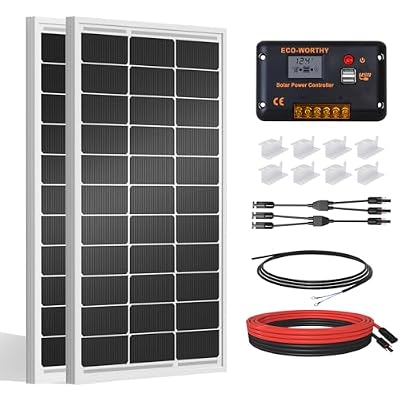
| ECO-WORTHY 200 Watts 12 Volt/24 Volt Solar Panel Kit … | ECO-WORTHY | ★ 4.6 | 1.1k | $169.98 |
| Renogy 200 Watts 12 Volts Monocrystalline RV Solar Pa… | RenogySolar | ★ 4.6 | 524 | $285.99 |
| Renogy 400 Watt 12 Volt Premium 4 Pcs 100W Panel+40A … | RenogySolar | ★ 4.5 | 574 | $494.94 |
Frequently Asked Questions
How much solar do I need to run a 12V fridge in my van?
A typical 12V compressor fridge uses 300-600 Wh per day depending on size, ambient temperature, and how often you open it. To reliably power just the fridge, plan for at least 100-200 W of solar plus a 100Ah lithium battery. Most vanlifers running a fridge alongside lights and fans land at 200-300 W total.
Is 200 watts of solar enough for van life?
For weekend trips, part-time travel, or a minimalist setup with a fridge, lights, and device charging, 200 W is often plenty. For full-time living with a laptop workload, multiple fans, and cloudy-region travel, 200 W will leave you short and you’ll want 300-450 W instead.
Can solar alone keep my batteries charged year-round?
In sunny southern climates, yes, a well-sized array can. But in winter, in northern latitudes, or during long cloudy stretches, solar alone often falls short. Most full-timers add a DC-to-DC charger that recharges from the alternator while driving as a reliable backup.
Should I get rigid or flexible solar panels?
Rigid panels are more durable, more efficient, and longer-lasting, making them the better choice for most permanent roof installs. Flexible panels are lighter and conform to curved roofs, but they degrade faster and run hotter. Many vanlifers use rigid panels on the roof plus a portable folding panel for flexibility.
How long do van solar panels last?
Quality monocrystalline panels typically carry 20-25 year output warranties and lose only about 0.5% efficiency per year. The panels usually outlast the van. Charge controllers and batteries wear out sooner, with lithium batteries good for roughly 2,000-5,000 charge cycles.
The Bottom Line
To size a van solar system, work backward: tally your daily watt-hours, build a battery bank that stores one to two days of that, then add enough solar to refill it on an average day, padding 20-30% for losses. For most full-time vanlifers without air conditioning, that lands around 300-450 watts of solar paired with a 100-200Ah lithium battery. Start with your real consumption, account for your climate and roof space, and you’ll build a system that quietly keeps up instead of constantly leaving you in the dark.