Last updated: November 13, 2026
Affiliate disclosure: Epic Van Life is reader-supported. When you buy through links on this page, we may earn a commission at no extra cost to you. Prices and availability change often — check the current price on Amazon before you buy.
Updated 2026 · Reviewed 11 November 2026 · Author: Jordan Hayes · Sources: manufacturer specifications and Amazon listings checked 11 November 2026.
Short answer: The best battery backup power station is the EcoFlow DELTA 2 Max, with 2,048Wh of capacity, 2,400W of output and expansion to 6,144Wh. The EcoFlow DELTA 3 charges fastest and switches to battery in 10 milliseconds, and the BLUETTI Elite 200 V2 is the best long-life LiFePO4 value. If you need a true uninterruptible power supply for a desk, the CyberPower CP1500PFCLCD is the budget pick.
Top picks at a glance:
- EcoFlow DELTA 2 Max — Best Overall
- EcoFlow DELTA 3 — Best for Fast Charging
- Jackery Explorer 2000 v2 — Best for Long Outages
- BLUETTI Elite 200 V2 — Best LiFePO4 Value
- Anker SOLIX F3000 — Best for Whole-Home Backup
- Goal Zero Yeti 1500 — Best for Quiet Indoor Backup
- CyberPower CP1500PFCLCD UPS — Best Budget UPS
How we choose & verify: Our picks come from manufacturer specifications and Amazon listings, checked 11 November 2026, cross-checked against independent testing and owner reports where available. Each Amazon link was checked against that model’s listing data to confirm it points to the exact model. Prices are ranges observed in November 2026 research, not fixed prices — check the current price before you buy.
— Jordan Hayes, Epic Van Life
Key insight: Capacity in watt-hours tells you how long a station runs, output in watts tells you what it can run — a fridge needs only 100–200W to run but a big surge to start. Buy for your largest load first, then check the UPS switchover time if a computer or CPAP must never lose power.
In this guide: What makes a good battery backup power station? · Which are the 7 best battery backup power stations? · What are the 7 best battery backup power stations? · How do I size a battery backup power station for my home? · Should I buy a power station or a UPS for home backup? · Frequently asked questions
- What makes a good battery backup power station?
- Which are the 7 best battery backup power stations?
- What are the 7 best battery backup power stations?
- How do I size a battery backup power station for my home?
- Should I buy a power station or a UPS for home backup?
- Which battery backup power station should I buy?
- Frequently asked questions
What makes a good battery backup power station?
A good backup station does three things well: it stores enough energy to outlast a typical outage, it delivers enough watts to start and run your essentials, and it recharges fast enough to be ready for the next outage. Capacity matters most — 1,000Wh runs a fridge for roughly half a day, 2,000Wh covers a full day of fridge, lights and phones — but output matters too, because a station that cannot start your fridge compressor is useless no matter how big its battery is.
UPS switching is the next test. A station with a 10–15 millisecond switchover keeps a desktop computer, router or CPAP running through a blackout without a reboot, while a station without UPS mode leaves a gap. Battery chemistry matters for lifespan: LiFePO4 cells last 3,000–6,000 cycles, several times longer than older lithium-ion cells, so a LiFePO4 station is the better buy if you plan to use it for years.
Which are the 7 best battery backup power stations?
See also: Best Camping Generators for Quiet Campgrounds: 7 Picks • Best Solar Pool Heaters 2026: 7 Top Picks
Prices below are ranges observed in November 2026 research, not fixed prices. Check the current price before buying.
| Pick | Best for | Key spec | Price range |
|---|---|---|---|
| EcoFlow DELTA 2 Max | Best Overall | 2,048Wh, 2,400W output, expands to 6,144Wh | Check current price |
| EcoFlow DELTA 3 | Best for Fast Charging | 1,024Wh LiFePO4, 1,800W output, 10 ms UPS | Check current price |
| Jackery Explorer 2000 v2 | Best for Long Outages | 2,042Wh, 2,200W output, 39.5 lb | Check current price |
| BLUETTI Elite 200 V2 | Best LiFePO4 Value | 2,073.6Wh LiFePO4, 2,600W output, 6,000 cycles | Check current price |
| Anker SOLIX F3000 | Best for Whole-Home Backup | 3,072Wh LiFePO4, 3,600W output, expands to 12,288Wh | Check current price |
| Goal Zero Yeti 1500 | Best for Quiet Indoor Backup | 1,505Wh LiFePO4, 2,000W output, 4,000 cycles | Check current price |
| CyberPower CP1500PFCLCD UPS | Best Budget UPS | 1,500VA/1,000W, pure sine wave, 12 outlets | Check current price |
What are the 7 best battery backup power stations?
1. EcoFlow DELTA 2 Max — Best Overall
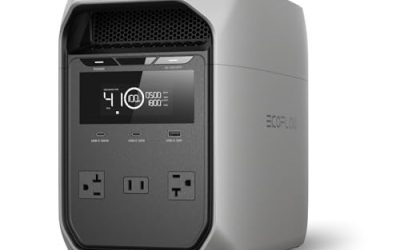
The EcoFlow DELTA 2 Max is the best overall backup station because it balances capacity, output and expansion: 2,048Wh, 2,400W of continuous output and room to grow to 6,144Wh with extra batteries. It charges from empty to 80% in 43 minutes from a wall outlet, so it is ready again fast after an outage.
- 2,048Wh capacity, expandable to 6,144Wh
- 2,400W continuous output, 3,100W surge
- Charges 0–80% in 43 minutes from AC
- About 50.7 lb, LiFePO4 battery
- Price: check the current price on Amazon: EcoFlow DELTA 2 Max
Strengths:
- Biggest usable capacity here without add-ons
- Fastest AC recharge in this guide
- Expansion batteries double or triple capacity
Watch out:
- Heavy at over 50 lb — not a grab-and-go unit
- Expansion batteries cost extra
- Fan noise is noticeable at full load
2. EcoFlow DELTA 3 — Best for Fast Charging
The EcoFlow DELTA 3 is the fastest-charging station here: a full charge from a wall outlet takes 56 minutes, and its 10-millisecond UPS switchover keeps computers and routers running through a blackout.
- 1,024Wh LiFePO4, 4,000 cycles to 80%
- 1,800W output, 3,600W surge, X-Boost to 2,200W
- 10 ms UPS switchover, 6 AC outlets
- 27.6 lb, 500W solar input, expands to 5kWh
- Price: check the current price on Amazon: EcoFlow DELTA 3
Strengths:
- Charges fully in 56 minutes from AC
- True 10 ms UPS for computers and CPAP
- Lightest station here for its capacity
Watch out:
- 1,024Wh is small for a full day of fridge backup
- Solar input caps at 500W
- Expansion battery sold separately
3. Jackery Explorer 2000 v2 — Best for Long Outages
The Jackery Explorer 2000 v2 is the best pick for long outages: 2,042Wh of capacity and 2,200W of output in a 39.5 lb package that is lighter than most 2,000Wh rivals. It runs a full-size fridge, lights and phones for a day or more, and its simple interface makes it easy to hand to a family member during a blackout.
- 2,042Wh capacity
- 2,200W continuous output, 4,400W surge
- 39.5 lb — lighter than most 2,000Wh stations
- LiFePO4 battery, app monitoring
- Price: check the current price on Amazon: Jackery Explorer 2000 v2
Strengths:
- Strong capacity-to-weight ratio
- Simple, beginner-friendly interface
- Quiet operation for indoor use
Watch out:
- No expansion batteries — capacity is fixed
- Fewer AC outlets than the DELTA 2 Max
- Solar charging is slower than some rivals
4. BLUETTI Elite 200 V2 — Best LiFePO4 Value
The BLUETTI Elite 200 V2 is the best long-life value: a 2,073.6Wh LiFePO4 battery rated for more than 6,000 cycles to 80% capacity, 2,600W of AC output and a 5-year warranty. Its UPS switches in 15 milliseconds or less, and its 1,000W solar input makes it a strong choice if you plan to recharge from panels during a long outage.
- 2,073.6Wh LiFePO4, 6,000+ cycles to 80%
- 2,600W AC output, 3,900W Power Lifting mode
- UPS switchover of 15 ms or less
- 53.4 lb, 1,000W solar input, 5-year warranty
- Price: check the current price on Amazon: BLUETTI Elite 200 V2
Strengths:
- Longest battery lifespan in this guide
- High 2,600W output for its price class
- Strong solar input for off-grid recharging
Watch out:
- Capacity is fixed — not expandable
- Heavy at 53.4 lb
- Power Lifting mode only works on resistive loads
5. Anker SOLIX F3000 — Best for Whole-Home Backup
The Anker SOLIX F3000 is the biggest station here and the best pick for whole-home backup: 3,072Wh, 3,600W of continuous output and expansion to 12,288Wh with extra batteries. It is UL9540 certified for home energy storage, and its 2,400W solar input can recharge it from panels in a day.
- 3,072Wh LiFePO4, 4,000 cycles
- 3,600W continuous AC output
- Expandable to 12,288Wh with extra batteries
- 2,400W solar input, UL9540 certified
- Price: check the current price on Amazon: Anker SOLIX F3000
Strengths:
- Largest capacity and output here
- Expands to whole-home scale
- UL9540 certification for home use
Watch out:
- Most expensive station in this guide
- Heavy and bulky — needs a fixed spot
- Expansion batteries are a big extra cost
6. Goal Zero Yeti 1500 — Best for Quiet Indoor Backup
The Goal Zero Yeti 1500 is the quiet, refined pick for indoor backup. This is the new 2026 sixth-generation model — not the older Yeti 1500X — with a 1,505Wh LiFePO4 battery rated for 4,000 cycles, a 2,000W inverter and a 5-year warranty. It runs a fridge, CPAP and lights silently, and its UL 2743 certification covers portable power safety.
- 1,505Wh LiFePO4, 4,000 cycles
- 2,000W AC output, 3,600W surge
- UL 2743 certified, 5-year warranty
- App monitoring, solar-ready
- Price: check the current price on Amazon: Goal Zero Yeti 1500
Strengths:
- Silent operation — no fumes, no engine
- 4,000-cycle battery lasts a decade of daily use
- Trusted brand with strong warranty support
Watch out:
- Costs more per watt-hour than the BLUETTI
- 1,505Wh is modest for multi-day outages
- Do not confuse it with the older Yeti 1500X
7. CyberPower CP1500PFCLCD UPS — Best Budget UPS
The CyberPower CP1500PFCLCD is the only true UPS in this guide and the cheapest way to protect a desk: 1,500VA/1,000W of pure sine wave power, 12 outlets and an LCD that shows load and runtime. It keeps a computer, monitor and router alive through short outages and gives you time to save work and shut down cleanly.
- 1,500VA/1,000W pure sine wave output
- 12 outlets, LCD status display
- About 25 lb, compact tower design
- Automatic voltage regulation
- Price: check the current price on Amazon: CyberPower CP1500PFCLCD UPS
Strengths:
- Cheapest pick by a wide margin
- True UPS — instant switchover, no gap
- Pure sine wave is safe for sensitive electronics
Watch out:
- Minutes of runtime, not hours — it is not a power station
- Sealed lead-acid battery needs replacing every few years
- Cannot run a fridge or large appliances
How do I size a battery backup power station for my home?
Add up the watts of everything you must keep running, then multiply by the hours you need. A fridge draws 100–200W once running, a router and modem about 10–20W, LED lights 10–30W, and a laptop 50–65W. A 2,000Wh station therefore covers a fridge, router, lights and phones for roughly a day, while a 1,000Wh station covers about half a day.
Check the surge rating too: a fridge compressor can draw three times its running watts for a second at startup, so a station with 2,000W of continuous output and 3,500W or more of surge is the safe minimum for a full-size fridge. If you only need to keep a desk alive, a small UPS like the CyberPower is cheaper and switches faster than any power station.
Should I buy a power station or a UPS for home backup?
Buy a power station if outages last hours: it stores far more energy, runs fridges and lights, and recharges from solar panels. The EcoFlow, Jackery, BLUETTI, Anker and Goal Zero picks here are all power stations, and they double as portable power for camping and van life.
Buy a UPS if you only need minutes of backup for a computer or home office. A UPS switches instantly with no gap, costs far less, and is designed to sit under a desk permanently. Its battery lasts minutes, not hours, so it protects against short blips and gives you time to save work — it will not keep a fridge cold overnight.
Which battery backup power station should I buy?
- Best Overall: EcoFlow DELTA 2 Max — check current price.
- Best for Fast Charging: EcoFlow DELTA 3 — check current price.
- Best for Long Outages: Jackery Explorer 2000 v2 — check current price.
- Best LiFePO4 Value: BLUETTI Elite 200 V2 — check current price.
- Best for Whole-Home Backup: Anker SOLIX F3000 — check current price.
- Best for Quiet Indoor Backup: Goal Zero Yeti 1500 — check current price.
- Best Budget UPS: CyberPower CP1500PFCLCD UPS — check current price.
If you only remember one rule: size the station for your fridge first, then check the UPS switchover time if a computer must never lose power.
Frequently asked questions
What size battery backup power station do I need?
For a fridge, router, lights and phones through a one-day outage, a 2,000Wh station is the safe minimum. A 1,000Wh station covers about half a day, and a 3,000Wh station covers a fridge plus a freezer or a well pump. Add up your loads in watts, multiply by the hours you need, and buy the next size up.
How long will a power station run a fridge?
A modern full-size fridge draws about 100–200W once running, so a 2,000Wh station runs it for roughly 10–16 hours after inverter losses. Older fridges and freezers draw more, and the startup surge can briefly triple the load. In practice, expect a 2,000Wh station to keep a fridge cold for a full day if you keep the door closed.
Can I use a power station as a UPS for my computer?
Yes, if it has a UPS mode with a fast switchover — the EcoFlow DELTA 3 switches in 10 milliseconds and the BLUETTI Elite 200 V2 in 15 milliseconds, which keeps a desktop running. Stations without UPS mode leave a gap, so the computer reboots. For a desk, a dedicated UPS switches instantly and costs less.
What is the difference between LiFePO4 and lithium-ion batteries?
LiFePO4, or lithium iron phosphate, lasts 3,000–6,000 charge cycles — several times longer than older lithium-ion cells, which typically last 500–800 cycles. LiFePO4 is also more stable at high temperatures. Most stations in this guide use LiFePO4, which is why they can promise a decade of use.
Can I charge a backup power station with solar panels?
Yes — every station here accepts solar input, from 500W on the EcoFlow DELTA 3 to 2,400W on the Anker SOLIX F3000. A 400W panel recharges a 2,000Wh station in about 5–7 hours of good sun. Check the panel voltage range before buying, and use the maker’s own panels or a compatible third-party panel.
How many watts do I need for home backup?
Most homes need 2,000–3,000W of continuous output for the essentials: a fridge at 100–200W, a freezer at 100–150W, lights, a router and phones. A well pump or sump pump needs 1,000–2,000W and a large startup surge. Add your largest loads together, allow for surge, and buy a station rated above that total.
{
“@context”: “https://schema.org”,
“@graph”: [
{
“@type”: “Article”,
“headline”: “Best Battery Backup Power Stations 2026: 7 Top Picks”,
“description”: “Best battery backup power stations in 2026: 7 backup stations from EcoFlow, Jackery, BLUETTI and Anker \u2014 capacity, output, UPS switching and prices compared.”,
“author”: {
“@type”: “Person”,
“name”: “Jordan Hayes”
},
“datePublished”: “2026-11-11”,
“dateModified”: “2026-11-11”,
“mainEntityOfPage”: {
“@type”: “WebPage”,
“@id”: “https://epicvanlife.com/best-battery-backup-power-stations/”
}
},
{
“@type”: “ItemList”,
“name”: “Best Battery Backup Power Stations 2026: 7 Top Picks”,
“itemListElement”: [
{
“@type”: “ListItem”,
“position”: 1,
“name”: “EcoFlow DELTA 2 Max”,
“url”: “https://www.amazon.com/dp/B0C4DW17PD?tag=epicvanlife05-20”
},
{
“@type”: “ListItem”,
“position”: 2,
“name”: “EcoFlow DELTA 3”,
“url”: “https://www.amazon.com/dp/B0DCBYMC9D?tag=epicvanlife05-20”
},
{
“@type”: “ListItem”,
“position”: 3,
“name”: “Jackery Explorer 2000 v2”,
“url”: “https://www.amazon.com/dp/B0DFG2WDQH?tag=epicvanlife05-20”
},
{
“@type”: “ListItem”,
“position”: 4,
“name”: “BLUETTI Elite 200 V2”,
“url”: “https://www.amazon.com/dp/B0DCJV9LTB?tag=epicvanlife05-20”
},
{
“@type”: “ListItem”,
“position”: 5,
“name”: “Anker SOLIX F3000”,
“url”: “https://www.amazon.com/dp/B0F8BC2LFS?tag=epicvanlife05-20”
},
{
“@type”: “ListItem”,
“position”: 6,
“name”: “Goal Zero Yeti 1500”,
“url”: “https://www.amazon.com/dp/B0GMKKGQCY?tag=epicvanlife05-20”
},
{
“@type”: “ListItem”,
“position”: 7,
“name”: “CyberPower CP1500PFCLCD UPS”,
“url”: “https://www.amazon.com/dp/B00429N19W?tag=epicvanlife05-20”
}
]
},
{
“@type”: “Product”,
“name”: “EcoFlow DELTA 2 Max”,
“description”: “Home backup power station with 2,048Wh capacity, 2,400W output and expansion to 6,144Wh.”,
“brand”: {
“@type”: “Brand”,
“name”: “EcoFlow”
},
“offers”: {
“@type”: “Offer”,
“priceCurrency”: “USD”,
“availability”: “https://schema.org/InStock”
}
},
{
“@type”: “Product”,
“name”: “EcoFlow DELTA 3”,
“description”: “Fast-charging backup power station with 1,024Wh LiFePO4, 1,800W output and 10 ms UPS.”,
“brand”: {
“@type”: “Brand”,
“name”: “EcoFlow”
},
“offers”: {
“@type”: “Offer”,
“priceCurrency”: “USD”,
“availability”: “https://schema.org/InStock”
}
},
{
“@type”: “Product”,
“name”: “Jackery Explorer 2000 v2”,
“description”: “Long-outage backup power station with 2,042Wh capacity and 2,200W output at 39.5 lb.”,
“brand”: {
“@type”: “Brand”,
“name”: “Jackery”
},
“offers”: {
“@type”: “Offer”,
“priceCurrency”: “USD”,
“availability”: “https://schema.org/InStock”
}
},
{
“@type”: “Product”,
“name”: “BLUETTI Elite 200 V2”,
“description”: “Long-life LiFePO4 backup station with 2,073.6Wh, 2,600W output and 6,000-plus cycles.”,
“brand”: {
“@type”: “Brand”,
“name”: “BLUETTI”
},
“offers”: {
“@type”: “Offer”,
“priceCurrency”: “USD”,
“availability”: “https://schema.org/InStock”
}
},
{
“@type”: “Product”,
“name”: “Anker SOLIX F3000”,
“description”: “Whole-home backup power station with 3,072Wh LiFePO4, 3,600W output and expansion to 12,288Wh.”,
“brand”: {
“@type”: “Brand”,
“name”: “Anker”
},
“offers”: {
“@type”: “Offer”,
“priceCurrency”: “USD”,
“availability”: “https://schema.org/InStock”
}
},
{
“@type”: “Product”,
“name”: “Goal Zero Yeti 1500”,
“description”: “Quiet indoor backup power station with 1,505Wh LiFePO4, 2,000W output and 4,000 cycles.”,
“brand”: {
“@type”: “Brand”,
“name”: “Goal Zero”
},
“offers”: {
“@type”: “Offer”,
“priceCurrency”: “USD”,
“availability”: “https://schema.org/InStock”
}
},
{
“@type”: “Product”,
“name”: “CyberPower CP1500PFCLCD UPS”,
“description”: “Budget UPS with 1,500VA/1,000W pure sine wave output, 12 outlets and an LCD display.”,
“brand”: {
“@type”: “Brand”,
“name”: “CyberPower”
},
“offers”: {
“@type”: “Offer”,
“priceCurrency”: “USD”,
“availability”: “https://schema.org/InStock”
}
}
]
}
{
“@context”: “https://schema.org”,
“@type”: “FAQPage”,
“mainEntity”: [
{
“@type”: “Question”,
“name”: “What size battery backup power station do I need?”,
“acceptedAnswer”: {
“@type”: “Answer”,
“text”: “For a fridge, router, lights and phones through a one-day outage, a 2,000Wh station is the safe minimum. A 1,000Wh station covers about half a day, and a 3,000Wh station covers a fridge plus a freezer or a well pump. Add up your loads in watts, multiply by the hours you need, and buy the next size up.”
}
},
{
“@type”: “Question”,
“name”: “How long will a power station run a fridge?”,
“acceptedAnswer”: {
“@type”: “Answer”,
“text”: “A modern full-size fridge draws about 100\u2013200W once running, so a 2,000Wh station runs it for roughly 10\u201316 hours after inverter losses. Older fridges and freezers draw more, and the startup surge can briefly triple the load. In practice, expect a 2,000Wh station to keep a fridge cold for a full day if you keep the door closed.”
}
},
{
“@type”: “Question”,
“name”: “Can I use a power station as a UPS for my computer?”,
“acceptedAnswer”: {
“@type”: “Answer”,
“text”: “Yes, if it has a UPS mode with a fast switchover \u2014 the EcoFlow DELTA 3 switches in 10 milliseconds and the BLUETTI Elite 200 V2 in 15 milliseconds, which keeps a desktop running. Stations without UPS mode leave a gap, so the computer reboots. For a desk, a dedicated UPS switches instantly and costs less.”
}
},
{
“@type”: “Question”,
“name”: “What is the difference between LiFePO4 and lithium-ion batteries?”,
“acceptedAnswer”: {
“@type”: “Answer”,
“text”: “LiFePO4, or lithium iron phosphate, lasts 3,000\u20136,000 charge cycles \u2014 several times longer than older lithium-ion cells, which typically last 500\u2013800 cycles. LiFePO4 is also more stable at high temperatures. Most stations in this guide use LiFePO4, which is why they can promise a decade of use.”
}
},
{
“@type”: “Question”,
“name”: “Can I charge a backup power station with solar panels?”,
“acceptedAnswer”: {
“@type”: “Answer”,
“text”: “Yes \u2014 every station here accepts solar input, from 500W on the EcoFlow DELTA 3 to 2,400W on the Anker SOLIX F3000. A 400W panel recharges a 2,000Wh station in about 5\u20137 hours of good sun. Check the panel voltage range before buying, and use the maker’s own panels or a compatible third-party panel.”
}
},
{
“@type”: “Question”,
“name”: “How many watts do I need for home backup?”,
“acceptedAnswer”: {
“@type”: “Answer”,
“text”: “Most homes need 2,000\u20133,000W of continuous output for the essentials: a fridge at 100\u2013200W, a freezer at 100\u2013150W, lights, a router and phones. A well pump or sump pump needs 1,000\u20132,000W and a large startup surge. Add your largest loads together, allow for surge, and buy a station rated above that total.”
}
}
]
}