Last updated: October 19, 2026
For most camper vans, the ECO-WORTHY 1.6kWh 400W kit is the best all-around starting point: four 100W panels, a 40A MPPT controller and a pair of 12V 100Ah lithium batteries cover the fridge, lights, fans and device charging of a weekend-to-weeklong build without forcing you to shop for parts separately. Bigger rigs with a coffee maker, induction hob or remote-work setup should look at the 7.168kWh system, while minimalist builds can start with a single 100W panel. A “solar kit” simply bundles panels with a charge controller and cables; some kits add batteries and an inverter, and the difference matters a lot in a van.
Quick List
- ECO-WORTHY 7.168kWh 800W kit – best for heavy daily loads and full-time van life
- ECO-WORTHY 200W 12V/24V kit – best for a low-cost panel-and-controller upgrade
- ECO-WORTHY 1.6kWh 400W kit – best for a complete, balanced weekend-to-weeklong system
- 480W kit with 100Ah LiFePO4 and 1000W inverter – best for buyers who want an inverter included on a modest roof
- Renogy 400W Premium kit – best for building your own battery bank around a quality MPPT controller
- Renogy 100W 12V Starter kit – best for trickle-charging a single battery on a small van
Which One Is Right for You?
| If you… | Choose |
|---|---|
| already own a lithium battery and want a proven MPPT controller with Bluetooth monitoring | Renogy 400W Premium kit |
| want panels, controller, batteries and cabling in one box for a typical van | ECO-WORTHY 1.6kWh 400W kit |
| work remotely, run an induction cooktop or want multiple days of reserve | ECO-WORTHY 7.168kWh 800W kit |
| only need to keep a starter or house battery topped up on a small footprint | Renogy 100W 12V Starter kit |
| want to add a modest amount of solar to an existing system on a tight budget | ECO-WORTHY 200W 12V/24V kit |
| need a built-in inverter for occasional AC loads such as a laptop brick or small blender | 480W kit with 100Ah LiFePO4 and 1000W inverter |
The deciding factor is rarely panel wattage alone. Roof space, the size of your battery bank and whether you need AC power determine which of these makes sense. Work out your daily watt-hours first, then match the kit to that number rather than the other way around.

ECO-WORTHY 7.168KWH 800W Solar Panel Kit for RV Off Grid Complete System | 4PCS 195W Solar Panels, 3000W UPS Inverter Charger, 2PCS 12.8V 280AH Lithium Batteries, 60A MPPT Controller Bluetooth
Included for '6 Best Solar Panel Kits for Camper Vans (October 2026) Reviews & Picks' because the listing specifies 4PCS 195W Solar Panels and 3000W UPS Inverter Charger, details this guide uses to compare options.
View on Amazon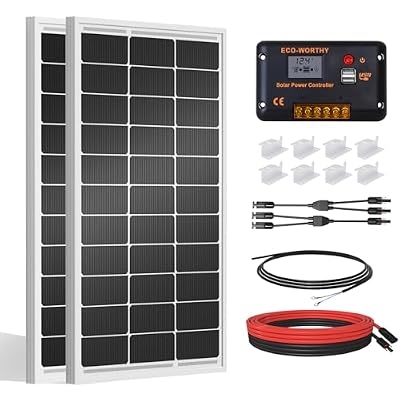
ECO-WORTHY 200 Watts 12 Volt/24 Volt Solar Panel Kit with High Efficiency Monocrystalline Solar Panel and 30A PWM Charge Controller for RV, Camper, Vehicle, Caravan and Other Off Grid Applications
Included for '6 Best Solar Panel Kits for Camper Vans (October 2026) Reviews & Picks' because the listing specifies Camper and Vehicle, details this guide uses to compare options.
View on Amazon
ECO-WORTHY 1.6KWH Complete Solar Panel Kit 400W 12V for RV Off Grid | 4 * 100W Solar Panel + 40A MPPT Controller + 2 * 12V 100Ah Lithium Battery + Upgraded 2000W Power Inverter + Bluetooth Module
Included for '6 Best Solar Panel Kits for Camper Vans (October 2026) Reviews & Picks' as a relevant option in this category; details come from the product listing.
View on Amazon
480W Solar Panel Kit with 100Ah LiFePO4 Battery and 1000W Inverter, 12V Complete Off-Grid Solar Power System: 4×120W Solar Panels + 40A MPPT Controller + Pure Sine Wave Inverter for RV Cabin Shed
Included for '6 Best Solar Panel Kits for Camper Vans (October 2026) Reviews & Picks' as a relevant option in this category; details come from the product listing.
View on Amazon
Renogy 400Watt Premium Solar Kit with 40A MPPT Charge Controller | 4x100W monocrystalline panels. 40A MPPT charge controller. Includes Bluetooth module, Z-brackets, cables, adaptor kit.
Included for '6 Best Solar Panel Kits for Camper Vans (October 2026) Reviews & Picks' because the listing specifies Z-brackets and cables, details this guide uses to compare options.
View on Amazon
Renogy 100W 12V Solar Panel Starter Kit with 30A PWM Controller | Complete kit includes Monocrystalline solar panel, Charger Controller, cables, Z-brackets. For RVs, campers, off-grid.
Included for '6 Best Solar Panel Kits for Camper Vans (October 2026) Reviews & Picks' because the listing specifies Complete kit includes Monocrystalline solar panel and Charger Controller, details this guide uses to compare options.
View on AmazonAll 6 Picks in Detail
1. ECO-WORTHY 7.168kWh 800W Kit – Best for Heavy Loads and Full-Time Living
As an Amazon Associate we earn from qualifying purchases at no extra cost to you.

This is the largest system in the group and effectively a whole-van power plant. The listing name states four 195W panels, a 3000W inverter charger and two 12.8V lithium batteries. Manufacturer information indicates each battery is 280Ah, which adds up to the 7.168kWh in the product name. It suits full-time vanlifers, remote workers and anyone running a compressor fridge, fans, a laptop and an electric kettle or induction burner in the same day. The inverter charger can also accept shore or generator power, according to the product name’s UPS wording, so the batteries can be topped up at a campground when the weather refuses to cooperate. Plan the install carefully: the pieces are heavy, and the wiring needs correctly rated fuses, a busbar and a safe mounting location for the batteries.
- Panels: 4 x 195W (about 780W of rated array power)
- Inverter charger: 3000W, with a UPS function per the listing name
- Batteries: 2 x 12.8V lithium, 7.168kWh total
- Controller: confirm model and amperage on the listing
- Panel footprint: large panels, so measure roof space before ordering
Pros:
- Enough storage to ride out several cloudy days
- Inverter size handles high-draw appliances
Cons:
- Heavy and bulky for smaller vans and thin payload margins
- Installation is a serious project that calls for proper fusing and busbars
Compared with the 1.6kWh kit, this option offers more than four times the storage but demands far more space, weight capacity and installation care.
2. ECO-WORTHY 200W 12V/24V Kit – Best for a Simple Panel Upgrade
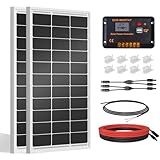
This kit pairs monocrystalline panels with a 30A PWM charge controller and is flexible about system voltage, since the name states 12V and 24V compatibility. It fits a van that already has a battery bank and just needs a way to recharge it from the roof. It does not include batteries, and the listing name does not specify the panel count or dimensions, so confirm those on the product page before planning a layout. Because the controller accepts either voltage, the kit also gives you room to grow if you later move to a 24V battery bank, as long as the rest of the system matches. For a van that mostly sits in the shade of campground trees, remember that any panel kit is only as good as the light it receives, and PWM controllers handle partial shading less gracefully than MPPT.
- Rated panel power: 200W in total
- Controller: 30A PWM
- System voltage: 12V or 24V
- Panel type: monocrystalline
- Included in the box: confirm cabling and mounting hardware on the listing
Pros:
- Low entry point into roof solar
- Small enough for compact roofs shared with a vent fan
Cons:
- PWM controllers recover less energy than MPPT, especially in cold or hazy light
- Limited headroom if you later add loads
Next to the Renogy 100W starter kit, it doubles the panel power, but the Renogy kit comes from a brand with a larger accessory ecosystem.
3. ECO-WORTHY 1.6kWh 400W Kit – Best for a Complete Mid-Size System

This is the kit most van builders will find easiest to live with. The listing name states four 100W panels, a 40A MPPT controller and two 12V 100Ah lithium batteries. Two 100Ah units at a nominal 12.8V would hold roughly 2.5kWh on paper, while the product name quotes 1.6kWh, so confirm the usable-energy figure and the inverter details on the product page before you size your loads around it. It suits weekend and week-long trips, compressor fridges, USB charging, and lights, and the 400W array is enough to refill a day of moderate use in good sun. Because the batteries arrive with the kit, the main installation decisions are where to mount them, how to fuse them and how to route the panel cables through the roof.
- Panels: 4 x 100W (400W total)
- Controller: 40A MPPT
- Batteries: 2 x 12V 100Ah lithium
- System voltage: 12V
- Inverter: confirm size and inclusion on the listing
Pros:
- Complete package reduces mismatched-part risk
- MPPT control improves harvest compared with PWM
Cons:
- Four panels need a clear stretch of roof
- Large AC loads may exceed what the included inverter can handle
Compared with the Renogy 400W Premium kit, it adds batteries, while the Renogy kit leaves battery choice entirely up to you.
4. 480W Kit with 100Ah LiFePO4 and 1000W Inverter – Best for Built-In AC Power

Not every listing names its brand clearly, and this one leads with its numbers: four 120W panels, a 100Ah LiFePO4 battery, a 1000W inverter and a 40A MPPT controller. That combination suits a van that needs occasional AC for a laptop charger, a hair dryer on low or a small blender, and where a 1000W inverter is adequate. Check the brand, warranty and exact battery specifications on the product page, since the listing name is the only detail we relied on. A 1000W inverter is plenty for chargers and small appliances, but it will not run a microwave, an induction hob or a roof air conditioner, so treat it as a convenience feature rather than a full AC supply. Wire the inverter with heavy cable and a close-coupled fuse, because even a 1000W load pulls well over 80 amps from a 12V battery.
- Panels: 4 x 120W (480W total)
- Battery: 100Ah LiFePO4, nominal 12V
- Inverter: 1000W
- Controller: 40A MPPT per the listing name
- Brand and warranty terms: confirm on listing
Pros:
- Slightly more panel power than the 400W kits
- Includes inverter and battery in one purchase
Cons:
- Single 100Ah battery limits overnight reserve
- Less-known brand means checking support details carefully
It is closest to the ECO-WORTHY 1.6kWh kit, trading half the battery capacity for a bit more solar.
5. Renogy 400W Premium Kit – Best for Building Around a Quality Controller

Renogy’s Premium kit supplies four 100W monocrystalline panels and a 40A MPPT controller with a Bluetooth module for phone monitoring. Manufacturer information shows it does not include a battery or inverter, which makes it a good match for builders who already chose a battery bank or a separate all-in-one inverter. It also suits those who prefer a brand with widely documented installation guides. Because the kit ends at the controller, you decide how big the battery bank is, whether you want a separate inverter or an all-in-one unit, and which fuses and breakers protect the cable runs. That freedom is valuable on a custom build, and it is also the reason this kit is not the quickest route to a working system for a first-time installer.
- Panels: 4 x 100W monocrystalline
- Controller: 40A MPPT, 12V/24V auto-detect per manufacturer information
- Monitoring: Bluetooth module included per the listing name
- Battery and inverter: not included
- Maximum PV input of the controller: 100V per manufacturer information
Pros:
- Strong documentation and app monitoring
- Controller leaves room to reconfigure panels in series or parallel
Cons:
- You must buy battery, fuses and inverter separately
- Panel version may vary, so confirm the exact generation on the listing
Versus the ECO-WORTHY 400W kit, you gain brand ecosystem and flexibility but lose the all-in-one convenience.
6. Renogy 100W 12V Starter Kit – Best for Small-Footprint Trickle Charging

A single 100W panel with a 30A PWM controller and cables is the smallest sensible kit here. It suits compact vans and weekend rigs where the aim is to keep a single battery topped up, run a few LED lights and charge phones. It is not meant to power a compressor fridge over several days. In decent summer sun a single 100W panel might add a few hundred watt-hours per day, which is a useful trickle for a van that is driven often or used mostly for weekends. Manufacturer information says the controller can support more panels later, so you can start small and expand as the build grows.
- Panel: 1 x 100W monocrystalline
- Controller: 30A PWM
- System voltage: 12V
- Included: cables and mounting brackets per the listing name; confirm contents
- Expandable: manufacturer information says more panels can be added, within the controller limits
Pros:
- Easy to install in an afternoon
- Small footprint leaves roof space for vents and racks
Cons:
- Limited daily energy for anything beyond light loads
- PWM is less efficient than the MPPT used in larger kits
It is the natural step down from the ECO-WORTHY 200W kit when roof space and budget are both tight.
Specs Compared
| Kit | Panels | Controller | Battery | Inverter |
|---|---|---|---|---|
| ECO-WORTHY 7.168kWh 800W | 4 x 195W | Confirm on listing | 2 x 12.8V lithium, 7.168kWh | 3000W inverter charger |
| ECO-WORTHY 200W 12V/24V | 200W total, count: confirm on listing | 30A PWM | Not included | Not included |
| ECO-WORTHY 1.6kWh 400W | 4 x 100W | 40A MPPT | 2 x 12V 100Ah lithium | Confirm on listing |
| 480W kit with 100Ah LiFePO4 | 4 x 120W | 40A MPPT | 1 x 100Ah LiFePO4 | 1000W |
| Renogy 400W Premium | 4 x 100W | 40A MPPT, Bluetooth | Not included | Not included |
| Renogy 100W Starter | 1 x 100W | 30A PWM | Not included | Not included |
How We Chose These
We worked from the listed product names, manufacturer product and specification pages, and retailer specification fields as a desk-research roundup. Each kit had to be a genuine bundle of panels plus a charge controller, so a van owner could realistically build a system around it. We favored clear statements of panel wattage, controller type and battery chemistry, and we noted where a listing leaves a value unstated instead of guessing. We also weighed how well each kit scales: whether panels can be added, whether the controller supports 12V and 24V, and whether batteries and an inverter are included. Finally, we looked for a spread of sizes so every van, from compact to large, has a realistic option.
What to Look For
Start With Your Daily Watt-Hours
Solar sizing begins with the energy you use, not the panels you like. List every load, multiply its watts by the hours it runs, and add the results. A typical compressor fridge averages roughly 400 to 600 Wh per day depending on ambient temperature, LED lights add perhaps 50 Wh, phones and a laptop may add 150 to 300 Wh, and a roof fan another 100 Wh or so. That puts a modest setup near 800 to 1,100 Wh per day.
A useful rule of thumb: divide your daily watt-hours by about 3 (a conservative figure for usable sun-hours after losses), and the result is the panel wattage you want. Using 1,000 Wh as an example, you land near 330 to 400W of panels. That is why a 400W array is the sweet spot for many camper vans, and why a single 100W panel serves only light use.
MPPT vs PWM Controllers
PWM controllers simply connect the panel to the battery and pull the panel voltage down to battery voltage, wasting the difference. MPPT controllers convert extra voltage into extra current, which typically boosts harvest in cold weather, hazy light and when the battery is partially charged. For arrays of 200W or more, MPPT usually pays for itself. PWM remains acceptable for one small panel and a short wire run.
Also check the controller’s maximum PV input voltage. If you wire four panels in series, their open-circuit voltages add up, and exceeding the controller’s limit can damage it. Cold mornings raise panel voltage, so leave a safety margin.
Battery Chemistry and Capacity
Lithium iron phosphate (LiFePO4) batteries offer deeper usable capacity and lighter weight than lead-acid, and a 12V 100Ah unit stores about 1.28kWh nominally. Many have a built-in battery management system that stops charging below freezing temperatures, so winter campers should check the low-temperature protection and consider an insulated or heated battery location. Capacity should cover at least one full day of loads, ideally two, so cloudy weather does not leave you in the dark.
Roof Space, Weight and Wiring Safety
Standard 100W panels are roughly 42 by 21 inches, so four need around 12 square feet of unshaded roof before you account for vents, racks and spacing. Larger 195W panels are close to 59 inches long. Every wire from the panels to the controller, and from the controller to the battery, needs correctly sized cable and a fuse or breaker placed close to the battery. Undersized wire overheats, and an unfused lithium battery can deliver enough current to start a fire. If you are unsure about the wiring, have a qualified installer review the layout.
Series vs Parallel Wiring and Shading
How you connect panels changes both voltage and shading behavior. Parallel wiring keeps voltage at the panel level and current adds up, so one shaded panel drags down only itself; it needs thicker cable and combiner connectors. Series wiring adds voltages and keeps current low, which allows thinner wire and longer runs, but a shadow on one panel can throttle the whole string. On a van roof where vents, racks and shadows move through the day, parallel (or a series-parallel mix) is often more forgiving, provided the cable is sized for the current. Always check the controller’s maximum current and voltage ratings before settling on a layout.
Questions
How many watts of solar do I need for a camper van?
Most weekend and part-time vans do well with 200 to 400W, while full-time rigs often use 400 to 800W. Calculate your daily watt-hours and divide by roughly 3 to find a starting panel size. If you travel in winter or at high latitudes, plan for fewer usable sun-hours and size up accordingly.
Can I run an air conditioner from these kits?
Generally no. Roof air conditioners draw far more power than a 400W array and typical battery banks can supply for long. Only the largest system here, with its 3000W inverter and big battery, comes anywhere near, and even then you should confirm the surge rating of the unit.
Do I need an inverter?
Only if you plan to run AC devices such as laptop chargers, blenders or power tools. Many 12V appliances and USB chargers run directly from the battery, which avoids the inverter’s standby drain. If you do add one, switch it off when you are not using AC power, since even an idle inverter draws a small but constant load that adds up over a week.
Is a Bluetooth monitor worth having?
Yes, because it shows how much energy you harvest and helps you spot shading or wiring issues early. Several kits here include a Bluetooth module or controller, but confirm that on each listing. Seeing the daily harvest number also teaches you how much your real-world roof produces compared with the rated wattage, which is the most useful figure when you decide whether to add panels.
Will solar charge my batteries while I drive?
Solar works whenever the panels get light, including while parked and moving. Many builders also add a DC-DC charger so the alternator tops up the batteries on cloudy travel days.
Should I choose 12V or 24V?
Most camper vans use 12V because appliances and accessories are widely available for it. Larger systems sometimes choose 24V to reduce current and wire thickness, but you need compatible batteries and an inverter.
Update History
- October 20, 2026 – Initial publication; product set drawn from current catalog listings.
- Check the product page for current specifications and availability before buying.
Sources
- Manufacturer product and specification pages for Renogy and ECO-WORTHY
- Retailer listing titles and specification fields
- Third-party reviewer notes on the larger ECO-WORTHY kit, used only for general context