Last updated: October 19, 2026
The best 12V roof vent fan in this group for most camper vans is the Kohree 14-inch 10-speed vent fan: it adds a remote, a built-in temperature sensor and a rain sensor to a reversible 12V motor, so it can pull hot air out, push fresh air in and close itself when a shower hits. Budget builders can look at the manual OUTPRIZE, which keeps the design simple. A roof vent fan is a 12V motor mounted in a roof opening that exhausts or draws air through the cabin. Most listed models target the standard 14 by 14 inch RV opening, so check that your van roof can take one.
Quick List
- Kohree 14″ 10-Speed – best overall for remote, thermostat and rain-sensor convenience
- RV Vent Fan 14×14 10-Speed – best for a similar feature list in a generic package
- OUTPRIZE Manual 14″ – best for quiet, simple, no-electronics operation
- Starvent 6-Speed Reversible – best for a middle ground of speeds and reversibility
- GDDGHS 14×14 With Screen – best for sealing kit and wide lid opening
- 14″ Universal White Lid Vent – best for replacing an existing vent with a white interior ring
Which One Is Right for You?
See also: 6 Best 12v Portable Fridges for Van Life (October 2026) Complete Guide • 6 Best Foam Mattresses for Camper Vans (October 2026) Complete Guide
| If you… | Choose |
|---|---|
| want a manual lid, low noise and the fewest parts to fail | OUTPRIZE Manual 14″ |
| want a remote, a thermostat and a rain sensor in one fan | Kohree 14″ 10-Speed |
| want similar smart features from a generic listing | RV Vent Fan 14×14 10-Speed |
| want a middle option with six speeds and reversible airflow | Starvent 6-Speed Reversible |
| want putty included and a screen with a wide opening angle | GDDGHS 14×14 |
| are replacing an existing 14-inch vent and care about the interior trim | 14″ Universal White Lid Vent |
The main fork is manual or powered lid. A manual lift is cheaper and less complex, but you must open and close it by hand. A powered lid with a rain sensor is more convenient, especially if you leave the van parked with the fan running during a day out, but it adds another electrical part that needs wiring care.

Starvent RV Roof Vent Fan 6-Speed-Reversible
Included for '6 Best 12v Roof Vent Fans for Camper Vans (October 2026) Buying Guide' as a relevant option in this category; details come from the product listing.
View on Amazon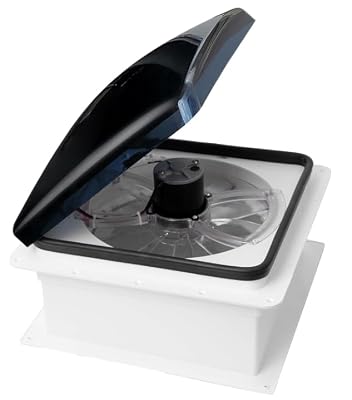
OUTPRIZE Manual RV Roof Vent Fan, 12V DC 14" Super Quiet | 45dB, Reliable, 3-Speed, Reversible
Included for '6 Best 12v Roof Vent Fans for Camper Vans (October 2026) Buying Guide' because the listing specifies 12V DC 14" Super Quiet and 45dB, details this guide uses to compare options.
View on Amazon
GDDGHS 14x14“ RV Roof Vent with 12V Fan for Camper Trailer | Durable Camper Roof Vent Fan with Screen, 45°Opening, Rainproof, Includes Putty Tape + 2 Handles
Included for '6 Best 12v Roof Vent Fans for Camper Vans (October 2026) Buying Guide' because the listing specifies Durable Camper Roof Vent Fan with Screen and 45°Opening, details this guide uses to compare options.
View on Amazon
Kohree 14" RV Vent Fan, 12V for Camper Vent, Green | 10 Speed Reversible, Super Quiet, With Remote Control, Temperature & Rain Sensor, Exhaust Fan for Camper,Trailer
Included for '6 Best 12v Roof Vent Fans for Camper Vans (October 2026) Buying Guide' because the listing specifies 12V for Camper Vent and Green, details this guide uses to compare options.
View on Amazon
RV Vent Fan 14x14, 10-Speed Roof Vent Fan with Remote Control & Rain Sensor, 12V RV Exhaust Fan
Included for '6 Best 12v Roof Vent Fans for Camper Vans (October 2026) Buying Guide' because the listing specifies 10-Speed Roof Vent Fan with Remote Control & Rain Sensor and 12V RV Exhaust Fan, details this guide uses to compare options.
View on Amazon
14" RV Roof Vent for Camper Trailer Universal White Lid Roof Vent with 12V RV Vent Fan 6" Blades White lid Inner for Garnish Ring
Included for '6 Best 12v Roof Vent Fans for Camper Vans (October 2026) Buying Guide' as a relevant option in this category; details come from the product listing.
View on AmazonAll 6 Picks in Detail
1. Starvent 6-Speed Reversible – Best Middle Ground
As an Amazon Associate we earn from qualifying purchases at no extra cost to you.
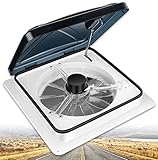
The Starvent listing is brief: an RV roof vent fan with six speeds and reversible airflow. That puts it between the three-speed manual model and the ten-speed remote models. Six speeds are plenty for most users, who tend to use only a low setting overnight and a high setting when cooking.
- RV roof vent fan format
- Six speeds
- Reversible intake and exhaust
- Opening size, lid type and rain sensor: confirm on listing
- Airflow, noise and current draw: confirm on listing
With so little spelled out in the name, check the product page for the opening dimension, the lid type and whether a remote is included. If it is a 14-inch design, it should fit the same cutout as the other fans in this guide.
For a camper that sees both hot afternoons and cool nights, six speeds are a practical sweet spot. A low setting provides gentle air movement for sleeping, a medium setting handles breakfast cooking and the top setting clears a steamy shower or a stuffy cabin in minutes. Because the listing name is brief, the best approach is to compare the product page photos with your existing cutout and wiring, and to confirm whether a trim ring, a screen and a manual are included.
Pros
- Six speeds are enough for most conditions
- Reversible airflow
Cons
- Few details stated in the listing name
- May lack remote or rain sensing
Against the OUTPRIZE, it offers more speeds but less clarity on lid type and noise.
2. OUTPRIZE Manual 14″ – Best for Simple Quiet Operation
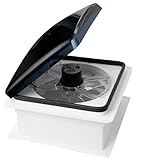
OUTPRIZE takes the opposite approach to the remote-controlled fans. The lid is lifted by hand, the fan has three speeds and the motor is reversible. The listing claims operation around 45 dB, which would make it one of the quietest in this group. If you value reliability and an easy mental model of how it works, this is the vent to choose.
- 14 inch size for a standard RV opening
- 12V DC motor, three speeds, reversible
- Noise level named as about 45 dB
- Manual lid lift without a rain sensor
- Airflow rating and current draw: confirm on listing
The lack of a rain sensor means you need to close the lid before leaving the van, or accept that rain can come in when the lid is open. Many van owners fit a rain hood or a vented cover to reduce that risk, but check whether a compatible accessory exists.
Manual vents suit people who enjoy simplicity and have no interest in a remote or an app. There is less to go wrong in a damp, vibrating environment: one switch, one motor, and a crank or a lift mechanism. The fan can still be left open on mild nights, and a hand-operated lid is a good fit for someone who always opens windows manually anyway. Check that the lid arm holds firmly in the open position so wind or road vibration does not slam it shut.
Pros
- Fewer electronics and lower complexity
- Quiet operation claimed
- Reversible airflow
Cons
- Manual lid with no automatic rain closing
- Only three speeds
Compared with the Starvent, it has fewer speeds but a quieter claim and a plainer interface.
3. GDDGHS 14×14 With Screen – Best for a Sealing Kit and Wide Opening

The GDDGHS combines a 14 by 14 inch vent with a 12V fan, an insect screen, a lid that opens to 45 degrees and a package that includes putty. The listing emphasizes rainproof construction, a durable body and a screen, which fits buyers who want to leave the vent partly open in damp weather.
- 14 by 14 inch roof vent with a 12V fan
- Screen included
- 45 degree lid opening angle
- Rainproof design and putty included, per the listing
- Speeds, reversibility and current draw: confirm on listing
The included putty is handy, but for a permanent roof seal many installers also use a butyl tape and a self-leveling lap sealant rated for the roof material. Follow the manufacturer’s installation guidance and do not rely on a single sealant if the roof is curved or ribbed.
The 45 degree opening is a useful design detail because it lets the vent breathe even while you cook or shower without leaving the lid fully upright and exposed to wind. A wider opening can also help moist air escape faster. As with any vent that has a large lid, make sure the hinge is strong and the lid has a positive latch on the road. Inspect the screen frame for gaps where small insects could crawl in, and seal them with a small bead of sealant if needed.
Pros
- Screen and sealing material included
- Wide lid opening for airflow
Cons
- Fewer electronic features named
- Details on the fan speeds are not in the listing name
Compared with the Kohree, it favors installation completeness over remote features.
4. Kohree 14″ 10-Speed – Best Overall for Smart Convenience

The Kohree combines the features most van owners end up wanting: ten fan speeds, reversible airflow, a remote control, a temperature sensor and a rain sensor. According to the manufacturer’s pages, it is built for a standard 14-inch opening, draws roughly 25 watts at its top speed and lists a maximum airflow of around 934 cubic feet per minute and a maximum noise around 50 dB. Those are manufacturer figures and depend on installation, so treat them as a guide.
- 14 inch RV roof opening size
- Ten speeds with reversible intake and exhaust
- Remote control with temperature and rain sensing
- Powered lid that closes when rain is detected, per the maker
- Roughly 25 W at maximum per the maker; wiring and fuse guidance: check the manual
At about 2 amps at 12V, the draw at full speed is modest, so running it overnight on a house battery is realistic. Using a low speed brings consumption down further, which makes it a good match for a sleeping van where you want a trickle of air.
The temperature sensor is the feature that changes daily habits. Set it to a comfortable threshold and the fan will switch on by itself when the cabin heats up in the afternoon, which is useful if you leave a dog or plants in the van with a window open, though a fan is never a substitute for safe temperature management for animals. Keep the remote in a fixed holder so it is not lost, and check whether the fan retains its settings after power is removed. If you disconnect the battery for storage, expect to re-pair or reset the preferences.
Pros
- Remote, thermostat and rain sensor
- Many speeds for fine control
- Reversible airflow
Cons
- More electronics than a manual fan
- Needs a clean, stable 12V supply
Compared with the generic 10-speed fan below it, the Kohree has more published documentation, which makes it the safer pick if you want to verify specifications.
5. RV Vent Fan 14×14 10-Speed – Best for a Similar Feature Set

This listing promises the same core feature set as the Kohree: ten speeds, a remote control and a rain sensor in a 14 by 14 inch format, driven by a 12V motor. It will appeal to buyers who prefer a plain, unbranded listing or who find it more readily available. The details to look at carefully are the lid mechanism, the screen and the quality of the included gasket.
- 14 by 14 inch roof opening format
- Ten speeds with a remote control
- Rain sensor named in the listing
- 12V DC exhaust fan
- Airflow rating, noise level and current draw: confirm on listing
Because the listing names fewer technical figures, plan to check the manual and wiring diagram before drilling or cutting. Airflow claims should be viewed with caution unless they are tied to a clear standard.
Generic listings like this one often share the same motor and lid assembly as better-known models, which is not necessarily a problem, but it makes the details of the packaging important. Look for a clear wiring diagram, a foam gasket and a mounting template in the box. If the product page includes a manual PDF, read it before buying: it should specify the supply voltage range, the fuse size and the wire color code. A fan that is vague about these basics is harder to wire safely.
Pros
- Ten speeds and a remote
- Rain sensor for hands-off closing
Cons
- Less published detail on airflow and noise
- Brand support may be limited
Next to the Kohree, it matches the headline features but offers less manufacturer documentation.
6. 14″ Universal White Lid Vent – Best for Replacement Jobs

This product is described as a universal 14-inch roof vent for a camper trailer with a white lid, a 12V fan with 6-inch blades and an inner garnish ring. It is aimed at someone replacing an old vent or building a clean, finished look inside the cabin. Treat it as a runner-up for vans because it is described for camper trailers, so check the roof curve and flange fit before buying.
- 14 inch universal roof vent
- 12V fan with 6 inch blades
- White lid and inner garnish ring
- Designed for camper trailers; van roof fit: confirm on listing
- Speeds, reversibility and rain sensing: confirm on listing
The garnish ring is a nice detail on a finished interior, but the main question is whether the flange sits flat on your roof. Many vans have a slightly curved roof, so a gasket or spacer may be necessary.
If you are replacing an old vent, remove the old unit carefully, scrape off the old sealant and check the plywood or roof structure for soft spots before fitting the new one. A new vent mounted on damaged material will not stay watertight. The white lid and the interior ring give a clean finish, but a matching wall color and trim are worth checking before you start, because the inner ring cannot hide a ragged opening cut.
Pros
- Finished interior trim included
- Straightforward for replacement jobs
Cons
- Described for trailers rather than vans
- Limited feature details in the listing name
Next to the GDDGHS, it focuses on trim and replacement ease rather than on a screen and a sealing kit.
Specs Compared
| Product | Opening size | Speeds | Reversible | Lid and sensors | Noise or airflow |
|---|---|---|---|---|---|
| Kohree 14″ 10-Speed | 14 in | 10 | Yes | Powered lid, remote, temperature and rain sensor | Maker lists about 934 CFM and up to about 50 dB |
| RV Vent Fan 14×14 10-Speed | 14 by 14 in | 10 | Confirm on listing | Remote, rain sensor | Confirm on listing |
| OUTPRIZE Manual 14″ | 14 in | 3 | Yes | Manual lid | About 45 dB per listing |
| Starvent 6-Speed Reversible | Confirm on listing | 6 | Yes | Confirm on listing | Confirm on listing |
| GDDGHS 14×14 | 14 by 14 in | Confirm on listing | Confirm on listing | Screen, 45 degree opening, putty included | Confirm on listing |
| 14″ Universal White Lid Vent | 14 in | Confirm on listing | Confirm on listing | White lid, inner garnish ring, 6 in blades | Confirm on listing |
How We Chose These
This guide compares six roof vent fans from the current catalog using research, not personal installation claims. We read manufacturer pages and listing specification fields and grouped the products by lid type, feature set and fit. We looked at the opening size, speeds, reversibility, noise claims, rain and temperature sensing, power draw where published, and installation accessories. Where a listing name did not state a value, such as current draw or airflow, we marked it as something to confirm on the product page. We also considered general guidance on ventilation, moisture control and 12V wiring when explaining how to choose.
What to Look For
Opening size and roof fit
Most RV vents fit a 14 by 14 inch cutout, with a flange that sits on top of the roof and a trim ring inside. Many vans, however, have corrugated roofs, structural ribs or curved panels, and the available flat area may be smaller than the flange. Measure the roof carefully and mark the cutout between ribs. If your roof is curved, you may need a spacer, a different mounting kit or a vent built for vans. A rule of thumb is to leave at least a couple of inches of clearance between the vent flange and any roof rib, rack or solar panel so the sealant can form a continuous bead.
Airflow, speeds and noise
Cubic feet per minute, or CFM, describes how much air the fan moves. A fan that moves 900 CFM can exchange the air in a small van cabin of about 300 cubic feet in well under a minute, in theory, but real flow is much lower once you include screens, inlets and pressure losses. More speeds give finer control, which helps at night because you can run the fan quietly at a low speed and save high speed for cooking. Noise ratings are measured under particular conditions, so treat them as a rough indication. Always supply an intake path such as a cracked window, a second vent or a screened opening; otherwise the fan has nothing to pull in.
Power draw and wiring
A 12V roof fan at 25 watts draws about 2 amps, calculated by dividing watts by volts. Over eight hours that is about 16 amp-hours, which a 100 amp-hour battery can supply but which you may want to limit if you rely on a small battery bank. Use the wire gauge and fuse size given in the manual, and run wires with a drip loop to prevent water tracking along the cable into the roof. Reversing polarity can damage electronics, so confirm red and black wire functions before connecting. A switch or a remote does not replace a fuse; always protect the circuit close to the power source.
Lid type, rain protection and sealing
A manual lid is reliable, but a powered lid with a rain sensor can close itself and protect the interior if a storm arrives. Rain sensors vary in sensitivity, so check that the sensor can be disabled or reset when you want the vent open in light drizzle. Sealing is the most important installation step: clean the roof, apply butyl tape under the flange, fasten the flange as instructed and cover screw heads with a sealant that is compatible with your roof material. Inspect the seal each season, because a hairline gap can lead to water damage and mold inside a wall cavity.
Choosing a fan that matches your van and your habits
Start with how you use the van. A weekend camper who sleeps with a window cracked may be happy with a three-speed manual fan, while a full-timer who works from the van in summer will value a thermostat, a remote and many speeds. Count your vents too: a single vent exhausts air but needs a window or a second vent for intake. Two vents, one at each end of the cabin, create natural cross-flow that works even with the fan off. Finally, compare the practical details you can verify from the product page: the weight, the flange height, the cable length and whether the interior trim matches your wall thickness. A worked example: a vent flange that stands 3 inches above the roof might clear a roof rack, but a 5 inch profile with the lid open could hit it, so measure before you buy.
Moisture, condensation and cooking
Ventilation is not just about temperature. Cooking, showers and sleeping all add moisture, and a van is a small, tightly sealed box. Running the fan in exhaust mode while you cook, then leaving it on low for a while, can reduce condensation on windows and metal. Pair the fan with a cracked window on the opposite side to create cross-flow. Never use a roof vent as a substitute for a carbon monoxide alarm if you run a heater or stove, and keep a working alarm in the van.
Questions
Do I need a 14-inch vent for my van?
The 14 by 14 inch size is common for RV and van conversions, but your roof must have enough flat space between ribs. Measure the available area and check the vent’s flange dimension before cutting anything.
How much battery power does a roof fan use?
A fan rated at about 25 watts draws roughly 2 amps at 12V on its highest speed, and much less on low. Running a low speed overnight typically uses a small fraction of a 100 amp-hour battery.
Do I need a rain sensor?
It is not essential, but it is convenient. If you often leave the van parked with the fan running, a rain sensor reduces the chance of water entering. If you always close the vent before leaving, a manual lid is adequate.
Can I replace an existing vent with one of these?
Often yes, if the existing opening is the standard 14 by 14 inch size. Compare the flange, screw pattern and wiring plug before removing the old vent, and expect to clean and reseal the roof.
Is a reversible fan worth it?
Yes, because exhaust mode removes hot air and cooking odors, while intake mode brings in fresh air on cool nights. A reversible fan gives you both without needing a second vent.
How do I keep insects out?
Choose a vent with a screen, as on the GDDGHS, or add a removable screen kit. Check the screen regularly for tears and keep the mesh clean for good airflow.
Update History
- October 20, 2026 – Initial publication; product set drawn from current catalog listings.
- Check the product page for current specifications and availability before buying.
Sources
- Manufacturer product and specification pages for Kohree
- Retailer listing titles and specification fields for the six vent fans
- General guidance on 12V wiring, ventilation and moisture control in small living spaces