Last updated: September 12, 2026
Most van builds need 200–400W of solar, but that number is meaningless until you add up your loads. Total your daily watt-hours, divide by 12.6 to get amp-hours, size the battery for two days of that, then size panels for the worst sun month you actually plan to live in — not July. Winter is where the math breaks.
Below is the whole calculation, with a load table you can copy and swap your own numbers into. Ten minutes with a notepad is the difference between a system that carries you through a cloudy week and one that leaves you idling the engine to keep the fridge cold.
Quick answer: Our top pick in 2026 is the 12V compressor fridge, 50L (35% duty) — our #1 rated choice. See the full ranked comparison, alternatives and buying advice below.
- Step 1: Build a load table before you shop for anything
- Step 2: Size the battery bank from your daily amp-hours
- How much solar does a van need for that battery bank?
- MPPT vs PWM: not a close contest anymore
- The DC-DC charger is what actually saves the build
- Troubleshooting: why your system underperforms
- Putting it together
- Frequently Asked Questions
Step 1: Build a load table before you shop for anything
Every sizing mistake starts here: people pick a panel first, then discover the fridge eats most of it. Work in amp-hours at 12V, the unit batteries and charge controllers are labelled in. The conversion is simple:
- Watt-hours per day = watts × hours of actual running time
- Amp-hours at 12V = watt-hours ÷ 12.6 (use 12.6V, the real nominal voltage of a LiFePO4 bank under load, not 12.0)
The trap is “hours per day.” A 45W compressor fridge does not draw 45W for 24 hours — it cycles. A well-insulated 45–55L unit (Dometic CFX3, Iceco VL, Isotherm) runs a 30–35% duty cycle at 70°F ambient, climbing past 50% when the van interior hits 95°F. That is why the same fridge draws 28Ah/day in Oregon and 45Ah/day in Arizona. Choose it before you size anything else; see our notes on picking a 12V compressor fridge.
Worked example: a typical two-person build
| Load | Watts | Real hours/day | Wh/day | Ah/day @ 12.6V |
|---|---|---|---|---|
| 12V compressor fridge, 50L (35% duty) | 45 | 8.4 | 378 | 30.0 |
| Roof fan, medium speed | 20 | 8 | 160 | 12.7 |
| Laptop charging | 60 | 3 | 180 | 14.3 |
| LED lights (4 × 3W) | 12 | 4 | 48 | 3.8 |
| Inverter idle draw | 15 | 6 | 90 | 7.1 |
| Phones, headlamps, misc USB | 10 | 2 | 20 | 1.6 |
| Water pump | 60 | 0.3 | 18 | 1.4 |
| Daily total (mild weather) | 894 | ~71 | ||
| Add: diesel heater, winter | 25 avg | 6 | 150 | 11.9 |
| Add: satellite internet | 30 avg | 5 | 150 | 11.9 |
| Winter working total | 1,194 | ~95 |
Two numbers fall out of that: roughly 70Ah/day for a simple summer build and 95Ah/day once a heater and a remote-work setup are in the van. Note the inverter idle line — a 2000W inverter left switched on all evening quietly burns 7Ah doing nothing. Switch it off, or wire it to a dedicated switch.
Step 2: Size the battery bank from your daily amp-hours
See also: Gifts for Van Lifers: Small, Useful and Actually Wanted • Van Toilets Compared: Composting, Urine-Diverting, Cassette and Bucket
The rule is two days of autonomy — enough to sit out one fully overcast day without dropping below a safe state of charge. What changes wildly between chemistries is usable capacity. A 100Ah AGM is not 100Ah you can spend: draw lead below 50% regularly and cycle life collapses, while LiFePO4 is comfortable at 80–90% depth of discharge for thousands of cycles.
| Daily use | Target usable (2 days) | LiFePO4 bank needed (85% usable) | AGM bank needed (50% usable) | Approx. weight LiFePO4 / AGM |
|---|---|---|---|---|
| 40 Ah/day (weekender) | 80 Ah | ~100 Ah | ~160 Ah | 26 lb / 105 lb |
| 70 Ah/day (full-time, mild) | 140 Ah | ~165 Ah → buy 200 Ah | ~280 Ah → buy 300 Ah | 50 lb / 195 lb |
| 95 Ah/day (winter + remote work) | 190 Ah | ~225 Ah → buy 300 Ah | ~380 Ah → buy 400 Ah | 76 lb / 260 lb |
Do the arithmetic yourself: daily Ah × 2 ÷ usable fraction. For 70Ah/day on lithium that is 70 × 2 = 140, then 140 ÷ 0.85 = 165Ah, so you buy the next size up — 200Ah. The AGM column is the honest reason almost every serious build has moved to LiFePO4: an equivalent lead bank is roughly four times the weight and eats payload you need for water and gear. If you are weighing the two, our breakdown of LiFePO4 versus AGM for van builds covers cold-charging limits, which is the one place lead still has an edge.
One caveat: LiFePO4 must not be charged below freezing without an internal heater or low-temperature cutoff. If you winter in the mountains, buy a battery with built-in heating or plan to keep the bank inside the heated cabin.
How much solar does a van need for that battery bank?
Now, and only now, does panel wattage become a question you can answer. The formula:
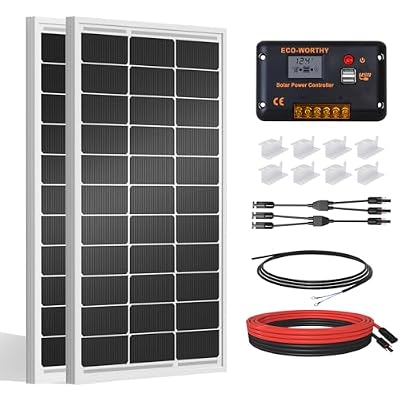
Panel watts needed = daily Wh ÷ (peak sun hours × system efficiency)
System efficiency is where optimism dies. A flat roof-mounted panel never hits its rated output: heat derates it 10–15%, the controller and wiring take a few percent, the panel is horizontal instead of tilted at your latitude, and half your parking spots have a tree in them. Use 0.75 with an MPPT controller in good summer conditions and 0.60–0.65 in winter, when low sun angle punishes a flat panel hardest.



| Season / region | Peak sun hours | Efficiency factor | Panel W for 894 Wh/day | Reality on a van roof |
|---|---|---|---|---|
| Summer, Southwest US | 5.5 | 0.75 | ~215W | Easy. 200W covers it. |
| Summer, Pacific NW / Northeast | 4.5 | 0.72 | ~275W | 300W is comfortable. |
| Spring / fall, most of US | 4.0 | 0.70 | ~320W | 400W gives margin. |
| Late fall, 40°N and above | 2.5 | 0.65 | ~550W | Near the roof limit. |
| December–January, 40°N+ | 1.5 | 0.60 | ~990W | Not happening. Plan otherwise. |
Read the bottom two rows again. A Transit or Sprinter roof, once you subtract a fan and a vent, realistically holds 400–600W of rigid panel. In December at northern latitudes you would need roughly double that to run the same loads you ran in June — and your loads went up, because the heater is running and you are inside more. Solar alone does not carry a full-time van through winter above about 38°N. Anyone telling you 400W is “enough year-round” is quietly assuming you migrate south.
MPPT vs PWM: not a close contest anymore
A PWM controller drags the panel down to battery voltage and throws away the difference. Modern “12V” 100W panels have a Vmp near 18–20V; pulling that to 13.6V discards roughly 25–30% of the harvest. An MPPT controller converts that surplus voltage into extra current instead.
The gap is widest exactly when it matters: cold mornings (panel voltage rises when cold, and MPPT captures it), low light, and partial shade. MPPT also lets you wire panels in series, which means thinner, cheaper wire from roof to controller. Reserve PWM for a trickle panel on a starter battery. Sizing: a 20A MPPT handles about 260W on 12V, a 30A roughly 400W, a 50A up to 700W — check the controller’s rated input, not just the amps. Fusing and cable gauge are in our van electrical wiring guide.
The DC-DC charger is what actually saves the build
Here is the part most sizing articles skip. A DC-DC (B2B) alternator charger pulls power from your engine’s alternator into the house bank while you drive, at a fixed, battery-safe rate. A 30A unit puts back 30Ah for every hour of driving; a 50A unit, 50Ah.
Compare that to the tables above. One hour of driving on a 30A DC-DC replaces about 40% of a full-timer’s daily use. Two hours on a 50A unit replaces an entire winter day. In December, when 600W of roof panel is scraping together 20Ah, the alternator is doing 80% of the charging — which is why builds that survive winter almost always have one, and builds that don’t are the ones running the engine at idle in a parking lot.
Use a proper DC-DC charger rather than a plain isolator relay: it protects a smart alternator from a lithium bank that will accept everything it can give, and it delivers the correct charge profile. Size it to your alternator — 30A is safe on almost anything, 50A wants a healthy modern one and heavy cable. Read wiring a DC-DC charger to a smart alternator first. Shore power is the third leg: a 20–30A converter resets the bank overnight at a campground. You want at least two working sources in any season.
Troubleshooting: why your system underperforms
- Panels never hit rated watts. Normal. Expect 70–80% of rating at midday in summer. If you see under 50% at noon in clear sun, suspect shading, a PWM controller, or undersized wire.
- Battery never reaches 100%. Often the controller’s absorption stage is too short, or the array is simply undersized for the season. Check the charge profile matches your chemistry — LiFePO4 wants roughly 14.2–14.6V absorption and no float-stage overcharging.
- Big overnight drain you can’t explain. Inverter idle, an always-on stereo head unit, a fridge with a failing door seal, or a propane/CO detector. Put a shunt-based monitor on the bank; guessing from a voltage readout is useless with lithium, whose voltage barely moves between 90% and 20%.
- Great in summer, dead in January. This is not a fault. It is the seasonal math. Add alternator charging, reduce the heater’s runtime with better insulation and window covers, or move south.
- Voltage drop. Long thin runs between roof and controller lose real power. Series-wiring the panels and using correctly gauged cable fixes most of it.
Putting it together
For the 70Ah/day example: a 200Ah LiFePO4 bank, 400W of roof solar on a 30A MPPT, a 30A DC-DC charger, and a 30A shore charger. That combination runs three seasons on solar alone and survives winter on the alternator. Scale the panels up or the loads down using the same three formulas — daily Wh, battery from 2× autonomy and usable depth, panels from worst-month sun hours. If you are still costing out the build, our van conversion cost breakdown puts electrical spend in context against the rest of the project.
Frequently Asked Questions
Is 400W of solar enough for full-time van life?
For three seasons in most of the US, yes — 400W on an MPPT controller comfortably covers a 70Ah/day build with a fridge, fan, lights and a laptop. It is not enough for December and January above roughly 38°N, where short days and low sun angle can cut harvest to a quarter of summer output. Pair it with a DC-DC alternator charger and the shortfall stops mattering.
How many amp-hours does a 12V compressor fridge use per day?
A well-insulated 45–55L 12V compressor fridge typically uses 25–35Ah per day at mild ambient temperatures, running a 30–35% duty cycle. In a hot van interior the duty cycle can exceed 50%, pushing consumption to 45–55Ah per day. Chest-style units hold cold better than front-opening drawers because cold air does not spill out when you open them, which is worth several amp-hours daily in summer.
Do I need MPPT or is PWM good enough for a small system?
MPPT is worth it for anything you live on. Because most modern 100W panels have an 18–20V maximum power voltage, a PWM controller throws away roughly 25–30% of the available energy by dragging the panel down to battery voltage. MPPT also allows series wiring for thinner cable runs and performs far better in cold and low light. PWM is only sensible for a tiny maintenance panel on a starter battery.
How much battery do I need for 400W of solar?
Battery size comes from your loads, not from your panels — but as a sanity check, 400W of solar is well matched to a 200Ah LiFePO4 bank supporting about 70Ah of daily use. Charging a much smaller bank with that array wastes harvest once it fills by midday; a much larger bank will rarely reach full charge outside summer. Size the battery first, then the panels.
Can a DC-DC charger replace solar entirely?
It can if you drive most days. A 50A DC-DC charger replaces a full-timer’s daily consumption in about two hours of driving, which makes it the more reliable source in winter and for anyone who moves frequently. Solar earns its place when you park for several days at a stretch, and it works silently without engine hours. Most robust builds run both, plus a shore charger.
Ready to decide? Our #1 pick for 2026 is the 12V compressor fridge, 50L (35% duty).
Live price & availability on Amazon.