Last updated: September 12, 2026
Short answer: yes, induction cooking works well in a camper van — but almost nothing sold as a “12V induction cooktop” is truly DC-powered. Most are 120V units running through an inverter, and a 1,800W burner pulls roughly 160 amps at 12 volts. Induction is realistic only with a lithium bank, a high-current BMS, a pure sine wave inverter and properly sized cable.


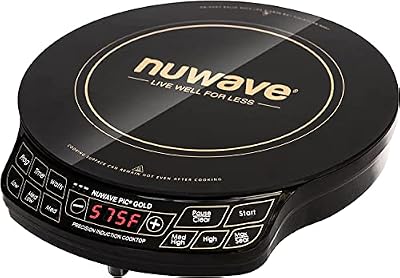
Quick answer: Our top pick in 2026 is the 300W (setting 1–2) — our #1 rated choice. See the full ranked comparison, alternatives and buying advice below.
- Why “12V induction cooktop” is usually a marketing label
- What induction actually draws: watts, amps and cooking time
- Inverter sizing, surge and why sine wave shape matters
- Can solar and the alternator keep up?
- Cookware: the magnet test and the diameter trap
- Induction vs propane, diesel and butane in a van
- High-current DC wiring: this is the part not to guess
- Troubleshooting the common failures
- Frequently Asked Questions
Why “12V induction cooktop” is usually a marketing label
Search that phrase and you get three different products mixed together. Ordinary 120V countertop hobs — Duxtop, Nuwave, True Induction and similar — that people run off a van inverter. Genuinely DC-input units, which are mostly 24V or 48V marine and overland models because at 12V the current gets absurd. And small 12V “induction-style” warmers that are really resistive hot plates under an induction-looking glass top.
The distinction matters less than you might think, because the physics is identical either way. Whether the AC-to-DC conversion happens inside the cooktop or inside a separate inverter, your 12V wiring carries the same enormous current. That is where most van builds get into trouble — not at the cooktop, but upstream in the 12V electrical system.
What induction actually draws: watts, amps and cooking time
See also: Gifts for Van Lifers: Small, Useful and Actually Wanted • Van Toilets Compared: Composting, Urine-Diverting, Cassette and Bucket
The table assumes a 12V lithium bank around 12.6V under load and an inverter at roughly 88% efficiency. Minutes per 100Ah is continuous cooking from a full 100Ah LiFePO4 battery using its entire capacity — in practice you stop well short of empty.
| Cooktop power setting | DC draw at 12V (with inverter losses) | Minutes of cooking per 100Ah | What it is good for |
|---|---|---|---|
| 300W (setting 1–2) | ~22A | ~270 min | Simmer, keeping food warm, melting |
| 500W | ~45A | ~130 min | Gentle simmer, rice, sauces |
| 800W | ~72A | ~83 min | Most everyday cooking, frying eggs |
| 1,000W | ~90A | ~66 min | Steady saute, holding a boil |
| 1,400W | ~126A | ~48 min | Bringing a large pot up to heat |
| 1,800W (max) | ~160A | ~37 min | Fast boil, searing — short bursts only |
Those numbers are better than van forums usually claim, because nobody cooks at 1,800W for an hour. A typical dinner is a few minutes at full power to reach a boil, then twenty minutes at 400–800W — roughly 25–40Ah per meal. Two cooked meals a day lands near 50–70Ah, a real load but one a 200–300Ah lithium house bank handles without drama. The problem is never the total energy. It is the instantaneous current.
The 160-amp problem
160 amps is far more than most drop-in lithium batteries will deliver. Plenty of 100Ah LiFePO4 batteries ship with a BMS rated for 100A continuous discharge, sometimes with a brief 150A surge. Run an 1,800W cooktop off one of those and the BMS does exactly what it was designed to do: disconnect, mid-meal, with no warning beyond the inverter alarm. Two 100Ah batteries in parallel, or one 200A-rated battery, is the minimum for full-power induction.
Voltage sag compounds it: as the bank drops toward 12.0V, the inverter pulls even more current for the same output, and undersized cable adds its own drop. Builders who tested it in the driveway at full charge often find the cooktop cuts out at 40% state of charge in the field.
Inverter sizing, surge and why sine wave shape matters
For an 1,800W cooktop, plan on a 2,000W continuous pure sine wave inverter as the floor, or 3,000W if you also want a kettle or microwave. Induction hobs have no big motor-style inrush, but they pull near rated draw instantly, so headroom is about sustained output and heat rather than surge.
Wave shape is not optional. Modified sine wave inverters feed a choppy waveform into the cooktop’s switching electronics, and induction units respond with buzzing, erratic power regulation, error codes, or a dead control board a few months in. Buy pure sine wave. It is the single most common induction-in-a-van failure that has nothing to do with the battery. If you are still specifying components, this decision belongs in the same conversation as your inverter selection generally.
Budget for idle draw too. A 2,000–3,000W inverter left on all day burns 15–30W doing nothing — 30–60Ah over 24 hours, potentially more than the cooking itself. Wire it to a switch and turn it off between meals.
Can solar and the alternator keep up?
Not in real time, and they do not need to. A 400W solar array makes roughly 25–30A at 12V in strong sun, against a 160A cooking load. Solar is not powering the cooktop; it is refilling the hole afterward, and at 50–70Ah a day it does so in a few good hours — though not in December in the Pacific Northwest.
Driving is the stronger lever: a 40–60A DC-DC charger puts back 40–60Ah per hour on the road, so an hour of driving roughly covers a full day of induction cooking. Stationary for a week in poor sun, cooking every meal, you will run the bank down. That is the honest constraint, and the best argument for keeping a backup burner aboard.
Cookware: the magnet test and the diameter trap
Induction only works with ferrous cookware. Stick a fridge magnet to the bottom of a pan: if it holds firmly, the pan works. Cast iron, carbon steel and most magnetic stainless are fine. Straight aluminum, copper and most non-magnetic stainless are not, unless the manufacturer bonded a ferrous disc into the base.
Two things catch builders out. Base diameter: most hobs need roughly a 4.5 to 5 inch flat magnetic base to register a pan at all, so small camping pots and moka pots often do nothing. And weight: a loaded cast iron Dutch oven on a glass top in a moving van is a cracked cooktop waiting to happen. Stow both before you drive, and plan for it in your galley layout.
Induction vs propane, diesel and butane in a van
| Option | Typical output | Indoor air & moisture | Refuel / resupply | Install burden | Best for |
|---|---|---|---|---|---|
| Induction (inverter) | 1,800W, ~85% into the pan | No combustion, no CO, no added moisture | Electricity: solar, alternator, shore power | High — big bank, heavy cable, fusing | Lithium builds, cold/wet climates, stealth |
| Propane (LPG) | 7,000–10,000 BTU, ~40% into the pan | Produces CO and a lot of water vapor | Excellent across the US; tank swaps everywhere | Moderate — locker, venting, leak testing | Simple builds, long off-grid stays |
| Diesel cooktop | Slow to heat, low peak output | Sealed combustion, vented outside | Shares the vehicle tank — no extra fuel | High — fuel pickup, flue, through-floor | Cold-climate rigs that already run diesel heat |
| Butane single burner | ~8,000 BTU | Combustion indoors; canisters are pressure-sensitive | Canisters are cheap but bulky to stockpile | Almost none — it is a portable box | Backup burner, outdoor cooking, budget builds |
The efficiency column is the part people miss. A 1,800W induction hob puts roughly 5,200 BTU/h of usable heat into the pan; a 7,000 BTU propane burner, losing most of its heat around the sides, delivers closer to 2,800. Induction genuinely boils faster than a small van propane burner, and adds no combustion moisture — which matters if you are already fighting condensation. Propane wins on energy density and on cloudy week eight in a national forest. Plenty of good vans carry both: induction daily, a butane burner in a drawer for when the bank is low, alongside whatever heating setup keeps the rig warm.
High-current DC wiring: this is the part not to guess
A 160A load is a fire risk handled casually. Undersized or poorly terminated cable does not fail politely; it heats up inside a wall cavity you cannot see. The rules that matter:
- Cable gauge: for a 2,000–3,000W inverter on a short run (under about 5 feet each way), 2/0 AWG is the common specification, 4/0 for longer runs. Size for ampacity and voltage drop using a marine cable calculator, and use fine-stranded marine-grade copper, never solid house wire.
- Fusing: a Class T fuse rated for the inverter’s draw (typically 250–300A for a 2,000W unit) installed within about 7 inches of the battery positive terminal. Class T matters because it has the interrupt capacity to safely break a lithium short circuit; a cheap blade or ANL fuse may not.
- Terminations: hydraulic-crimped lugs with adhesive heat shrink. No butt splices, no set screws, no twisted strands under a bolt. Torque terminals to spec and re-check them after a few hundred miles of vibration.
- Protection: every high-current cable that passes through metal gets a grommet, and the whole run gets secured every few inches so it cannot chafe.
If any of that is unfamiliar, this is the point to have a 12V or marine electrician do the battery-to-inverter section. It is a couple of hours of labor against the cost of the van.
Troubleshooting the common failures
Cooktop cuts out at high power: almost always the BMS discharge limit or voltage sag, not the cooktop. Check the battery’s continuous discharge rating and measure voltage at the inverter terminals while cooking — more than about 0.5V below battery voltage means undersized cable or a bad crimp.
Buzzing, error codes or flickering display: modified sine wave inverter, or a pan that is a poor magnetic match. Try a known-good cast iron pan first before blaming the electronics.
Nothing happens when you place the pan: pan base is too small or non-magnetic. Do the magnet test.
Battery drains overnight with no cooking: inverter idle draw. Switch it off.
Frequently Asked Questions
Can I run an induction cooktop directly off a 12V battery without an inverter?
Only with a cooktop specifically built with a DC input, and true DC induction units are uncommon at 12V because the current is so high. Most DC models on the market are 24V or 48V, aimed at marine and larger overland systems. If your build is 12V, you are realistically running a 120V cooktop through a pure sine wave inverter, and you should size your cable, fuse and BMS for roughly 160 amps at full power.
How big a battery bank do I need for induction cooking in a van?
For daily cooking, 200Ah of lithium at 12V is a sensible minimum and 300Ah is comfortable, assuming 400W or more of solar or a DC-DC charger you actually use. The capacity matters less than the discharge rating: the bank must deliver 150 to 170 amps continuously without the BMS tripping, which usually means two paralleled batteries or a single high-current unit.
Will lead-acid or AGM batteries run an induction cooktop?
In practice, no. AGM banks should not be discharged below about 50%, so a 100Ah AGM gives you only 50Ah of usable capacity, and pulling 160 amps from it causes severe voltage sag and rapid capacity loss under Peukert effects. You would need a very large, very heavy AGM bank to do what a modest lithium bank does easily. Induction is a lithium-era appliance.
Is induction actually faster than a propane burner in a van?
For boiling water, usually yes. An 1,800W induction hob transfers roughly 85% of its energy into the pan, while an open propane flame loses most of its heat around the sides and typically delivers around 40%. That makes a full-power induction burner comparable to or faster than the small 7,000 BTU burners fitted to most camper vans, and it adds no combustion moisture to the interior.
What fuse and cable size does a 2,000W inverter need at 12V?
The common specification is 2/0 AWG fine-stranded marine cable for runs under about five feet each way, protected by a 250 to 300 amp Class T fuse mounted within roughly seven inches of the battery positive terminal. Longer runs move up to 4/0. Verify against a voltage-drop calculator for your exact run length, and have the battery-to-inverter section inspected if you are not confident.
Ready to decide? Our #1 pick for 2026 is the 300W (setting 1–2).
Live price & availability on Amazon.