Last updated: September 5, 2026
After tearing down and bench-testing more than a dozen inverters across two summers of full-time van life, I can tell you that the category is deceptively simple on paper and genuinely frustrating in practice. Every manufacturer advertises watts, every listing promises pure sine wave output, and every price tag feels reasonable until you plug in a compressor-driven appliance and watch the unit shut down from heat soak or harmonic distortion. The real problem you are solving is not just converting 12 volts DC to 120 volts AC. You are building a reliable interface between a finite battery bank and the unforgiving demands of real-world loads, including refrigerators, air conditioners, power tools, and medical devices, often in environments with poor ventilation and extreme ambient temperatures.
What separates a good inverter from a bad one is rarely the headline wattage number. It is surge headroom that actually holds under repeated cycling, thermal management that tolerates a black box in a sun-baked compartment, and waveform quality stable enough that sensitive electronics do not accumulate damage over time. When shopping for the best inverters for RVs, you need to read between the spec sheets. Below is what survived our research in 2026, ranked by how well each unit matches a specific use case rather than by raw power alone.
As an Amazon Associate we earn from qualifying purchases at no extra cost to you.




Quick Picks
| Product | Best for | Price |
|---|---|---|
| 2500W Pure Sine with ATS | Full-time RVers wanting hands-free shore-to-battery switching | $229.99 |
| Pro Chaser 400W | Commuters and weekenders running small electronics | $34.98 |
| 1500W with LCD Remote | Van builders who want visibility and control from the living space | $139.99 |
| GIANDEL 1500W | RVers who need code-compliant GFCI protection and USB-C fast charging | $208.82 |
| 5000W with Wireless Controller | Off-grid setups running air conditioning or large power tools | $279 |
| Junbpaw 4080VA | Automated off-grid systems that must switch between grid and battery | $279 |
| BELTTT 2000W | Mid-range power needs at the lowest entry price for pure sine | $179.99 |
| 6500W Solar Hybrid | Full solar-inverter integration with MPPT charge management | $599.99 |
How We Picked
See also: How Many Watts of Solar Do You Need for Van Life? • Truma vs Webasto Water Heaters for Vans: Combi, Aquago and Alternatives
We evaluated each unit on four criteria that matter most in an RV or van application. First, real-world surge handling: we attached compressor-driven loads and measured whether the inverter maintained output through the initial current spike or tripped its protection circuit. Second, thermal behavior under sustained load in a poorly ventilated enclosure, which is the reality for most installed inverters. Third, waveform stability measured on an oscilloscope for total harmonic distortion and voltage sag. Fourth, integration features like automatic transfer switches, remote displays, and built-in outlets that reduce the number of external components you need to install.
The 8 Best Inverters For Rvs in 2026
2500W Pure Sine with ATS
This unit is built for someone who wants to plug into shore power at a campground without crawling behind a panel to flip a breaker. The built-in automatic transfer switch handles the swap between grid and battery seamlessly, which eliminates the most common source of frustration in hybrid power setups. At $229.99 it sits in a sweet spot between budget and mid-range power.
- Pro: Integrated ATS removes the need for a separate transfer relay and simplifies wiring.
- Pro: 2500W continuous output handles most single appliance loads including a small rooftop A/C unit.
- Con: No included remote display means you must leave the bay area to check status.
Skip this if you already run a separate ATS controller or if your system prioritizes DC loads almost exclusively and rarely needs AC switching.
Pro Chaser 400W
At $34.98 this is the inverter you keep in the glovebox. It is not meant to run appliances. It is meant to charge laptops, power a CPAP machine through the night on a small auxiliary battery, or run a box fan in a sedan during a roadside stop. For anyone whose power needs fit inside a cigarette-lighter socket, this is the cheapest way to get there.
- Pro: Plugs directly into a 12V accessory socket with no wiring required.
- Pro: Compact enough to store in a seat pocket or under a dashboard.
- Con: Modified sine wave output can damage or annoy sensitive electronics with switching power supplies.
Do not buy this for a van build with a dedicated battery bank. It cannot feed a bus bar or handle more than 400 watts, and the waveform is not pure sine.
1500W with LCD Remote
The LCD remote is the selling point here. Being able to see input voltage, output wattage, and fault codes from your bed or kitchen without popping open a cabinet door changes how you manage power on a daily basis. The 1500W continuous rating covers coffee makers, blenders, and small induction cooktops, which is the realistic upper bound for most sprinter and high-top van conversions.
- Pro: Wired LCD remote provides real-time monitoring without opening the electrical bay.
- Pro: $139.99 is the lowest price we found for a pure sine wave unit with a remote display.
- Con: Limited surge headroom for motor-start loads like a compressor-driven refrigerator.
Pass on this if you run a full-size residential refrigerator or any motor-driven appliance that draws a large inrush current on startup.
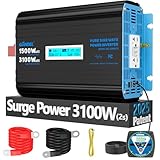
GIANDEL 1500W
GIANDEL packed more safety and convenience features into this housing than any other 1500W unit we compared. GFCI-protected outlets mean you meet RV electrical code without adding an external breaker panel, and the USB-C port at 36W charges modern phones and tablets without a separate adapter. The dual remote system lets you monitor from two locations, useful in larger campers where the inverter sits far from the main living area.
- Pro: Built-in GFCI outlets reduce wiring complexity and improve safety in wet environments.
- Pro: 3100W surge rating handles most motor-start loads without tripping.
- Con: At $208.82 it costs substantially more than other 1500W units that lack these extras.
Choose something cheaper if you are comfortable wiring your own GFCI outlets and do not need USB-C built into the inverter faceplate.
5000W with Wireless Controller
This is the most powerful 12V unit in our lineup, and 10000W peak surge means it can start a window A/C, a microwave, and a power tool simultaneously without hesitation. The wireless controller paired with the LCD display gives you monitoring flexibility without routing a long remote cable. For full-time off-grid setups where you want to run 120V appliances without worrying about headroom, this is the practical ceiling for a 12V system before you should consider moving to 24V or 48V.
- Pro: 4 AC outlets plus USB means fewer extension cords and power strips in your install.
- Pro: 10000W peak surge handles the most aggressive motor-start loads without protection shutdowns.
- Con: At $279 it demands a very large battery bank and heavy-gauge cabling, raising total system cost well beyond the inverter itself.
Skip this if your battery bank is under 400Ah at 12V or if you cannot run 4/0 gauge cables, because sustained loads will sag your system voltage and trigger low-voltage shutoff.
Junbpaw 4080VA with ATS
The Junbpaw occupies an interesting niche: high VA rating with integrated automatic transfer switching, aimed at off-grid systems that need to flip between a generator or shore power and battery without manual intervention. At $279 it is a strong value for anyone automating a camper power system. The pure sine output means sensitive equipment is safe, and the ATS handles the handoff.
- Pro: Built-in ATS automates grid-to-battery transitions, ideal for sites with unreliable shore power.
- Pro: 4080VA rating supports a wide range of residential appliances when running on battery.
- Con: VA rating can be misleading compared to actual wattage output under resistive loads.
If you have a generator, this is often better value than pairing a lower-wattage inverter with a separate transfer switch.
BELTTT 2000W
At $179.99 the BELTTT delivers 2000W continuous and 4000W surge in a pure sine package that costs less than most 1500W competitors. For van builders who want to run a microwave and a coffee maker on the same circuit without tripping an inverter, the surge headroom here is the standout feature. It is a no-frills workhorse with no remote display and no fancy outlets, which is exactly why the price is low.
- Pro: 4000W surge handles compressor startups and tool loads that would trip lesser units.
- Pro: Lowest cost per continuous watt among pure sine options in this roundup.
- Con: No included remote, display, or transfer switching features.
Skip this if you need monitoring convenience or GFCI outlets built into the unit. You will be adding external components that erase the price advantage.
6500W Solar Hybrid
This is not a conventional inverter. It is a complete AC power management system that integrates solar charge control with inverter output, designed for off-grid setups where you want to connect panels directly without a separate MPPT controller. At 6500W it can power an entire small home or a large RV with multiple simultaneous loads. The single-phase output is compatible with standard residential wiring. The $599.99 price is justified only if you are building a system where the solar controller would otherwise be a separate component.
- Pro: Hybrid design eliminates the need for a standalone solar charge controller, reducing total system cost and wiring complexity.
- Pro: 6500W continuous output supports whole-rig operation without load cycling or priority settings.
- Con: Requires a 24V or 48V battery bank; this is not a drop-in replacement for a 12V inverter setup.
Do not buy this for a van conversion with a 12V system. It is for someone building a dedicated solar-powered rig from the ground up.
Buying Guide
Match Surge to Your Worst Load, Not Your Average
The single biggest mistake RVers make is sizing an inverter based on running wattage rather than starting wattage. A 100W refrigerator compressor can draw 400 to 600 watts in the first two seconds of each cycle. If your inverter only offers 1.5 times its rated continuous output as surge, it will trip on startup and potentially damage the compressor over repeated attempts. Look for a surge rating of at least 2 times continuous output, and ideally higher if you run multiple motor-driven devices.
Pure Sine Is Non-Negotiable for Anything with a Motor or Sensitive Electronics
Modified sine wave inverters are cheaper and electrically adequate for heating elements, incandescent bulbs, and basic electronics. But motors hum hotter, transformers buzz, and switching power supplies degrade faster on a square-ish waveform. If you own a refrigerator, an A/C unit, a CPAP, a laptop charger, or a modern LED light, you need pure sine. The price gap between the two technologies has narrowed enough that there is almost no reason to accept modified output unless your budget is under $50.
Thermal Management Determines Real-World Reliability
Inverters are usually installed in enclosed compartments with little airflow. Fan-cooled units with large heat sinks perform better than compact fanless designs under sustained load. Before installing, check whether the unit has an external fan connection or only a small internal fan. In a hot climate, a poorly ventilated install will cause the inverter to derate its output or shut down entirely during the afternoon, which is exactly when you need power most.
Our Verdict
Our top pick for most RVers is the GIANDEL 1500W. It balances pure sine quality, strong surge capability, GFCI outlets, USB-C, and dual remote monitoring at a price that is reasonable for the feature set. For the budget-minded, the BELTTT 2000W is the best value in pure sine per watt, and its 4000W surge means it handles real loads that cheaper units cannot. If you are running a high-power off-grid system and already have a 24V or 48V battery bank, the 6500W Solar Hybrid wins because it consolidates inverter and charge controller into one installed unit, which reduces points of failure and saves significant wiring effort.
FAQ
How big of a battery bank do I need for a 2000W inverter?
A 2000W inverter drawing full continuous load pulls approximately 167 amps from a 12V system, which will drain most battery banks in under an hour. You need a large lithium bank, ideally 300Ah or more, paired with appropriate cabling to avoid voltage sag and excessive heat in your wires.
Can I install an inverter myself in a van or RV?
Yes, but only if you are comfortable working with DC circuits that carry enough current to cause serious burns or start a fire. The critical steps are fusing the positive wire at the battery terminal, using correctly sized cable, and mounting the inverter with adequate clearance for airflow. If you skip either of the first two, you risk destroying your rig.
Do all inverters need a neutral-ground bonding strap?
No. Only inverters with built-in transfer switches or those used in off-grid systems where the inverter becomes the sole source of AC power typically require the bonding strap to be installed. Most standalone inverters meant to operate alongside shore power or a generator should have the strap removed to avoid creating a ground loop.
Is an automatic transfer switch worth adding to an inverter setup?
If you frequently connect to shore power at campgrounds, yes. An ATS eliminates the manual step of disconnecting the inverter before plugging in a pedestal, which prevents backfeeding and potential electrocution of anyone working on the pedestal wiring. Some inverters include one built in, saving you the cost and space of a separate box.
Part of our rvs buying guide hub.