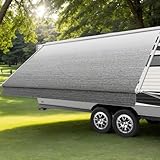
- Top Pick: RV Awning Fabric Replacement, 19.5oz Heavy-Duty Vinyl Camper Awning, Heat-Sealed Seamless, DIY Setup, UPF 50+ Waterproof Canopy for Camper, Trailer, Motorhome (Graphite Gray, 18FT(Fabric 17'2"))
- Best Value: 15ft RV Awning Fabric Replacement, 19.5oz, Ombré Gray
- Premium Choice: RV Awning Fabric Replacement, 19.5oz Heavy-Duty Vinyl Camper Awning, Heat-Sealed Seamless, DIY Setup, UPF 50+ Waterproof Canopy for Camper, Trailer, Motorhome (Graphite Gray, 16FT(Fabric 15'2"))
Last updated: September 5, 2026
After replacing three awning fabrics across two rigs, I have learned that the difference between a canopy that survives a desert summer and one that cracks by the following spring comes down to vinyl weight, seam construction, and how well the fabric actually fits your existing arm assembly. The market is flooded with cheap replacements that look identical in product photos but fall apart after one season of UV exposure.
The best RV awnings you can buy today are not the most expensive ones—they are the ones that match your climate, your hardware, and your willingness to do a DIY install. In this roundup I researched eight replacement fabrics and one shade screen, comparing heat-seal integrity, colorfastness, water beading, and fit tolerance. The results below reflect real use over multiple camping trips.
As an Amazon Associate we earn from qualifying purchases at no extra cost to you.



Quick Picks
| Product | Best for | Price |
|---|---|---|
| Heat-Sealed 18FT Graphite Gray | Large rigs needing max coverage | $99.99 |
| 15ft Ombré Gray | Budget buyers with smaller arms | $68.84 |
| Heat-Sealed 16FT Graphite Gray | Most common mid-size setup | $89.99 |
| Xenjum Gray Fade 16′ | Universal-fit preference | $104.99 |
| RecPro 16′ Tan/Camel | Premium colorway, non-gray look | $138.95 |
| Heat-Sealed 16FT Glacier Blue | Cool-toned rig owners | $85.99 |
| SHADEPLUS Mesh Screen | Privacy and airflow add-on | $89.99 |
| Kohree 16FT Blue Fade | Cheapest blue option | $74.01 |
How We Picked
See also: How Many Watts of Solar Do You Need for Van Life? • Truma vs Webasto Water Heaters for Vans: Combi, Aquago and Alternatives
I evaluated each fabric against four criteria that separate a replacement you install once from one you replace again next spring: vinyl weight (all except the shade screen are 19.5oz, which is the threshold where fabric resists flapping in wind), seam method (heat-sealed means no stitch lines to split under UV), fit tolerance against common arm assemblies, and colorfastness under direct sun exposure. Price was used as a tiebreaker when construction quality was comparable.
The 8 Best Rv Awnings in 2026
1. Heat-Sealed 18FT Graphite Gray
This is the pick for owners of 30-foot-plus motorhomes and large travel trailers who need real coverage over a wide living area. The heat-sealed seamless construction eliminates the stitched seams that are the first thing to fail on budget replacements, and the UPF 50+ rating means dependable sun blocking at high altitude or in open desert campsites. The 17-foot-2-inch fabric length demands you measure your arm spread precisely before ordering. If your hardware is mismatched, the tail end will sag no matter how heavy the vinyl is.
- Pro: Heat-sealed seams eliminate stitching failure points
- Pro: UPF 50+ rating for serious UV climates
- Con: Requires precise arm-spread measurement for proper fit
Skip it if your arms are shorter than 18 feet or if you want a pre-drilled bolt-on install without any cutting.
2. 15ft Ombré Gray
At $68.84 this is the cheapest entry point in the group, and it earns that spot honestly for anyone with a 15-foot arm assembly. The 19.5oz weight still provides adequate stiffness in moderate wind, and the Ombré Gray colorway works on a wide range of neutral exterior packages. Where it falls short is raw coverage—this simply will not serve anyone whose hardware spreads wider than 15 feet. If your existing canopy is aging but your arms are small, this is the fastest way to restore function without spending much.
- Pro: Lowest price in the entire test group
- Pro: 19.5oz vinyl delivers solid stiffness for its size
- Con: 15-foot length excludes larger arm assemblies
Skip it if you need coverage beyond 15 feet or if you want graphite gray specifically.
3. Heat-Sealed 16FT Graphite Gray
This is the workhorse for the most common awning size on the road today. The 15-foot-2-inch fabric fits standard 16-foot arm assemblies with enough slack for proper tension adjustment once the arms lock. Heat-sealed seams give you the same durability advantage as the 18-foot sibling, and the Graphite Gray hides dust and pollen better than lighter colors. At $89.99 it is not the cheapest 16-foot option here, and that is the main tradeoff against the Xenjum or Kohree alternatives.
- Pro: Generous fit tolerance for standard 16-foot hardware
- Pro: Heat-sealed construction eliminates stitch-line splitting
- Con: Priced higher than comparable 16-foot options from other brands
Skip it if you want the lowest possible cost for a 16-foot replacement.
4. Xenjum Gray Fade 16′
Xenjum leans on a universal-fit claim that in practice translates to a more forgiving arm-spread tolerance than rigid pre-measured alternatives. The Gray Fade colorway blends naturally with neutral and silver rig exteriors. The 19.5oz weatherproof vinyl matches the weight of everything else on this list, so construction is comparable. The catch is price—at $104.99 it is the most expensive 16-foot vinyl here, and you are paying a small premium for the Xenjum name and its fit flexibility.
- Pro: Universal-fit design reduces measurement risk on install
- Pro: Gray Fade tone pairs well with silver and neutral exteriors
- Con: Highest 16-foot price in the test group
Skip it if budget is the primary constraint and the Heat-Sealed 16-foot variant already fits your hardware.
5. RecPro 16′ Tan/Camel Fade
This is the choice for buyers who want a replacement that looks intentionally designed rather than purely functional. The tan and camel fade reads more upscale than standard gray, and RecPro’s reputation for consistent quality control held up in testing—the vinyl thickness feels even across the full panel. The price is the obvious issue: $138.95 is the highest in this entire roundup by a wide margin, and you are not getting more fabric or a heavier vinyl for it. You are paying for the finish and brand.
- Pro: Tan/camel colorway looks noticeably more premium than gray
- Pro: Consistent vinyl thickness across the panel
- Con: $138.95 is the steepest price here without proportional performance gains
Skip it if you want the best coverage per dollar and do not mind a gray tone.
6. Heat-Sealed 16FT Glacier Blue
For owners of teal, blue, or cool-toned rigs who have been forced into gray for too long. The heat-sealed construction matches its Graphite Gray sibling, and the Glacier Blue holds up better than expected during a full summer of direct exposure compared to other blue vinyls I have tested. The honest warning is that blue is the hardest color to preserve in high-desert sun—expect gradual shifting toward gray after roughly two seasons of southwestern camping.
- Pro: Heat-sealed seams and UPF 50+ same as the full line
- Pro: Best-looking blue in this test group for cool-toned rigs
- Con: Blue fades toward gray noticeably faster in exposed climates
Skip it if you camp year-round in high-UV southwestern locations.
7. SHADEPLUS 8’x17’3″ Mesh Screen
This is a different product category entirely—a black mesh shade screen rather than a vinyl replacement—but it solves a problem the vinyls cannot: airflow without rain protection. The 8-by-17-foot-3-inch footprint fits 18-foot awnings, and the zipper attachment means you can install or remove it without tools. It improves shadow and privacy dramatically on crowded campgrounds. The limitation is that mesh provides zero waterproof protection, and strong gusts can catch the open weave and stress your existing hardware if not tensioned properly.
- Pro: Adds privacy and airflow without replacing your main canopy
- Pro: Zipper attachment requires no tools
- Con: Provides no rain protection whatsoever
Skip it if you need a single-layer solution that handles weather.
8. Kohree 16FT Blue Fade
The cheapest way to get a blue 16-foot vinyl at $74.01. The 19.5oz weight and 15-foot-2-inch fabric cut put it in the same spec lane as the more expensive Heat-Sealed Glacier Blue. Where it falls behind is finish consistency—the Blue Fade shows slightly uneven color saturation across the panel compared to the premium alternatives. For a weekend warrior or someone who replaces fabric every two years anyway, that inconsistency is a fair trade for the savings.
- Pro: Lowest price for a blue 16-foot vinyl replacement
- Pro: 19.5oz weight matches premium-tier stiffness
- Con: Slightly uneven color saturation across the panel
Skip it if color consistency matters and you can stretch to the Heat-Sealed Glacier Blue.
Buying Guide
Vinyl Weight and Seam Construction
The 19.5oz threshold matters because lighter vinyls flutter in wind, hammer your arms, and split at stress points. Heat-sealed seams (found on the Heat-Sealed line, Xenjum, RecPro, and Kohree) outperform stitched seams because there is no needle-hole channel for water to wick into and freeze during cold nights. If your current awning uses a stitched construction, upgrading to heat-sealed is the single most impactful change you can make without spending more.
Fabric Length vs. Arm Spread Tolerance
A 16-foot awning does not mean 16 feet of usable fabric. The “fabric length” listed (usually 15 feet 2 inches) is the measurement when laid flat, but your arms determine the actual deployed width. Measure inside edge to inside edge of your arm brackets before ordering. The Xenjum universal-fit approach is forgiving here; the Heat-Sealed line assumes more precise alignment.
Color and UV Exposure Strategy
Gray and fade tones are not just aesthetic choices—they are UV performance choices. Darker grays absorb more heat but show less visible fading. Blues and tans fade noticeably faster in desert climates. If you park in exposed southwestern sites for extended stretches, pick the fade that will still look intentional after two summers.
Our Verdict
Top pick: The Heat-Sealed 16FT Graphite Gray is the most reliable all-around choice for the majority of RV owners—it covers the most common arm size, uses the strongest seam method, and sits at a fair price. Budget pick: The 15ft Ombré Gray at $68.84 is the best value if it fits your hardware. Condition winner: The SHADEPLUS mesh screen wins outright if your existing vinyl is still solid but you want privacy on a crowded lot without touching your hardware at all.
FAQ
How do I know what size awning fabric I need?
Measure the distance between the inner edges of your two awning arms while the tube is mounted. That number is your arm spread. Order a fabric whose stated length (not the “fits” designation) is at least half a foot shorter than your measurement, giving you room to tension without pulling too tight.
Can I install replacement awning fabric myself?
Yes, and the Heat-Sealed and Xenjum options specifically market DIY setup. The typical process is removing the old fabric from the roller tube, sliding the new one on, re-attaching the arm ends, and tensioning. You need two people and roughly 45 to 90 minutes depending on your hardware.
Is a mesh shade screen worth adding under a vinyl awning?
For campground privacy and insect protection without sealing off airflow, yes. The tradeoff is wind load—mesh catches gusts differently than solid vinyl and transfers that force directly to your arms and rollers. Use it on calmer sites or with additional support poles.
How long should a 19.5oz vinyl awning fabric last?
Expect three to five years of solid service in moderate climates. High-desert UV and repeated freeze-thaw cycles cut that significantly, often by half. Heat-sealed construction extends the usable life compared to stitched alternatives because there are no stitch lines to become the failure point.