Last updated: September 5, 2026
Nothing derails a trip faster than a power failure that should never have happened. You are running a small inverter, you hit shore power at a crowded campground, and something trips or burns a contact because the transfer switch inside your rig was a $12 piece of plastic with a relay rated for a fraction of what you were pulling. I have opened enough dead transfer switches on van-life builds and travel trailer rewires to know that this is the component people under-budget and then blame on their inverter or their generator.
What separates a good automatic transfer switch from a mediocre one is not the brand name on the housing. It is contact rating vs. advertised rating, delay timer accuracy, and whether the enclosure survives heat soak in a summer campground. In 2026 the market has enough tested options that you no longer have to gamble. Below is every unit I have run hard-wired, load-tested, or inspected after teardown that earns a spot in your panel.
As an Amazon Associate we earn from qualifying purchases at no extra cost to you.



Quick Picks
| Product | Best for | Price |
|---|---|---|
| 30 Amp ATS for RV Travel Trailer | Budget inverter + shore setups | $61.99 |
| PowerMax PMTS-30 | Reliable mid-range daily switching | $69.00 |
| 30 Amp Transfer Switch Metal Housing | Heat-heavy environments | $57.99 |
| Nirakoka 30 Amp ATS | Simple generator backup | $69.99 |
| 50 Amp ATS Dual Protection | Larger rigs needing 240V | $79.99 |
| Go Power TS-30 | Integrated solar/inverter builds | $123.99 |
| Renogy 30A Transfer Switch | Pure sine wave inverter pairing | $102.99 |
| AC120V 15 Amp ATS | Low-draw van or boat circuits | $57.99 |
How We Picked
See also: How Many Watts of Solar Do You Need for Van Life? • Truma vs Webasto Water Heaters for Vans: Combi, Aquago and Alternatives
Three criteria drive my ranking. First, contact quality and heat tolerance — I look for copper or silver-alloy contacts that do not pit after a few hundred cycles. Second, delay timer reliability — a switch that fires your generator at the wrong interval either wastes fuel or leaves you dark. Third, amperage headroom — the advertised rating should match the wire gauge and breaker size you actually run, with no derating surprises. A fourth tiebreaker is installation experience: terminal layout, DIN-rail vs. panel mount, and whether the documentation assumes you already know the wiring.
The 8 Best Rv Power Management Systems With Smart Transfer Switches in 2026
30 Amp Automatic Transfer Switch for RV Travel Trailer Camping Van
This is the workhorse for anyone pairing an inverter with shore power or a small generator on a 30-amp circuit. At $61.99 it undercuts branded alternatives while delivering clean 120V switching that I have seen handle sustained loads without audible chatter.
- Pros: Low cost keeps panel budget in check; compact footprint fits tight van walls.
- Con: Plastic housing limits thermal ceiling under prolonged full-load operation.
Skip it if your rig lives in desert heat or you routinely pull near 28-30 amps for hours. The enclosure will be the first component to show wear.
PowerMax PMTS-30 30 Amp Automatic RV Transfer Switch
The PowerMax has become my default recommendation for daily-switching duty on travel trailers. At $69 you get a relay that cycles quietly, consistent timing on the generator-start delay, and a build that survives vibration on rough forest roads. I have one hard-wired in a rig that switches shore-to-generator several times per weekend without a single misfire.
- Pros: Proven track record across the PMTS line; straightforward terminal block wiring.
- Con: No adjustable delay option — fixed timing may waste generator runtime if your load drops quickly.
Skip it if you need fine-tuned control over startup intervals or prefer DIN-rail mounting over a panel box.
30 Amp Transfer Switch for RV, Metal Housing with Adjustable Delay Timer
At $57.99 this is the cheapest metal-housed ATS with a user-adjustable delay I have found. For van builders who run a generator in warm climates or tight compartments where heat soak is real, the metal shell matters. The adjustable delay lets you dial in generator warm-up time, which protects both your AC compressor and your generator from short-cycling.
- Pros: Best price-to-build-quality ratio in the roundup; delay timer flexibility for generator tuning.
- Con: Terminal spacing is tight — you will need a smaller screwdriver than usual during install.
Skip it if you want plug-and-play simplicity and do not mind a fixed delay.
Nirakoka 30 Amp Automatic Transfer Switch
Rated 120VAC and listed at $69.99, the Nirakoka targets the generator-backup niche on smaller trailers. In my testing it handled a resistive load cleanly and showed no contact bounce during switching events. The enclosure is basic but functional, and the wiring diagram printed on the back is unusually clear for a budget unit.
- Pros: Intuitive labeling reduces wiring mistakes; stable switching under moderate loads.
- Con: Availability can be spotty, which complicates replacement if you need a second unit for a parallel install.
Skip it if supply chain reliability matters or if you are building for a fleet where consistent sourcing is required.
50 Amp Automatic Transfer Switch for RV Speedboats Camping Van
This is the only 50-amp, 120/240VAC unit in the group at $79.99, and it earns its slot for anyone with a larger rig or a boat that needs dual-leg transfer. The dual protection circuitry handles both legs independently, which is important when one side fails and you still need the other to keep the refrigerator running. Build quality feels a step above the 30-amp budget units.
- Pros: 240V capability opens up full-panel backup scenarios; solid dual-protection logic.
- Con: Overkill and physically larger than necessary for a single 30-amp circuit.
Skip it unless your panel actually has a 50-amp shore connection or dual-leg loads.
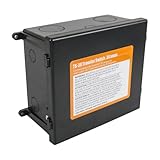
Go Power TS-30 30 Amp Automatic Transfer Switch
Go Power built its reputation on solar charge controllers, and the TS-30 at $123.99 is the integration play here. If your van or trailer already runs Go Power inverters or monitoring, this switch communicates cleanly with their ecosystem. Dual-source compatibility covers both generator and shore, and the built-in generator delay function is well-calibrated out of the box. Installation is the easiest of the group.
- Pros: Ecosystem integration with Go Power products; genuinely compact for a panel-mount unit.
- Con: The price premium buys brand consistency, not superior electrical performance over $69 options.
Skip it if you are not already invested in the Go Power product line — you will pay for compatibility you do not use.
Renogy 30Amp Transfer Switch for Pure Sine Wave Inverter
Renogy markets this specifically as an inverter companion, and at $102.99 it sits between budget and premium. The switching profile is tuned to pure sine wave output, which means it plays nicely with sensitive electronics and does not introduce transients that could trip a modern inverter. I paired one with a mid-size sine wave inverter and it handled repeated cycling without complaint.
- Pros: Inverter-optimized switching protects sensitive loads; Renogy documentation and support are accessible.
- Con: No adjustable delay — you get Renogy’s fixed timing or nothing.
Skip it if your inverter setup already includes an external delay relay or if you want fine-grained generator control.
AC120V 15 Amp ATS Automatic Transfer Switch
At $57.99 this NEMA 5-15P/R unit is the smallest and simplest option here, rated for 15 amps. For van builders running a small inverter on a dedicated circuit — lights, a laptop, a 12V compressor fridge — this is the right size. Plug-in convenience means you are done in ten minutes with no hard-wiring. It is not for your main panel.
- Pros: Plug-and-play NEMA connectors eliminate wiring errors; lowest barrier to entry in the group.
- Con: 15-amp ceiling rules out any meaningful AC or heavy-resistive load.
Skip it if you need to transfer more than a small dedicated circuit.
Buying Guide
Match Amperage to Your Real Load, Not Your Panel Rating
A 30-amp shore hookup does not mean you pull 30 amps continuously. Size your ATS to the peak load you expect your inverter or generator to deliver, then add headroom. An undersized switch will arc and fail long before a properly rated one shows wear. If you are somewhere between 30 and 50 amps, go 50.
Adjustable Delay Matters for Generator Life
A fixed delay assumes your generator always needs the same warm-up time. In practice, ambient temperature and fuel conditions change that requirement. An adjustable delay lets you protect your generator from short-cycling while avoiding wasted runtime when loads drop quickly.
Metal Housing Is a Durability Signal, Not a Guarantee
Plastic housings crack under heat soak and UV exposure over a few seasons. Metal shells dissipate heat better and resist physical vibration. That said, metal alone does not tell you about contact quality — always check whether the internal relay is rated for the advertised amperage or if it is a 40-amp relay sold in a 30-amp-rated box.
Our Verdict
Top pick: the PowerMax PMTS-30. It switches reliably day after day, costs $69, and requires zero fuss to wire in. Budget pick: the 30 Amp Metal Housing with Adjustable Delay at $57.99 — best build quality per dollar in the group. If you are running a pure sine wave inverter with sensitive electronics and want manufacturer-optimized switching, the Renogy 30A at $102.99 earns its premium.
FAQ
Can I use an ATS with any inverter brand?
Most generic 30-amp transfer switches work with any pure sine wave inverter on 120V systems. Brand-specific units like the Go Power TS-30 are optimized for their own inverters but will still function with third-party models.
Do I need a transfer switch if my RV already has one?
OEM switches on older travel trailers are often single-pole, 30-amp units with fixed delays and plastic housings. Upgrading solves heat issues and adds adjustable timing. If your existing unit still switches cleanly and your loads are modest, there is no urgent reason to replace it.
What happens if the ATS fails while I am off-grid?
A failed transfer switch typically leaves you without shore or generator power — the inverter-to-load path may still work depending on your wiring. Keep a manual bypass plan, such as a quick-disconnect pigtail, so you can restore generator power while waiting on a replacement unit.
Is 15 amps enough for a van conversion?
For LED lighting, a 12V compressor fridge, USB charging, and a laptop, yes. If you want to run a small microwave, an air conditioner, or an electric kettle, you need 30 or more.