Last updated: October 8, 2026
Pick the Ram ProMaster if you want the easiest, cheapest full-time camper build: it is wider inside (about 75.6 inches at its widest, enough for most people to sleep sideways across the van), its walls are close to vertical so cabinets fit with less scribing, it runs on a gas V6 that any shop can service, and a comparable high-roof ProMaster usually costs noticeably less than a Sprinter. Pick the Mercedes Sprinter if you need all-wheel drive, plan to drive forest roads, snow, or high mountain passes often, or want better fuel economy on long highway miles from its diesel engine.
In short, the ProMaster is the better platform for a layout and a budget, and the Sprinter is the better platform for traction and range. Both have high-roof versions with real standing room, so the decision mostly comes down to bed layout, where you plan to drive, and how much you are willing to spend on maintenance over the next ten years.
As an Amazon Associate we earn from qualifying purchases.

VanMart Vanspeed Thinsulate Van Insulation – Premium Soundproof & Thermal Barrier for Camper Van Conversions, Lightweight, Multiple Size Options for Sprinter, Transit, & ProMaster 20 feet
Included for 'Sprinter vs Promaster: Which to Convert' as a representative home product in this roundup; selection reflects the product set returned for this topic.
View on Amazon
Living in a Bubble Van Bug Screen for Mid & High Roof Mercedes Sprinter, Ford Transit & Other Campervans, Universal Size Rear Door Flyscreen Mosquito Net, Center Zipper Closure (Large)
Included for 'Sprinter vs Promaster: Which to Convert' as a representative home product in this roundup; selection reflects the product set returned for this topic.
View on AmazonCurrent-generation specs side by side
The figures below are for the 2026 model-year cargo vans, the usual starting point for a conversion. Interior measurements are before insulation and wall panels, which typically eat 1.5 to 3 inches per side.
| Spec | Mercedes Sprinter (cargo) | Ram ProMaster (cargo) |
|---|---|---|
| Engine | 2.0L 4-cyl turbo diesel, standard or high-output (roughly 170 hp and 211 hp) | 3.6L Pentastar V6 gas, 276 hp / 250 lb-ft |
| Transmission | 9-speed automatic | 9-speed automatic |
| Drive layout | RWD standard, AWD available with high-output engine | FWD only |
| Wheelbases | 144 in, 170 in, 170 in extended | 118 in, 136 in, 159 in, 159 in extended |
| Interior height (high roof) | about 79 in | about 76 in (high roof), up to about 86 in (super high roof) |
| Max cargo width | about 70 in | about 75.6 in |
| Width between wheel wells | about 53 in | about 56 in |
| Load floor height | higher (driveshaft and rear axle underneath) | as low as about 21 in |
| Max cargo volume | up to about 533 cu ft (170 extended, high roof) | up to about 524 cu ft (159 extended, high roof) |
Interior space and layout
See also: Best Ways to Keep a Van Tidy on the Road • Best Cyber Monday Cologne Deals
Width decides your bed
This is the single biggest practical difference. A ProMaster’s boxy body gives roughly 75 inches of usable width at bed height, so after insulation many builders still fit a sideways (east-west) bed for someone up to about six feet tall. That frees several feet of floor for a kitchen, a bench, or a garage. In a Sprinter, interior width is around 70 inches and the walls curve inward as they rise, so a sideways bed only works for shorter sleepers unless you add fiberglass window flares. Most Sprinter builds end up with a north-south bed or a raised rear platform, which costs length.
Height and length
The Sprinter high roof offers about 79 inches of standing room, slightly more than the ProMaster high roof. If you are tall, the ProMaster super high roof (around 86 inches inside) is the tallest factory option of the two, though it adds wind noise and height-clearance issues at drive-thrus and parking garages. For length, the Sprinter 170 extended and ProMaster 159 extended are close in cargo volume; the 144 Sprinter and 136 ProMaster are the popular “park anywhere” sizes.
Build ease
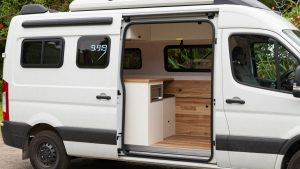
ProMaster walls are nearly flat and vertical, so upper cabinets, wall panels, and a bed frame need less custom shaping. Sprinter walls taper, which means more angled cuts and more time. The ProMaster’s low floor also makes the step in easy and leaves more headroom above a raised bed. The Sprinter’s advantage is a deep aftermarket: swivel seat bases, window kits, bug screens, roof racks, and ladders are made for it in large numbers, and most universal van parts list Sprinter fitment first.
Drivetrain: FWD vs RWD and AWD
The ProMaster is front-wheel drive only. That keeps the floor low and puts the engine weight over the drive wheels, which helps on wet pavement and light snow when the van is lightly loaded. The trade-off shows up on steep, loose climbs: a heavy rear build shifts weight off the front tires, and a loaded ProMaster can spin its front wheels on a gravel hill that an AWD van climbs easily.
The Sprinter is rear-wheel drive by default, with AWD available on the high-output engine. If your plan involves ski-resort parking lots, washboard BLM roads, or muddy trailheads, the AWD Sprinter is the only real choice of these two. A RWD Sprinter with a full build is not much better than a ProMaster in snow, so do not pay the Sprinter premium unless you are buying the AWD version or you value its diesel range.
Diesel vs gas: running costs and repairs
- Fuel economy: A built-out Sprinter diesel usually returns better highway mileage than a built-out ProMaster V6, often by a few miles per gallon. Diesel fuel often costs more per gallon than regular gas, which narrows the gap.
- Emissions system: Modern Sprinters use diesel exhaust fluid (DEF) and a particulate filter. These systems need regular highway driving to stay healthy, and repairs can be expensive.
- Service access: The ProMaster’s Pentastar V6 is shared with millions of Chrysler, Dodge, Jeep, and Ram vehicles, so parts are cheap and almost any shop can work on it. Sprinter service often means a Mercedes van dealer, higher labor rates, and longer waits in rural areas.
- Longevity: Diesels are known for long engine life, but total cost of ownership depends more on emissions-component and transmission repairs than on the engine block itself.
For a full-timer who drives far from cities, the ProMaster’s “fix it anywhere” advantage is real. For someone covering big highway miles every year, the Sprinter’s fuel savings add up.
Payload and weight
A finished camper with water, batteries, a fridge, and gear easily weighs 2,000 to 3,000 pounds before passengers. ProMaster cargo vans are rated for up to roughly 4,700 pounds of payload depending on configuration, and the lighter FWD drivetrain helps. Sprinter payload varies widely by 2500, 3500, and 4500 rating, roof, and AWD. Before you buy either, check the payload on the specific van’s door-jamb sticker, not the brochure maximum, and plan your build to stay under it with a margin for water and passengers.
Purchase price and resale
New, a comparably sized high-roof ProMaster usually lists for several thousand dollars less than a Sprinter, and the gap widens once you add Sprinter AWD. Sprinters tend to hold value well on the used market, especially AWD models, which partly offsets the higher entry price. Used ProMasters are plentiful and are often the cheapest route to a high-roof van.
Which van fits which traveler
| If you… | Choose | Why |
|---|---|---|
| Want a sideways bed and maximum floor space | ProMaster | About 75 in of width and near-vertical walls |
| Ski, drive snowy passes, or hit rough dirt roads | Sprinter AWD | Only AWD option of the two |
| Are on a tight build budget | ProMaster | Lower purchase price, simpler build, cheap parts |
| Drive long highway distances every year | Sprinter | Better diesel highway economy and range |
| Are over about 6 ft 3 in | ProMaster super high roof | Tallest factory interior |
| Want the widest aftermarket parts selection | Sprinter | Most van-specific parts target it first |
Gear that helps either build
Whichever van you choose, three upgrades pay off early. Insulation such as VanMart Vanspeed Thinsulate cuts both heat loss and road noise, and it is easier to install in the open shell than after framing. A magnetic bug screen like the Living in a Bubble screen, made for mid and high roof Sprinters and Transits, lets you leave the sliding door open on warm nights. If you are converting a Sprinter, a 360-degree swivel seat base for the passenger seat turns the cab into part of the living space. For a garage area holding tools and recovery gear, a lockable steel unit such as the etesan 32-inch cargo shelving keeps heavy items anchored.
Bottom line
For most first-time builders, the ProMaster is the smarter, cheaper, more spacious conversion base. Choose the Sprinter when you genuinely need AWD or you will rack up big highway mileage and are comfortable with dealer-level diesel maintenance costs.