Last updated: October 8, 2026
- Best Wooden Dog Crates for Travel and Home
- Our top choices by situation
- Wood construction: solid timber versus wood composite
- Head-to-head comparison of the main crate types
- Ventilation matters more than appearance in a van
- How to choose the correct interior size
- Washable surfaces and the parts that wear first
- A practical decision matrix
- Final buying checklist
Best Wooden Dog Crates for Travel and Home
The best wooden dog crates for van travel are furniture-style crates with solid ventilation panels, a washable floor, a secure front door, and enough interior length for your dog to stand, turn around, and lie down comfortably; for most campers, a wood-composite crate is a better choice than untreated solid wood.
Wooden crates can make a van or living room feel less like a kennel, but they are not automatically travel-safe. Their main advantages are appearance, useful furniture surfaces, and better insulation from visual distractions than an open wire crate. Their weaknesses are weight, moisture damage, chewing, and doors or fasteners that may not tolerate movement in a vehicle. The right choice depends on whether the crate is mainly a home den, an occasional travel crate, or a permanent part of your van layout.

Amazon Basics Furniture Style Dog Crate, Sturdy Wooden Pet Kennel, End Table with Space for Pet, Two Bowls Included, 30" x 20.4" x 23.6", Walnut
Included for 'Best Wooden Dog Crates for Travel and Home' because the listing specifies Sturdy Wooden Pet Kennel and End Table with Space for Pet, details this guide uses to compare options.
View on Amazon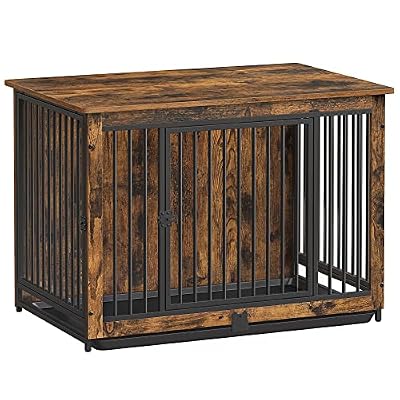
Feandrea 38" Dog Crate Furniture, Heavy-Duty Dog Kennel Side End Table
Included for 'Best Wooden Dog Crates for Travel and Home' because the listing specifies Heavy-Duty Dog Kennel Side End Table, details this guide uses to compare options.
View on Amazon
FurnPulse 48" XL Dog Crate Furniture for Medium & Large Dogs, Heavy Duty Chew-Resistant Steel Dog Kennel with 3 Doors & Locking Rings, 400 lb Top, Indoor Wooden Dog Cage & Pet House, Rustic Brown
Included for 'Best Wooden Dog Crates for Travel and Home' because the listing specifies 400 lb Top and Indoor Wooden Dog Cage & Pet House, details this guide uses to compare options.
View on Amazon
Easycom Foldable Dog Crate Furniture for Large Dogs, Rustic Brown (DC108)
Included for 'Best Wooden Dog Crates for Travel and Home' because the listing specifies Rustic Brown (DC108), details this guide uses to compare options.
View on AmazonOur top choices by situation
See also: Best Ways to Keep a Van Tidy on the Road • Best Cyber Monday Cologne Deals
- Best overall for home and occasional van trips: a wood-composite furniture crate with a removable tray and metal-bar ventilation on at least two sides.
- Best for a dog that chews: a metal crate placed inside a ventilated wooden cabinet, rather than an exposed wooden crate.
- Best for a compact van: a low-profile furniture crate with a front door and a second side access door, provided both doors can be secured during travel.
- Best for wet or sandy trips: a sealed wood-composite or laminated model with a removable plastic tray. Avoid unfinished timber.
- Best budget approach: a standard wire crate with a separate fitted cover or simple ventilated cabinet. It usually costs less and is easier to replace than a large wooden crate.
Wood construction: solid timber versus wood composite
Solid pine or hardwood looks attractive, but the material itself is not the key safety feature. Untreated timber absorbs water, odors, and urine; repeated wet cleaning can swell joints and lift the finish. Thin decorative panels may also split around screws when the crate is repeatedly moved.
Wood-composite products, including ecoFLEX-style plastic-and-wood materials and laminated engineered panels, are usually easier to wipe clean and less vulnerable to small spills. They are still not indestructible: a determined chewer can damage corners, door surrounds, and exposed edges. Look for rounded or capped edges, corrosion-resistant hardware, and a floor that can be removed without dismantling the crate.
For a van, avoid relying on the crate’s furniture weight to keep it in place. A wooden crate should be secured to a structural wall, floor track, or properly rated tie-down point. Do not attach restraints only to a thin cabinet panel or decorative trim.
Head-to-head comparison of the main crate types
| Crate type | Typical outside size | Typical weight | Ventilation | Chew resistance | Best use |
|---|---|---|---|---|---|
| Solid-wood furniture crate | 30–40 in long | 35–70 lb | Moderate, depending on slats | Low to moderate | Home use and calm dogs |
| Wood-composite furniture crate | 28–42 in long | 25–60 lb | Moderate to good | Moderate | Home plus occasional travel |
| Wood cabinet with internal metal crate | 30–44 in long | 45–90 lb | Good if the cabinet has large openings | Good | Chewers and permanent van installations |
| Wire crate with wooden cover | 30–42 in long | 18–35 lb | Good when uncovered on multiple sides | Good against wood damage | Frequent removal and flexible layouts |
These are planning ranges rather than specifications for every model. Furniture crates often have thicker panels and larger outside dimensions than their usable interior suggests, so measure the inside floor area before buying.
Ventilation matters more than appearance in a van
A crate with decorative wooden slats on one side may look open while still restricting airflow. For vehicle use, aim for substantial ventilation on at least two sides, preferably three, with no panel pressed tightly against a wall. Keep the door and ventilation openings clear of bedding, curtains, storage bins, and loose blankets.
Door placement is especially important in a narrow van. A front-only door works when the crate faces the aisle, but it becomes awkward if a bed, galley, or swivel seat blocks that aisle. A side door can make daily access easier, though it may be unsuitable if the side of the crate sits against a wall. Dual-door designs offer flexibility, but every unused door needs a positive latch that cannot rattle open while driving.
No crate should be used as a substitute for climate control or supervision. Vans can heat rapidly even on mild days. Use ventilation, shade, temperature monitoring, and appropriate travel planning; never assume that a wooden enclosure will keep a dog cool.
How to choose the correct interior size
Measure your dog in the position used for each dimension:
- Length: measure from the nose to the base of the tail while standing, then add 2–4 inches.
- Height: measure from the floor to the highest point of the head or ears, then add 2–4 inches.
- Width: measure the widest part of the body and add at least 4 inches.
For example, if a dog measures 28 inches from nose to tail base, 24 inches at the shoulder or head, and 16 inches wide, a practical minimum interior target is approximately 32 inches long, 28 inches high, and 20 inches wide. Check that the door opening is at least as large as the dog’s shoulder height and body width; a roomy interior is useless if the entrance is narrow.
Do not oversize dramatically in a moving van. Extra empty space can allow a dog to slide farther during braking and consumes valuable storage volume. The goal is comfortable movement, not a room-sized enclosure.
Washable surfaces and the parts that wear first
The floor is usually the first ownership problem. A fabric-covered wooden base traps moisture and hair, while a fixed floor makes accidents difficult to clean. Prioritize a removable plastic or coated-metal tray with a raised edge. A waterproof mat can sit above it, but leave enough clearance for the door to close without catching.
Common wear points include:
- Door latches: vibration can loosen screws or create rattles. Check them monthly and use locking hardware where appropriate.
- Bottom edges: wet bedding and condensation can cause swelling or finish failure. Lift and dry the crate rather than mopping around it.
- Ventilation bars: dogs may bend or loosen thin bars by leaning against them. Choose substantial metal bars or a protected internal crate for strong dogs.
- Exposed corners: chewing often starts where the dog can grip an edge. Metal corner guards or an internal crate are more reliable than bitter sprays.
- Hinges and fasteners: road vibration loosens furniture-style fittings faster than stationary home use. Carry spare screws or suitable replacement hardware.
Clean removable trays with mild soap and water, then dry them fully. Avoid saturating unfinished wood. If the crate develops a persistent odor, swelling, mold, or a sharp damaged edge, stop using it until the affected part is repaired or replaced.
A practical decision matrix
| Your situation | Recommended construction | Prioritize | Typical price range |
|---|---|---|---|
| Under $150, occasional use | Wire crate with wood cover | Removable tray, light weight, replacement parts | $70–$150 |
| $150–$300, home and weekend travel | Wood-composite furniture crate | Two-sided ventilation, secure latch, washable floor | $150–$300 |
| Permanent van installation | Ventilated cabinet around a metal crate | Anchoring, airflow, service access, corrosion resistance | $250–$700+ |
| Strong chewer or anxious dog | Internal metal crate, optional wood exterior | Escape resistance, rounded metal, door security | $200–$700+ |
Final buying checklist
Before ordering, compare the usable interior dimensions, not just the advertised crate size. Confirm that the door opens into a space you can actually reach in the van, that ventilation remains clear after installation, and that the crate can be anchored without drilling into wiring, plumbing, or a fuel system. Check the material around every latch and screw, inspect the tray for a raised lip, and calculate the total footprint including door swing.
For most people, the best wooden dog crates are not the most ornate models. Choose a sealed wood-composite crate for a calm dog and mixed home use; choose a metal crate inside a ventilated wooden cabinet for a chewer or a permanent van build. That distinction usually matters more than color, tabletop styling, or whether the crate matches the rest of the furniture.