Last updated: September 7, 2026
🛒 Best Price Today on Amazon
Prime members get fast, free shipping on everything above, plus member-only deals. New members get a 30-day free trial — cancel anytime.
Why the Right Solar Charge Controller Makes or Breaks Your Van Solar System
A solar charge controller for your van is the brain of your off-grid electrical system. It regulates the power flowing from your solar panels to your batteries, preventing overcharge and extending battery life. Choose the wrong one and you waste solar potential; choose the right one and your fridge, lights, and devices run smoothly for days without hookups. Here's what to look for and the top picks for van conversions in 2025.
MPPT vs PWM: The Core Decision
See also: Best Ways to Keep a Van Tidy on the Road • Best Cyber Monday Cologne Deals
Before comparing models, understand the two controller technologies. A PWM (Pulse Width Modulation) controller is a simple, inexpensive switch that connects the panel directly to the battery, pulling the panel voltage down to battery voltage — which wastes any excess voltage as lost potential. An MPPT (Maximum Power Point Tracking) controller is smarter: it uses a DC-to-DC converter to capture that excess voltage and convert it into usable charging amperage, typically harvesting 15–30% more energy from the same panels. For van life, where roof space is limited and every watt counts, MPPT is almost always the right choice — the higher upfront cost pays back quickly in extra usable power, especially in cloudy weather and partial shade.
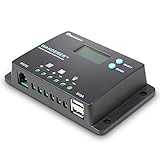
1. Renogy Rover 40A MPPT Solar Charge Controller
The Renogy Rover is the go-to MPPT controller for van builders. It supports 12V and 24V battery banks and handles up to 520W of panels on a 12V system. MPPT technology converts excess voltage into usable amperage, pulling up to 30% more power from your panels compared to PWM. The LCD display shows real-time charging status, and the built-in USB port charges devices directly. Compatible with lithium, AGM, and gel batteries, the Rover is the sweet spot for mid-to-large van arrays that want strong performance without paying a premium price.
2. Victron SmartSolar MPPT 75/15
Victron is the gold standard for serious van lifers who want reliability and smart monitoring. The SmartSolar 75/15 connects to the Victron Connect app via Bluetooth, giving you live data on solar input, battery state, and historical performance right on your phone. Its build quality is exceptional and it integrates seamlessly with Victron's Battery Monitor and inverter chargers. Best for 12V systems with up to 220W of panels, it's the controller to choose if you value long-term reliability and a genuinely useful monitoring app that helps you diagnose problems before they leave you without power.
3. Epever Tracer 20A MPPT Charge Controller
The Epever Tracer offers serious MPPT performance at a budget-friendly price point. It supports up to 260W of panels on 12V and includes a remote display option. The Tracer series is widely used among DIY van converters for its balance of features and value. It handles multiple battery chemistries and has configurable charging parameters, making it flexible for custom battery bank setups. For first-time builders on a tight budget who still refuse to give up MPPT efficiency, the Tracer is the value champion.
Buying Guide: Sizing Your Van Solar Charge Controller
- MPPT vs PWM: Always choose MPPT for vans — it's more efficient, especially in partial shade or variable light.
- Amperage rating: Divide total watt-peak of your panels by battery voltage (12V or 24V) to get required amps.
- Voltage window: Ensure the controller's max PV input voltage exceeds your panel string's open-circuit voltage.
- Battery compatibility: Confirm support for your battery type (LiFePO4, AGM, flooded, gel).
- Bluetooth monitoring: Victron's app integration is worth the premium for full-time van dwellers.
- Temperature compensation: Important if you camp in very cold or hot climates to protect battery health.
How to Match a Controller to Your Panels and Battery
Sizing is where most first builds go wrong. Start with your total panel wattage and your battery voltage. A common van setup — say 400W of panels on a 12V bank — produces roughly 400 ÷ 12 = 33 amps of charging current, so you'd want at least a 40A controller to leave headroom. Undersizing the controller means it will clip your peak output on bright days, throwing away the very power you paid for.
Equally important is the PV input voltage window. Add up the open-circuit voltage (Voc) of your panels in series and make sure it stays comfortably below the controller's maximum PV input rating, even in cold weather when panel voltage rises. Wiring panels in series raises voltage (better for MPPT harvesting and thinner wire runs), while wiring in parallel raises amperage. Getting this configuration right is the difference between a system that quietly overperforms and one that shuts down on a cold morning.
Common Charge Controller Mistakes to Avoid
Two errors show up again and again in van builds. First, mounting the controller far from the batteries with undersized wire — controllers should sit close to the battery bank with correctly gauged cable to minimize voltage drop. Second, forgetting to set the correct battery profile: a LiFePO4 bank needs different charge voltages than AGM, and running the wrong profile shortens battery life or leaves capacity on the table. Take five minutes to configure the charge parameters for your exact battery chemistry, and update them if you ever upgrade your bank.
Frequently Asked Questions
Do I really need MPPT, or is PWM good enough for a small van?
For very small systems — a single 50–100W panel trickle-charging a starter battery — a PWM controller can be an acceptable, cheaper option. But for any real van build running a fridge, fan, lights, and electronics, MPPT is worth it. It harvests 15–30% more energy from the same panels, performs far better in cloudy and shaded conditions, and lets you wire panels in series for cleaner installs. Given how limited van roof space is, MPPT's extra efficiency almost always justifies the cost.
What size charge controller do I need for my van?
Divide your total panel wattage by your battery bank voltage to estimate the charging amperage, then choose a controller rated above that. For example, 400W of panels on a 12V system produces about 33 amps, so a 40A controller gives you safe headroom. Always size up rather than down — a controller running near its limit runs hotter and may clip your peak production on the sunniest, most productive days.
Can one charge controller handle both my starter and house batteries?
A standard solar charge controller is designed to charge one battery bank — your house bank. To keep the starter battery topped up as well, most van lifers add a separate DC-to-DC charger or a battery isolator that shares charge between banks. Some controllers offer a small dual-output trickle feature, but for reliable charging of two separate systems, dedicated devices are the cleaner, safer approach.
Does the charge controller need to match my solar panel brand?
No. Charge controllers work with panels from any manufacturer as long as the electrical specifications are compatible — specifically the panel's voltage and current must fall within the controller's input ratings. You can absolutely pair Renogy panels with a Victron controller, or mixed-brand panels with an Epever unit. What matters is matching the numbers (Voc, wattage, and current), not the logos.
Is Bluetooth monitoring actually useful, or just a gimmick?
For full-time van dwellers, app-based monitoring like Victron's is genuinely useful, not a gimmick. Being able to see live solar input, battery state of charge, and historical trends on your phone helps you understand your system's behavior, spot a failing panel or loose connection early, and plan your power usage around the weather. Weekend builders may not need it, but for anyone living off their solar setup, the visibility it provides pays for itself in avoided dead-battery surprises.
Final Thoughts
For most van builds, the Renogy Rover 40A hits the sweet spot of performance and price. If you want premium app monitoring and long-term reliability, invest in the Victron SmartSolar. Budget builders who still want MPPT efficiency should check out the Epever Tracer. Pair whichever controller you choose with quality solar panels and properly sized wiring, and your van will harvest free energy wherever the sun shines.
As an Amazon Associate we earn from qualifying purchases at no extra cost to you.