Last updated: September 18, 2026
Quick answer: Our top pick in 2026 is the Fill directly from a trusted potable spigot — our #1 rated choice. See the full ranked comparison, alternatives and buying advice below.
The Short Answer
Yes—if you regularly fill your van from campground, RV park, or public water spigots and want better-tasting water with some protection from sediment and certain contaminants. A van water filter is not a complete water-purification system, though. It will not make questionable water safe, remove every chemical or microorganism, or replace good judgment about your water source.
For most van owners, an inline filter is a relatively inexpensive comfort upgrade. A basic model typically costs about $15 to $35, weighs roughly 1 to 2 pounds, and connects between the campground faucet and your fresh-water hose. The real question is whether your travel habits justify carrying and replacing one.
As an Amazon Associate we earn from qualifying purchases at no extra cost to you. Product prices and availability are accurate as of the date shown and are subject to change.

What You Actually Get
See also: Best Van Water Filter for Refill Stations in 2026: Tested and Ranked • How to Winterize a Van Water System (2026): Step-by-Step
A common RV inline filter uses activated carbon, often called GAC, along with KDF media. Activated carbon can improve taste and odor, particularly the chlorine taste common in municipal water. It may also reduce some organic compounds, but performance varies by filter design and water conditions. KDF media is generally used to help control certain metals and inhibit microbial growth inside the filter media.
That sounds more comprehensive than it is. An inline RV filter is primarily a taste, odor, and sediment-management product. It is not the same as a reverse-osmosis system, ultraviolet purifier, certified microbiological purifier, or whole-house treatment system. It also does not reliably remove salt, hardness, nitrates, fluoride, or every dissolved contaminant.
The filter attaches to a standard garden-hose-style potable-water connection. You connect one end to the campground spigot and the other to your drinking-water hose, then fill the van’s tank or use the hose directly, depending on your setup. Many owners leave the filter connected during a campsite stay, while others use it only when filling the tank.
Size varies by model, but many inline RV filters are approximately 10 to 12 inches long and 3 inches in diameter. They usually require no electricity, batteries, pump, or installation. That simplicity is the main appeal: there is no plumbing project and no counter space sacrificed inside the van.
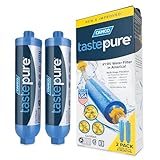
As a real-world price reference, the Camco Tastepure RV Water Filter with GAC and KDF filtration is listed around $20.82, while a two-pack is about $30.58. That puts the per-filter cost at roughly $15.29 in the two-pack, before tax or shipping. Actual prices change, but a reasonable planning range is $15 to $25 for one and $25 to $40 for a two-pack.
Pros
- Better taste and smell: Carbon filtration can make heavily chlorinated campground water more pleasant to drink and cook with.
- Some sediment reduction: An inline filter can catch visible grit, rust particles, and other larger debris before they reach your tank, faucet aerators, or drinking-water hose.
- Simple installation: Most units screw onto standard potable-water hoses in seconds. No tools, wiring, drilling, or permanent modification is required.
- Low operating cost: At approximately $15 to $25 per filter, the cost is modest compared with bottled water, countertop systems, or a built-in purification setup.
- No power consumption: The filter works from water pressure, so it uses zero watts and does not draw down your house battery.
- Useful for frequent travelers: If you stay at several parks each month, the filter provides a consistent first line of treatment even when water taste varies from site to site.
- Less plastic waste than bottled water: Filtering water from a refillable tank or hose can reduce the number of single-use bottles you carry and discard.
Cons
- It is not a safety guarantee: A basic inline filter should be used with treated, potable water from a known source. It should not be your solution for creek water, an untested private well, or a spigot marked non-potable.
- Limited contaminant removal: Carbon and KDF media do not equal reverse osmosis or certified pathogen removal. If you are worried about bacteria, viruses, parasites, heavy contamination, or a specific chemical, choose a treatment method designed and certified for that concern.
- Flow can decline: As the media loads with sediment, water pressure may fall. This is especially noticeable when filling a tank, running a shower, or using multiple faucets.
- Replacement is necessary: A filter is not a permanent device. Replacement timing depends on water quality and usage, but many travelers replace inline filters about every three months or sooner when flow drops, taste changes, or the filter becomes visibly dirty. Follow the product’s instructions.
- It adds connection points: Every extra fitting is another potential leak. Use a potable-water hose, hand-tighten connections, and avoid leaving the filter unsupported where its weight can stress the spigot or hose.
- Cold-weather storage takes care: Water left inside a filter can freeze and damage the housing. Drain it before freezing conditions, and store it in a clean, dry place.
- It does not clean your van’s tank: Filtering water as it enters cannot remove biofilm, sediment, or stale water already inside a neglected fresh-water tank. Tank sanitation remains part of normal RV maintenance.
Who Should Buy It
Buy an inline van water filter if you fill up primarily at established campgrounds, RV parks, municipal fill stations, or other clearly labeled potable-water sources. It is particularly worthwhile if you notice chlorine taste, unpleasant odors, fine sediment, or inconsistent water quality during trips.
It also makes sense for people who drink from the van’s tank rather than carrying bottled water. A filter can improve everyday water for coffee, cooking, brushing teeth, and drinking without requiring a permanent filtration installation. Full-time travelers may appreciate the convenience enough to keep a spare filter on hand; the two-pack is useful for this reason and lowers the approximate per-unit price.
Families, pet owners, and anyone who uses a lot of water may also find the filter worthwhile, although high-volume use will shorten its practical service life. If your van has a sensitive pump, small faucet aerators, or older plumbing, reducing incoming sediment can be a reasonable preventative measure—not a guarantee against plumbing problems.
Who Should Skip It
Skip a basic inline filter if you almost always use bottled water, stay only at locations with excellent water and never notice taste or sediment, or rarely fill your van’s tank. In those cases, the extra hose connection, storage space, and replacement schedule may not deliver enough value.
You should also skip it as your only treatment method if your water source is uncertain. For backcountry water, use a purpose-built purifier or treatment system matched to the risks in that area. For a private well, have the water tested and select equipment based on the results. If you need dependable removal of dissolved salts, hardness, nitrates, or a known chemical, a basic GAC-and-KDF inline filter is the wrong tool.
Cheaper Alternatives
| Option | Cost | Trade-off |
|---|---|---|
| Fill directly from a trusted potable spigot | $0 | Lowest cost, but you accept the source’s taste, sediment, and water-quality variation. |
| Use a clean potable-water hose with a screen washer | About $5–$15 | Can catch larger debris at the connection, but it does not meaningfully improve taste or remove dissolved contaminants. |
| Buy bottled water for drinking | About $4–$15 per trip | Convenient for occasional travelers, but costs more over time, takes storage space, and creates plastic waste. |
| Refill a countertop pitcher filter | About $20–$40 to start; $5–$15 per replacement | Often better for drinking water taste, but it treats only the water poured through it and needs indoor storage and filling. |
| Camco Tastepure single inline filter | About $20.82 | Easy and inexpensive, but it still has the capacity and contaminant-removal limits of a basic inline filter. |
| Camco Tastepure two-pack | About $30.58 | Lower cost per filter and a convenient spare, but you still need to monitor flow, storage, and replacement timing. |
FAQ
Does a van water filter make campground water safe to drink?
Only use it with water that is already designated potable. An ordinary RV inline filter can improve taste and reduce some sediment, but it should not be treated as a complete purifier. If a campground issues a boil-water notice or labels a source unsafe, do not rely on the filter to correct the problem.
Should I filter water before it enters the van’s tank?
Usually, yes, if you regularly drink from the tank and the source is potable. Filtering while filling can reduce incoming taste, odor, and sediment. It does not eliminate the need to sanitize the tank periodically or drain stale water before storage. Travelers who use only the campground hose may prefer filtering at the faucet for drinking and cooking instead.
How long does an inline RV water filter last?
There is no universal number of gallons because sediment levels and water use vary widely. A light-use traveler may get several trips from one filter, while a full-time traveler in dusty or sediment-heavy areas may need replacement much sooner. Replace it when flow drops noticeably, taste or odor returns, the housing is damaged, or the manufacturer’s recommended interval has passed.
Is an inline filter worth it in 2026?
For most van travelers who use campground water, yes. It is a low-cost, zero-watt upgrade that can make daily water more pleasant. Just think of it as a basic prefilter and taste improver—not a substitute for a tested water source, proper tank maintenance, or specialized purification when the water is genuinely unsafe.
Ready to decide? Our #1 pick for 2026 is the Fill directly from a trusted potable spigot.
Live price & availability on Amazon.