Last updated: September 7, 2026
As an Amazon Associate we earn from qualifying purchases at no extra cost to you.


🛒 Best Price Today on Amazon
Prime members get fast, free shipping on everything above, plus member-only deals. New members get a 30-day free trial — cancel anytime.
Camping Solar Generator: Off-Grid Power for Van Life and Camping
A camping solar generator, more accurately called a portable power station with solar charging capability, has become one of the most popular and practical pieces of gear for van lifers, overlanders, and weekend campers. Unlike gasoline generators, solar generators produce zero emissions, make no noise, require no fuel purchases, and can recharge for free from the sun using a compatible solar panel. This guide reviews the best solar generators for camping by capacity, features, and value so you can find the right power solution for your outdoor lifestyle.
1. Jackery Explorer 1000 Portable Power Station
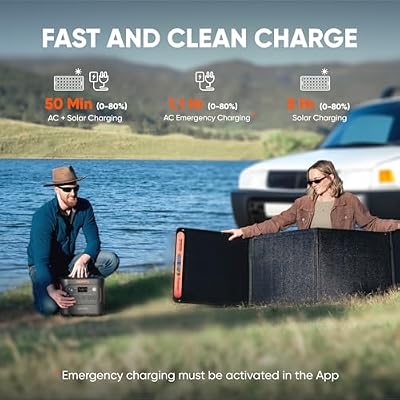
The Jackery Explorer 1000 is the most popular camping solar generator in its class because of its balanced combination of 1002Wh capacity, 1000W AC output, multiple charging ports, and competitive weight of 22 pounds. It powers laptops, CPAP machines, small refrigerators, LED lights, and all standard USB devices simultaneously. The LCD display clearly shows remaining capacity and input/output wattage. It recharges in 7-8 hours from two 100W solar panels or in 1.8 hours from a wall outlet.





As an Amazon Associate we earn from qualifying purchases. Product prices and availability are accurate as of the date/time indicated.
2. EcoFlow Delta 2 Solar Generator
The EcoFlow Delta 2 raises the bar with X-Stream fast charging technology that takes the unit from 0 to 80% in under an hour from a wall outlet, making it ideal for van lifers who occasionally have AC access and want to top up quickly. At 1024Wh capacity and 1800W output (with X-Boost technology supporting up to 2400W), it handles larger appliances than most competitors at this capacity. The companion app provides detailed monitoring and charging schedules via Bluetooth or Wi-Fi.


As an Amazon Associate we earn from qualifying purchases. Product prices and availability are accurate as of the date/time indicated.
3. Bluetti AC200P Portable Power Station
For van lifers who need serious off-grid power, the Bluetti AC200P offers 2000Wh capacity and 2000W AC output (4800W surge) in a single unit. It handles induction cooktops, power tools, and high-draw appliances that smaller units cannot. The 17 output ports include AC, USB-A, USB-C, carport, and wireless charging. Recharging options include solar, wall outlet, carport, and even a lead-acid battery. At 60 pounds, it is heavy but stays in the van rather than being carried on hikes.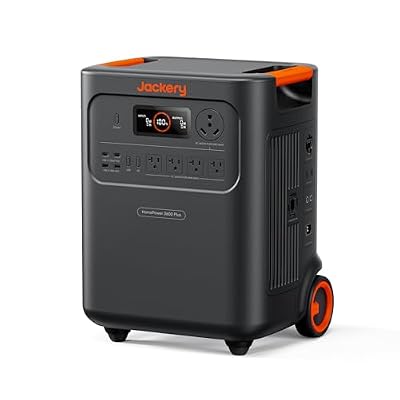
Jackery HomePower 3600 Plus Portable Power Station, 3600W AC Output, 3584Wh LFP Solar Generator, Expandable up to 21kWh, Essential Home Backup for Home Use, Emergencies, RV (Solar Panel Optional)


As an Amazon Associate we earn from qualifying purchases. Product prices and availability are accurate as of the date/time indicated.
Solar Generator Buying Guide
See also: Best Ways to Keep a Van Tidy on the Road • Best Cyber Monday Cologne Deals
- Capacity sizing: Add up the daily watt-hour draw of all devices you plan to power. A 1000Wh unit typically covers a day of laptop, phone, fan, and LED lighting for one person.
- Output wattage: Ensure the unit’s AC output exceeds the wattage of your highest-draw appliance. A coffee maker or electric skillet may draw 1000-1500W, near the limit of mid-size units.
- Solar input: Check the maximum solar input wattage and voltage range before buying compatible panels. Oversizing your panel array wastes money if the station cannot accept the input.
- LiFePO4 vs NMC battery: LiFePO4 (lithium iron phosphate) batteries have longer cycle lives (2000-3500 cycles vs 500-1000 for NMC), better thermal stability, and are worth the premium for daily van life use.
- Weight considerations: Portable power stations range from 11 pounds (small units) to 60+ pounds (large units). Consider how often you move the unit when evaluating weight.
- Warranty: Look for at least a 2-year warranty from an established brand with US-based customer support. Budget brands often have poor after-sales support.
Final Thoughts
A quality camping solar generator is one of the most impactful investments a van lifer or serious camper can make. The ability to power your devices, refrigerator, and small appliances from free solar energy fundamentally changes what is possible in a remote campsite. The Jackery 1000 offers the best balance of capacity, weight, and price for most users. Step up to the EcoFlow Delta 2 for fast charging capability or the Bluetti AC200P if you need serious power for high-draw appliances. Any of these units, paired with an appropriate solar panel, delivers reliable off-grid electricity that makes van life more comfortable and sustainable than ever before.
Frequently Asked Questions
What capacity should I buy for weekend camping?
For two or three nights running lights, phones, and a fan, a 300-500Wh unit is enough. Add a 12V cooler and you need 800-1,200Wh, since compressor coolers draw 300-500Wh per day in summer heat. Buy one size up from your calculation, because capacity is measured in ideal conditions and real output runs 10-15 percent lower.
How many solar panels does it take to recharge in a day?
Divide your daily use by four to five effective sun hours. A 1,000Wh unit consumed to empty needs roughly 200-300W of panel to refill in one good day, more in winter or under trees. Check the maximum solar input spec too, because many mid-size units cap at 200W regardless of how much panel you connect.
Can I charge it while driving?
Yes, but a standard 12V socket is fused at 10-15 amps, giving only about 100-120W. That is slow. A dedicated DC-to-DC alternator charger on heavy cable delivers 300-600W and refills a mid-size unit in two to three hours of driving, which is the fastest practical top-up on a road trip.
Is it safe to use inside a tent or van?
Yes. Unlike a gas generator there are no exhaust fumes, so indoor use is fine. The only requirement is airflow around the cooling vents and a stable surface. Keep it off damp ground, since most units are not weather sealed and carry no meaningful IP rating on the ports.
How should I store it between trips?
Charge to roughly 50-80 percent and store somewhere climate stable rather than a hot garage or freezing shed. Top it up every three months to keep the battery management system awake. Leaving a unit fully depleted for months is the most common way people ruin an otherwise healthy lithium pack.