Last updated: September 9, 2026
There is a moment every RVer learns to dread: you hook up to a campground faucet, turn on the tap, and a cloud of rust-colored water hits your sink. Or worse, the water looks fine but tastes like you are drinking a swimming pool. Municipal supply lines feeding RV parks are not always trustworthy, well water at dispersed camping sites can carry sulfur and sediment, and old hoses sitting in the sun breed bacteria. An inline water filter is the simplest insurance policy you can buy for your rig.
What separates a worthwhile filter from a waste of money comes down to three things: how much it actually reduces chlorine taste and odor, whether it survives being left pressurized overnight, and how often you can realistically replace it without gutting your budget. Many cheap filters look identical on the outside but use thin carbon beds that channel water around the media instead of through it. After comparing multiple options across campgrounds, gas station hookups, and a county fair lot with questionable plumbing, these are the eight that earned a permanent spot in my hose reel for 2026.
As an Amazon Associate we earn from qualifying purchases at no extra cost to you.


Quick Picks
| Product | Best for | Price |
|---|---|---|
| RV Water Filter 4-Pack with Hose Protector | Value bulk buying | $29.99 |
| Camco Tastepure Single | USA-made quality | $20.82 |
| GLACIER FRESH 4-Pack with 2 Hose Protectors | Marine and RV combo | $34.84 |
| GLACIER FRESH 2-Pack with 1 Hose Protector | Casual weekend campers | $21.24 |
| Crystala Filters 3-Pack | Premium taste on a budget | $38.99 |
| Hourleey 2-Pack | Multi-contaminant reduction | $24.99 |
| Camco Tastepure 2-Pack | Stocking spares | $30.58 |
| OKBA External Dual Filter System | Whole-rig filtration | $53.99 |
How We Picked
See also: How Many Watts of Solar Do You Need for Van Life? • Truma vs Webasto Water Heaters for Vans: Combi, Aquago and Alternatives
We evaluated each filter on filtration effectiveness (how noticeably it cut chlorine taste, odor, and visible sediment over a multi-week test), build quality (housing thickness, gasket integrity, whether it leaked at high campground pressure), compatibility with standard RV inline setups and common hose thread sizes, and long-term cost of ownership (price per filter divided by realistic replacement interval). We also weighed user-reported issues like bypass channeling and gasket degradation that only appear after several weeks of use.
The 8 Best Water Filters For Rvs in 2026
RV Water Filter, 4 Pack RV Inline Water Filter with Flexible Hose Protector
This four-pack is the best way to lock in a low cost per filter without sacrificing taste improvement. Each unit uses a standard activated carbon element housed in a translucent canister, and the included flexible hose protector keeps the connection point from kinking. The filters cut chlorine and sediment effectively at moderate campground pressure, and the clear housing lets you see when the carbon bed is spent. The gaskets are the weakest point here; leave one pressurized overnight and some users report slow weeping at the threads. Skip this if you need fluoride reduction or are dealing with sulfur-smelling well water, since a single carbon stage cannot address those contaminants.
Camco Tastepure RV Water Filter – GAC & KDF Filtration – Made in the USA
Camco has been the default RV filter recommendation for years, and for good reason. The combination of granular activated carbon and KDF media handles chlorine taste, odor, and sediment while also inhibiting bacterial growth inside the filter housing. The build quality feels noticeably better than the cheap four-packs, with a thicker housing and a more durable O-ring. Being made in the USA also means consistent manufacturing standards. The main drawback is the single-unit price: at twenty dollars for one filter, annual replacement costs add up if you camp frequently. Skip this if budget per filter is your primary concern and you only camp a handful of weekends per season.
GLACIER FRESH RV/Marine Water Filter with 2 Flexible Hose Protectors 4 Pack
GLACIER FRESH positions this as a dual-use filter for both RVs and boats, and the construction reflects that. The housings feel heavier and the hose protectors are longer than what most competitors include, which matters when you are coiling up in a marina slip or a tight RV bay. Four filters with two flexible protectors covers a season of typical use for a couple camping weekly. Taste reduction on chlorinated municipal water is solid, and the carbon bed seems to resist channeling better than the generic four-packs. The downside is price: this pack costs more per filter than the basic options, and the marine branding may mean you are paying for certifications you do not need. Skip if you camp infrequently or want the absolute lowest cost per cartridge.
GLACIER FRESH RV/Marine Water Filter with 1 Flexible Hose Protectors 2 Pack
Same GLACIER FRESH filtration quality, just a smaller package for people who want to try before committing to a four-pack. The two filters come with one hose protector, which is enough if you already have one lying around or prefer to swap cartridges without a protector in mild weather. Chlorine and sediment reduction matches the larger pack, and the canister threads on a standard RV inline fitting without needing an adapter. The con here is obvious: buying in pairs means you pay a small premium per filter versus the four-pack. Skip this if you camp enough to go through four filters in a season; get the larger pack and save per-unit cost.
Crystala Filters RV/Marine Inline Filter with 2 Flexible Hose 3-Pack
Crystala sits in the middle of the pack on price and above average on filtration performance. The carbon media in these filters has a finer grain size, which translates to a noticeably cleaner taste on the first pull from a chlorinated campground line. Three filters plus two hose protectors covers a solid camping season. The housing is clear and the gasket seal is tight enough to withstand overnight pressure without weeping. The tradeoff is the highest per-filter cost in this roundup, and replacement cartridges can be harder to source than Camco or generic options. Skip if you are price-sensitive or want a filter you can grab at any camp store without hunting for the brand.
Hourleey 2 Pack RV Inline Water Filter with Flexible Hose Protector
Hourleey leans into multi-contaminant claims, specifically listing fluoride, chlorine, sediment, rust, and odor reduction. In practice, the fluoride reduction is modest for a single-stage inline filter, but the chlorine and taste improvements are real and last longer than budget alternatives. The two-pack pricing makes it easy to keep a spare in your water bay. Hose protectors are included for both units, which is a nice touch at this price point. The housing is slightly bulkier than some competitors, which can crowd a tight water hookup station. Skip this if you need serious fluoride removal or are dealing with high sulfur content in well water; you would be better served by a multi-stage system.
Camco Tastepure RV Water Filter 2-Pack
The same proven GAC and KDF combination as the single, now in a two-pack at a modest per-unit savings. If you already know you like the Camco filter and want to stock up without running to the store mid-trip, this is the logical move. The two-pack also makes sense for households with multiple rigs or for splitting with a camping partner. Quality is identical to the single unit, so the performance concerns are the same: excellent chlorine reduction, good sediment handling, reliable build. The downside is that two filters still means a mid-season replacement if you camp frequently. Skip this if you want the lowest per-filter cost; the generic four-packs win on that metric alone.
OKBA External RV Dual Water Filter System
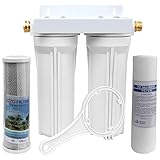
This is not an inline cartridge; it is a dual-stage external system that mounts at your water inlet and handles filtration before water enters your fresh tank. The two-stage design means one filter targets sediment and the other handles taste and odor, which gives you broader contaminant coverage than any single inline cartridge in this list. Flow rate is noticeably better than a small inline filter because the housings are larger. The cost is also the highest here, and installation requires a bracket and some basic plumbing. Skip this if you are happy swapping a single inline filter and do not want to mount hardware permanently to your rig.
Buying Guide
Filter Media Type Matters More Than Housing Brand
Most inline RV filters use a single stage of granular activated carbon. The ones that also include KDF media, like Camco, get an added benefit of reducing bacterial growth inside the filter itself and slightly improving heavy metal capture. If you are camping on treated municipal water, basic GAC handles chlorine taste and odor well enough. If you pull from wells or suspect older pipes contributing sediment, look for a filter that explicitly lists sediment reduction capacity or pair it with a pre-filter screen.
Flow Rate and Pressure Drop
Inline filters restrict flow to some degree. A clogged or low-quality filter will noticeably slow your fill rate, which becomes painful when you are filling a 40-gallon tank at a campground with a metered hookup. Higher-quality carbon beds with proper housing design minimize pressure drop. When comparing options, read user reports about how fast the filter fills your tank, not just initial taste claims.
Replacement Interval and Cost Per Gallon
Most manufacturers suggest replacing inline filters every 40 to 60 days of continuous use or when flow drops noticeably. If you camp weekly in summer, you will go through four to six filters per season. Divide your total pack price by the number of filters to get cost per cartridge, then multiply by annual usage. The cheapest filter that needs replacing every two weeks is more expensive long-term than a premium filter lasting two months. Track your own replacement intervals rather than trusting the printed recommendation blindly.
Our Verdict
The best water filters for RVs in this test come down to one top pick, one budget pick, and one upgrade path. Our top pick is the Camco Tastepure single filter at twenty dollars and change. The GAC and KDF combination, consistent build quality, and proven performance make it the easiest recommendation for most RVers who want reliable taste and odor reduction without guessing. Our budget pick is the generic RV Water Filter 4-Pack with hose protectors at twenty-nine ninety-nine total. The per-filter cost is the lowest here, and for casual campers who only need chlorine taste reduction a few weekends a season, it gets the job done. The OKBA External Dual Filter System wins outright if you boondock near untrusted water sources or fill your tank from questionable sources regularly. Its two-stage design and larger housings deliver broader contaminant coverage than any inline cartridge can match.
FAQ
Do RV water filters remove bacteria?
No. Standard inline carbon filters reduce chlorine, sediment, and taste but do not kill or remove bacteria, parasites, or viruses. If you are camping in an area with uncertain water safety, you need a UV purifier or a filter rated for biological contamination, which is a different product category entirely.
How often should I replace my RV inline water filter?
Most manufacturers recommend replacement every 40 to 60 days of active use or when you notice a drop in flow rate. In practice, if you camp weekly during summer, plan on replacing the filter every four to eight weeks depending on water quality at your hookups. Water with heavy sediment will clog a filter faster than clean municipal water.
Can I leave my RV water filter pressurized overnight?
Budget filters with thin gaskets are prone to weeping at the threads when left pressurized for extended periods. Higher-quality filters like the Camco units handle overnight pressure better, but best practice is to reduce pressure at the spigot or install a pressure regulator before the filter. This extends filter life and reduces leak risk.
Are marine water filters different from RV filters?
Not fundamentally. Filters marketed for both RV and marine use are typically the same inline carbon cartridge with a housing rated for slightly higher pressure or corrosion resistance. If a filter fits your RV hose threads and housing size, it will work regardless of whether the packaging says marine, RV, or both. The dual labeling is mostly a marketing choice.
Part of our rvs buying guide hub.