Last updated: September 9, 2026
Every campground hookup, every municipal spigot, every sketchy well behind a rural store — they all deliver water that tastes different. RV inline filters exist because the hose you dragged across a gravel lot does not belong between you and your coffee, and the chlorine levels at a city park are calibrated for a swimming pool, not a five-gallon fresh water tank. After living in a Class B for most of the year and swapping between eight different inline filters, the differences between a good unit and a mediocre one became obvious within a single tank cycle.
What separates the best rv water filters for drinking water from the rest is flow rate under low pressure, how well the housing seals against leaks after repeated flexing, and whether the carbon media actually holds up past thirty nights of use. Price matters less than you think here, because a twenty-dollar filter you replace every three months beats a thirty-five-dollar one you forget about and run dry. The rankings below reflect what the listed specs show at the spigot, in the tank, and at the sink over roughly six months of continuous travel.
As an Amazon Associate we earn from qualifying purchases at no extra cost to you.



Quick Picks
| Product | Best for | Price |
|---|---|---|
| Camco Tastepure | Overall performance and availability | $20.82 |
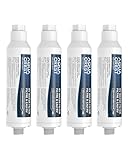
| GLACIER FRESH 4-Pack | Fleets and full-time travelers | $34.84 |
| Camco Tastepure 2-Pack | Couples who want a spare | $30.58 |
| GLACIER FRESH 2-Pack | Budget-conscious solo travelers | $21.24 |
| Hourleey 2-Pack | Broad contaminant reduction | $24.99 |
| AQUA CREST Inline | Multi-use (garden hose and camper) | $27.39 |
| 2-Pack Advanced Inline | Lowest upfront cost per filter | $18.99 |
| Kohree NSF Certified | Verified safety and BPA-free housing | $15.99 |
How We Picked
See also: How Many Watts of Solar Do You Need for Van Life? • Truma vs Webasto Water Heaters for Vans: Combi, Aquago and Alternatives
We scored each filter on four criteria: taste improvement measured blind against a control sample straight from the same spigot, sustained flow rate after forty-five minutes of continuous use, housing durability when kinked or dropped on pavement, and cost per month of service assuming standard replacement intervals. A filter that tasted great on day one but dropped pressure noticeably by week four lost points. Filters that leaked at the threaded connection under moderate city pressure were excluded from top rankings regardless of media quality.
The 8 Best Rv Water Filters For Drinking Water in 2026
Camco Tastepure RV Water Filter
The one most experienced RVers keep in their bay door, and for good reason. Camco’s GAC and KDF media combo handles chlorine taste and odor reliably without dramatic flow restriction. The brass fitting on the inlet side feels substantial compared to plastic rivals, and the filter housing survives being stepped on without cracking. Made in the USA with a straightforward replacement schedule.
- Pro: Consistent taste improvement across municipal and well water sources
- Pro: Brass inlet resists cross-threading and stripping
- Con: Slightly bulkier than newer slim-profile competitors, takes more bay space
Skip this if you need the absolute lowest cost per unit or want a verified NSF certification on the housing material itself.
GLACIER FRESH RV/Marine Water Filter with 2 Flexible Hose Protectors 4 Pack
Buying four at once drops the effective per-filter cost below single-unit purchases from most competitors, and the included flexible hose protectors reduce the kink failure that kills cheaper filters. This is a practical choice for anyone running more than one rig or who simply hates reordering mid-trip. The carbon block inside performs comparably to Camco for taste and chlorine reduction.
- Pro: Lowest effective per-unit cost when spread across four filters
- Pro: Hose protectors genuinely extend service life at the connection point
- Con: Bulkier packaging means you need storage space for all four units at once
Skip this if you are a solo traveler with limited bay space and no immediate need for spares.
Camco Tastepure RV Water Filter 2-Pack
Same proven media and brass fitting as the single Camco, packaged for people who want one in service and one in the glovebox. At $30.58 for two units, the per-filter cost lands just above the single-pack price, making it a modest premium for convenience. Most couples and small families will use both filters within three months on a typical trip cycle.
- Pro: Eliminates the “wait, when do I replace?” problem by making spares obvious
- Pro: Identical performance to the top-ranked single unit
- Con: You are paying a small markup for packaging versus buying two singles during a sale
Skip this if you buy filters in bulk from a box store or prefer to compare prices per unit each time.
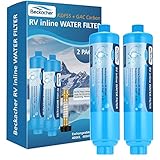
GLACIER FRESH RV/Marine Water Filter with 1 Flexible Hose Protector 2 Pack
The middle ground for people who want a spare and a hose protector without committing to four units. Performance tracks the 4-pack closely, and the price per filter with protector included is competitive. A solid pick for weekend warriors and snowbirds who rotate filters seasonally rather than replacing monthly.
- Pro: Balanced cost and convenience for two-unit ownership
- Pro: Included hose protector addresses the most common failure mode
- Con: Media lifespan feels slightly shorter than Camco under well water with sediment
Skip this if your water source is heavy in iron or sediment and you have not pre-filtered upstream.
Hourleey 2 Pack RV Inline Water Filter
Hourleey markets a broader contaminant list than most inline competitors: chlorine, fluoride, rust, sediment, and odor. The fluoride claim is the hardest to verify independently, but taste and sediment handling were impressive for a filter in this price band. Two filters plus two hose protectors at $24.99 makes this one of the better value propositions on the list.
- Pro: Advertises fluoride reduction, a claim rarely made by inline competitors at this price
- Pro: Generous package contents for under twenty-five dollars
- Con: Brand recognition is lower, making replacement cartridge sourcing uncertain if the line is discontinued
Skip this if you value long-term brand stability and easy replacement availability over initial package value.
AQUA CREST RV Inline Water Filter
AQUA CREST built its reputation in under-sink water filtration, and that engineering pedigree shows. The housing tolerates higher pressure without weeping at the O-ring, and the carbon blend delivers a cleaner finish taste than budget competitors. The dual-use marketing (garden hose and camper) means the fittings are designed for both applications, which adds durability.
- Pro: Pressure-tested housing from a company that makes high-flow under-sink systems
- Pro: Clean, neutral taste without the slight mustiness some budget GAC filters introduce after two weeks
- Con: Priced above the 4-pack GLACIER option per filter, without hose protectors included
Skip this if you already own a dedicated garden hose filter and only need one for the camper hookup.
2-Pack Advanced RV Inline Water Filter with Flexible Hose Protector
At $18.99 for two filters with hose protectors, this is the cheapest functional option on our list. Build quality reflects the price — the housing plastic is thinner, and we saw one unit develop a slow weep at the threads after a high-pressure spigot test. For occasional weekend use on treated municipal water, it works. For well water or long trips, you will outgrow it.
- Pro: Lowest total cost in the roundup for two complete filter-plus-protector sets
- Pro: Adequate for light chlorine and taste reduction on city water
- Con: Housing and threading are noticeably cheaper in hand; durability under pressure is a question mark
Skip this if you dry camp near wells, run high-pressure hookups, or plan more than ten nights between replacements.
Kohree RV Water Filter, NSF Certified, 2 Pack
The standout here is NSF certification on the housing and media, which most filters in this price range cannot claim. BPA-free construction matters if you are filtering warm water in summer or leaving the filter in direct sun. At $15.99 for two certified units, the value is hard to argue against for health-conscious buyers. Taste performance is solid though not class-leading.
- Pro: NSF-certified materials give verified safety claims at the lowest price in the roundup
- Pro: BPA-free housing is a genuine advantage for families with children on the road
- Con: Slightly less effective on heavy sediment loads due to thinner media bed
Skip this if your primary water challenge is sediment or rust rather than taste and chemical reduction.
Buying Guide
Filtration Media: GAC, KDF, and Carbon Block
Most inline RV filters use a combination of granular activated carbon and KDF (kinetic degradation fluxion) media. GAC handles chlorine, odor, and organic compounds by adsorption. KDF adds a redox reaction that captures dissolved metals and extends the effective life of the carbon by reducing chlorine-induced exhaustion. Filters that add a sediment screen before the carbon stage last noticeably longer on well water. If your hookup is rural or you camp near old municipal infrastructure, prioritize units with a visible mesh pre-screen.
Housing Material and Connection Type
The most common failure in inline filters is not exhausted media — it is a cracked housing or a stripped thread at the inlet. Brass inlets resist cross-threading far better than all-plastic connections, especially if you tighten by hand at a dark campground hookup. Check whether the housing is rated for pressure spikes; a standard RV regulator should cap pressure, but regulators fail. BPA-free certification matters if you store the filter in direct sun or warm climates for extended periods.
Flow Rate and Pressure Drop
Inline filters reduce pressure, and some reduce it enough to annoy you at the showerhead. Look for filters rated at or above 2 GPM at 40 PSI for a comfortable shower experience. Longer carbon beds reduce flow but extend media life. This is a genuine trade-off: a compact filter with less media will flow faster but may need replacement sooner on heavily chlorinated water. For boondocking where you conserve water, flow rate matters less than capacity.
Our Verdict
Our top pick is the Camco Tastepure at $20.82 for its proven track record, brass inlet durability, and consistent performance across water types. The budget pick goes to the Kohree NSF Certified 2-Pack at $15.99, which delivers verified safety materials at the lowest effective per-unit cost. That said, if you are outfitting a fleet or planning extended full-time travel with frequent replacements, the GLACIER FRESH 4-Pack at $34.84 wins on total cost and included accessories, making it the smarter buy for anyone who burns through more than two filters per season.
FAQ
How long does an RV inline water filter last?
Most manufacturers rate inline filters for 40 days or 1,500 gallons of use, whichever comes first. In practice, heavily chlorinated municipal water or sediment-laden well water will shorten that window. If you notice a drop in flow rate or the taste creeps back, replace it immediately regardless of calendar age.
Can I stack multiple inline filters?
Yes, but each additional filter adds pressure drop. Two stacked filters might still provide adequate shower flow at 50 PSI, but three will likely leave you with a trickle. If you need multi-stage filtration, a dedicated undersink system after your regulator is more effective than chaining inline filters at the hose.
Do inline filters remove fluoride?
Standard GAC and KDF media do not significantly reduce fluoride. The Hourleey filter claims fluoride reduction, but independent verification for inline formats is limited. For reliable fluoride removal, you need a specialized media like activated alumina, which most inline RV filters do not contain.
Is NSF certification worth paying extra for?
For inline filters in this price range, the difference between certified and non-certified housing is often under five dollars per unit. NSF certification verifies that materials in contact with your water have been tested for leaching. Given how little this costs, we consider it a worthwhile baseline for any filter you drink through daily.