Last updated: October 4, 2026
Setting up camp in a camper van or motorhome is an exciting milestone after a long drive, but waking up to a slow roll down an incline because of inadequate wheel chocks ruins the trip instantly. Selecting the right wheel chocks is fundamental to your rig’s baseline safety, preventing unexpected movement when parked on sloped terrain, uneven campsites, or soft dirt surfaces.
Navigating the market can feel overwhelming with dozens of materials, varying designs, and different weight ratings available. This decision guide breaks down what actually matters—from tire sizing and grip mechanics to material durability—so you can invest in a reliable set that keeps your home-on-wheels securely anchored wherever you roam.
As an Amazon Associate we earn from qualifying purchases at no extra cost to you.
- Understanding Tire Sizing and Weight Ratings
- Material Selection: Rubber, Plastic, and Metal
- Standard Chocks Versus Locking X-Chocks
- Surface Traction and Grip Mechanics
- Portability and Storage Considerations
- Common Sizing and Placement Mistakes
- When It’s Time to Spend More on Premium Options
- Related Guides
- FAQ
- Related Guides
Understanding Tire Sizing and Weight Ratings
One of the most critical factors when shopping for wheel chocks is matching the product to your vehicle’s physical dimensions and weight class. A small, lightweight plastic chock designed for a standard passenger car will buckle or slide under the immense weight of a fully loaded Class A motorhome or a heavy-duty camper van build. Always check the manufacturer specifications regarding maximum vehicle weight ratings before making a purchase.
Beyond weight capacity, the height of the chock relative to your tire’s radius matters immensely. A good rule of thumb is that the chock should reach at least one-third to one-half of the way up the tire’s sidewall. If the chock is too low, the tire can easily roll right over it during a slip. Larger tires require taller, wider chocks with a broader footprint to effectively arrest rotational momentum.
Material Selection: Rubber, Plastic, and Metal
See also: How Many Watts of Solar Do You Need for Van Life? • Truma vs Webasto Water Heaters for Vans: Combi, Aquago and Alternatives
Wheel chocks are typically manufactured from three primary materials: heavy-duty rubber, hard molded plastic, and solid metal (such as aluminum or steel). Each material behaves differently under varying weather conditions and load pressures, making material choice a vital consideration for your specific travel style.
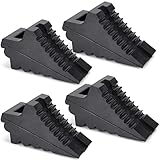
Heavy-duty rubber chocks are widely regarded as the gold standard for RVs because they naturally conform to uneven ground, absorb shock, and offer exceptional friction against asphalt, concrete, and gravel. Molded plastic chocks are lightweight, highly affordable, and completely immune to rot or rust, though cheap variants can crack under extreme cold or slip on smooth wet pavement. Metal chocks provide incredible structural strength for massive rigs, but they are heavier to handle and can scratch painted surfaces or wheels if mishandled.
Standard Chocks Versus Locking X-Chocks
When outfitting your rig, you will generally choose between traditional external wheel chocks and locking stabilizer chocks (often referred to as X-chocks). Standard chocks sit on the outside tread of the tire against the ground, physically blocking the wheel from rotating forward or backward. They are essential for parking safety on any incline.
Locking stabilizer chocks, on the other hand, are designed specifically for dual-axle trailers and RVs. They slide directly between the tandem tires and expand outward using a threaded screw mechanism. While they do provide some anti-roll security, their primary superpower is eliminating the annoying rocking, swaying, and bouncing motion that occurs when people walk around inside the living space.
Surface Traction and Grip Mechanics
A wheel chock is only as good as its interface with the ground and the tire. If the bottom of the chock slides across slick asphalt or muddy grass when weight is applied, it fails its primary purpose. Look for chocks featuring ribbed bottoms, waffle grid patterns, or rubber pads that maximize surface area friction.
Similarly, the face of the chock that presses against the tire should feature ridges or a concave curve that matches the curvature of the wheel tread. A flat or slick face can allow the tire to slide upward along the ramp angle rather than biting securely into the barrier. If you frequently camp on sandy beaches or muddy forest service roads, chocks with integrated spike plates or wide base footprints will prevent the entire assembly from sinking into the earth.
Portability and Storage Considerations
Storage space is always at a premium inside a camper van or RV, meaning the physical footprint of your gear matters. Large, heavy-duty rubber chocks take up substantial space in a storage bay or rear garage, whereas plastic chocks are often hollow or stackable, saving valuable square footage.
Consider whether the chocks include built-in handles, nylon pull ropes, or mounting brackets. A high-visibility color, such as bright orange or yellow, is also surprisingly important. Many campers accidentally drive away and leave their chocks behind on the campsite because dark black rubber blends into asphalt or shadows. Brightly colored chocks are much easier to spot during your pre-departure walkaround.
Common Sizing and Placement Mistakes
Even the highest-quality chocks can fail if used incorrectly. One of the most frequent mistakes is using only a single chock on the downhill side of just one tire. For reliable security, you should always chock both sides of a single tire on an incline, or utilize chocks on multiple wheels if you are parked on a steep or shifting grade.
Another common error is placing the chock too far away from the tire tread. If there is a gap of even a few inches, the RV can build up enough rolling momentum before hitting the chock to hop over it or push it out of position. The chock should always be pushed firmly and snugly directly against the tire before setting the parking brake.
When It’s Time to Spend More on Premium Options
Budget chocks from big-box stores can work fine for light pop-up campers or casual weekend trips on flat pavement, but investing in premium gear is necessary under certain conditions. If your rig weighs over 10,000 pounds, if you frequently camp on steep mountain grades, or if you live in your van full-time across harsh seasonal climates, cheap plastic chocks will eventually degrade or fail.
Spending more on commercial-grade rubber chocks or precision-engineered locking stabilizer systems guarantees superior durability, weather resistance, and peace of mind. Think of wheel chocks as cheap insurance for a multi-thousand-dollar home; prioritizing quality materials and proper sizing ensures your rig stays safely where you parked it every single time.
Related Guides
When outfitting your rig for your next trip, securing your parking spot is just one piece of the puzzle. Explore our Best Wheel Chocks for Rvs in 2026: Compared and Ranked to see our top product picks. For camp setup essentials beyond parking stability, check out our Best Steps for Rvs in 2026: Compared and Ranked for safe entry and exit. Finally, ensure your drinking water is completely safe at every hookup by reading through our Best Uv Water Purification System for Rvs in 2026: Compared and Ranked.
FAQ
Do I need wheel chocks if my RV has an automatic transmission and parking brake?
Yes, absolutely. Transmissions and parking brakes secure the drivetrain, but they do not eliminate all mechanical play, nor do they prevent movement if a tire loses traction on loose gravel or mud. Wheel chocks physically block the wheels from rotating, providing an essential secondary layer of physical safety.
How many wheel chocks should I use for my camper van?
At a minimum, you should use two wheel chocks placed securely against the downhill side of your tires. For maximum stability and peace of mind on steeper slopes, using four chocks—one in front of and one behind each rear tire—prevents any forward or backward shifting.
Are rubber chocks better than plastic ones?
Generally, heavy-duty rubber chocks offer superior grip because they naturally conform to uneven ground and resist sliding on slick pavement. Plastic chocks are lighter and immune to rotting, but cheap plastic can crack under heavy loads or slide across smooth asphalt.
What is the difference between standard chocks and locking stabilizer chocks?
Standard wheel chocks sit against the outside tread of the tire to stop the vehicle from rolling. Locking stabilizer chocks fit between dual tires, applying outward pressure to eliminate the annoying rocking and swaying motion while walking inside the rig.