Last updated: September 18, 2026
Quick answer: Our top pick in 2026 is the 100Ah AGM lead-acid — our #1 rated choice. See the full ranked comparison, alternatives and buying advice below.
The Short Answer
Yes—lithium battery is worth it for van life if you camp regularly, rely on solar or alternator charging, and can budget for a complete 12-volt electrical system rather than just the battery. For occasional weekend trips, a good AGM battery can cost less and be simpler to install.
For most full-time or frequent van dwellers in 2026, LiFePO4 lithium is the better long-term choice. It stores more usable energy in less space, charges faster, and generally lasts far longer than lead-acid. The catch is that lithium works best when paired with compatible chargers, proper fusing, a battery monitor, and low-temperature protection.
As an Amazon Associate we earn from qualifying purchases at no extra cost to you. Product prices and availability are accurate as of the date shown and are subject to change.

What You Actually Get
See also: Best Van Water Filter for Refill Stations in 2026: Tested and Ranked • How to Winterize a Van Water System (2026): Step-by-Step
A lithium battery’s capacity is usually listed in amp-hours (Ah), but watt-hours (Wh) are easier to understand. A 12V 280Ah battery provides roughly 3,360 watt-hours of nominal energy. A 12V 300Ah battery provides about 3,600 watt-hours at a nominal 12V, or approximately 3,840Wh when calculated at 12.8V.
You will not normally want to use every last watt-hour. Planning around 80% to 90% usable capacity helps preserve a reserve and avoids pushing the battery to its limits. That means a 280Ah lithium battery may provide roughly 2,700 to 3,000Wh of practical daily energy, depending on your settings and electrical design.
That is enough for a substantial van setup. A 12V compressor refrigerator might use approximately 300 to 600Wh per day, while a laptop, lights, fans, water pump, phone charging, and internet equipment can add another 300 to 1,000Wh. Induction cooking, electric heating, hair dryers, and air conditioning consume much more. A 1,500-watt induction cooktop can use 1,500Wh in one hour, although normal cooking sessions are usually shorter.
Two batteries in this size range are examples of what shoppers will find:
- ECO-WORTHY EnergyRock 12V 280Ah Metal Case LiFePO4: listed at $529.99, with approximately 3,360Wh of nominal capacity.
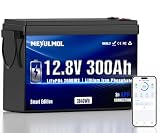
- 12V 300Ah LiFePO4 with APP monitoring and 200A BMS: listed at $359.99, with claimed 15,000-plus cycles, low-temperature protection, and expansion capability up to 4S4P.
Features matter as much as capacity. A battery management system, or BMS, protects against overcharging, excessive discharge, overcurrent, and temperature problems. Bluetooth or app monitoring is convenient, but it does not replace a properly installed shunt-style battery monitor. Before buying, confirm the battery’s dimensions, terminal layout, maximum continuous charging and discharging current, cold-weather behavior, and warranty.
Pros
- More usable capacity: Lithium can typically be discharged more deeply than lead-acid without the same level of stress. A 280Ah lithium battery can offer similar practical energy to a substantially larger lead-acid bank.
- Lower weight: A large lithium battery often weighs roughly 60 to 80 pounds, depending on its case and internal construction. A comparable lead-acid bank can be considerably heavier and may require two or more batteries.
- Compact storage: Lithium gives you more energy in a smaller footprint. That leaves room for clothing, water, tools, and food—valuable space in a van.
- Faster charging: LiFePO4 batteries can generally accept higher charging currents than lead-acid batteries when the charger and BMS support it. This is useful when driving between campsites or dealing with limited winter sun.
- Better voltage stability: Lithium voltage stays relatively steady during much of its discharge. Appliances such as refrigerators, inverters, and fans are less likely to encounter the noticeable voltage sag associated with a heavily loaded lead-acid battery.
- Long service potential: Manufacturers commonly claim thousands of cycles for LiFePO4 batteries. Actual life depends on temperature, charge settings, depth of discharge, storage, and build quality, so treat cycle claims as a specification—not a guarantee.
- Useful monitoring options: App connectivity can show voltage, current, state of charge, and alarms without opening a compartment.
Cons
- Higher upfront cost: A lithium battery may cost approximately $300 to $700 for a 200Ah to 300Ah 12V unit, while a basic AGM battery may be available for roughly $200 to $400. Prices vary widely by brand, warranty, and features.
- Installation is not plug-and-play: You may need a DC-to-DC charger, solar charge controller, inverter, bus bars, fuses, disconnects, properly sized cable, and a shunt. A complete upgrade can easily add $300 to $1,000 or more beyond the battery.
- Cold charging concerns: Most LiFePO4 batteries should not be charged below freezing unless they include a heater or charging cutoff. Discharging in cold conditions may be allowed, but charging is the critical limitation.
- Incompatible factory systems: Some vans have alternators or smart charging systems that cannot safely charge lithium directly. A compatible DC-to-DC charger is often required.
- Less forgiving of poor design: Undersized cable, missing fuses, incorrect charging profiles, and loose connections can create heat, shutdowns, or fire hazards. Battery installation should follow the manufacturer’s instructions and applicable electrical codes.
- Limited repairability: If the BMS fails, the battery may shut down even when its cells are healthy. Many enclosed consumer batteries are replaced rather than repaired.
- Weight is not the only fit issue: A battery can be light but still too tall, wide, or deep for your intended compartment. Measure the available space, including cable clearance and ventilation access.
Who Should Buy It
Buy lithium if you live in your van, take multiweek trips, or camp off-grid several nights at a time. It is especially worthwhile when you use a refrigerator continuously, work from a laptop, run a CPAP machine, use an inverter, or want to minimize generator use.
It also makes sense if your van has limited battery space or payload capacity. A properly sized 200Ah to 300Ah lithium bank can support ordinary electrical loads without filling an entire storage compartment. If you drive regularly, fast charging from a DC-to-DC charger makes the investment even more useful.
Choose a battery with low-temperature charging protection if you travel in freezing weather. For an electrical system with a 2,000-watt inverter, check the battery’s continuous discharge rating carefully. At 12 volts, 2,000 watts can require roughly 167 amps before accounting for inverter losses, so a battery with a 200A BMS may be more appropriate than one with a lower limit. Use proper overcurrent protection and confirm that the wiring can handle the load.
Who Should Skip It
Skip lithium if you camp only a few weekends per year, use modest loads, or have no interest in upgrading the charging system. A 100Ah or 200Ah AGM battery may be adequate for lights, phones, a small refrigerator, and occasional fan use.
It may also be the wrong choice if the battery will sit in an unheated exterior compartment through freezing winters and you cannot install a heater or reliable low-temperature cutoff. Lithium is not automatically safer or better simply because it is newer. A well-sized, correctly installed AGM system can be the more sensible option for simple, inexpensive builds.
Cheaper Alternatives
| Option | Cost | Trade-off |
|---|---|---|
| 100Ah AGM lead-acid | $180–$350 | Lower purchase price, but roughly 50Ah of recommended usable capacity and substantially more weight. |
| 200Ah AGM bank | $400–$800 | Familiar and widely supported, but bulky, heavy, slower to charge, and less efficient at high loads. |
| 100Ah LiFePO4 lithium | $180–$350 | Lower entry cost and lighter weight, but about one-third the capacity of a 300Ah battery. |
| Portable power station | $300–$1,200 | Simple setup with built-in inverter and outlets, but limited expansion, proprietary components, and less convenient permanent wiring. |
| DIY lithium cell bank | $250–$600 in parts | Potential savings and customization, but requires careful cell matching, compression, a suitable BMS, and electrical experience. |
Remember that the battery is only one part of the price. A realistic installed lithium upgrade can range from about $700 to $1,800, depending on whether you already own solar equipment, an inverter, wiring, and chargers.
FAQ
How many amp-hours do I need for van life?
A 100Ah battery may work for light weekend use. A 200Ah battery suits many part-time campers, while 280Ah to 300Ah is a comfortable range for full-time living with a refrigerator, electronics, fans, and moderate inverter use. High-wattage cooking or heating may require more capacity or a different energy plan.
Can I charge a lithium battery from my van alternator?
Usually, but do not assume a direct connection is safe. A DC-to-DC charger is commonly used to regulate current and work with modern smart alternators. Match the charger size to the alternator, battery, cable, and manufacturer limits.
Is a 300Ah lithium battery enough for air conditioning?
Usually not for extended operation. A small air conditioner can draw hundreds to more than 1,000 watts, and an inverter adds losses. A 300Ah battery may run air conditioning briefly, but sustained cooling generally requires a much larger battery bank, substantial solar or alternator charging, and careful energy planning.
What is the best lithium battery for a van?
The best choice has the capacity you need, a credible warranty, a well-documented BMS, low-temperature charging protection, suitable continuous current ratings, and dimensions that fit your compartment. App monitoring is helpful, but safe charging and correct installation matter more than a smartphone feature.
Ready to decide? Our #1 pick for 2026 is the 100Ah AGM lead-acid.
Live price & availability on Amazon.