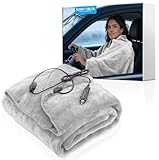
- Top Pick: Sealy 12-Volt Electric Portable Heated Car Blanket, 59"x43", Grey
- Best Value: Westinghouse Heated Car Blanket, Charcoal, 59" x 43”
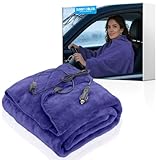
- Premium Choice: Sunny color Wearable Car Electric Blanket 12 Volt Heated Travel Blanket Plug in Heating Throw for Car Truck SUV Van with Controller 2 Heating Level Ideal for Camping, Traveling(41×55, Gray)
TL;DR: A 12V electric blanket for van life is the most power-efficient way to stay warm in bed — drawing 40–60W versus the 800–2000W a diesel heater pulls at startup. It does not replace a heater for sub-freezing build temps, but it dramatically reduces how long your heater needs to run each night. Best pick: ASIN B08JDF53RV.
Best 12V Electric Blanket for Van Life Camping (2026)
Cold nights in a van come down to a simple math problem: how many watt-hours can you spend keeping warm without draining your house battery below safe levels? A 12V electric blanket for van life sits at the efficient end of that equation. It heats the air immediately around your body — not the entire van interior — so it uses a fraction of the power a forced-air heater requires. Run it through the night on a 100Ah LiFePO4 battery and you spend roughly 40–60Wh per hour, leaving the bulk of your capacity for morning coffee, lighting, and phone charging. Pair it with solid van insulation to keep ambient temperature manageable, a blackout curtain system to trap heat in the sleeping zone, and check your LiFePO4 battery capacity to make sure you have enough reserve to run it safely overnight.
As an Amazon Associate we earn from qualifying purchases at no extra cost to you.





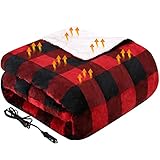
🛒 Best Price Today on Amazon
Prime members get fast, free shipping on everything above, plus member-only deals. New members get a 30-day free trial — cancel anytime.
Start 30-Day Prime Free Trial →See Today’s Amazon DealsTop Pick
12V Electric Blanket vs. Diesel Heater: The Honest Comparison
See also: Best Portable Heater for Van Life: Safe Options Compared • Best Mattresses Under $500
A diesel heater heats the van’s entire air volume — walls, ceiling, floor, and the cold zone above and below the bed. This is necessary when temperatures drop below freezing and you need the living space to be functional, not just the sleeping zone. But for nights when ambient temperature is 35–45°F and you just need to stay warm in bed, a diesel heater is massively over-specified for the job.
A 12V electric blanket draws 40–60W continuously. A diesel heater at low output draws 8–15W for the controller and fan — but also burns diesel, requires maintenance, produces exhaust, and needs to heat the full interior before you feel warm. For the specific use case of sleeping warmth at moderate cold temperatures, the electric blanket wins on efficiency, simplicity, and cost of operation every time.
Key Specs to Compare
| Spec | What to Look For | Why It Matters |
|---|---|---|
| Wattage | 40–60W at 12V | Lower draw = less battery drain overnight |
| Size | Twin or Full (50″×60″ minimum) | Covers a van sleeping platform without bunching |
| Heat settings | 3+ levels | Allows fine-tuning for temperature swings through the night |
| Auto shut-off | Yes — 1–3 hour timer | Prevents overnight battery drain and overheating safety risk |
| Connector type | 12V car/cigarette lighter or hardwire | Cigarette plug is plug-and-play; hardwire is cleaner for permanent builds |
| Material | Polyester fleece or micro-mink | Fleece heats faster; micro-mink retains heat longer after power cuts |
| Washability | Machine washable (controller detaches) | Van life gets dirty; easy cleaning is non-negotiable |
| Cord length | 8+ feet | Reaches from a 12V outlet or shore power port to the bed platform |
Power Consumption: Real Numbers for Trip Planning
At 45W draw, a 12V electric blanket running 8 hours consumes 360Wh — 0.36kWh. On a 100Ah LiFePO4 battery (approximately 1,280Wh usable at 12.8V nominal), that is 28% of total capacity for a full night of sleep warmth. Most van build recommendations target keeping 20% of battery capacity in reserve, so a 100Ah battery can comfortably run the blanket overnight alongside lights and phone charging with capacity to spare.
On AGM batteries, the calculation tightens: 100Ah AGM gives roughly 600Wh usable (50% depth of discharge limit). Running a 45W blanket for 8 hours — 360Wh — uses 60% of your AGM’s safe capacity. Factor in other overnight loads and you may be cutting it close. If you’re on an AGM system, use the blanket on the lowest heat setting or limit runtime to 5–6 hours.
Hardwire vs. Cigarette Lighter Plug
Most 12V electric blankets ship with a cigarette lighter plug (SAE J563 connector). This is plug-and-play: connect to any 12V outlet in the van and you are running. The limitation is that cigarette lighter sockets are typically fused at 10–15 amps and share circuits with other accessories. At 45W draw (3.75A at 12V), the blanket is well within rating — but verify your van’s socket circuit capacity if you are running other accessories simultaneously.
For a permanent build, hardwiring the blanket to its own 10A fused circuit from the house battery is cleaner and more reliable. Use 14-gauge wire for runs up to 15 feet and 12-gauge for longer runs. A rocker switch in the sleeping area lets you turn it on and off without reaching for the connector.
Frequently Asked Questions
Can you leave a 12V electric blanket on all night safely?
Most 12V electric blankets include an automatic shut-off timer (typically 1–3 hours) specifically to prevent overnight overheating. Models without auto shut-off should not be left unattended for extended periods. If your blanket lacks an auto shut-off, plug it into a smart 12V timer switch set to cut power after 3 hours — this covers the coldest part of the night when you fall asleep and shuts off before morning warmth makes it unnecessary.
Will a 12V electric blanket work with a van’s alternator while driving?
Yes. At 45W draw, the blanket takes a negligible load from your alternator — equivalent to turning on a few extra dashboard lights. Many van lifers pre-warm their sleeping setup during the last 30–45 minutes of driving before they park for the night, so the blanket and bedding are at temperature before they switch off the engine. This strategy reduces overnight battery draw further.
What temperature range is a 12V electric blanket useful for van life?
Electric blankets are practical and sufficient as your primary heat source down to approximately 25–30°F ambient outside temperature, assuming reasonable van insulation. Below that threshold, the van’s metal body conducts cold faster than the blanket can compensate for air temperature in the sleeping zone. Below 20°F, a diesel or propane heater becomes the necessary primary source, with the electric blanket adding supplemental warmth directly at the bed.
Is a 12V electric blanket the same as a heated mattress pad?
No — they heat differently. An electric blanket drapes over you and heats from above. A heated mattress pad sits under you and heats from below. For van life, heated mattress pads are generally more effective because heat rises — warming the surface you are lying on keeps your core temperature higher than warming the air above you. However, mattress pads are harder to find in 12V versions; most require 120V AC via an inverter, which adds conversion losses.
Can two people share a 12V electric blanket in a van?
A Full or Queen size 12V blanket (60″×80″ or larger) covers two people comfortably on a standard van sleeping platform. Look for dual-zone control models that let each person set their preferred heat level independently — these typically have two separate heating elements and two controllers on a single 12V connection. Total draw is roughly double a single-zone model, so factor 80–100W into your overnight power budget.
Maximize your cold-night efficiency: invest in proper van insulation to reduce heat loss through the walls, add a blackout curtain system to create a thermally sealed sleeping zone, and verify your LiFePO4 battery bank has the overnight capacity to run your blanket comfortably without hitting low-voltage cutoff.