Last updated: October 11, 2026
For most van builds, the best mattress under $500 is the Zinus Green Tea Memory Foam 8-inch — roughly $200–$300 in queen, $150–$200 in twin — because it’s a true 8-inch all-foam mattress sold in every standard size, and its low profile preserves headroom on a raised platform. If your platform isn’t a standard size, a cut-to-fit foam build (a 2.8 lb/ft³ base plus a 2-inch topper) costs about the same and fits the frame exactly. Every pick below shares one weakness: foam sitting on a solid platform traps condensation, and moisture — not the foam itself — is what kills van mattresses.
- Quick comparison: best mattresses under 0 for a van platform
- Best overall: Zinus Green Tea Memory Foam, 8 inch
- Best budget: Linenspa 8-Inch Hybrid
- Best for non-standard platforms: a cut-to-fit foam build
- Best for hot sleepers and humid climates: latex over a firm base
- Best for convertible beds: Milliard 6-Inch Tri-Fold
- How to choose: the numbers that actually matter
- Ownership realities: what wears out first
- Frequently Asked Questions
Quick comparison: best mattresses under $500 for a van platform
| Pick | Best for | Key specs | Typical price (2026) |
|---|---|---|---|
| Zinus Green Tea Memory Foam 8″ | Best overall | 8 in. all-foam, memory foam over poly core, medium-firm, twin through king | $150–$330 |
| Linenspa 8″ Hybrid | Best budget | 8 in., gel memory foam over a 6 in. innerspring unit, medium | $180–$280 |
| Cut-to-fit foam build (HD36-R base + topper) | Non-standard platforms | 4–6 in. base rated 2.8 lb/ft³ and 35 ILD, plus 2 in. comfort layer, any dimension | $220–$450 |
| Sleep On Latex 3″ topper over a firm base | Hot sleepers, humid climates | 3 in. Dunlop latex, no memory foam, soft/medium/firm options | $300–$500 |
| Milliard 6″ Tri-Fold | Convertible beds and seating | 6 in., three folding sections, twin 38 × 75 in. folds into three ~25 in. panels | $150–$280 |
Best overall: Zinus Green Tea Memory Foam, 8 inch
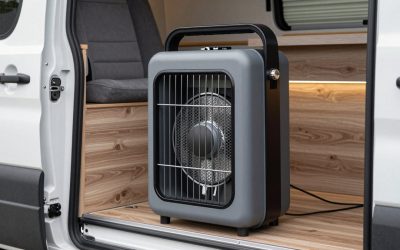
See also: Best Portable Heater for Van Life: Safe Options Compared • Best Wearable Posture Trainers With App Feedback
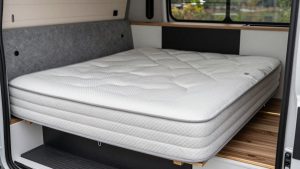
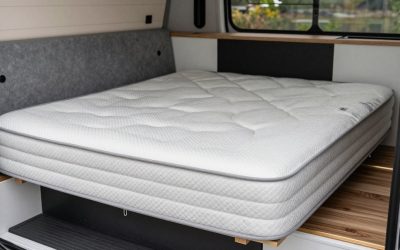
This is the pick for a standard transverse or longitudinal platform in a full-size or larger van. It’s 8 inches thick, medium-firm, and available from twin (38 × 75 in.) up through king, which means replacement is easy anywhere in the country. The 8-inch profile matters more than it sounds: on a platform built 18 inches off the floor in a high-roof van with roughly 76–79 inches of interior height, an 8-inch mattress leaves about 50 inches of seated headroom, versus roughly 48 with a 10-inch.

Queen Size Mattress in a Box 60x80 10 Inch Soft Pocket Spring
Included for 'Best Mattresses Under $500' as a relevant option in this category; details come from the product listing.
View on AmazonWho it suits: couples and solo travelers who want a real mattress feel without a custom order. Main trade-off: it’s a one-sided all-foam bed with no air channel underneath, so it needs a slatted or ventilated platform, and memory foam stiffens noticeably below about 65°F — a real consideration if you sleep in cold climates.
Best budget: Linenspa 8-Inch Hybrid
Linenspa’s hybrid pairs gel memory foam with a 6-inch innerspring unit, and it regularly lands under $250 in queen. That coil core is the useful part for van life: air moves through an innerspring unit far better than through solid foam, so condensation under the mattress is less of a problem. The foam-on-coils feel is medium and slightly bouncier than an all-foam bed.
Who it suits: budget builds, warm and humid regions, and anyone who dislikes the “sinking” feel of memory foam. Main trade-off: the coil unit can’t be trimmed, so this only works if your platform already matches a standard size, and heavier sleepers (over roughly 200 lb) may feel the springs sooner than they’d like.
Best for non-standard platforms: a cut-to-fit foam build
Most van beds aren’t mattress-shaped. Transverse platforms are typically 68–74 inches long because that’s the usable interior width of a Sprinter, Transit, or ProMaster, while a standard twin is 75 inches and a queen is 80. Rather than building the van around the mattress, build the mattress around the van.
A proven combination: a 4- to 6-inch base of HD36-R foam — per Foam Factory’s published spec sheet, 2.8 lb/ft³ density at 35 ILD — cut to your exact platform dimensions, topped with 2 inches of memory foam or latex. That base density is well above the 1.5 lb/ft³ foam used in the cheapest mattresses and is the single biggest predictor of how long the bed holds its shape. Foam suppliers cut to any dimension, so a 53 × 71 in. platform gets a 53 × 71 in. mattress.
Who it suits: anyone with a custom frame, an L-shaped or wedge-shaped bed, or a wheel-well notch. Main trade-off: you assemble it yourself, there’s no warranty on a DIY stack, and the edges are square — a fitted sheet in a standard size won’t fit, so plan on a stretch cover or custom sheet.
Best for hot sleepers and humid climates: latex over a firm base
Latex is the material to reach for when memory foam sleeps too warm. A 3-inch Dunlop latex topper from Sleep On Latex, placed over a firm foam base or directly on a slatted platform, gives you pressure relief without the heat retention and without the cold-weather stiffening that memory foam has. Latex is also open-cell by nature, so it breathes better than a sealed foam block.
Who it suits: full-timers in the South, coastal, or tropical climates, and anyone who wakes up hot. Main trade-off: weight and cost. A queen 3-inch latex topper runs roughly 40 lb — a two-person lift — and prices sit in the $300–$500 range depending on size and firmness. You’re also buying a topper, not a complete mattress, so a base layer is required.
Best for convertible beds: Milliard 6-Inch Tri-Fold
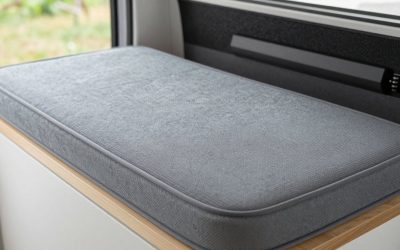
If your bed doubles as a dinette or a couch, a tri-fold is the practical answer. The Milliard 6-inch folds into three panels, so a twin (38 × 75 in.) breaks down into three sections roughly 25 inches long and stacks out of the way in seconds. It’s a genuine memory foam mattress rather than a guest-room air mattress, and it stays under $300 in most sizes.
Who it suits: weekend builds, campervans with a convertible rear bench, and anyone who needs floor space back during the day. Main trade-off: the fold seams create two permanent soft spots down the length of the bed, and 6 inches is the minimum thickness most adults will find comfortable long-term.
How to choose: the numbers that actually matter
Sizing math comes first
| Size | Dimensions (in.) | Van fit notes |
|---|---|---|
| Twin | 38 × 75 | Good for solo longitudinal beds; 1–5 in. too long for most transverse platforms |
| Twin XL | 38 × 80 | Longitudinal layouts only |
| Full | 54 × 75 | The most common transverse width; length is still the limiting factor |
| Full XL | 54 × 80 | Rare, and usually requires a longitudinal build |
| Short queen (RV) | 60 × 75 | 5 in. shorter than a standard queen — a useful compromise |
| Queen | 60 × 80 | Typically 6–12 in. too long for a transverse van bed |
| King | 76 × 80 | Does not fit transversely in any common van |
Measure your platform’s usable rectangle, not the van’s interior width — wheel wells, insulation, and wall panels eat 2–6 inches. Then compare the mattress length to your platform length, not the other way around.
Thickness, firmness, and density
- Thickness: 6 in. minimum for adults, 8 in. for side sleepers and couples, 10 in. only if you have the headroom to spare.
- Firmness: medium-firm (roughly 30–35 ILD in the support layer) suits most sleepers. Sleepers over about 200 lb should size up in density rather than softness.
- Foam density: 1.5 lb/ft³ poly foam is the cheap end and softens fastest; 1.8 lb/ft³ is the practical floor for nightly use; 2.5–2.8 lb/ft³ is what you get in a proper support base.
- Materials: memory foam is temperature-sensitive and sleeps warm; latex is temperature-stable, cooler, heavier, and pricier; plain poly foam is cheap and supportive but offers little pressure relief on its own.
If you have an existing back or joint condition, talk to a clinician about what support level you need before choosing firmness — a van mattress is not a medical product and firmness preferences vary a lot between people.
Ventilation is the part almost everyone skips
Your body pushes water vapor into the mattress every night, and the platform underneath is cold. Without airflow, that moisture condenses in the bottom foam layer and stays there. Fix it with one of three approaches: a slatted platform with 2–3 inch gaps, a 0.5–1 inch ventilated mesh underlay beneath the mattress, or a plastic spring grid such as those used in Froli-style systems. Any of the three works; none of them work if the mattress sits directly on a sealed plywood deck.
Ownership realities: what wears out first
The foam under your hips and shoulders compresses first — a 1.5 lb/ft³ layer can lose a visible amount of support height within two to three years of nightly use, while a 2.8 lb/ft³ base typically lasts considerably longer. Next is the cover: zippers and stitching fail at the corners where you sit to put on shoes. Last is the underside, which is where mold shows up as a dark speckled pattern if ventilation is poor.
Run the cost per use. A $260 mattress used 300 nights a year for three years works out to about $0.29 per night. A $150 tri-fold that sags and gets replaced annually costs roughly $0.50 per night — cheaper up front, more expensive per sleep. Expect a van mattress to last 2–4 years rather than the 7–10 you’d get indoors, because temperature swings from below freezing to over 100°F accelerate foam breakdown. Rotate a foam mattress head-to-foot every three months, and never flip a one-sided mattress onto its comfort layer.
Frequently Asked Questions
What size mattress fits a van bed platform?
Most transverse van platforms are 68–74 inches long and 48–60 inches wide, which puts you between a twin (38 × 75) and a full (54 × 75). A short queen (60 × 75) is often the best standard compromise. Measure the platform’s usable rectangle before buying, and remember that a queen at 80 inches long will overhang most transverse frames by 6–12 inches.
Is memory foam a bad idea in a cold van?
Not bad, but different. Memory foam softens above roughly 80°F and stiffens below about 65°F, so a bed that feels plush in summer can feel like a board on a 30°F morning until your body heat warms it. Latex and poly foam change far less with temperature, which is why cold-climate full-timers often prefer them.
How do I stop mold from forming under my van mattress?
Create an air gap. Slats spaced 2–3 inches apart, a 0.5–1 inch ventilated mesh underlay, or a spring grid all work. Lift the mattress and check the underside monthly in humid weather, and dry the platform if you find condensation. A waterproof mattress protector keeps spills and sweat out of the foam, which is the harder problem to reverse.
Can I cut a mattress to fit my van?
You can cut an all-foam mattress with an electric carving knife or a long serrated blade — go slowly and cut from the bottom to keep the comfort layer intact. You cannot cut an innerspring or hybrid mattress, because the coil unit has to stay intact to hold its shape. If your platform is non-standard, ordering custom-cut foam is usually cleaner than modifying a finished mattress.
Do I need a box spring or foundation under a van mattress?
No. Box springs exist to let coils flex, and they add height you don’t have. A solid slatted platform or a flat deck with a ventilated underlay is the correct base. What you do need is airflow: a mattress pressed directly against sealed plywood is the most common cause of a musty, damp van bed.
How long should a cheap van mattress last?
With nightly full-time use, budget foam mattresses typically hold up for two to three years before the hip and shoulder areas soften noticeably; denser builds and latex last longer. Heat, humidity, and constant use all shorten that timeline compared with a mattress in a climate-controlled bedroom.