Last updated: October 7, 2026
The best electric fireplace insert for most van-life and small-room installations is a 1,500-watt model with a 5,000-BTU heater, adjustable flame brightness, a realistic log or ember bed, and a depth under 9 inches; choose the Dimplex Revillusion 25-inch for flame realism, a Touchstone Sideline for a shallow wall opening, or a smaller 750/1,500-watt insert when battery capacity matters more than heat.
Best electric fireplace inserts at a glance
| Insert or type | Approx. opening width | Approx. height | Installation depth | Heat output | Best for |
|---|---|---|---|---|---|
| Dimplex Revillusion 25-inch | 25.6 in | 19.1 in | 8.5 in | Up to 5,118 BTU; 1,500 W | Most convincing flame appearance |
| Touchstone Sideline 40-inch | About 40.3 in | About 21.5 in | About 5.5 in | Up to about 5,000 BTU; 1,500 W | Wide, shallow installations |
| Napoleon Alluravision 42-inch | About 42.3 in | About 19.5 in | About 5.1 in | Up to about 5,000 BTU | Long horizontal fireplace openings |
| Compact 23- to 26-inch insert | 23–26 in | 17–20 in | 6–10 in | 750 or 1,500 W | Small rooms and lower electrical loads |
Dimensions are representative published specifications and can vary by trim, model revision, and installation configuration. Treat the manufacturer’s installation manual as the final authority, especially for clearances and rough-opening dimensions.
Our top picks by situation
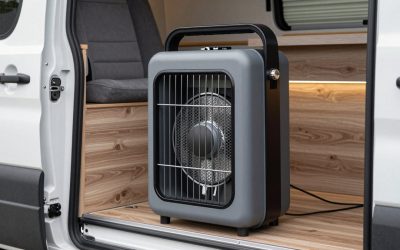
See also: Best Portable Heater for Van Life: Safe Options Compared • Best Mattresses Under $500
Best overall flame realism: Dimplex Revillusion 25-inch
The Revillusion range is a strong choice when the fire effect matters as much as the heat. Its partially transparent screen, log set, and depth illusion create a more open-looking fire than the flat orange video effect found on inexpensive inserts. Flame intensity and color can be adjusted, and the heater can be used independently of the flames.
Its roughly 25.6-by-19.1-inch cabinet is manageable in a compact entertainment center or custom van cabinet, but the approximately 8.5-inch depth still requires careful planning. The 1,500-watt heater draws about 12.5 amps on a 120-volt circuit, so it is best used from shore power or a properly sized inverter rather than a small auxiliary battery.
Best shallow insert: Touchstone Sideline
The Touchstone Sideline is better suited to a wide, modern opening where cabinet depth is limited. Models in the Sideline range are approximately 5.5 inches deep, although the required framing space can be greater than the product depth. The wide glass front, multiple flame colors, adjustable brightness, and included logs provide a visually clean installation.
This style is especially practical in a stationary tiny home, RV living room, or van conversion with a shallow media wall. The trade-off is that the long, thin flame display can look more like an illuminated screen than a deep fire when viewed from the side. Check whether the selected model requires a dedicated circuit and whether its heater can be disabled while the flame display remains on.
Best for a wide wall opening: Napoleon Alluravision
Napoleon’s Alluravision inserts suit installations where the desired look is a broad horizontal fireplace rather than a traditional firebox. The 42-inch class is approximately 42.3 inches wide, 19.5 inches high, and just over 5 inches deep. Multiple flame colors, ember-bed lighting, a remote, and thermostat control make it flexible for daily use.
Its main limitation is not performance but proportion: a 42-inch fireplace can overwhelm a narrow van wall and may leave little room for ventilation, speakers, storage, or service access. Measure the finished wall before choosing a wide model; the visible glass width is not the same as the required opening.
Best low-energy choice: a compact 750/1,500-watt insert
For occasional warmth, select a compact insert with two heat settings. The 750-watt mode uses half the power of a standard high setting while still taking the chill off a small enclosed room. These models generally have less convincing logs, simpler flame movement, and smaller viewing areas, but they are easier to fit and less demanding on an inverter.
How the important specifications compare
Opening dimensions and installation depth
Do not size an insert from the visible front alone. Record the opening width at the top, middle, and bottom; the height on both sides; the available depth; and the position of electrical wiring. A cabinet opening that is 26 inches wide may not accept a nominal “26-inch” insert if the outer frame is wider than the firebox.
Depth also has two measurements: the product cabinet depth and the required cavity depth. A five-inch insert may need additional space for the power cord, ventilation, brackets, and a serviceable receptacle. Never bury the plug behind a permanently inaccessible wall.
Heat output and electrical load
Most electric fireplace heaters are supplemental heat sources, not replacements for a building’s primary heating system. A typical 1,500-watt unit produces roughly 5,000 BTU per hour and draws approximately 12.5 amps at 120 volts. That is near the practical limit of a 15-amp circuit once other appliances are included.
In a van, the same load is much larger on the battery side. Allowing for inverter losses, a 1,500-watt heater may draw around 140 amps from a 12-volt battery bank. A 2,000-watt-hour battery theoretically provides:
2,000 Wh ÷ 1,500 W = 1.33 hours.
After allowing for inverter loss and avoiding complete battery discharge, usable runtime may be closer to 45–65 minutes. At 750 watts, the theoretical runtime is about 2.67 hours, with practical runtime often around 1.5–2 hours. These figures explain why electric inserts are far more economical on shore power than while boondocking.
Flame realism
Look for depth cues rather than extra color options. A realistic insert usually has separately lit logs, an ember bed with uneven brightness, flame movement at different depths, and a screen that does not reveal an obvious repeating video loop. Adjustable brightness is useful because maximum brightness often looks less natural in a dark room.
Three flame colors do not necessarily mean a more realistic fire. A single warm flame with dimmable embers may look better than blue, purple, and orange presets layered over a flat black screen.
Controls and safety
A remote control is convenient, but physical buttons on the unit matter when the remote is misplaced. Useful controls include independent flame and heat operation, a thermostat, a sleep timer, brightness adjustment, and a child-lock function.
Important safety features include overheat protection, automatic shutoff if airflow is restricted, a cool-touch or insulated front design, and a heater that stops when the thermostat reaches the set temperature. Keep curtains, bedding, clothing, and stored items away from the heater outlet. Do not cover the unit, block its intake, or install it where water can splash onto the controls.
Decision matrix for choosing an insert
| Your situation | Recommended specification | Why |
|---|---|---|
| Small van or narrow cabinet | 23–26-inch insert; 6–9-inch depth | Easier to frame and less likely to dominate the interior |
| Mostly shore-power use | 1,500 W with thermostat and timer | Maximum supplemental heat without battery-runtime concerns |
| Frequent off-grid use | Flame-only mode or 750 W low setting | Preserves battery capacity and still provides the visual effect |
| First-time DIY installation | Front-insert design with clear framing diagrams | Reduces custom cabinet work and service problems |
| Wide living-room feature wall | 36–42-inch shallow insert | Creates a balanced horizontal proportion |
| Children or pets nearby | Lockable controls, timer, and strong overheat protection | Reduces accidental operation and overheating risk |
Installation and ownership realities
Before cutting the cabinet, make a full-size cardboard template of the insert, including the trim. Test the template in the intended position with doors, drawers, seats, and walkways in their normal operating positions. This catches fit problems that a tape measure misses.
Use a properly grounded outlet and follow the manufacturer’s circuit instructions. Avoid extension cords unless the manual explicitly permits one with the required wire gauge and length. In a mobile installation, secure the unit against vibration, protect the glass from nearby loose cargo, and leave access to the controls and power connection.
Dust is the most common maintenance issue. Vacuum the intake and exhaust grilles several times each season, using a soft brush rather than pushing dust into the cabinet. Clean the glass with a non-abrasive product after the unit is cool and unplugged. Do not spray cleaner directly onto the display or control panel.
The first components likely to cause trouble are the remote control, display lights, fan, and flame motor or LED assembly—not the heating element itself. Keep the model number and remote-control part number with the vehicle records. If a fan becomes noisy, the display flickers, or the unit shuts down repeatedly, stop using the heater until the airflow path and electrical supply have been checked.
Final recommendation
Choose the Dimplex Revillusion 25-inch when realistic flames and traditional proportions are the priority. Choose the Touchstone Sideline or Napoleon Alluravision when a shallow, wide installation matters most. For a van or small off-grid space, the best electric fireplace insert is often a compact model with a 750-watt setting, independent flame-only operation, a timer, and accessible controls. The prettiest insert is not the right choice if its depth prevents safe framing or its heater overwhelms your electrical system.