Last updated: October 4, 2026
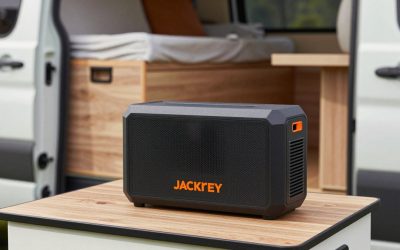
Buy the Jackery Explorer 300 if you need a light, grab-and-go battery for phones, laptops, cameras, a CPAP-free weekend of lights and fans, or a small 12V cooler for a night. Buy the Explorer 1000 v2 if you live or travel in a van, want to run a 12V fridge for multiple days, or need to power higher-wattage gear like an electric kettle, induction plate, hair dryer or power tools. The 1000 v2 stores more than three times the energy and delivers five times the continuous output.
For most van life and RV setups, the 1000 v2 is the better long-term buy because it can actually anchor a small electrical system, and its LiFePO4 battery chemistry is built for thousands of cycles. The Explorer 300 still makes sense as a second, portable unit or for tent camping and day trips. Typical pricing runs around $230–$300 for the 300 and roughly $450–$600 for the 1000 v2, with frequent sales on both.
Head-to-head specs
| Spec | Explorer 300 | Explorer 1000 v2 |
|---|---|---|
| Battery capacity | 292Wh | 1,070Wh |
| Continuous AC output | 300W | 1,500W |
| Battery chemistry | Lithium-ion (NMC) | LiFePO4 |
| Rated cycle life | About 500 cycles to 80% | About 4,000 cycles to 70% |
| Approximate weight | About 7 lb | About 24 lb |
| AC outlets | 2 | 3 |
| Typical price | About $230–$300 | About $450–$600 |
Capacity and output come from the product listings; chemistry, cycle and weight figures are Jackery’s published specs for these models and are approximate.
Capacity: how long will each run your gear?
See also: How Many Watts of Solar Do You Need for Van Life? • Truma vs Webasto Water Heaters for Vans: Combi, Aquago and Alternatives
A simple way to estimate runtime is capacity × 0.85 (to account for conversion losses) ÷ device watts. Here is what that looks like for common van and camping loads.
| Device (average draw) | Explorer 300 (292Wh) | Explorer 1000 v2 (1,070Wh) |
|---|---|---|
| Phone charge (about 15Wh each) | About 16 charges | About 60 charges |
| Laptop (60W) | About 4 hours | About 15 hours |
| 12V compressor fridge (average 40W) | About 6 hours | About 22 hours |
| LED string lights (10W) | About 25 hours | About 90 hours |
| Electric kettle (1,200W) | Not supported (over 300W) | About 45 minutes |
A 12V fridge’s average draw varies a lot with ambient temperature and how often you open it, so treat those figures as a starting point. The key takeaway is that the 1000 v2 can carry a fridge through a full day and night, while the 300 cannot.
Output: what each one can power
The Explorer 300’s 300W limit covers electronics, small fans, lights, a drone charger or a camera battery bank. Anything with a heating element, a motor that pulls hard on startup, or a microwave is off the table.
At 1,500W continuous, the 1000 v2 opens up much more: a small coffee maker, a single induction burner on a lower setting, a blender, a 1,200W kettle, or a circular saw for light DIY. Always check the wattage label on the appliance; many hair dryers and full-size microwaves still exceed 1,500W on their highest setting.
Battery life and chemistry
This is a bigger difference than it first appears. The Explorer 300 uses traditional lithium-ion cells rated for roughly 500 cycles before capacity drops to about 80%. Used a few weekends a month, that is many years. Used daily in a van, it could show noticeable wear in under two years.
The 1000 v2 uses LiFePO4 (lithium iron phosphate), rated for around 4,000 cycles to 70% capacity. If you cycle it every day, that is more than a decade on paper. LiFePO4 is also known for good thermal stability, which is reassuring in a vehicle that heats up in summer.
Charging options
Both units charge from a wall outlet, a 12V car socket, or Jackery’s SolarSaga panels. The smaller 300 refills quickly from a wall outlet and needs only a modest panel to top up over a sunny day. The 1000 v2 supports fast AC charging (Jackery advertises a roughly one-hour emergency charge mode through its app) and benefits from 200W or more of solar to recharge within a day. Car charging alone is slow for a 1,070Wh battery; many van owners pair it with solar on the roof.
Portability and space
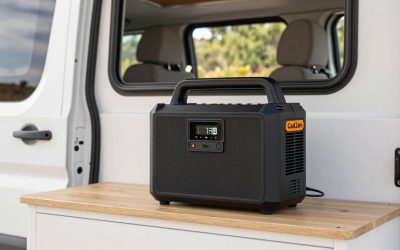
At about 7 lb, the Explorer 300 is lunchbox-sized and easy to carry to a picnic table, tent or photo location. The 1000 v2 at about 24 lb is still carryable with its fold-down handle, but it is something you place in a van cabinet or under a bench and leave there.
Which should you buy?
- Full-time or frequent van life: Explorer 1000 v2. It can run a fridge, cook small meals and keep devices charged, and it will survive daily cycling.
- Weekend car camping with a fridge: Explorer 1000 v2, or the 300 only if you use a cooler with ice instead.
- Tent camping, day trips, photography: Explorer 300. Light, cheap and enough for electronics.
- Home backup for outages: Explorer 1000 v2. It can keep a modem, router, lights and a laptop going overnight, and power a full-size fridge for several hours depending on its draw.
- Two-unit setup: many van owners keep a 1000-class unit as the main battery and a 300 as a portable satellite for outside the vehicle.
Quick questions
Can I use either one while it charges?
Both support pass-through use, so you can run devices while the battery recharges from the wall or solar. In a van, that lets solar cover daytime loads while the battery stores the surplus.
Can the Explorer 300 run a CPAP?
Many CPAP machines draw roughly 30–60W without the humidifier. On that basis the 300 could cover one or two nights, but check your machine’s actual draw and talk to your equipment supplier; the 1000 v2 gives far more margin for multi-night trips.
Bottom line
The Jackery Explorer 300 is an excellent compact power bank for light loads. The Explorer 1000 v2 is the one that actually supports van life, with 1,070Wh of LiFePO4 storage, 1,500W output and a cycle life built for daily use. If your budget stretches, the 1000 v2 is the smarter purchase for anything beyond weekend electronics charging.