Last updated: October 7, 2026
Best Audio Cables for Clean, Reliable Sound
The best audio cables are the shortest practical cables with connectors that match your equipment: use balanced XLR or TRS for microphones and long runs, shielded instrument cable for guitars and other unbalanced sources, and appropriately gauged speaker wire between an amplifier and passive speakers. In a van, also choose flexible jackets, solid strain relief, and lengths that won’t leave coils across walkways.
Choose by connection—not by “premium” claims
See also: Can You Listen to Apple Music Offline? • Top Radeon Graphics Deals
Audio cables don’t all carry the same kind of signal. A cable that works well from a guitar to an amp may be the wrong choice for connecting an amplifier to a speaker. Start by checking the connectors and input/output labels on both devices.

Elebase 1/4 Inch TRS Instrument Cable 10FT 2Pack,6.35mm Male Guitar Cord 3M
Included for 'Best Audio Cables for Clean, Reliable Sound' because the listing specifies 6.35mm Male Guitar Cord 3M, details this guide uses to compare options.
View on Amazon
Tan QY 2 RCA Stereo Audio Cable 3Ft-Gold Plated for Amplifier,Subwoofer
Included for 'Best Audio Cables for Clean, Reliable Sound' because the listing specifies Subwoofer, details this guide uses to compare options.
View on Amazon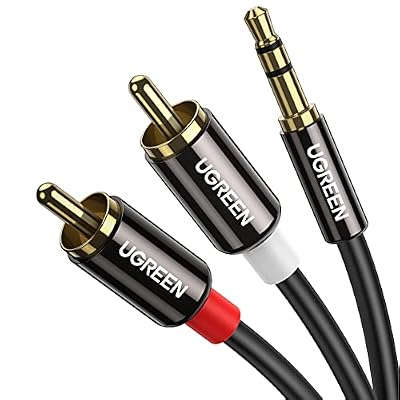
UGREEN 3.5mm to RCA Cable, 6.6FT 2RCA Male to Aux Audio Adapter, HiFi Sound
Included for 'Best Audio Cables for Clean, Reliable Sound' because the listing specifies 6.6FT 2RCA Male to Aux Audio Adapter and HiFi Sound, details this guide uses to compare options.
View on Amazon
Nanxudyj AUX Cord 6ft, 3.5mm Stereo Audio Cable 90 Degree Right Angle Nylon Braided Male to Male for Car, Headphones, Speaker, PS4/PS5, PC, Tablets - Hi-Fi Sound Portable TRS Auxiliary Cable
Included for 'Best Audio Cables for Clean, Reliable Sound' because the listing specifies Headphones and Speaker, details this guide uses to compare options.
View on Amazon- XLR: Three-pin connection commonly used for microphones and balanced audio. The locking connector helps prevent accidental unplugging.
- TRS: A tip-ring-sleeve plug, usually ¼-inch or 3.5 mm. A ¼-inch TRS cable can carry balanced mono audio between compatible devices; a 3.5 mm TRS cable commonly carries unbalanced stereo. The plug’s shape alone doesn’t tell you which signal it carries.
- TS: A tip-sleeve plug, usually ¼-inch, used for unbalanced instrument signals such as guitar and bass.
- RCA: Unbalanced connection found on some mixers, stereos, and amplifiers. Keep runs relatively short where possible.
- Speaker wire: Two conductors for an amplifier and passive speaker. It is not a substitute for a shielded instrument cable.
- USB or digital audio connections: Used for interfaces and digital equipment. These have their own compatibility and length requirements; don’t choose them by analog-audio rules alone.
Quick comparison by job
The figures below are practical starting points, not universal limits. Noise depends on the equipment, cable routing, and electrical environment as well as cable construction.
| Use | Recommended cable | Practical length | What to prioritize |
|---|---|---|---|
| Dynamic microphone to mixer | Balanced XLR, typically 22–26 AWG conductors | 3–10 m (10–33 ft) | Secure latches, flexible jacket, good connector strain relief |
| Guitar or bass to amp | Shielded ¼-inch TS instrument cable | 3–6 m (10–20 ft) | Effective shielding, quiet connectors, flexible jacket |
| Line-level gear, balanced | Balanced ¼-inch TRS or XLR, as the devices require | 1–10 m (3–33 ft) | Correct wiring and connectors; avoid adapters where possible |
| Phone or laptop headphone output to stereo input | 3.5 mm TRS to the correct stereo input, often dual RCA | 0.5–2 m (1.5–6.5 ft) | Proper stereo wiring and a snug fit |
| Amplifier to passive speaker | Two-conductor speaker wire, 16 AWG for short runs; 14 AWG for longer runs or higher current | As needed; keep runs matched and tidy | Correct polarity, suitable gauge, secure terminals |
| Van 12 V power wiring | Automotive-grade stranded copper wire sized for current and run length | Calculated for the installation | Fuse protection, correct gauge, abrasion protection—not an audio signal cable |
What matters in a cable
Shielding and interference
Balanced cables use two signal conductors plus a shield. A compatible balanced input rejects much of the interference picked up along the run, which makes XLR and balanced TRS useful near chargers, inverters, and other electronics. The benefit depends on both devices having balanced connections; plugging a balanced cable into an unbalanced setup does not magically make the whole connection balanced.
Instrument and RCA cables are usually unbalanced, so their shielding matters more as length and electrical interference increase. Keep them away from 12 V power wiring, inverter cables, and switching power supplies. If they must cross power cables, cross at roughly a right angle rather than bundling them together.
Conductor material and gauge
Oxygen-free copper is a common conductor material, but it is not a guarantee of better audible sound. For ordinary short audio runs, correct wiring, sound connectors, and shielding matter more than expensive claims about conductor purity. Avoid paying a large premium for exotic metals without a specific technical reason.
Gauge matters especially for speaker wire, where thinner conductors add resistance. A short run to a modest speaker may work well with 16 AWG copper; longer runs or higher-current systems can justify 14 AWG. For instrument cables, the cable’s flexibility and shielding are often more useful buying criteria than an unusually thick conductor.
Length, flexibility, and strain relief
Buy enough length to connect equipment without pulling on sockets, but not so much that excess cable becomes a trip hazard or a nest behind the seat. For an installed run, measure the actual route, include a little slack for movement, and secure the cable at intervals. Avoid tight bends, especially at plugs.
A soft, flexible jacket is easier to route in a compact van than a stiff studio cable. Look for plugs with a substantial boot or clamp where the cable enters the connector. Strain relief helps keep repeated bending from breaking the conductors at their most vulnerable point. For frequently moved cables, molded or metal connectors with a firm cable grip are preferable to a plug that relies on a loose sleeve.
Pick for your setup
- Recording voice or using a stage microphone: Choose a balanced XLR cable long enough to reach the interface or mixer without tension. A locking connector is useful when the cable may be bumped.
- Playing guitar or bass: Use a shielded TS instrument cable. For a van studio, a 3–6 m cable is usually easier to manage than a very long one unless the amp or recording position requires it.
- Connecting powered speakers or a mixer: Check the equipment manual for balanced XLR or TRS inputs and outputs. Match the connection on both ends; don’t assume that a ¼-inch socket always means instrument level.
- Connecting an amplifier to passive speakers: Use speaker wire and observe the marked polarity at both ends. Select gauge based on run length and expected power, rather than buying a shielded instrument cable.
- Building a vehicle audio or 12 V system: Separate signal cable selection from power-wire selection. Size power wiring for current, length, and installation conditions, and protect it with a correctly rated fuse near the source. Follow the equipment maker’s wiring instructions; a signal-cable chart cannot determine safe power-wire gauge.
Keep cables reliable on the road
The first failures are often mechanical: a plug gets bent, a conductor breaks where the cable meets the connector, or a jack loosens after repeated tugging. Dirt and oxidation can also make connections intermittent. Unplug by gripping the connector rather than pulling the cable, and coil cables in loose loops rather than wrapping them tightly around your hand or a connector.
Check cables occasionally by inspecting the plugs and jacket for looseness, cuts, crushed spots, or exposed conductors. Clean dusty connectors with a dry, lint-free cloth; don’t spray household cleaners into jacks. If a cable crackles when gently flexed, swaps in and out, or works only at a particular angle, replace it or have it repaired rather than relying on it for a recording or drive.
For most van setups, a small, sensible kit beats a collection of expensive cables: one short balanced XLR, one shielded instrument cable if you play, the exact adapter needed for your source, and correctly sized speaker or vehicle wire for installed equipment. Match each cable to its job, keep runs tidy, and spend extra where the connection will be moved or stressed often.