Last updated: October 11, 2026
For most van lifers, the best Black Friday keyboard piano deal to prioritise is the Alesis Recital Play 88-Key Piano Keyboard Bundle. It pairs a full 88-key layout with built-in speakers, headphone-quiet practice, and a bundle that arrives with the furniture you would otherwise buy separately — which is the exact combination that survives in a 60-to-90-square-foot living space. It suits players who already read music or have outgrown beginner territory and don’t want to relearn technique on a toy keybed. If your build is smaller than a short-wheelbase cargo van, or you break down your living space every single day, the POGOLAB 49-Key Roll-Up is the smarter buy: it folds into something close to a laptop sleeve. Buying for a child? The Soundo 37-Key and BIGFUN 37-Key toddler boards are the two that make sense at sale pricing. Everything else here sits between those poles, and the sections below explain which one matches your key count, your action preference, and your power setup.
- Top 3 Picks
- Quick Comparison
- How We Chose
- 1. RockJam RJ5061 61-Key Keyboard Piano Kit – Best for a Complete Starter Kit in a Small Van
- 2. Soundo 37 Keys Kids Piano with Microphone – Best for Young Beginners
- 3. BEATBIT Piano Note Guide for Beginners – Best for Learning Note Names Fast
- 4. Alesis Recital Play 88-Key Piano Keyboard Bundle – Best Overall
- 5. Yamaha 88-Key Digital Piano with Weighted Keys – Best for Weighted-Action Realism
- 6. BIGFUN 37-Key Toddler Piano Instrument Toy – Best for Toddlers
- 7. RockJam RJ561 61-Key Keyboard Piano Kit – Best for a 61-Key Kit With a Stool
- 8. MUSTAR 61-Key Electric Piano Keyboard with Light-Up Keys – Best for Self-Teaching
- 9. Basics Portable 61-Key Electric Keyboard Piano – Best for No-Fuss Simplicity
- 10. STRICH 88-Key Digital Piano Set – Best for Full-Size Bundle Value
- 11. Donner 61-Key Keyboard Piano with 249 Voices and 249 Rhythms – Best for Sound Variety
- 12. POGOLAB 49-Key Roll-Up Keyboard Piano – Best for Storage and Travel
- How to Choose
Top 3 Picks
Best Overall: Alesis Recital Play 88-Key Bundle
Eighty-eight full-size keys, onboard speakers for campsite playing, a headphone output for quiet hours, and a bundle that includes the stand and bench. It’s the pick for anyone who wants to keep genuine piano habits alive on the road without dedicating a wall to a console piano. If you can spare roughly four and a half feet of length and a permanent-ish setup spot, this is the one to watch on Black Friday.
Best Budget: POGOLAB 49-Key Roll-Up
Rechargeable, foldable, and small enough to live behind a seat or under a mattress topper. Forty-nine keys covers two-handed practice in most keys, and the built-in tone set is enough for learning repertoire rather than performing it. It’s the budget pick for travellers who genuinely cannot spare a fixed surface. For a child instead of an adult, the Soundo 37-Key with its included microphone is the budget alternative.
Best Premium: Yamaha 88-Key Digital Piano with Weighted Keys
Weighted keys, a compact chassis, Bluetooth, and a sustain footswitch in the box — the closest thing on this list to practising on an acoustic piano’s feel. It costs the most and weighs the most, so it suits a larger build with a dedicated music corner and a solid power setup. If touch response is the thing you refuse to compromise on, this is the pick.
Quick Comparison
See also: Can You Listen to Apple Music Offline? • Top Radeon Graphics Deals
| Product | Best for | Keys & action | Notable specs | Price tier |
|---|---|---|---|---|
| RockJam RJ5061 61-Key Kit | Complete starter kit | 61 full-size, synth action | Stand, bench and headphones included; ~37–39 in wide | Mid-range |
| Soundo 37-Key Kids Piano | Young beginners | 37 keys, toy-grade action | Microphone included; black finish | Budget |
| BEATBIT Piano Note Guide | Learning note names | Accessory — removable labels | Fits full-size key spacing; removable, black | Budget |
| Alesis Recital Play 88-Key Bundle | Overall van piano | 88 full-size keys, synth-style | Built-in speakers, headphone out, bundle stand and bench | Premium |
| Yamaha 88-Key Digital Piano | Weighted-action realism | 88 weighted keys | Bluetooth, music rest, sustain footswitch, compact chassis | Premium |
| BIGFUN 37-Key Toddler Piano | Toddlers | 37 keys, toy-grade | Black finish, battery-class power, very light | Budget |
| RockJam RJ561 61-Key Kit | 61-key kit with stool | 61 full-size, synth action | Stand, stool and headphones included | Mid-range |
| MUSTAR 61-Key Light-Up | Self-teaching | 61 keys, synth action | Light-up keys for guided learning | Mid-range |
| Basics Portable 61-Key | No-fuss simplicity | 61 full-size keys | Built-in speakers, built-in learning songs | Premium |
| STRICH 88-Key Digital Piano Set | Full-size bundle value | 88 velocity-sensitive keys | Stand, bench and pedal included | Premium |
| Donner 61-Key Keyboard | Sound variety | 61 keys, synth action | 249 voices, 249 rhythms, stand included | Mid-range |
| POGOLAB 49-Key Roll-Up | Storage and travel | 49 keys, soft/foldable | Rechargeable, foldable, 47 tones | Budget |
How We Chose
This roundup was assembled from published manufacturer specifications, product listings, and well-documented category norms — not from physical evaluation of the units. No keyboard here was played, measured on a bench, or stored in a van by us. The selection criteria were deliberately practical rather than audiophile.
First, key count as a proxy for footprint. A full-size white key is about 0.93 inches wide, so key count translates directly into whether a board fits across a bed platform, a galley counter, or a dedicated wall run. That single number eliminates more products than any other.
Second, action class. Synth-action, semi-weighted and weighted hammer actions behave differently and cost differently in weight and depth. We grouped products by class rather than pretending all keybeds are comparable.
Third, category fit. Toy keyboards for toddlers, note-reading accessories, and performance-grade digital pianos solve different problems, so we placed each product in the situation it actually serves instead of ranking them against each other on a single scale.
Fourth, power flexibility and upgrade path. In a van, whether a board runs on internal batteries, USB power, a 12-volt input, or a mains adapter through an inverter matters as much as tone. We also asked what a buyer does next when they outgrow the instrument — a board that dead-ends has less value than one that bridges to a better setup.
1. RockJam RJ5061 61-Key Keyboard Piano Kit – Best for a Complete Starter Kit in a Small Van

RockJam RJ5061 61 Key Keyboard Piano Kit with Stand, Bench & Headphones
Included for 'Best Black Friday Keyboard Piano Deals' because the listing specifies Bench & Headphones, details this guide uses to compare options.
View on AmazonThe RJ5061 is the kit to shortlist if you want to be playing this week without assembling a shopping list. It arrives as a bundle — keyboard, stand, bench and headphones — and in a van that matters more than it does in a house, because the stand and the bench are precisely the two items people forget and then improvise badly on a folding camp table and a cooler lid.
Key specs
- Key count: 61 full-size keys
- Action: synth-style, unweighted — light, fast, no hammer feel
- Included in the kit: stand, bench, headphones
- Quiet practice: headphone output for after-dark sessions
- Power: mains-adapter class; confirm whether your specific listing adds a battery option before buying
- Footprint: roughly 37–39 inches wide, with the stand occupying a similar depth to a camp chair
Strengths. Sixty-one keys is the pragmatic middle of the road for van life. It gives you five octaves, which covers the overwhelming majority of pop, folk, country and worship repertoire, plus enough range to practise scales in every key. A 61-key board is also narrow enough to sit crossways at the end of a bed platform or along a galley wall without becoming a permanent obstacle. The bundled headphones mean you can play at 11pm in a campsite with neighbours twenty feet away, which is the single most valuable feature a van instrument can have. Because the action is unweighted, the whole kit stays light enough for one person to shift it from travel position to playing position in under a minute.
Pros
- Everything needed to start is in one box — no separate stand, bench or headphone purchase
- Five-octave range suits most real repertoire
- Light enough for one person to reposition daily
- Headphone practice keeps campsite peace
- Narrow enough to fit across a standard bed platform
Cons
- Synth action transfers poorly to acoustic piano technique
- Bundled headphones and bench are basic rather than comfortable for long sessions
- No weighted feel, so dynamics are harder to control
- Mains power means an inverter or shore hookup unless your listing includes batteries
How it compares. Against the RockJam RJ561, the difference is furniture, not sound: the RJ561 swaps the bench for a stool and is otherwise the same proposition. Against the Donner 61-key, the RockJam trades a much larger voice and rhythm library for the convenience of a complete kit. Against the Basics 61-key, the RockJam gives up nothing in key count but sits a tier lower on price. If you want a bench you can sit on for an hour, step up; if you want to be playing tonight with no extra purchases, this is the efficient choice.
2. Soundo 37 Keys Kids Piano with Microphone – Best for Young Beginners

Soundo 37 Keys Kids Piano with Microphone, Music Keyboard, Black
Included for 'Best Black Friday Keyboard Piano Deals' because the listing specifies Music Keyboard and Black, details this guide uses to compare options.
View on AmazonThe Soundo 37-key is aimed squarely at children who are curious about music but not yet ready for a serious instrument. Thirty-seven keys is roughly three octaves — enough for nursery melodies, simple folk tunes and first-hand-position exercises, and small enough that a six-year-old can reach both ends without shifting position. The included microphone is the feature that actually keeps kids coming back, because singing along turns practice into play.
Key specs
- Key count: 37 keys
- Action: toy-grade, very light touch
- Included: microphone
- Finish: black
- Power: battery-class, typical for this category — verify the exact battery type on the listing
- Footprint: roughly 20–22 inches wide, light enough for a child to move alone
Strengths. In a van, children’s instruments fail for two reasons: they are too big to store, or too fragile to survive being stowed daily. A 37-key board avoids both problems. It slides under a bench seat, sits on a bunk, or wedges behind a seat back without dominating the space. The microphone adds a second mode of engagement, which matters on rainy days when everyone is inside and energy is high. Volume is typically modest, and most boards in this class include a headphone jack so a child can practise while a partner sleeps — worth confirming before purchase, because that single port is what makes a kids’ keyboard livable in a shared space.
Pros
- Small enough to store in a seat locker or under a bunk
- Microphone turns practice into play for younger children
- Light enough that a child can set it up independently
- Low replacement cost if it gets dropped, sat on or rained on
Cons
- Three octaves limits repertoire severely once a child progresses
- Toy-grade action gives almost no resistance, so finger strength doesn’t develop
- Sound quality is basic and speaker volume is limited
- Not a serious practice instrument for anyone past the first year
How it compares. Against the BIGFUN 37-key toddler board, the Soundo is the better choice for a slightly older child — the microphone and the broader melody-focused feature set suit a five-to-eight-year-old, while the BIGFUN leans younger and simpler. Against the RockJam RJ5061, the Soundo gives up twenty-four keys and any pretence of a real keybed in exchange for a fraction of the footprint. If your child is under four, go BIGFUN; if they’re old enough to sing along, go Soundo; if they’ve been taking lessons for a year, neither is enough and you should look at a 61-key kit.
3. BEATBIT Piano Note Guide for Beginners – Best for Learning Note Names Fast
The BEATBIT note guide is not a keyboard — it’s the cheapest meaningful upgrade you can make to one. It’s a removable set of note labels that sits over the keys and names them, so a beginner stops hunting for middle C and starts building the visual mapping that eventually makes the labels unnecessary. In a van, where you might practise in twenty-minute windows rather than hour-long sessions, cutting the search time per note has an outsized effect on how fast you progress.
Key specs
- Type: removable note guide, applied over the keybed
- Finish: black
- Sizing: designed for full-size key spacing — check the listing’s stated coverage against your key count
- Compatibility: works with any full-size-key instrument, weighted or unweighted
- Storage: flat, so it stows in a document sleeve or a book
Strengths. The value here is pedagogical, not musical. Beginners lose enormous amounts of practice time to note identification, and that friction is worse in a van because your sessions are shorter and more interrupted. Labels compress the identification step so the time goes into finger movement and rhythm instead. Because they’re removable, they’re also a temporary tool rather than a permanent crutch — the goal is to take them off within a few months once the note positions are internalised. They add essentially nothing to your packing volume and nothing to your weight budget, and they cost less than a tank of fuel.
Pros
- Very low cost relative to the practice time it saves
- Removable, so it doesn’t become a permanent dependency
- Adds no meaningful weight or storage volume
- Works with any full-size-key instrument you already own
Cons
- Only useful for the first few months of learning
- Must be sized correctly for your key count — an 88-key guide won’t fit a 49-key board
- Adds nothing to sound, feel or playability
- Some players find labels slow down reading from sheet music if left on too long
How it compares. Against buying a light-up keyboard like the MUSTAR 61-key, the note guide is the budget route to the same outcome: guided note identification. The MUSTAR does it electronically with illuminated keys that respond to built-in learning material, which is more engaging for children and more expensive. The guide is the better choice if you already own a keyboard and just want to read music faster. If you’re buying an instrument from scratch and want the guidance built in, the MUSTAR is the more complete answer — and the two together is a reasonable beginner setup.
4. Alesis Recital Play 88-Key Piano Keyboard Bundle – Best Overall

Alesis Recital Play 88-Key Piano Keyboard Bundle
Included for 'Best Black Friday Keyboard Piano Deals' as a relevant option in this category; details come from the product listing.
View on AmazonThis is the pick for the van lifer who wants a genuine piano rather than a compromise. Eighty-eight full-size keys means the same layout you’d find on an acoustic upright, so anything you learn on the road transfers directly to a real piano when you visit one. The bundle format matters: it arrives with the stand and bench, which removes the two most common sources of “I’ll set it up next week” procrastination.
Key specs
- Key count: 88 full-size keys
- Action: synth-style, unweighted
- Speakers: built-in, for playing without headphones
- Headphone output: yes — the critical feature for shared and campsite living
- Included: bundle stand and bench
- Footprint: roughly 52–54 inches wide — plan a dedicated run of wall or a flip-down surface
Strengths. Full range is the headline. With 88 keys you can play almost any written piano part without transposing or octave-shifting, and you build the spatial memory of the full instrument rather than a reduced version of it. Built-in speakers mean you can play outside on a nice evening without hauling a separate amp or speaker — a genuine quality-of-life difference when your living room is a campsite. The headphone output covers the opposite case. Because it’s a bundle, the total cost at Black Friday pricing is usually better than buying a board, stand and bench separately, and the stand is designed for the instrument rather than improvised from a folding table.
Pros
- Full 88-key range — no repertoire limitations
- Built-in speakers plus headphone output covers both playing modes
- Bundle includes stand and bench, reducing total outlay
- Standard full-size key spacing transfers to acoustic pianos
Cons
- Requires roughly four and a half feet of dedicated length
- Unweighted action doesn’t build the finger strength a hammer action does
- Heavier and bulkier to reposition than a 61-key or roll-up board
- Needs a stable surface or a properly levelled stand in a moving vehicle
How it compares. Against the Yamaha 88-key, the Alesis gives up weighted action in exchange for built-in speakers and a lower price tier — and that trade is the central decision on this list. Against the STRICH 88-key set, the Alesis is the more established brand name in the digital piano category and the bundle is more likely to include everything in one purchase. Against a 61-key kit, the Alesis costs more space but removes every repertoire ceiling. If you play seriously and have the room, this is the best overall pick; if you don’t have the length, nothing here changes that.
5. Yamaha 88-Key Digital Piano with Weighted Keys – Best for Weighted-Action Realism

Yamaha 88-Key Digital Piano with Weighted Keys, Compact Design, Bluetooth, Keyboard, Music Rest, Sustain Foot Switch, and Built-in Speakers for Home Practice or Travel P145BT
Included for 'Best Black Friday Keyboard Piano Deals' because the listing specifies Compact Design and Bluetooth, details this guide uses to compare options.
View on AmazonWeighted keys are the difference between practising piano and practising keyboard, and this is the instrument on the list that takes that seriously. Yamaha has built digital pianos for decades, and the weighted action in this class of instrument is designed to approximate the resistance and return of an acoustic mechanism. For a van lifer who plays classical repertoire, studies technique, or plans to sit exams, that resistance is not a luxury — it’s the training stimulus.
Key specs
- Key count: 88 weighted keys
- Action: weighted hammer-style, graded feel across the range
- Connectivity: Bluetooth, for app-based learning and audio streaming
- Included: music rest, sustain footswitch
- Design: compact chassis relative to a console piano
- Power: mains-adapter class
- Footprint: roughly 52–54 inches wide, with meaningful depth for the action mechanism
Strengths. Weighted keys build finger strength and control in a way no synth-action board can. Dynamics become expressive rather than binary, and repertoire that depends on touch — anything from the Baroque onward — becomes playable as written. Bluetooth is a genuinely useful van feature: it lets you stream a backing track or a lesson through the instrument’s own speakers, or connect to a learning app without a cable run across your living space. The included sustain footswitch matters too, because sustain is not optional for most piano literature and buying one separately is a common oversight. The compact chassis is Yamaha’s deliberate attempt to make an 88-key weighted instrument transportable.
Pros
- Weighted action builds real piano technique
- Bluetooth for lessons, backing tracks and app connectivity
- Sustain footswitch and music rest included
- Yamaha’s long history in the digital piano category
Cons
- Highest price tier on this list
- Heaviest option — repositioning it solo is a two-hand job
- Requires a stable, level surface; it will not tolerate a wobbling table
- Mains power only, so it depends on your inverter or hookup
How it compares. Against the Alesis Recital Play bundle, the Yamaha wins on touch and loses on price and onboard convenience — the Alesis includes a stand and bench, while the Yamaha assumes you already have a surface. Against the STRICH 88-key set, the Yamaha is the more premium instrument and the STRICH is the more complete package for a first purchase. If touch response is your non-negotiable, this is the pick; if you need furniture in the box and a lower tier, the Alesis or STRICH serve you better.
6. BIGFUN 37-Key Toddler Piano Instrument Toy – Best for Toddlers

Keyboard Piano for Kids, BIGFUN 37 Keys Toddler Piano Instrument Toy, Black
Included for 'Best Black Friday Keyboard Piano Deals' because the listing specifies BIGFUN 37 Keys Toddler Piano Instrument Toy and Black, details this guide uses to compare options.
View on AmazonThis is a toy, and it should be judged as one. The BIGFUN 37-key board is designed for children roughly eighteen months to four years old, where the goal isn’t musicianship but cause and effect: press a key, hear a sound, feel the reward. That loop is genuinely valuable developmentally, and it’s the reason a cheap, rugged board beats an expensive instrument that lives in a case because you’re afraid the child will destroy it.
Key specs
- Key count: 37 keys
- Action: toy-grade, minimal resistance
- Finish: black
- Power: battery-class, typical for toddler instruments
- Build: lightweight plastic, sized for small hands
- Footprint: roughly 20 inches wide
Strengths. Durability per pound is the point. A toddler keyboard needs to survive being sat on, dropped off a bunk, and shoved into a toy bin. This class of instrument is built for exactly that treatment, which means it can live out in the van rather than being rationed. It’s also quiet enough that it doesn’t dominate the interior, and light enough that a two-year-old can drag it around — which is exactly what you want, because independent access is what makes a toddler use it. Because the price tier is the lowest here, replacing it after an accident is a minor event rather than a family crisis.
Pros
- Lowest price tier — minimal financial risk
- Built to survive toddler handling
- Light and small enough to store anywhere
- Immediate cause-and-effect reward for very young children
Cons
- Not a musical instrument in any serious sense
- No touch sensitivity, so no dynamic control
- Sound quality is toy-grade
- Outgrown quickly — usually within a year
How it compares. Against the Soundo 37-key, the BIGFUN is the simpler, younger-leaning option; the Soundo’s microphone and melody features suit a child who is old enough to sing along deliberately. Against the RockJam RJ5061, the comparison is unfair in both directions — the BIGFUN is a toy and the RockJam is a starter instrument. The right sequence for most families is BIGFUN first, Soundo around age five, then a 61-key kit once the child shows sustained interest.
7. RockJam RJ561 61-Key Keyboard Piano Kit – Best for a 61-Key Kit With a Stool

RockJam RJ561 61 Key Keyboard Piano Kit with Stand, Stool & Headphones
Included for 'Best Black Friday Keyboard Piano Deals' because the listing specifies Stool & Headphones, details this guide uses to compare options.
View on AmazonThe RJ561 is the sibling of the RJ5061 with one meaningful difference in the box: a stool instead of a bench. That sounds trivial until you’ve tried to play for forty minutes on a bench with no back support and the wrong height, at which point seating becomes a technique issue rather than a comfort one. Wrong seat height changes your wrist angle, and wrist angle changes everything about how you play.
Key specs
- Key count: 61 full-size keys
- Action: synth-style, unweighted
- Included: stand, stool, headphones
- Headphone output: yes, for silent practice
- Power: mains-adapter class
- Footprint: roughly 37–39 inches wide with a stand footprint comparable to a folding chair
Strengths. Sixty-one keys remains the best compromise between range and footprint for a vehicle. Five octaves covers the vast majority of popular repertoire, and the board is narrow enough to fit crossways at the end of a bed platform. The kit format removes the guesswork: the stand is matched to the instrument, the stool is matched to the stand, and the headphones mean you can play at any hour without disturbing anyone within earshot. For a van lifer who wants a self-contained practice station that packs into three pieces, this is about as tidy as it gets. The stool is also easier to stow than a full bench because it typically nests or folds.
Pros
- Complete kit — instrument, stand, seating and headphones together
- Five-octave range covers most repertoire
- Stool takes less storage volume than a bench
- Headphone practice works in shared and campsite settings
Cons
- Synth action limits technique transfer to acoustic piano
- Bundled stool is basic and may need a cushion for long sessions
- Mains power unless your listing specifies battery operation
- Overlaps heavily with the RJ5061 — pick one, not both
How it compares. Against the RJ5061, the only real decision is seating: bench or stool. A bench is better for posture over long sessions; a stool stows smaller. Against the Donner 61-key, the RockJam gives up the huge voice and rhythm library but gains a matched stool and headphones in the box. Against the MUSTAR 61-key light-up, the RockJam trades guided learning for a more complete physical setup. If you already own a stool or a folding chair you like, the RJ5061 is the better value; if you don’t, this one is.
8. MUSTAR 61-Key Electric Piano Keyboard with Light-Up Keys – Best for Self-Teaching

MUSTAR Keyboard Piano, 61 Key Electric Piano Keyboard with Light-Up Keys
Included for 'Best Black Friday Keyboard Piano Deals' because the listing specifies 61 Key Electric Piano Keyboard with Light-Up Keys, details this guide uses to compare options.
View on AmazonLight-up keys are the most underrated learning feature in the budget-to-mid keyboard category. Instead of translating a note on a page into a key position and then finding it, the instrument shows you where to put your finger. For an adult teaching themselves in short, interrupted sessions — which is the normal pattern in a van — that removes a step that otherwise consumes most of a practice window.
Key specs
- Key count: 61 keys
- Action: synth-style, unweighted
- Learning aid: illuminated keys synced to built-in learning material
- Practice: headphone output for silent sessions
- Power: mains-adapter class
- Footprint: roughly 37–39 inches wide
Strengths. The guided-learning workflow is the reason to choose this board over a plain 61-key instrument at a similar tier. Following illuminated keys builds muscle memory for note positions faster than reading notation alone, and it keeps practice moving when you’re tired and don’t want to think hard. That matters disproportionately in van life, where practice often happens at the end of a driving day when cognitive bandwidth is low. Sixty-one keys is the right size for the vehicle, and the headphone output keeps late sessions private. Once the key positions are internalised, the light-up function becomes a feature you ignore rather than depend on — which is the correct arc for a learning aid.
Pros
- Light-up keys accelerate note-position learning
- 61-key range suits most repertoire and most van footprints
- Headphone output for quiet practice
- Good fit for adult self-teachers with irregular practice windows
Cons
- Unweighted action doesn’t develop piano-level finger strength
- Dependency risk if you never wean yourself off the lights
- Doesn’t teach rhythm or reading on its own
- Mains power limits where you can set up
How it compares. Against the RockJam RJ5061 and RJ561, the MUSTAR trades the bundled furniture for the learning feature — you’ll need a surface and a seat. Against the Basics 61-key, the MUSTAR is the more teaching-oriented board while the Basics leans toward simplicity and sound. Against a plain 61-key with a BEATBIT note guide, the outcome is similar; the light-up version is more engaging for children and the guide is cheaper for adults. If you’re teaching yourself from scratch, the light-up route is the more motivating one.
9. Basics Portable 61-Key Electric Keyboard Piano – Best for No-Fuss Simplicity
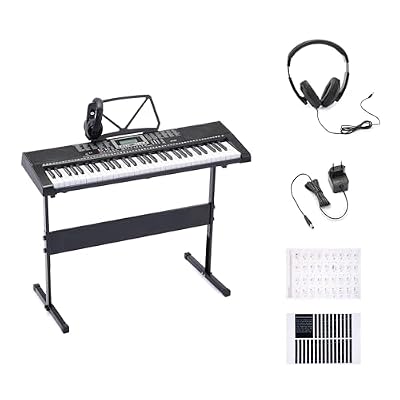
Amazon Basics Portable Electric Keyboard Piano with 61 Full Size Keys, Built-in Speakers, Songs for Learning, Digital Piano, Black
Included for 'Best Black Friday Keyboard Piano Deals' because the listing specifies Built-in Speakers and Songs for Learning, details this guide uses to compare options.
View on AmazonSome buyers don’t want 249 voices or a learning system. They want a keyboard that turns on, sounds decent, and doesn’t require reading a manual. This 61-key board sits in that category: full-size keys, built-in speakers, a set of built-in songs for learning, and no configuration burden. In a van, where setup friction determines whether you actually play, that simplicity has real value.
Key specs
- Key count: 61 full-size keys
- Speakers: built-in
- Learning content: built-in songs for practice
- Portability: slim chassis designed to be carried and stored easily
- Power: mains-adapter class; confirm battery support on your specific listing
- Footprint: roughly 37–39 inches wide
Strengths. The appeal is the absence of complexity. Full-size keys mean your hand position transfers to any other piano, built-in speakers mean no external gear, and the learning songs give a beginner something structured to work through without needing an app or a teacher. For a van lifer who plays casually — a few evenings a week, mostly for enjoyment — that’s the whole requirement. A slim chassis stores more easily than a bundle with a dedicated stand, and it can sit on a dinette table, a bed platform or a folded-down counter without a permanent installation. Fewer features also means fewer things to fail, which matters when the nearest music shop is a hundred miles away.
Pros
- Full-size keys with no setup complexity
- Built-in speakers and built-in learning songs
- Slim chassis stores easily in tight builds
- Fewer features means fewer failure points
Cons
- No stand, bench or headphones included — budget for those separately
- Unweighted action
- Priced at the premium tier despite mid-level specifications
- No light-up or guided learning system
How it compares. Against the RockJam RJ5061, this board costs more and includes less furniture, but it’s slimmer and simpler to stow — a reasonable trade if you already have a table and a chair. Against the MUSTAR 61-key, it gives up light-up keys in exchange for a cleaner, less gadget-driven experience. Against the Donner 61-key, it gives up the enormous voice and rhythm library. Choose this one if you value simplicity and slim storage over features and bundled extras.
10. STRICH 88-Key Digital Piano Set – Best for Full-Size Bundle Value
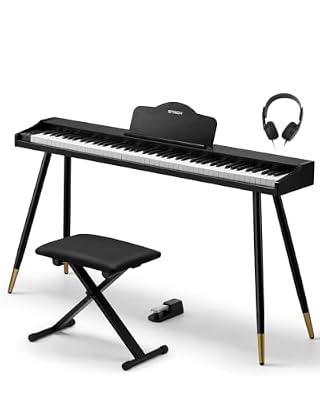
STRICH 88 Key Digital Piano Set, Full Size Velocity-Sensitive Keys, Electric Keyboard with Stand, Bench, Pedal, Headphones, Music Rest for Beginner, SPRITE-S(Black)
Included for 'Best Black Friday Keyboard Piano Deals' because the listing specifies Full Size Velocity-Sensitive Keys and Electric Keyboard with Stand, details this guide uses to compare options.
View on AmazonThe STRICH set is the answer to a specific question: how do I get 88 full-size keys plus the furniture in one purchase without going to the top of the price range? Velocity-sensitive keys, a stand, a bench and a pedal, all in one box. For a first full-size instrument in a van, that completeness reduces the number of separate decisions you have to get right.
Key specs
- Key count: 88 full-size keys
- Action: velocity-sensitive — responds to how hard you play
- Included: stand, bench, pedal
- Speakers: built-in
- Power: mains-adapter class
- Footprint: roughly 52–54 inches wide, requiring a dedicated wall run or flip-down surface
Strengths. Velocity sensitivity is the meaningful spec here. It means the instrument responds to playing force, so you can play softly or hard and hear the difference — the beginning of expressive control. Full 88-key range removes repertoire limits, and the bundled pedal means sustain works from day one, which is essential for most piano literature and frequently forgotten. The bench and stand being matched to the instrument avoids the wobble you get from improvised furniture, and wobble is worse in a vehicle than in a house because the floor is never perfectly level. For a buyer who wants one purchase and one delivery, this is the most efficient route to a full-size setup.
Pros
- Full 88-key range with velocity sensitivity
- Stand, bench and pedal all included
- Matched furniture reduces wobble on uneven ground
- Efficient single-purchase route to a complete setup
Cons
- Requires substantial dedicated length — the hardest constraint in a van
- Velocity-sensitive is not the same as weighted hammer action
- Bundle furniture is functional rather than premium
- Mains power only
How it compares. Against the Yamaha 88-key, the STRICH gives up weighted action and brand heritage in exchange for a lower price tier and included furniture — and for a first instrument, the furniture may matter more. Against the Alesis Recital Play bundle, the STRICH adds velocity sensitivity while the Alesis leans on its category reputation. Against a 61-key kit, both 88-key options demand roughly fifteen extra inches of width. If you have the length and want a complete setup in one purchase, the STRICH is the value pick in the full-size tier.
11. Donner 61-Key Keyboard Piano with 249 Voices and 249 Rhythms – Best for Sound Variety
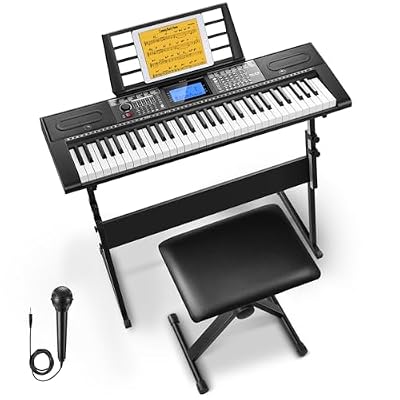
Donner 61 Key Keyboard Piano, Electric Piano Keyboard Kit with 249 Voices, 249 Rhythms - Includes Piano Stand, Stool, Microphone, Gift for Beginners, Black (DEK-610S)
Included for 'Best Black Friday Keyboard Piano Deals' because the listing specifies Electric Piano Keyboard Kit with 249 Voices and 249 Rhythms, details this guide uses to compare options.
View on AmazonTwo hundred and forty-nine voices and two hundred and forty-nine rhythms is an absurd amount of variety for the money, and in a van that variety has a practical function. When your living space is one room, the instrument is often your only entertainment. Being able to switch from piano to strings to organ to a drum pattern keeps the instrument interesting on the four-hundredth evening of the same view.
Key specs
- Key count: 61 keys
- Voices: 249
- Rhythms: 249
- Included: piano stand
- Practice: headphone output for private sessions
- Power: mains-adapter class
- Footprint: roughly 37–39 inches wide
Strengths. The voice library is the headline, but the rhythm section is the feature that changes how you use the instrument. Playing against a built-in rhythm is the cheapest way to develop timing, and timing is the skill that most self-taught players neglect. With 249 rhythms you have something for nearly every style, so you can practise a piece at the tempo and feel it needs rather than a metronome click. The included stand gets you playing immediately. Sixty-one keys keeps the footprint van-friendly, and the headphone jack means all of this is available after dark without disturbing anyone.
Pros
- Very large voice and rhythm library for the price tier
- Built-in rhythms make timing practice practical
- Stand included
- 61-key footprint fits most van layouts
Cons
- Unweighted synth action
- Sheer feature count can be overwhelming for a beginner
- Voice quality varies across a library that large
- No bench or headphones in the kit
How it compares. Against the RockJam RJ5061, the Donner gives up the bench and headphones but gains a dramatically larger sound set — a straight trade of furniture for features. Against the MUSTAR 61-key, the Donner offers breadth where the MUSTAR offers guided learning. Against the Basics 61-key, the Donner is the more feature-dense board at a lower tier. If you want one instrument that stays interesting for years and you already have a chair, this is the strongest 61-key pick.
12. POGOLAB 49-Key Roll-Up Keyboard Piano – Best for Storage and Travel

POGOLAB 49 Key Roll Up Keyboard Piano, Portable Digital Electric Foldable Piano Keyboard, Rechargeable, 47 Tones, 14 Educational Demo Songs, for Beginners Gift (Black & White)
Included for 'Best Black Friday Keyboard Piano Deals' because the listing specifies Portable Digital Electric Foldable Piano Keyboard and Rechargeable, details this guide uses to compare options.
View on AmazonEvery other instrument on this list asks you to give up permanent floor or wall space. The POGOLAB doesn’t. It rolls or folds into a compact package, runs on a rechargeable battery, and offers 47 tones. For a build where every surface does three jobs, that’s not a compromise — it’s the only design that fits.
Key specs
- Key count: 49
- Design: foldable / roll-up, portable
- Tones: 47
- Power: rechargeable battery
- Storage: folds to a fraction of its playing footprint
- Setup: lays flat on any table, bunk or lap
Strengths. Storage volume is the entire value proposition, and it’s decisive in a small van. A roll-up board can live behind a seat, under a mattress topper, or in a drawer, which means it’s always available rather than buried under gear. Rechargeable power removes the inverter dependency that every other board here has, so you can practise on a beach, in a laundromat, or at a picnic table with no hookup. Forty-nine keys is four octaves — enough for two-handed practice in most keys and enough for a substantial amount of repertoire, though not for pieces that use the full piano range. The soft keybed also makes it quiet in a way a rigid board isn’t, which helps in campsites.
Pros
- Folds down to a fraction of its playing size
- Rechargeable battery — no inverter needed
- Quiet, soft keybed suits campsite use
- Lowest price tier alongside the kids’ boards
Cons
- Soft keybed gives no meaningful finger resistance
- Four octaves limits repertoire
- Requires a flat surface to lay out — it can’t be played on a lap indefinitely
- Sound quality is modest compared with a rigid board
How it compares. Against the Soundo 37-key, the POGOLAB is the adult’s version of the same idea: portable, battery-powered, small. Against a 61-key kit, it gives up twelve keys, all furniture, and any real key feel in exchange for fitting in a drawer. Against everything else on this list, it’s the only option that costs you zero permanent space. If your van is small enough that a 61-key board would be in the way, this is the instrument you’ll actually use — and an instrument you use beats a better one you don’t.
How to Choose
Six variables decide this purchase, and they interact. Work through them in order and the shortlist usually collapses to two or three products.
1. Key count sets your footprint, and your footprint sets your options
A full-size white key is about 0.93 inches wide. Multiply that by the number of white keys and you get the keybed length before you add the chassis:
- 37 keys — 22 white keys ≈ 20.5 in of keybed, roughly 20–22 in overall
- 49 keys — 29 white keys ≈ 27 in of keybed, roughly 30–32 in overall
- 61 keys — 36 white keys ≈ 33.5 in of keybed, roughly 37–39 in overall
- 76 keys — 45 white keys ≈ 42 in of keybed, roughly 45–47 in overall
- 88 keys — 52 white keys ≈ 48.5 in of keybed, roughly 52–54 in overall
Now measure your van. A 61-key board fits crossways at the end of a typical bed platform. An 88-key board does not — it needs a dedicated wall run, a flip-down desk, or a permanent bench that doubles as storage. That single measurement eliminates more products than any other criterion. Don’t buy an 88-key instrument hoping to “figure out storage later”; in a van, later never comes.
2. Action class determines what you’re actually training
Three classes appear on this list. Synth action is light and springy — fast, easy on the hands, and the best choice for tight spaces because the mechanism is shallow and light. It does not build the finger strength that acoustic piano demands. Velocity-sensitive action responds to how hard you play, giving you dynamic range without hammer weight; it’s the middle ground. Weighted hammer action reproduces the resistance of an acoustic mechanism and is the only class that genuinely transfers to a real piano. The cost is weight, depth, and price. If you play classical repertoire or plan to take exams, weighted is worth the space. If you play pop songs for enjoyment, synth action is entirely adequate.
3. Portability is a weight and depth problem, not just a length problem
Three portability classes are worth thinking in. Foldable and roll-up boards store in a drawer or behind a seat and run on rechargeable batteries. Slim 61-key boards carry under one arm but need a surface. 88-key instruments with stands are effectively furniture — they have a home position and moving them is a project. Decide which class you’re buying before you compare specs, because a great instrument in the wrong class is still the wrong instrument.
4. Built-in sounds matter less than you think — with one exception
A 249-voice library is fun but rarely decisive. What matters is whether the board has a usable piano voice and enough polyphony to avoid note cut-off when you hold the sustain pedal. Cheap boards can drop notes when many are sounding at once; boards with larger polyphony handle dense passages cleanly. The exception is the rhythm section. Built-in rhythms are the most practical practice tool in this category, because playing against a beat develops timing — and timing is the skill self-taught players most often skip.
5. Power options are a van-specific decision, and they’re where people get caught out
Four power approaches appear here: disposable batteries, built-in rechargeable batteries, USB power, and a mains adapter. The first three run anywhere. The fourth requires either a shore hookup or an inverter, and inverters waste energy in conversion. Here’s the arithmetic: if a board draws roughly 10 watts through its adapter and your power station stores 300 watt-hours, you get about 30 hours of playing (300 ÷ 10). If it draws 20 watts, you get 15 hours. That’s the difference between practising daily for a month and practising daily for two weeks on a single charge. Check the stated power consumption on the adapter label, not the marketing copy. Boards with rechargeable internal batteries sidestep this entirely, which is why the roll-up option is more capable than its price suggests.
6. Furniture, seating and setup friction decide whether you actually play
The best instrument is the one with the lowest activation energy. A bundle with a matched stand, bench or stool and headphones removes three separate purchases and three separate excuses. If you’re buying a