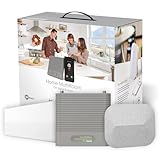
- Top Pick: weBoost Drive Reach RV II- Cell Phone Signal Booster kit | Boosts 4G LTE & 5G for All U.S. Carriers – Verizon, AT&T, T-Mobile & More | Made in the U.S. | FCC Approved (Model 474061)
- Best Value: weBoost Destination RV – Cell Phone Signal Booster for Stationary Use | Boosts 5G & 4G LTE for All U.S. & Canadian Carriers – Verizon, AT&T, T-Mobile, more | Made in the U.S. | FCC Approved (470159)
- Premium Choice: weBoost Drive Reach Overland – Cell Phone Signal Booster for Off Road Vehicles | Boosts 5G & 4G LTE for All U.S. Carriers – Verizon, AT&T, T-Mobile & More | Made in The U.S. | FCC Approved

TL;DR: A weBoost cell signal booster amplifies existing carrier signals — it can’t create signal from nothing, but it turns 1 bar into 3 bars in most situations. For remote work vanlifers and RVers, it’s one of the highest-ROI connectivity upgrades available. This guide covers which model fits your build and what to realistically expect.
weBoost Cell Signal Booster for RV and Van: Honest Review and Model Guide
Dead zones kill remote work days. Spotty LTE turns a video call into a slideshow. For vanlifers who depend on connectivity — whether for work, navigation, or staying in touch — a weBoost cell signal booster is one of those investments that pays for itself in the first month of serious use.
As an Amazon Associate we earn from qualifying purchases.


But boosters get oversold. They amplify existing signal — they can’t conjure bars from thin air. Understanding what they do and don’t do is essential before spending $300–$600 on one.
🛒 Best Price Today on Amazon
Prime members get fast, free shipping on everything above, plus member-only deals. New members get a 30-day free trial — cancel anytime.
Start 30-Day Prime Free Trial →See Today’s Amazon Deals- Top weBoost Boosters for Van and RV Builds
- weBoost Model Comparison for Mobile Use
- How a weBoost Signal Booster Actually Works
- Choosing the Right weBoost for a Van Build
- weBoost vs. Other Signal Booster Brands
- Power and Installation Considerations
- FAQ: weBoost Cell Signal Booster
- Frequently Asked Questions
- Related Articles
Top weBoost Boosters for Van and RV Builds

Ivation Portable Camping Shower | Compact Handheld & Hands-Free Rechargeable Outdoor Shower Head & Cleaning System w/ 3.7V Pump, 6-Ft Hose, Bidet Head, Removable Filter, Multiuse Hook & USB Cable


As an Amazon Associate we earn from qualifying purchases. Product prices and availability are accurate as of the date/time indicated.

Setpower 12V Refrigerator 21QT Car Refrigerator,50H Keep Cool 12V Fridge | 3-year Warranty,-4℉~68℉,15-Min Fast Cool,As Portbale Freezer or Fridge,Electric Cooler for Car Camping Truck RV SUV Travel


As an Amazon Associate we earn from qualifying purchases. Product prices and availability are accurate as of the date/time indicated.
weBoost Model Comparison for Mobile Use
See also: Best Ways to Keep a Van Tidy on the Road • Best Cyber Monday Cologne Deals
| Model | Max Gain (dB) | Uplink Power | Coverage Area | Best For | Price Range |
|---|---|---|---|---|---|
| Drive Reach | 50 dB | +23 dBm | Single device/hotspot | Solo vanlifers, remote workers | $300–$350 |
| Drive Reach OTR | 50 dB | +23 dBm | Cab-focused | Truckers, cab-heavy use | $350–$400 |
| Destination RV | 65 dB | +26 dBm | Full RV interior | Full-size RVs, multi-user | $500–$600 |
| Drive X RV | 50 dB | +23 dBm | Small–mid van/RV | Vans, Class B, small trailers | $350–$450 |
How a weBoost Signal Booster Actually Works
The system has three components: an outside antenna that captures whatever signal exists, an amplifier that boosts it up to 32x (in power terms), and an inside antenna that rebroadcasts the boosted signal within the vehicle. Your phone or hotspot connects to the inside antenna’s signal rather than the weak outdoor signal directly.
The key physics: signal strength is measured in decibels (dB) on a logarithmic scale. Every 3 dB improvement roughly doubles the signal power. A booster rated at 50 dB gain is delivering a 100,000x power amplification — which explains how a faint signal becomes usable. But if there’s truly zero signal outside, there’s nothing to amplify. The booster doesn’t generate a carrier signal; it enhances one.
In practice, most “dead zones” actually have some signal — just too weak for your phone’s antenna to lock onto reliably. This is where boosters shine. Marginal signal that causes constant drops becomes workable 4G LTE for streaming and calls.
Choosing the Right weBoost for a Van Build
For a cargo van conversion (Transit, Sprinter, ProMaster), the Drive Reach or Drive X RV are the right tier. The Destination RV’s higher gain is designed for larger RV interiors where the signal needs to travel further from the inside antenna — in a van, you’re always within a few feet of the inside antenna regardless. Spending the extra $200 for the Destination RV in a van build is largely wasted.
Antenna placement matters more than most buyers expect. The outside antenna should have clear sky view with as much vertical separation from the inside antenna as possible — ideally 12–20 inches of vertical separation through the roof. Insufficient separation causes “oscillation” where the inside and outside antennas interfere with each other, causing the booster to throttle its own gain. Follow the installation instructions on vertical separation precisely.
For roof-mount outside antennas, the install is permanent — drill through the roof, seal with butyl tape and lap sealant (same process as your vent fan). For vans without a roof fan, the antenna can sometimes mount near the vent opening. Magnetic-base omni antennas are a no-drill option but underperform permanent installs by 5–10 dB.
weBoost vs. Other Signal Booster Brands
weBoost and SureCall dominate the FCC-certified vehicle booster market. Wilson Electronics (weBoost’s parent) essentially invented the consumer cellular booster category. SureCall’s Fusion2Go series competes directly with the Drive Reach at similar price points and comparable performance specs.
Avoid uncertified boosters from unknown brands. The FCC regulates signal boosters because a poorly designed unit can interfere with carrier networks — legitimate carriers have blocked SIM cards for devices detected using illegal boosters. Stick with FCC-certified equipment from established brands.
A booster is one layer of a complete connectivity stack. For serious remote work, pair it with a hotspot device and the right data plan. Our mobile hotspot guide covers carrier selection, data plan strategy, and device recommendations. Our full cellular booster vanlife guide goes deeper on antenna theory, carrier-specific performance, and multi-carrier setups.
Power and Installation Considerations
weBoost units draw 1.5–3A from 12V DC — minimal impact on your electrical system. Most include both a 12V vehicle plug and a hardwire kit. For a permanent van build, hardwiring to your 12V panel is cleaner and more reliable than a plug hanging in the cab.
The inside antenna is typically a panel antenna mounted on the ceiling or wall, broadcasting downward or inward toward your workspace. Position it above your desk area rather than your sleeping area for maximum daytime work benefit. Cable routing through the ceiling or wall panels keeps the install clean — plan your routing before cutting any holes.
Total cable length matters. Longer coax cables between the amplifier and antennas introduce signal loss. Use the shortest practical cable runs and the supplied cable grades — substituting lower-quality coax will degrade performance meaningfully.
FAQ: weBoost Cell Signal Booster
Does a weBoost cell signal booster work with all carriers?
Yes. weBoost boosters are carrier-agnostic and work with all major US carriers (Verizon, AT&T, T-Mobile) and their MVNOs simultaneously. The booster amplifies all LTE and 5G Sub-6 frequencies it detects — you don’t need carrier-specific equipment.
Will a weBoost booster work where there is no signal at all?
No. Signal boosters require some existing signal to amplify. In areas of genuine zero coverage (deep wilderness, certain valleys), a booster won’t help. For those situations, a Starlink satellite system or satellite communicator (Garmin inReach, SPOT) are the appropriate tools.
How much does a weBoost improve data speeds?
Results vary by location, but users commonly report moving from unusable edge-of-network connections to functional 4G LTE for streaming and video calls. In fringe coverage areas, download speeds can improve from under 1 Mbps to 5–15 Mbps. In areas with moderate signal, the improvement is less dramatic but connection stability increases significantly.
Can I use a weBoost while driving?
Yes, all Drive series models are designed for use while in motion. The omnidirectional outside antenna maintains signal contact regardless of vehicle orientation. Performance is naturally variable as you pass through different coverage zones, but the booster continuously adjusts gain to optimize the current signal.
Is weBoost worth it for vanlife?
For remote workers, yes — without qualification. A single lost work day from poor connectivity costs more than the booster. For casual vanlifers who don’t depend on connectivity, the value proposition is lower. If you frequently camp in marginal coverage areas and want reliable navigation and communication, a booster is still a strong investment.
Frequently Asked Questions
How much does a weBoost actually improve signal?
An FCC-legal consumer booster provides up to 50dB of gain, which in practice can turn one weak bar into three, or turn an unusable connection into a workable one. It cannot create signal where there is none, so if your phone shows no service at all, a booster will not help.
How much power does a signal booster draw?
Typically 1-2 amps at 12V, or roughly 15-25W, meaning around 300-500Wh per day if left on continuously. That is significant on a small battery bank, so most people switch it on only when working. Many units have a low-power idle mode when no device is connected.
Where do I mount the outside antenna?
As high as possible and as far from the inside antenna as you can manage, usually on the rear roof corner or a ladder mount. Vertical separation matters most: at least six to eight feet between antennas, or the booster will oscillate and automatically reduce its own gain to prevent feedback.
Does it work while driving?
Yes, mobile-rated boosters are designed for it and are FCC-certified for vehicle use. Do not use a home or building booster in a vehicle, since it is not certified for mobile operation and can interfere with cell towers. Keep the antenna cable away from the engine bay to avoid noise.
Is the outside antenna weatherproof?
Roof-mount and trucker-style antennas are designed for permanent outdoor use and handle rain, snow and highway speeds. The vulnerable point is the coax connector, which should be wrapped in self-amalgamating tape and pointed downward so water cannot run into it. Check the mount torque after the first thousand miles.