Last updated: September 18, 2026
Choosing an MPPT vs PWM charge controller for a van is less about picking the “best” technology and more about matching the controller to your solar array, battery, budget, and travel habits. A weekend camper with one 100-watt panel may not gain enough from MPPT to justify the added cost. A van used as a full-time home, especially in cold, cloudy, or shaded conditions, can benefit from capturing every available watt.
The practical decision is also shaped by installation space, wiring, battery voltage, and how much power your home-on-wheels actually uses. A charge controller sits between the solar panels and battery, regulating incoming energy so the battery charges safely. MPPT controllers extract more usable energy from a panel, while PWM controllers are simpler and less expensive. Both can be reliable when correctly sized and installed.
As an Amazon Associate we earn from qualifying purchases at no extra cost to you. Product prices and availability are accurate as of the date shown and are subject to change.



Quick Verdict
Choose an MPPT controller if your van has more than about 200 watts of solar, panels wired at a higher voltage, long cable runs, partial shade, or a tight energy budget. MPPT is also the better long-term choice for a full-time van home with a refrigerator, laptop, Starlink-style internet equipment, induction cooking, or other substantial loads.
Choose a PWM controller if you have a small, simple 12-volt system, typically 50 to 200 watts of solar, a short cable run, and a limited budget. PWM can be a sensible fit for LED lights, phone charging, a small fan, and occasional weekend use. It is not automatically unsafe or inferior; it simply leaves more potential solar energy unused than MPPT.
Side by Side
See also: Best Van Water Filter for Refill Stations in 2026: Tested and Ranked • How to Winterize a Van Water System (2026): Step-by-Step
| Factor | MPPT | PWM |
|---|---|---|
| Energy harvest | Often 10% to 30% more usable energy, depending on conditions and panel voltage | Generally lower, especially in cold weather, shade, or when panel voltage is much higher than battery voltage |
| Comfort | Better for running several appliances and recovering the battery faster | Comfortable for lights, devices, fans, and light weekend use |
| Durability | Usually robust, but more electronics can mean more potential failure points | Simple design with fewer components and straightforward operation |
| Typical price range | About $100 to $350 for common van sizes; larger units cost more | About $20 to $80 for basic 10A to 30A models |
| Maintenance | Low; keep vents clear and check connections periodically | Low; similarly needs clean connections, ventilation, and correct settings |
| Space needed | Commonly about 6 to 10 inches tall, 4 to 8 inches wide, and 2 to 4 inches deep | Often about 4 to 7 inches tall, 3 to 6 inches wide, and 1 to 3 inches deep |
| Look | More polished displays, Bluetooth, and app-based monitoring are common | Basic screens or indicator lights; usually less visually prominent |
| Resale | Can add appeal to a documented, higher-end electrical system | Fine for basic builds but less attractive to buyers seeking maximum solar output |
| Best for | Full-time vans, larger arrays, shade, cold climates, and higher daily consumption | Small arrays, weekend vans, tight budgets, and simple 12-volt systems |
Where Mppt Wins
MPPT stands for maximum power point tracking. The controller continually adjusts the electrical operating point of the solar panel to harvest as much power as conditions allow. It then converts that power into the voltage and current appropriate for the battery.
That conversion matters because a “12-volt” solar panel often operates at roughly 18 to 22 volts under useful charging conditions. A PWM controller effectively pulls the panel voltage down toward the battery voltage. An MPPT controller can use more of the panel’s available voltage and turn it into additional charging current.
The advantage becomes more noticeable when the panels are cold, the wiring run is long, or the array is partly shaded. It is also useful when panels are wired in series at a higher voltage. For example, a van with 400 watts of solar and a 12-volt battery bank may need roughly 25 to 30 amps of charging capacity under strong sun. A 30A MPPT controller may fit that system, while a 50A model offers more headroom for expansion and high-output conditions.
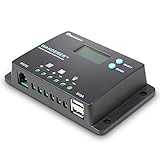
MPPT is often the cleaner choice when roof space is limited. If you can fit only a few panels, gaining more energy from each square foot can be more valuable than saving $70 or $150 on the controller. Bluetooth monitoring is another advantage. The Victron Energy SmartSolar MPPT Solar Charge Controller 100V, 50A, 12/24V and the Victron Energy SmartSolar MPPT 100V 30 amp 12/24-Volt Solar Charge Controller with Bluetooth are examples of the type of higher-feature equipment commonly considered for expandable van systems.
MPPT controllers can also support more flexible panel planning. Always check the controller’s maximum solar voltage, maximum charging current, battery chemistry settings, and allowable wire gauge before installation. A controller rated for 100 volts, for example, must not be connected to a series array whose cold-weather open-circuit voltage could exceed that limit.
Where Pwm Charge Controller for Van Wins
PWM stands for pulse-width modulation. It regulates charging by connecting and disconnecting the panel from the battery in controlled pulses. The design is simple, compact, and inexpensive, which makes it practical for a small van electrical system.
For a 100-watt panel charging a 12-volt battery, the energy difference between PWM and MPPT may not justify spending several times more on the controller. If the van is used for two-night trips and the battery normally remains well charged, the simpler option may provide all the performance you need.
PWM works best when the panel and battery are closely matched in voltage and the cable run is short. It is generally intended for nominal 12-volt panels with 12-volt battery systems, or nominal 24-volt panels with 24-volt systems. It is not the right way to connect an arbitrary high-voltage panel to a 12-volt battery.
Basic controllers are also easy to replace. The Renogy Wanderer 10A PWM Solar Charge Controller 12/24V for Solar Panels is a representative low-cost option listed at $24.99, while a 10 Amp Waterproof PWM Solar Charge Controller for RVs, trailers, campers, vans, boats, and off-grid use is listed at $26.99. These prices illustrate why PWM remains popular for small builds. A waterproof enclosure can be useful near an exterior electrical compartment, but “waterproof” should never be treated as permission to install a controller where it will be submerged or exposed to constant condensation.
Confirm that any PWM controller supports your battery chemistry. Lithium batteries require a controller with suitable charging profiles and, in many installations, a low-temperature charging cutoff managed by the battery or system electronics.
Cost Over 5 Years
A basic PWM system may cost about $20 to $80 for the controller. A mainstream MPPT controller may cost about $100 to $350, with premium, high-current models exceeding that range. Installation can add more than the controller itself, particularly if you need new cable, fuses, bus bars, breakers, or a larger enclosure.
MPPT’s possible energy gain can reduce generator use or shore-power charging. Suppose an array produces 1.5 kilowatt-hours less usable energy per month with PWM than it would with MPPT. That is 90 kilowatt-hours over five years. The financial value depends on whether that energy replaces campground electricity, gasoline for a generator, or simply provides extra convenience. In a seldom-used van, the savings may be negligible. In a full-time van home, faster recovery and fewer energy compromises can make the higher purchase price worthwhile.
Do not assume the cheapest controller has the lowest five-year cost. Undersized wiring, poor ventilation, incorrect battery settings, or a controller without adequate protection can create replacement and repair expenses. Buy based on the complete system rather than the sticker price alone.
Which One for Your Home
Small apartment
If “home” means a compact van used as a mobile apartment for occasional trips, PWM is usually enough with 50 to 200 watts of solar. It can support lights, phones, a small water pump, and modest ventilation. Choose MPPT if your roof has limited panel space or you frequently camp in cloudy conditions.
Family with kids or pets
Family use often means more charging, longer refrigerator runtime, fans, tablets, and safety-related monitoring equipment. An MPPT controller is the safer choice for a 200- to 500-watt array, particularly if the van must remain comfortable while parked for several days. Size the controller to the array and leave room for future expansion.
Rental
For a rental van or a temporary conversion, PWM keeps the system affordable and easier to explain to the next user. A 10A controller may suit a single small panel, but do not use it for a larger array simply because it is inexpensive. A removable MPPT setup can make sense when the panels, battery, and controller will move to another vehicle later.
Long-term home
For full-time living, choose MPPT unless the system is exceptionally small and energy use is minimal. The extra harvest, higher-voltage wiring options, monitoring features, and upgrade potential are valuable over years of daily use. Include proper fusing, a battery disconnect, strain relief, ventilation, and a controller compatible with your battery manufacturer’s charging requirements.
FAQ
Is MPPT always better than PWM in a van?
MPPT is more efficient in many situations, but not always more cost-effective. With a small, well-matched 12-volt panel and low energy demand, PWM may provide adequate performance at a much lower price.
Can I use an MPPT controller with a 12-volt battery?
Yes. Many MPPT controllers are designed for 12-volt and 24-volt battery systems. Check the controller’s battery voltage range, solar input limit, charging-current rating, and compatibility with AGM, gel, flooded lead-acid, or lithium batteries.
How many watts can a 10A controller handle?
At a nominal 12-volt battery voltage, 10 amps represents roughly 120 watts of charging output. Manufacturers may allow a somewhat larger solar array because real-world panels rarely produce their nameplate maximum continuously, but follow the controller’s published limits. Do not exceed its maximum charging current or solar input voltage.
Does an MPPT controller charge faster in shade?
MPPT cannot create energy that the panels do not receive, and one shaded panel can still limit an array. However, MPPT may make better use of the reduced available power and can be more helpful in weak sunlight or cold conditions. Panel layout, bypass diodes, wiring, and shade management remain equally important.
Ready to decide? Our #1 pick for 2026 is the Energy harvest.
Live price & availability on Amazon.