

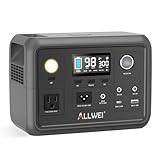
- Top Pick: ALLWEI Portable Power Station 300W, 256Wh Solar Generator LiFePO4 Battery
- Best Value: GENSROCK Portable Power Station 120W, Power Bank with AC Outlet 24000mAh
- Premium Choice: DaranEner Portable Power Station, 192Wh LiFePO4 Battery Backup Solar Generator with w/2 300W (Peak 600W) AC Outlets, USB-C PD 60W Fast Charge, Power Bank for Camping, Outdoor, Home,Emergency
Last updated: September 18, 2026
Choosing a portable power station is less about buying the biggest battery and more about matching the outputs to the devices you actually use. Many shoppers compare only watt-hours, then discover that a station cannot run a refrigerator, charge a laptop quickly, or power several devices at once. Others focus on peak wattage, which is available only briefly, rather than continuous output. Port selection is another common mistake: a unit may have plenty of USB-A ports but no USB-C Power Delivery port for a modern laptop.
This guide explains how to choose portable power station outputs in 2026, including the wattage, ports, battery size, safety features, and practical details that matter most. The goal is not to find the highest number on the box. It is to find a balanced power station that can handle your devices without paying for capacity you will rarely use.
As an Amazon Associate we earn from qualifying purchases at no extra cost to you. Product prices and availability are accurate as of the date shown and are subject to change.


- Decide These 3 Things First
- Size: Match Capacity and Portability
- Material: Look for LiFePO4 and a Protective Case
- Construction: Compare Continuous and Peak Wattage
- Comfort and Performance: Choose the Outputs You Will Actually Use
- Price Tiers: Pay for Capacity, Not Just Features
- Warranty: Read the Terms, Not Just the Length
- Delivery and Assembly: Verify What Arrives in the Box
- Spec Checklist
- Red Flags
- FAQ
Decide These 3 Things First
- List the devices you need to run. Write down each device’s running wattage and starting or surge wattage. A phone may need 5 to 20 watts, a laptop 45 to 100 watts, and a small refrigerator roughly 60 to 150 watts while running, with a higher startup surge.
- Estimate how long you need power. Battery capacity is measured in watt-hours (Wh). A 256Wh station does not deliver 256Wh to your devices because some energy is lost through conversion. For everyday planning, estimate about 80% usable capacity: approximately 205Wh from a 256Wh unit.
- Choose the right output types. Decide whether you need AC outlets, USB-C PD, USB-A, a 12V car-style outlet, or all four. An AC outlet is versatile, but direct USB-C charging is usually more efficient for phones, tablets, cameras, and laptops.
Size: Match Capacity and Portability
See also: How to Install a 12v Fridge Securely (2026): Step-by-Step • How to Test Portable Power Station Capacity (2026): Step-by-Step
Portable power stations generally fall into three useful size groups. Compact models under 150Wh are best for phones, tablets, cameras, lights, routers, and short emergency use. They often weigh between 2 and 5 pounds and can fit in a vehicle console or day bag.
Mid-size models from 150Wh to 500Wh offer a more useful balance for camping and home backup. They can charge several phones, run a laptop for multiple work sessions, power LED lights, and handle selected small appliances. Expect weights of approximately 5 to 15 pounds, depending on the battery chemistry and enclosure.
Larger units over 500Wh can run a refrigerator, CPAP machine, television, or small appliances for longer periods, but portability declines quickly. A 1,000Wh station commonly weighs 20 to 30 pounds or more. Before buying, check the actual dimensions as well as the battery rating. A unit measuring about 10 by 7 by 8 inches may fit neatly in a closet, while a larger model may need a dedicated shelf.
For reference, a 256Wh LiFePO4 model such as the ALLWEI 300W station is a practical mid-size option. A smaller 89.6Wh Daran unit is easier to carry but better suited to personal electronics than household appliances.
Material: Look for LiFePO4 and a Protective Case
Battery chemistry affects safety, lifespan, weight, and price. Lithium iron phosphate, usually abbreviated LiFePO4 or LFP, is increasingly common because it is known for strong cycle life and good thermal stability. It is often heavier than some other lithium chemistries, but that tradeoff can make sense for a station used regularly or kept ready for emergencies.
Look for a rigid, impact-resistant outer case with covered vents, protected switches, and a firm handle. The enclosure should not flex when you press on it, and ports should sit securely rather than wobble. A rubberized base helps prevent sliding on a vehicle floor or campsite table.
Material quality also matters around the AC inverter. Ventilation openings should be clear and positioned where the fan can move air. Do not place a station under bedding, inside a closed cabinet while operating, or directly in wet grass. Even a well-built power station needs airflow and protection from moisture.
Construction: Compare Continuous and Peak Wattage
The most important output number is continuous AC wattage. This tells you how much power the inverter can provide during normal operation. Peak, surge, or starting wattage describes the short burst available when a motor starts. It is not a second, higher continuous rating.
A 300W station may run a 60W fan, 45W laptop, or small television, but it may not run a 300W appliance continuously once conversion losses and other devices are included. Leave at least 20% to 30% headroom. For a device drawing 200W, choose an inverter rated for roughly 250W or more.
Motor-driven appliances such as refrigerators, pumps, blenders, and some CPAP machines can require two to three times their running wattage during startup. A station advertised as 300W with 600W peak output may handle a brief surge, but compatibility depends on the appliance and the inverter’s surge duration.
Also check whether the AC outlets can provide their full rated output simultaneously. Two outlets do not necessarily mean 300W per outlet. The total load is usually limited by the inverter rating.
Comfort and Performance: Choose the Outputs You Will Actually Use
Port selection determines how convenient a power station feels day to day. A useful minimum for a mid-size unit is one AC outlet, one USB-C PD port, two USB-A ports, and a 12V DC outlet. Larger stations may include multiple AC outlets, but more is not always better if the battery is too small to support them for long.
USB-C Power Delivery is especially important. A 20W port is suitable for most phones, while 45W to 65W is more useful for tablets, handheld gaming systems, and many laptops. A 100W USB-C port can support larger laptops, but the cable and laptop charger must also support that level.
For example, the DaranEner 192Wh model includes USB-C PD rated at 60W, making it more suitable for laptop charging than a station with standard USB ports only. The GENSROCK 120W model is oriented toward lighter loads and personal electronics. Its 24,000mAh description should not be confused directly with watt-hours; portable power stations are best compared using Wh, output wattage, and port specifications together.
Check recharge performance as well. A station may accept wall charging, solar input, and 12V vehicle charging, but input wattage determines how quickly it refills. A solar-compatible unit is not automatically fast to recharge from a panel. Confirm the maximum solar input and whether a panel is included or sold separately.
Price Tiers: Pay for Capacity, Not Just Features
Budget power stations from about $60 to $110 typically offer 80Wh to 200Wh, 100W to 200W of continuous AC output, and basic USB charging. They are suitable for phones, lights, tablets, cameras, and occasional laptop charging. The Daran 89.6Wh model, listed around $89.99, fits this compact category, while the GENSROCK 120W model is listed around $66.99.
Mid-range models from about $110 to $220 commonly provide 190Wh to 400Wh, 300W to 500W of continuous output, LiFePO4 batteries, and more capable USB-C ports. The ALLWEI 300W, 256Wh model is listed around $128.99, and the DaranEner 192Wh model around $109.99. These prices are useful reference points, but sales, bundles, and included accessories can change the value.
Premium stations generally begin around $250 and can exceed $1,000 as capacity reaches 1,000Wh or more. You are paying for larger batteries, higher inverter output, faster charging, app controls, expandable capacity, and sometimes better warranty coverage. Do not pay premium prices for features you will not use. If your largest device is a 65W laptop, a 2,000W inverter may add cost and weight without improving your experience.
Warranty: Read the Terms, Not Just the Length
A one- to two-year warranty is common in the budget category, while established mid-range and premium products may offer three to five years. The length matters, but so do the conditions. Check whether the warranty covers the battery, inverter, display, ports, and charging accessories separately.
Look for a clearly identified manufacturer or U.S. support channel, a stated return period, and instructions for obtaining service. Some warranties require registration within a specific number of days. Also review storage guidance: leaving a lithium battery fully discharged for months may cause problems that are excluded from coverage.
A longer warranty does not guarantee better performance, but it can be valuable for a station intended for emergency backup rather than occasional camping.
Delivery and Assembly: Verify What Arrives in the Box
Most portable power stations require no assembly, but delivery details still affect value. Confirm whether the package includes an AC charging cable, car charging cable, solar adapter, protective bag, and user manual. A solar panel is often optional, even when the product is described as solar-ready.
Check shipping weight and box dimensions if you live in an apartment or plan to carry the station upstairs. A 10-pound unit is manageable for most adults; a 30-pound unit may be better treated as semi-portable. Inspect the case, screen, ports, and handle immediately after delivery, and test charging before storing it for an emergency.
Spec Checklist
| Spec | Budget | Mid | Premium |
|---|---|---|---|
| Typical price | $60–$110 | $110–$220 | $250–$1,000+ |
| Battery capacity | 80–200Wh | 190–500Wh | 500–2,000Wh+ |
| Continuous AC output | 100–200W | 300–600W | 1,000–2,000W+ |
| USB-C PD | 18–30W | 45–100W | 65–240W |
| Battery chemistry | Lithium-ion or LiFePO4 | Prefer LiFePO4 | LiFePO4 is common |
| Typical weight | 2–6 lb | 5–15 lb | 20–50 lb+ |
| Best for | Phones, lights, tablets | Laptops, camping, short backup | Appliances and extended backup |
Red Flags
- Only peak wattage is advertised: Find the continuous AC rating before buying.
- No watt-hour rating: A milliamp-hour figure alone makes battery comparisons difficult.
- Unclear USB-C output: “USB-C port” does not automatically mean laptop-capable PD charging.
- No surge duration: Peak wattage without a stated duration is difficult to apply to motorized devices.
- Vague safety information: Look for overcharge, over-temperature, short-circuit, and overload protection.
- Missing accessories: Confirm whether solar adapters and car cables are included.
- Too-good-to-be-true capacity claims: Compare the stated Wh rating with the product’s weight, dimensions, and price.
FAQ
How many watts should a portable power station have?
Choose based on your largest device, then add 20% to 30% headroom. For phones and lights, 100W may be sufficient. For laptops and small appliances, 300W to 600W is more flexible. Refrigerators, power tools, and heating appliances may require 1,000W or more plus substantial surge capacity.
Is a higher watt-hour rating always better?
No. More watt-hours provide longer runtime, but they also increase price, size, and weight. A 256Wh station can be a better everyday choice than a 1,000Wh model if you mainly charge electronics and need something easy to carry.
Can a portable power station run a refrigerator?
Sometimes. Check the refrigerator’s running and startup wattage, then compare both with the station’s continuous and peak output. Allow for conversion losses and other connected devices. For reliable food-storage backup, a larger station with at least several hundred watt-hours is usually more practical than a compact personal-power model.
What is the most useful port on a portable power station?
For many buyers, USB-C PD offers the best everyday convenience because it can charge phones, tablets, cameras, and laptops directly. An AC outlet remains important for appliances with standard plugs, while USB-A and 12V DC ports are useful for older accessories and vehicle equipment.
Ready to decide? Our #1 pick for 2026 is the Typical price.
Live price & availability on Amazon.


