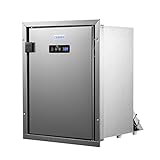
- Top Pick: RecPro 4.4 Cu Ft 12V RV Refrigerator | Stainless Steel | Frost-Free
- Best Value: EDHBay RV Car Protable Refrigerator 12V 24V 34 Quart 32L Drawer Freezer for Truck Van RV Camper SUV Boat Travel Camping Road Trips Tailgating -4℉~50℉
- Premium Choice: CIGREEN 12 Volt RV Refrigerator Built-in Fridge Compressor Refrigerator Mini Fridge with Freezer for Apartment Office Boat Yacht RV Caravan (Silver Stainless Steels, 40L)
Last updated: September 18, 2026
The Short Answer
Most 12V refrigerators built for camper cabinets fall between 20 and 24 inches wide, 20 and 27 inches deep, and 25 and 44 inches tall, depending on capacity. The single most important number for your cabinet build is width, because that is the dimension most cabinets run short on after you account for ventilation gaps. Plan for at least 2 inches of clearance at the rear and 1 inch on the sides and top for compressor-cooled models — a compressor fridge that is boxed in with zero airflow will run hotter, cycle harder, and die years early.
If you are framing a cabinet from scratch, a safe interior rough opening for a mid-size built-in unit is 23 inches wide by 26 inches deep by 45 inches tall. For a portable drawer-style or chest-style 12V fridge, 22 inches wide by 16 inches deep by 16 inches tall will cover most 30–40 quart models with room to vent.
As an Amazon Associate we earn from qualifying purchases at no extra cost to you. Product prices and availability are accurate as of the date shown and are subject to change.



Standard Sizes
See also: How to Install a 12v Fridge Securely (2026): Step-by-Step • How to Test Portable Power Station Capacity (2026): Step-by-Step
There are three general categories of 12V fridge you might install in a camper cabinet: compact built-in units (roughly 1.0–1.5 cu ft), mid-size upright units (2.5–4.5 cu ft), and portable drawer or chest units (25–50 quarts). Below are representative dimensions for each category, including the four example models referenced in this guide.
| Model / Type | Capacity | Width | Depth | Height | Approx. Weight |
|---|---|---|---|---|---|
| RecPro 4.4 Cu Ft 12V RV Refrigerator (stainless, frost-free) | 4.4 cu ft | ~22 in / 56 cm | ~23.5 in / 60 cm | ~43 in / 109 cm | ~90 lb / 41 kg |
| BODEGACOOLER 12V RV Refrigerator with APP control | 2.82 cu ft (80 L) | ~19.3 in / 49 cm | ~20.9 in / 53 cm | ~29.5 in / 75 cm | ~48 lb / 22 kg |
| CIGREEN 12V Built-in Compressor Fridge (40L) | 1.4 cu ft (40 L) | ~19.3 in / 49 cm | ~17.7 in / 45 cm | ~20.5 in / 52 cm | ~37 lb / 17 kg |
| EDHBay 34 Quart Drawer Fridge (12V/24V) | 1.2 cu ft (32 L) | ~22.4 in / 57 cm | ~15.7 in / 40 cm | ~15 in / 38 cm | ~42 lb / 19 kg |
| Typical compact built-in (25–30 L class) | 0.9–1.1 cu ft | 15–17 in / 38–43 cm | 16–18 in / 41–46 cm | 18–22 in / 46–56 cm | 25–35 lb / 11–16 kg |
| Typical 50 L upright 12V fridge/freezer | 1.8 cu ft | 21–23 in / 53–58 cm | 18–20 in / 46–51 cm | 26–30 in / 66–76 cm | 50–60 lb / 23–27 kg |
| Typical 60–100 qt portable chest fridge | 2.0–3.5 cu ft | 27–31 in / 69–79 cm | 16–19 in / 41–48 cm | 18–21 in / 46–53 cm | 55–75 lb / 25–34 kg |
Prices as of early 2026 run roughly $250–$400 for portable drawer and chest units in the 30–40 quart range (the EDHBay drawer unit sits at $289.99), $450–$600 for mid-size upright compressor fridges like the BODEGACOOLER ($544.99) and CIGREEN 40L ($549.99), and $650–$900 for full frost-free built-ins like the RecPro 4.4 cu ft ($689.95). Power draw for compressor models typically falls between 45 and 70 watts while running, averaging 0.7–1.5 amp-hours per hour on a 12V system depending on ambient temperature and thermostat setting.
Always verify the exact spec sheet from the manufacturer before cutting plywood. Dimensional tolerance on imported 12V fridges can run a quarter inch or more, and door hinges, handles, or rear compressor housings sometimes add an inch beyond the listed body dimensions.
How to Measure Your Space
- Measure the cabinet opening in three places. Measure width at the top, middle, and bottom of the opening; depth at the top and bottom; and height at both sides. RV and van cabinets are rarely square. Use the smallest measurement of each set.
- Subtract ventilation clearance. Deduct 2 inches from the depth for rear airflow (compressor models need it), and 0.5–1 inch per side and top. What remains is the maximum fridge body size you can accept.
- Check the door swing and hinge side. An upright fridge door typically needs its full width plus 2–3 inches of clearance to open past 90 degrees if a cabinet wall or adjacent appliance sits beside it. Reversible-hinge models give you flexibility during install.
- Account for slide-out rails if applicable. A drawer-style fridge like the EDHBay 34-quart needs an extra 16–20 inches of travel depth for the slides to extend fully. Measure from the back wall of the cabinet to the front face of any surrounding trim with the drawer fully extended on paper before committing.
- Measure your access path. The doorway, aisle width, and any turns between your camper door and the cabinet matter more than the cabinet itself. The RecPro 4.4 cu ft weighs around 90 pounds — you will likely need two people and a clear 24-inch-wide path.
- Confirm power and vent routing. Leave room behind or beside the unit for a DC power connection with a service loop of 6 inches of wire, and note that most compressor fridges vent from the front grille, the sides, or the rear — check which before sealing the enclosure.
- Write everything down and re-check once. One tape-measure error at framing stage costs a full cabinet rebuild. Measure twice, order once.
By Room or Use Case
Van Conversions and Small Campers
Space is the binding constraint. A drawer-style unit like the EDHBay 34 quart slides under a counter and turns the countertop above it into usable work surface — one of the best space-per-liter trades you can make in a van. Plan a rough opening around 23 by 17 by 16 inches plus slide travel. If you prefer an upright, the CIGREEN 40L at roughly 19.3 by 17.7 by 20.5 inches fits a base cabinet with a shortened countertop section. Expect 35–45 amp-hours per day at moderate ambient temperatures.
Travel Trailers and Fifth Wheels
These typically have a dedicated refrigerator bay sized for a factory absorption unit, often 23 to 24 inches wide. A frost-free compressor unit like the RecPro 4.4 cu ft is a common swap-in because it matches those bay dimensions closely while running on far less power. Confirm the bay’s depth includes rear vent clearance — absorption fridges vent through the roof, and a compressor swap needs that space treated differently, usually with a lower rear grille vent.
Truck Campers and Overlanding Rigs
Vibration and tilt tolerance matter as much as footprint here. Choose a compressor model rated for off-level operation (most Danfoss/Secop-type compressors handle 30 degrees of tilt) and secure it with brackets or straps. Portable chest fridges in the 50-quart range, roughly 27 by 16 by 19 inches, strap down easily and can live in a garage compartment rather than a dedicated cabinet.
Boats and Yachts
Marine installs prioritize a locked door (look for a latch that holds at heel angles) and corrosion resistance. The CIGREEN stainless units are frequently used in this role. Cabinet clearances follow the same 1–2 inch ventilation rules, but add gasketed trim rings so the door stays sealed in chop.
Off-Grid Cabins and Apartments as Backup
A 2.8–4.4 cu ft 12V fridge on a solar battery bank draws 25–40 amp-hours daily — manageable on a 400W solar setup with 200 amp-hours of lithium. Standard 24-inch-deep residential base cabinets accommodate most upright 12V models with a filler strip at the sides.
Common Sizing Mistakes
- Forgetting rear clearance. The most common failure. Compressor fridges need 2+ inches behind the unit; sealing them flush shortens compressor life dramatically.
- Ignoring handle and hinge protrusion. Listed dimensions usually exclude handles. Add 1–2 inches to depth and check which way the door hinges before finalizing the opening.
- Sizing to the fridge instead of the opening. Measure your space first, then shop. Buying a fridge and hoping the cabinet works out is how fillers strips and returns happen.
- Overlooking the access path. A 90-pound fridge that fits the cabinet but not the hallway or the dinette turn is a very expensive problem.
- Skipping floor reinforcement. A loaded 4.4 cu ft fridge can weigh 150+ pounds with food. Verify the cabinet floor and mounting structure can carry it, especially in moving vehicles.
- Confusing quart and cubic foot ratings. Roughly 30 quarts equals 1 cubic foot. A “34 quart” unit is not comparable to a “4.4 cu ft” unit — check the conversion before comparing models side by side.
FAQ
How much clearance does a 12V fridge need in a cabinet?
Plan on at least 2 inches of clearance at the rear for compressor cooling and ventilation, and 0.5–1 inch on the sides and top. Front-venting models can sit closer at the rear, but check the manufacturer’s install guide — clearance requirements vary by model and are not standardized.
Will a standard RV fridge opening fit a 12V compressor fridge?
Often yes. Many compressor fridges are designed to match the common 23–24 inch wide RV refrigerator bay, and the RecPro 4.4 cu ft follows that convention. Measure your bay’s height and depth as well, since compressor units can be shallower than the absorption fridges they replace, leaving a cosmetic gap at the front.
How big is a 4.4 cubic foot refrigerator in inches?
The RecPro 4.4 cu ft unit measures approximately 22 inches wide, 23.5 inches deep, and 43 inches tall, weighing around 90 pounds. That is the closest thing to a “standard” full-size 12V camper fridge footprint in 2026.
Is a drawer-style or upright 12V fridge better for a small cabinet?
Drawer-style units (like the 34-quart EDHBay) win for vans and small builds because they slide under counters and need only about 16 inches of height plus slide travel. Upright units win on usable cold volume per floor-space inch and easier access without bending. If your cabinet is taller than 30 inches and at least 21 inches wide, go upright; below that, a drawer or chest unit is the practical choice.