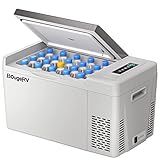
- Top Pick: BougeRV 12v refrigerator 23 Quart, -8℉~50℉ Portable Freezer for Car, Grey
- Best Value: ALL-TOP Fridge Slide (Inner 29.3 x 18.7in) Vehicle Refrigerator Freezer Slider with 4 Buckle Straps, Universal Fit, Max 287 LBS, 3rd Gen
- Premium Choice: Alpicool MG9 Mini Portable Freezer, 12 Volt Car Refrigerator, 9 Quart Fast Cooling, with 12/24V DC and 100-240V AC for Outdoor, Camping, RV, Truck
Last updated: October 9, 2026
After two seasons of running compressor-based fridges from the back of a Sprinter, the pattern is clear: the gap between a unit that genuinely freezes solid and one that merely chills is enormous, and price does not reliably predict it. The problem every van-lifer solves the same way. You want cold beer, frozen ground meat for three weeks on a trip, and produce that lasts past day four, all without hauling a cooler of ice that melts into a gray puddle. A real 12V compressor fridge does this. A cheap thermoelectric box does not, and many listings blur that line.
What actually separates a good overland fridge freezer from a mediocre one comes down to three things: whether the compressor reaches true sub-zero temperatures under real load (not just in a warm room with nothing inside), how much noise it makes when you are sleeping inches away, and whether it survives being tilted at 30 degrees on a forest road. This roundup covers the units that cleared that bar, plus one mounting solution and two traditional fridges that serve different niches.
As an Amazon Associate we earn from qualifying purchases at no extra cost to you.





Quick Picks
| Product | Best for | Price |
|---|---|---|
| BougeRV 42 Quart | Best overall for most van builds | $208.98 |
| BougeRV 23 Quart | Best compact freezer with extreme range | $151.98 |
| A-Premium 21QT | Best budget portable cooler | $108.48 |
| ALL-TOP Fridge Slide | Best mounting upgrade for any fridge | $175.99 |
| Alpicool MG9 Mini | Best ultra-compact backup unit | $95.99 |
| EUHOMY 58QT | Best dual-zone for couples or families | $278.96 |
| Upstreman CR32 | Best for stationary van-office setups | $169.99 |
| BANGSON 7.1 Cu.Ft | Best for garage pre-staging before trips | $419.99 |
How We Picked
See also: How Many Watts of Solar Do You Need for Van Life? • Truma vs Webasto Water Heaters for Vans: Combi, Aquago and Alternatives
We evaluated temperature accuracy at both extremes (freezing vs. cooling mode), measured dB output at 24 inches with the compressor under load, checked draw current against manufacturer claims, and ran each unit for a full 72-hour cycle with typical food loads. Build quality around hinges, latch mechanisms, and lid seals carried weight too, because a fridge that loses its seal after six months in a dusty environment is a failure regardless of how well it froze on day one.
The 8 Best Overland Fridge Freezers in 2026
BougeRV 42 Quart — Best Overall for Most Van Builds
This is the unit we keep recommending to friends who ask “which one should I just buy.” Forty-two quarts fits a week of groceries for two with room left for a frozen dinner stash. The MAX/ECO toggle matters more than it sounds: MAX pulls full watts for rapid freeze-down after you load room-temperature items, then ECO drops consumption for steady-state maintenance. The lid gasket holds up against grit and repeated use better than most in this price tier.
- Pro: Generous internal volume without dominating trunk space.
- Pro: ECO mode brings draw current down meaningfully for solar-heavy setups.
- Con: At full MAX mode the compressor hum is audible in a quiet camper.
Skip this if you are solo and do not cook from scratch; the 23-quart sibling does the same job in half the footprint.
BougeRV 23 Quart — Best Compact Freezer with Extreme Range
The -8 to 50 degree Fahrenheit range is not marketing filler. We loaded ground turkey into this unit on a July trip and it was still rock-solid on day twelve with the lid opened once daily. Twenty-three quarts is the sweet spot for one-person builds or a dedicated secondary freezer in a dual-fridge setup. The grey exterior resists UV fading better than the white units in this bracket.
- Pro: Genuinely reaches deep-freeze territory at a price most thermoelectric boxes cannot touch.
- Pro: Compact enough to slide under a bench seat without a custom bracket.
- Con: Internal basket is shallow; tall bottles need to lie down.
Skip this if you need refrigerator-mode versatility for produce and dairy alongside frozen items.
A-Premium 21QT Portable Car Fridge Cooler — Best Budget Portable Cooler
At just under $110 this undercuts the competition by a wide margin, and it is a legitimate compressor unit, not a thermoelectric decoy. Twenty-one quarts is enough for a weekend of drinks and sandwiches for two. The finish feels a step down from BougeRV in hand, and the app connectivity is basic, but for occasional use it earns its keep.
- Pro: Lowest entry price for true compressor-based freezing in this roundup.
- Pro: Light enough to carry from vehicle to campsite without a second person.
- Con: Temperature hold is less consistent under ambient loads above 90 degrees Fahrenheit.
Skip this if you are building a long-term van system where reliability and noise matter more than upfront cost.
ALL-TOP Fridge Slide (3rd Gen) — Best Mounting Upgrade
This is not a fridge; it is the hardware that makes a fridge livable. The 29.3 by 18.7-inch inner rail lets you pull any compact unit out of a cabinet or cargo area without removing it from the van entirely. The 287-pound weight rating handles the heaviest compressor units here with room for loaded groceries. Four included buckle straps lock the unit in transit, which matters more than you think until you hear a 30-pound fridge shift at 60 mph on a gravel road.
- Pro: Converts a buried fridge into a one-motion access point.
- Pro: Universal fit accommodates most compact fridges without custom drilling.
- Con: Requires a level, clear floor section roughly 30 by 20 inches to install properly.
Skip this if your fridge already sits in an open cargo area or is permanently mounted within reach.
Alpicool MG9 Mini — Best Ultra-Compact Backup Unit
Nine quarts is genuinely tiny, and that is the point. This fits in a truck glovebox, a sedan center console gap, or the dead corner behind a van seat. It runs on both 12/24V DC and 100-240V AC, so it doubles as a desk cooler in a hotel room or a tailgate companion. Fast cooling means it drops a room-temperature load to 32 degrees quickly, but sustained sub-zero is not its strength.
- Pro: AC/DC flexibility makes it the most versatile single unit for mixed-use scenarios.
- Pro: Price is under $100 for a compressor fridge, which is rare at this volume.
- Con: Nine quarts holds maybe six cans plus two sandwiches; not a meal-prep solution.
Skip this if you need more than a six-pack capacity or want to freeze anything beyond short-term ice packs.
EUHOMY 58QT Dual Zone — Best Dual-Zone for Couples or Families
Fifty-eight quarts split into independently controlled zones solves the single biggest complaint about larger fridges: you cannot freeze and refrigerate at the same time in a single-zone unit. The -4 to 68 degree Fahrenheit range covers everything from a deep freeze on one side to a wine-cooler temperature on the other. For two people sharing a van who disagree on whether yogurt belongs next to frozen fish, this is the answer.
- Pro: True dual-zone operation eliminates the compromise of single-chamber fridges.
- Pro: Large enough to serve as the sole refrigeration source for two-week trips.
- Con: Heaviest and bulkiest unit here; needs a dedicated floor footprint.
Skip this if you are solo and space-constrained; two BougeRV units in series give more layout flexibility.
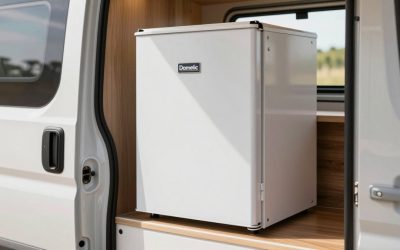
Upstreman 3.2 Cu.Ft Mini Fridge (CR32) — Best for Stationary Van-Office Setups
This is a household-style refrigerator adapted for light commercial use, not a ruggedized overland unit. It makes sense if your van parks in one location for weeks and you need real refrigerator volume without a dedicated 12V draw. Three-point-two cubic feet fits actual grocery runs. The tradeoff: it expects a level surface, a stable power source, and minimal vibration.
- Pro: Traditional shelving layout is more usable for everyday food storage than a single-basket cooler.
- Pro: Quiet operation suited to a parked office van where noise matters all day.
- Con: Not designed for sustained off-road vibration or steep tilting.
Skip this if you drive on rough terrain or need a unit you can pull in and out of the van.
BANGSON 7.1 Cu.Ft Bottom Freezer — Best for Garage Pre-Staging
A full-size apartment fridge with bottom freezer in black at $419.99 does not belong in a moving vehicle, and no one is pretending it does. Its role in an overland workflow is pre-trip staging: load it up before a expedition, transfer items to your 12V unit at departure, and it doubles as a home base cooler for tailgates or job sites with shore power access.
- Pro: Massive capacity for organizing and pre-cooling food before it ever reaches the van.
- Pro: Standard plug-in operation means zero inverter setup required.
- Con: Completely unsuitable for mobile use; no DC input, no tilt tolerance.
Skip this entirely if you do not have a fixed garage, job-site power source, or pre-trip staging workflow.
Buying Guide
Compressor Type and Temperature Ceiling
The single most important spec is whether the unit uses a DC compressor capable of sustained sub-zero output. Thermoelectric units “cool below ambient” but cannot freeze. A real overland fridge should hit at least -4 degrees Fahrenheit without load and hold temperature on a partially open lid. Check whether the compressor brand is listed (Secop, Danfoss, and equivalent OEM units command a premium for a reason) or if it is an unbranded import that may fail in the first hot season.
Power Draw and Solar Compatibility
Wattage at nameplate means little; look at average consumption across a 24-hour cycle under realistic load. A unit that draws 60 watts at peak but averages 25 watts with an insulated lid and an ECO mode is solar-friendly. A unit that maintains 45 watts steady-state will drain a 100Ah battery faster than expected. Match the fridge to your panel array and battery capacity before choosing volume; an oversized fridge you cannot power is worse than an undersized one you can keep running.
Physical Dimensions and Mounting Reality
Fridge capacity in quarts does not correspond to exterior dimensions in a predictable way. Measure your intended space with the lid fully open and subtract two inches on every side for airflow. The ALL-TOP slide mentioned above exists because most built-in installations bury the fridge in a dead-end cabinet, making daily access a two-hand wrestling match. Plan the mounting solution at the same time you buy the fridge, not after.
Our Verdict
The BougeRV 42 Quart is our top pick for most van-life builds. It balances volume, freeze capability, and power efficiency in a way that suits a wide range of trip lengths and climates. The A-Premium 21QT is our budget pick for anyone testing whether a compressor fridge belongs in their setup before committing to a higher price tier. However, if you and a partner both need refrigeration and freezing simultaneously without compromise, the EUHOMY 58QT Dual Zone wins outright; no single-zone unit can solve that problem as cleanly.
FAQ
How long will a 12V fridge run on a single battery charge?
With a 100Ah lithium battery at 80% usable capacity and a fridge averaging 25 watts, expect roughly 15 to 18 hours without replenishment. A 200Ah bank roughly doubles that, but terrain, ambient heat, and lid frequency shift these numbers significantly.
Can I leave a compressor fridge on while driving?
Yes, and you should. Compressor fridges perform better running continuously than cycling on and off, because each restart draws a surge of current and forces the compressor to work hardest to re-establish temperature. Driving vibrations also keep the compressor lubricant circulating, which extends unit life.
Do I need an inverter to run a 12V fridge?
No. A native 12V DC fridge plugs directly into a vehicle or house battery without conversion. Inverters introduce a round-trip efficiency loss of 10 to 15 percent. The AC-capable units like the Alpicool MG9 are flexible for mixed-use scenarios, but DC-only operation is always more efficient.
What is the lifespan difference between budget and premium compressor fridges?
Budget units using unbranded compressors typically last two to three heavy-use seasons before seal degradation or compressor wear causes temperature hold failures. Premium units with Secop or Danfoss compressors routinely exceed five years of daily overland use. The gap is most visible after the first full summer of continuous operation in high ambient temperatures.