Last updated: September 27, 2026
The best campervan for single tall person 6 foot 5 is a high-roof Ram ProMaster, Ford Transit, or Mercedes Sprinter with a longitudinal or convertible bed over 80 inches long, because none of the standard transverse beds are long enough for you to sleep straight, and only true high-roof models give you full standing headroom after insulation and flooring.
Real Interior Height After You Build It Out
Factory spec sheets measure bare metal floor to bare metal ceiling at the highest point. Once you add insulation, sound deadening, flooring, and a ceiling finish, you lose 1.5 to 3 inches of standing height. For a 6’5″ (77-inch) person, you need at least 78 to 79 inches of finished height to stand upright without hunching.
| Van Model (High Roof Only) | Factory Cargo Height (Center) | Finished Height After Conversion | Usable Standing Height for 6’5″ |
|---|---|---|---|
| Ram ProMaster 3500 High Roof (159″ or 159″ Ext) | 76.0 inches | 73.5 – 74.5 inches | Tight: you will brush ceiling with shoes on, requires thin floor/ceiling build |
| Ford Transit 350 High Roof (148″ or 148″ Extended) | 77.2 inches | 74.5 – 76.0 inches | Marginal: workable if you keep flooring under 0.75″ and use recessed ceiling panels |
| Ford Transit 350 High Roof Extended (HR Extended) with High Roof | 77.2 inches | 74.5 – 76.0 inches | Same height as above, but extra length helps with longitudinal bed |
| Mercedes Sprinter 2500 170″ High Roof | 79.1 inches | 76.5 – 77.5 inches | Best: true stand-up height even after 2″ of build-up |
| Mercedes Sprinter 2500 170″ Extended High Roof | 79.1 inches | 76.5 – 77.5 inches | Best: same height with more rear storage for longer bed platforms |
Takeaway for 2026 builds: The Sprinter high roof is the only platform that leaves you with a clear inch to spare at 6’5″ after a normal conversion. The Transit can work if you intentionally save vertical space. The ProMaster has the most vertical walls and widest interior, but the lowest ceiling, so tall builders often use a lowered floor section in the galley or a skylight-adjacent standing zone to compensate.
How to Save 1-2 Inches of Headroom in Any Van
- Use 1/2-inch polyiso or Thinsulate directly against the metal instead of 1-inch furring strips plus 1-inch board where headroom matters most. You lose a little R-value but gain critical head height.
- Choose 5mm plywood or tongue-and-groove cedar on the ceiling instead of 3/4-inch planks with heavy cross battens. Attach to existing roof ribs where possible.
- Keep the floor assembly under 1 inch in the standing aisle: 1/4-inch closed-cell foam + 1/2-inch plywood + vinyl is enough. Avoid a full 3/4-inch subfloor plus radiant layers in the walkway.
- Place your primary standing zone between the roof ribs where the ceiling is tallest, typically just behind the cab. Avoid placing a MaxxFan or AC directly over where you cook and stand.
Bed Length Is the Dealbreaker: Transverse vs. Longitudinal
See also: MaxxFan Deluxe vs Fantastic Fan for Vans: Which to Choose? • Can I Lay LVP in a Van? Van Flooring Guide
For a single tall person, bed orientation determines comfort more than any other feature. You need a sleeping surface at least 4 inches longer than your height to account for a pillow and foot stretch.
Worked calculation for you: 6’5″ = 77 inches + 2 inches for pillow compression/setback + 2 inches for toe-point/stretch = 81 inches ideal. A minimum of 79 inches is tolerable if you sleep slightly curled or diagonally, but you will touch the walls every night on anything shorter.
Standard transverse (side-to-side) platforms measure the van’s interior width between wall panels:
- ProMaster (widest): 75.6 inches wall-to-wall, about 73-74 inches after insulation and wall finish. Even the widest van is 7 inches too short for you.
- Transit: 70.2 inches wall-to-wall, about 68-69 inches finished.
- Sprinter: 70.4 inches wall-to-wall, about 68-69 inches finished.
No transverse bed works for 6’5″ without a slide-out flare or bump-out. Flarespace-style side flares can add 6-8 inches on a Transit or Sprinter, getting you to 76-77 inches, which is still short for true comfort and usually costs $2,500-$4,000 installed.
Decision Matrix: Which Bed Layout for a Solo Tall Person?
| Your Priority | Best Layout | Dimensions You Get | Trade-off |
|---|---|---|---|
| Maximum sleep comfort, van stays under 19.5 feet | Longitudinal fixed bed on one side (driver or passenger) | 80 to 84 inches long x 24 to 30 inches wide for a single berth | Narrows the aisle, but as a solo traveler you keep full garage height underneath |
| Want to keep floor space open during day | North-south convertible: bench seats to full-length bed | 80 to 82 inches when deployed, 28-32 inches wide | Daily setup/teardown, need a perfectly flat support system |
| Need to park in regular spaces, keep van stealthy | Ford Transit 148″ High Roof with longitudinal bed + front cab swivel | 79-81 inches if you build over wheel well notch | Requires notching the platform around the wheel well and using a thinner mattress there |
| Maximum garage and headroom | Sprinter 170″ or ProMaster 159″ Extended with elevated longitudinal bed | 82-84 inches long, high enough for bikes/kayak underneath | Longer wheelbase, less nimble in cities |
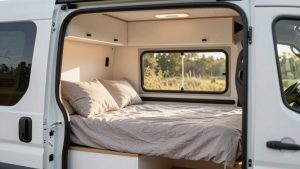
For a single 6’5″ occupant, the most efficient use of space is a single longitudinal bed along the driver side wall, 80-82 inches long and 27-30 inches wide. It leaves a full-length aisle on the passenger side where you retain maximum headroom, and you can use the entire rear garage for storage. You do not need a full 54-inch wide platform, which is why solo tall builds feel far more spacious than double-occupancy layouts in the same van.
Top Three High-Roof Platforms for 6’5″ and Up in 2026
1. Mercedes Sprinter 2500 170″ High Roof – Best for Standing Comfort
The Sprinter remains the benchmark for tall conversions because its finished height is the tallest and its straight walls make a long longitudinal bed easy to frame. The 170″ wheelbase is long enough to fit an 82-inch bed without extending into the cab. The 170″ Extended adds another 15.5 inches of cargo length, useful if you want an 84-inch bed plus a rear door shower. Running costs are usually higher than Transit or ProMaster (diesel maintenance and parts typically run $1,200-$2,000 per year more in general market ranges), but headroom is unmatched.
2. Ford Transit 350 High Roof Extended (148″ Extended) – Best All-Arounder
The Transit high roof with the EcoBoost V6 and AWD is widely available and usually $8,000-$15,000 less than a comparable Sprinter on the used market. Interior width is narrower than the ProMaster, so skip any transverse idea and build longitudinal. The extended 148″ body gives you 83-84 inches of flat floor behind the partition, which translates to an 81-inch bed with a small bulkhead. The Transit’s roof ribs are deep, so plan a ceiling that sits between ribs to claw back that 1.5 inches you need.
3. Ram ProMaster 3500 High Roof 159″ Extended – Best for Width and DIY Simplicity
The ProMaster is front-wheel drive, has the widest rectangular cargo box, and the lowest load floor, which helps with getting in and out. While its finished ceiling is the shortest of the three, its vertical sidewalls let you mount a longitudinal bed higher and still sit up without hitting the curved roof edges that Sprinters and Transits have. If you are 6’5″ and prioritize bed width within a longitudinal layout or want to run a 30-inch wide bed with side storage, the ProMaster’s width is an advantage. It is also often the most affordable new chassis, usually in the mid $45,000-$55,000 range for the cargo van before conversion.
Conversion Tips That Matter at 6’5″
- Build the bed first, around the mattress. Buy your 80-inch or 84-inch mattress (custom 30×82 RV mattresses are common) before you frame. Many builders frame 75 inches out of habit and then discover their feet hit the wall.
- Use a longitudinal platform with an open foot end. Leave the foot of the bed open to the aisle or rear doors instead of boxing it against a wall, so you can hang feet off if needed and improve ventilation.
- Choose mattress thickness carefully. A 6-inch memory foam or latex is usually enough for side sleeping and saves 2-4 inches of garage height versus an 8-10 inch residential mattress. That saved height lets you raise the bed platform without losing sit-up height.
- Check cab seat swivels. If you use swivel front seats to create a lounge, test the swivel clearance with the longitudinal bed in place. On a 148″ Transit, a full-length driver’s side bed can interfere with a swiveled driver’s seat unless you stop the platform 4-6 inches short and use a fill cushion.
- Shower solution: Forget a fixed interior wet bath if you are tall. A 24×32 inch wet bath will feel like a coffin and steals 32 inches of bed length. Use a rear-door pull-out shower, an aisle shower pan with a ceiling-mounted curtain, or a gym membership plus outdoor shower. This saves headroom and floor length.
- Door height: The sliding door opening is 4-6 inches shorter than interior ceiling height on all three vans. You will duck to enter no matter which van you choose. Add a grab handle at the door header to make entry easier.
What to Avoid
Avoid any factory campervan that advertises a transverse rear bed without flares and claims it sleeps someone 6’5″. This includes most short-wheelbase pop-top builds and low-roof conversions that rely on a 72-74 inch crosswise bed. As a solo tall traveler you also do not need a pop-top to gain sleeping length; a high-roof longitudinal build is quieter, better insulated, and lets you stand to get dressed without opening the roof.
Also avoid building heavy overhead cabinets directly over a longitudinal bed at head height. At 6’5″ you will hit them when sitting up. Keep overhead storage to the aisle side and use a soft bulkhead or shallow shelf on the sleeping side.