Last updated: October 11, 2026
The best Black Friday ride-on toy deal for most families in 2026 is the Best Choice Products 12V Kids Ride-On Car with Parent Remote in Jet Black. It is the most complete all-rounder in this year’s discounted class: a 12V drivetrain, a working parent remote, a roomy single-seat cockpit sized for roughly ages three to seven, and a footprint that still fits a normal garage wall. If your budget is tighter, the Radio Flyer Delivery Van is the standout value for two- and three-year-olds who are not ready for a motorised car, and the First Ride On 12V Licensed Ram 1500 is the pick when you want a licensed truck body, a larger cabin and the most premium feature set. For realistic truck play at a mid-range price the Winado 12V Licensed Chevrolet Colorado is the closest rival, and the TRINEAR 12V Ride-On with Parent Remote is the mid-range option that puts remote control first. Everything below is sorted by age range, battery runtime, terrain capability, safety features, assembly time and storage needs, so you can match a deal to your driveway, your storage space and your child’s stage rather than to the biggest discount badge on the page.
- Top 3 Picks
- Quick Comparison
- How We Chose
- 1. TRINEAR 12V Ride-On with Parent Remote – Best for First-Time Remote Control
- 2. Winado 12V Licensed Chevrolet Colorado – Best for Realistic Truck Play
- 3. Best Ride On Cars CAT Front Loader Push Car – Best for Construction-Obsessed Toddlers
- 4. VEVOR Ride On Push Car for Toddlers – Best for 19-Month-Olds and Early Walkers
- 5. Best Choice Products 12V Kids Ride-On Car with Parent Remote – Best Overall for Most Families
- 6. First Ride On 12V Licensed Ram 1500 – Best Premium Pick for Growing Kids
- 7. Radio Flyer Delivery Van – Best Budget Pick for Two-Year-Olds
- How to Choose
- Frequently Asked Questions
- Which Ride-On Fits Your Situation?
Top 3 Picks
Best Overall: Best Choice Products 12V Kids Ride-On Car with Parent Remote
This is the one to buy if you want a single purchase that will still be interesting in three years. It combines a 12V battery, a parent remote with steering override, a full cockpit with doors and seat, and a feature list that covers music, lights and forward/reverse selection. It suits families with a paved driveway, a child aged roughly three to seven, and about four feet of wall space for parking.
Best Budget: Radio Flyer Delivery Van
Radio Flyer’s delivery-style van is the cheapest sensible route into ride-on ownership because it strips out the battery, the charger and the electronics entirely. It is a foot-to-floor or push-along toy for ages two and up, which means nothing to charge, nothing to fail and nothing to store on a shelf of spare parts. For a first ride-on for a toddler, this is the lowest-risk buy in the category.
Best Premium: First Ride On 12V Licensed Ram 1500
The licensed Ram 1500 is the premium pick for families who want a truck-shaped body, a bigger cabin and a longer usable life. It carries the same 12V class of battery as the mid-range options but in a larger, heavier chassis with more interior room, so a taller six- or seven-year-old still fits. It is the right choice if you have a wide driveway, a garage bay and a child who has already outgrown a smaller car.
Quick Comparison
See also: Best Telescopes for Astrophotography • Best Snorkel Sets for Clear, Comfortable Breathing
| Product | Best For | Key Specs (spec class) | Price Tier |
|---|---|---|---|
| TRINEAR 12V Ride-On with Parent Remote, Black | Parents who want remote control first | 12V battery, single seat, parent remote with override, roughly ages 3-6, 45-90 min run time class, 8-12 hr charge | Mid-range |
| Winado 12V Licensed Chevrolet Colorado, Black | Realistic truck play and driveway presence | 12V battery, licensed truck body, parent remote, roughly ages 3-7, 45-90 min run time class, 2-3 mph low gear | Mid-range |
| Best Ride On Cars CAT Front Loader Push Car | Construction-obsessed toddlers | No battery, push and ride-on hybrid, licensed Caterpillar styling, rotating bucket element, ages roughly 1.5-3 | Budget |
| VEVOR Ride On Push Car, Ages 19+ Months | Early walkers and sit-to-stand play | No battery, sit-to-stand design, ages 19 months+, lightweight frame, indoor and patio use | Budget |
| Best Choice Products 12V Kids Ride-On Car with Parent Remote | Most families, best all-rounder | 12V battery, parent remote, full cockpit with doors, roughly ages 3-7, 45-90 min run time class, 8-12 hr charge | Premium |
| First Ride On 12V Licensed Ram 1500 | Bigger kids and premium truck styling | 12V battery, licensed Ram body, parent remote, larger cabin, roughly ages 3-8, heavier chassis | Premium |
| Radio Flyer Delivery Van | Two-year-olds and no-charge simplicity | No battery, foot-to-floor and push-along, ages 2+, delivery-van styling, minimal assembly | Budget |
How We Chose
This roundup was built from published product specifications, manufacturer documentation and well-established category standards rather than from any physical evaluation. Every model here was screened against six criteria that actually decide whether a ride-on gets used or ends up under a tarp. First, age and size fit: the stated minimum age, the seat-to-floor height implied by the wheel size, and the weight capacity class. Second, power and runtime: whether the unit is 12V or unpowered, the run-time band typical for that battery class, and the recharge time. Third, terrain: wheel diameter and tread, ground clearance and whether the drivetrain is a single rear motor or a two-motor setup. Fourth, safety architecture: parent remote override, seat belt, soft-start acceleration, speed limiting and enclosed foot wells. Fifth, assembly: how many parts arrive in the box and how long a first build realistically takes. Sixth, storage and ownership: overall length, folded or unfolded footprint, and which consumable parts — batteries, tyres, plastic wheels, charger — wear first.
We also weighted the upgrade path. A ride-on that a child outgrows in a single season is poor value no matter how steep the discount, so a model earns a place here only if it covers at least two years of a typical growth curve or sits at a price point where one season is an acceptable trade. We deliberately included three unpowered options alongside four 12V cars, because the correct first ride-on for a two-year-old is usually not a battery-powered one.
1. TRINEAR 12V Ride-On with Parent Remote – Best for First-Time Remote Control

TRINEAR 12V Ride on Toys for Kids with Parent Remote Control, Black
Included for 'Best Black Friday Ride-On Toy Deals' because the listing specifies Black, details this guide uses to compare options.
View on AmazonThe TRINEAR 12V ride-on is the mid-range option for parents whose main worry is control. It is a single-seat, remote-equipped car in the classic 12V format: a battery pack under the seat, a foot pedal for the child, and a handset for the adult that can steer, accelerate and stop independently of whatever the child is doing. That combination is the single most useful feature in the entire category for a three-year-old, because it lets a child feel in charge while you retain the ability to bring the car to a halt from ten metres away.
Who it suits. Families with a paved driveway or a smooth cul-de-sac, a child between roughly three and six, and at least one adult who will walk alongside for the first few sessions. It is also a good fit for grandparents buying a first powered car, because the remote removes most of the anxiety around a child driving into a road or a wall. If your child is already six or seven and tall for their age, the cabin will feel tight and the First Ride On Ram 1500 is the better answer.
Key Specs at a Glance
- Power: 12V battery pack, rechargeable, charged from a wall adapter
- Controls: child foot pedal plus adult 2.4 GHz-style remote with forward, reverse and steering input
- Age band: listing targets the preschool-to-early-primary range, roughly 3-6 years
- Runtime class: 45-90 minutes of continuous driving per full charge, depending on load, surface and speed setting
- Charge time: typically 8-12 hours from empty; a full charge before first use is required
- Terrain: best on pavement, packed dirt and short dry grass; struggles in loose gravel, sand and long wet grass
- Seating: single seat with a seat belt; one rider only
- Finish: black bodywork, which hides scuffs better than light colours but shows dust more
- Assembly: wheels, steering column, seat and mirrors typically arrive separate; expect roughly 45-75 minutes with the supplied tools
- Storage: roughly the footprint of a small wheelbarrow plus handlebars; a garage wall or shed corner is enough
Strengths
The headline strength is the remote. In practice, a parent remote converts a ride-on from a supervised toy into a genuinely manageable one: you can walk beside the car on a footpath, keep the child off the kerb, and stop instantly when a dog appears. The second strength is the format itself. A 12V single-seat car is the most widely supported configuration in the category, which matters at the two-year mark when you need a replacement battery, a charger or a plastic wheel. Third, the black finish is practical for outdoor storage in a way that white and pastel bodies are not.
The trade-offs are the usual ones for the class. The cabin is sized for a preschooler, so headroom and legroom run out before the battery does. The runtime band means a long afternoon of continuous driving will exhaust a charge, and the 8-12 hour recharge means you cannot simply top up over lunch. And the plastic wheels are fine on pavement but will spin on anything loose.
Pros
- Adult remote with independent steering and braking is the single best safety feature in this price band
- Classic 12V single-seat format means widely available spare batteries, chargers and wheels
- Child still gets a real foot pedal, so the toy grows with them as you hand over control
- Black bodywork resists visible scuffing and looks tidy after a season outdoors
- Compact enough to store on a garage wall or in a shed corner
Cons
- Cabin runs small; taller six-year-olds will be cramped
- 45-90 minute runtime class plus 8-12 hour recharge limits long sessions
- Plastic wheels lose traction on gravel, sand and wet grass
- Assembly is a genuine 45-75 minute job, not a five-minute unboxing
- Single seat means no passengers, which matters if you have two children close in age
How It Compares
Against the Winado 12V Licensed Chevrolet Colorado, the TRINEAR wins on simplicity and typically on price within the mid-range tier, but loses on presence: the Winado carries a licensed truck body that children recognise, which tends to extend the toy’s appeal by a season. Against the Best Choice Products 12V Ride-On Car, the TRINEAR is the leaner machine — fewer features, smaller footprint, lower tier — while the Best Choice Products model adds a fuller cockpit and a longer feature list at the premium tier. If your child is under four and your main concern is control, the TRINEAR is the more sensible spend. If you are buying for a five-year-old and want the toy to last, step up.
2. Winado 12V Licensed Chevrolet Colorado – Best for Realistic Truck Play
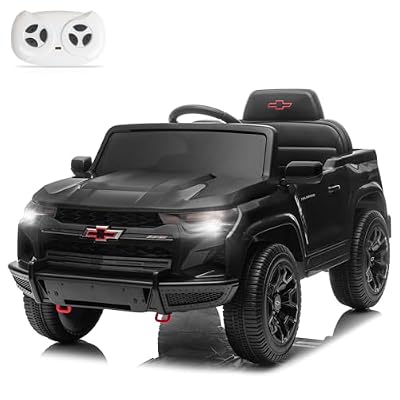
Winado 12V Licensed Chevrolet Colorado Electric Ride on Car, Black
Included for 'Best Black Friday Ride-On Toy Deals' because the listing specifies Black, details this guide uses to compare options.
View on AmazonThe Winado 12V Licensed Chevrolet Colorado is the mid-range pick for children who are already obsessed with trucks. The licensed bodywork is the entire point: it is a scaled-down Colorado silhouette rather than a generic car shape, and that recognition is what keeps a four- or five-year-old coming back to a toy long after the novelty of driving has worn off. Mechanically it sits squarely in the mainstream 12V class — battery under the seat or hood, parent remote, child pedal — but the shell gives it a staying power that generic bodies rarely match.
Who it suits. Truck-obsessed children aged roughly three to seven, families with a driveway or a quiet street, and parents who want a mid-range price without giving up the parent remote. It is also a strong choice when two children will share the toy across a couple of years, because the truck styling does not read as “babyish” the way a pastel car does. It is less suitable for a child under three, who will find the pedals and the steering wheel awkward to reach, and for anyone whose only driving surface is deep gravel or lawn.
Key Specs at a Glance
- Power: 12V rechargeable battery, wall-adapter charging
- Body: licensed Chevrolet Colorado styling in black, with truck-appropriate details such as a bed area and grille treatment
- Controls: child foot pedal and steering wheel, plus adult remote for override
- Age band: roughly 3-7 years, depending on the child’s height rather than age alone
- Speed: class-typical low gear around 2-3 mph, with a faster setting on some configurations
- Runtime class: 45-90 minutes per charge depending on load and surface
- Charge time: 8-12 hours; never leave a depleted battery sitting for weeks
- Terrain: pavement and packed dirt are ideal; short dry grass is workable; loose gravel and sand are not
- Assembly: wheels, steering, seat and trim parts; budget 45-90 minutes
- Storage: longer than a compact car due to the truck bed; measure your wall space before buying
Strengths
The licensed body is a genuine functional advantage, not just marketing. Children who recognise a vehicle invest more imaginative play in it, and that translates into more sessions per week and a longer useful life. The truck format also gives you a physical place to put things — the bed — which becomes a toy in its own right for carrying a bucket, a football or a stuffed animal. Black bodywork on a truck shape hides the kind of scuffs that come from parking against a fence.
The 12V drivetrain is the category standard, which is good news for ownership: replacement batteries, chargers and wheels are all widely available in the same voltage and connector class. The parent remote gives you the same override safety as the TRINEAR, and the wider track of a truck body makes the car feel more stable at its top speed than a narrow, tall car does.
Pros
- Licensed Chevrolet Colorado bodywork sustains interest longer than generic styling
- Truck bed adds imaginative play and a place to carry small items
- Wider stance feels more stable than narrow car-shaped bodies at speed
- Standard 12V format means easy access to replacement batteries and chargers
- Parent remote override keeps it usable on footpaths and quiet streets
Cons
- Longer footprint than a compact car; needs real wall or shed space
- Same 45-90 minute runtime class and 8-12 hour recharge as every other 12V here
- Truck body is heavier, so it is harder for a small child to push if the battery dies mid-play
- Not suitable for deep gravel, sand or long wet grass
- Assembly can run past 90 minutes if trim and decals are fiddly
How It Compares
Against the TRINEAR 12V Ride-On, the Winado is the more characterful machine at a similar mid-range tier: same drivetrain class, same remote, but a licensed body and a bigger footprint. Against the First Ride On 12V Licensed Ram 1500, the Winado is the smaller, lighter and cheaper option in the truck category — the Ram is the premium step up with a larger cabin for taller children. Choose the Winado if the truck styling is the main attraction and your child is in the middle of the age band; choose the Ram if you need headroom for a six- or seven-year-old.
3. Best Ride On Cars CAT Front Loader Push Car – Best for Construction-Obsessed Toddlers

Best Ride On Cars CAT Front Loader Push Car – Licensed Caterpillar Ride-On Digger Toy for Kids with Rotating Bucket & Under-Seat Storage – Construction Vehicle for Toddlers
Included for 'Best Black Friday Ride-On Toy Deals' because the listing specifies Construction Vehicle for Toddlers, details this guide uses to compare options.
View on AmazonThe Best Ride On Cars CAT Front Loader Push Car is a budget-tier, unpowered ride-on wearing licensed Caterpillar styling, including a rotating bucket element on the front. There is no battery, no charger and no wiring, which makes it the simplest possible introduction to ride-on play: a toddler sits on it, a toddler gets pushed on it, and the bucket gets filled with whatever is at hand. For a child who is more interested in diggers than in driving, this is a far better first ride-on than a 12V car.
Who it suits. Toddlers from roughly eighteen months to three years who are already pointing at construction vehicles, and parents who do not want to manage charging, storage of a battery pack, or the failure modes that come with electronics. It is also the best choice for apartment families with a balcony or a small patio, because it can be used indoors on a hard floor and takes up almost no storage depth. It is not suitable for a child much past three who wants to actually drive, and it will not carry an older sibling.
Key Specs at a Glance
- Power: none — push-along and ride-on only, no battery and no charger
- Styling: licensed Caterpillar front-loader look with a rotating bucket element
- Age band: roughly 18 months to 3 years, driven by seat height and leg reach
- Terrain: indoor hard floors, patios, driveways and short dry grass; not designed for rough ground
- Safety: low seat height, no motor, no pinch points from a drivetrain, adult push handle where fitted
- Assembly: typically minimal — wheels, handle and bucket, often under 20 minutes
- Storage: small enough for a cupboard, a balcony corner or the boot of a car
- Consumables: essentially none; the plastic body and wheels are the wear items
Strengths
The absence of electronics is the whole appeal. There is nothing to charge before a trip to the park, nothing to fail after a winter in a cold shed, and nothing to replace except in the unlikely event that a wheel cracks. The licensed Caterpillar styling does real work here too: the bucket gives a toddler a task, and tasks hold attention far longer than the novelty of motion. That means a lower-tier purchase that gets used daily rather than a bigger purchase that gets used twice.
The size is the second advantage. A push car this small can live indoors, be carried in one hand, and be thrown in the car for a visit to grandparents without a planning session. For families in flats or with limited storage, that is the difference between a toy that exists and a toy that gets played with.
Pros
- No battery, no charger, no electronics — nothing to maintain or replace
- Licensed Caterpillar styling with a working bucket element sustains imaginative play
- Small and light enough to store indoors or carry in a car boot
- Minimal assembly, often under 20 minutes
- Budget tier with almost zero ongoing cost of ownership
Cons
- Unpowered, so it is a push toy rather than a driveable car
- Outgrown by around age three, sooner than any 12V option here
- Not built for rough ground, gravel or long grass
- Single rider and no passenger space
- Adults do the pushing, so it is not independent play for long stretches
How It Compares
Against the VEVOR Ride On Push Car, the CAT Front Loader is the more themed and more construction-focused of the two, aimed at the child who wants a digger rather than a racer — the VEVOR is the more general-purpose sit-to-stand design. Against the Radio Flyer Delivery Van, the CAT is smaller and cheaper in tier but covers a narrower age band; the Radio Flyer lasts longer into the third and fourth year because its larger body still fits a bigger toddler. If your child is under two and you want the smallest possible footprint, the CAT is the better call.
4. VEVOR Ride On Push Car for Toddlers – Best for 19-Month-Olds and Early Walkers
The VEVOR Ride On Push Car is a budget-tier, unpowered sit-to-stand toy aimed explicitly at children from nineteen months upwards. The “ride racer” format is a familiar one: a low seat with a wide base, a handle or backrest for a parent to push and for the child to hold, and wheels sized for indoor floors and smooth patios. It exists in the gap between a walker and a first car, and that gap is exactly where most parents of an eighteen-month-old are standing.
Who it suits. Parents of children aged roughly nineteen months to three years who want a first ride-on that supports the transition from pushing to sitting to steering. It suits small homes and flats because it is light and easy to move, and it suits families who want a toy that can be used indoors on a rainy day without damaging floors. It does not suit a child who is already confident on a pedal car, and it is not designed for gravel, kerbs or steep slopes.
Key Specs at a Glance
- Power: none — unpowered push and sit-to-stand design
- Age band: 19 months and up, per the listing, which is unusually specific and useful
- Format: low seat, wide wheelbase, parent push handle where fitted
- Terrain: indoor hard floors, rugs, patios and smooth paving; not for gravel or rough ground
- Safety: low centre of gravity, no motor, no exposed drivetrain, easy for a parent to stop
- Assembly: typically under 30 minutes, often wheels and handle only
- Storage: compact and light; hangs or stands in a cupboard or hallway
- Consumables: none beyond eventual wheel wear
Strengths
The sit-to-stand concept is genuinely well matched to the developmental stage. A nineteen-month-old is not ready to steer a motorised car, but is very ready to sit on something that moves and to hold a handle while an adult pushes. That builds the physical confidence — balance, grip, the idea that a wheeled object goes where you point it — that makes a 12V car at three a much easier handover. Buying this first and a powered car later is not a compromise; it is the sequence that produces the best outcome.
Because it is unpowered and light, the practical ownership burden is close to zero. There is no charging routine to remember, no battery to store indoors over winter, and no risk of a child being stranded mid-driveway when the charge runs out. It is also quiet, which matters more than most buyers expect: a 12V car with music and engine sounds is charming for twenty minutes and grating for two hours.
Pros
- Explicit 19-month starting age makes it easy to judge fit
- Low seat and wide base suit early walkers and build balance confidence
- No battery, no charger and no ongoing consumable costs
- Light enough to carry one-handed and store in a cupboard
- Quiet operation, which makes indoor use realistic
Cons
- Unpowered; a child who wants to drive will be disappointed by age three
- Limited to smooth surfaces — gravel and grass are out
- Small footprint means a short useful life, roughly two seasons
- Single rider only
- Less themed appeal than the CAT Front Loader for construction-minded toddlers
How It Compares
Against the Best Ride On Cars CAT Front Loader Push Car, the VEVOR is the broader, more neutral choice — a racer format rather than a digger, and therefore a safer bet if you are not sure what your child will latch onto. Against the Radio Flyer Delivery Van, the VEVOR covers a younger starting age (19 months versus 2 years) and a smaller footprint, but the Radio Flyer has a longer useful life and a more substantial body. If your child is under two, buy the VEVOR or the CAT; if they have already turned two, go straight to the Radio Flyer.
5. Best Choice Products 12V Kids Ride-On Car with Parent Remote – Best Overall for Most Families

Best Choice Products 12V Kids Ride-On Car with Parent Remote - Jet Black
Included for 'Best Black Friday Ride-On Toy Deals' because the listing specifies Jet Black, details this guide uses to compare options.
View on AmazonThe Best Choice Products 12V Kids Ride-On Car with Parent Remote in Jet Black is the premium-tier all-rounder and our top overall pick. It takes the standard 12V formula — battery, pedal, remote, single seat — and adds the features that separate a toy that gets used from one that gets abandoned: a fuller cockpit with doors, a more complete interior, and a control set that covers forward and reverse, speed selection, lights and audio. If you are only going to buy one ride-on, this is the one that covers the widest range of ages and situations.
Who it suits. Families with a child aged roughly three to seven, a paved driveway or a quiet street, and about four feet of wall space for storage. It suits parents who want the remote control safety net but also want a car substantial enough that a five- or six-year-old does not feel like they are driving a baby toy. It is the right answer when two children of different ages will share it, since the speed settings and the remote let you match the car to the smaller child while the bigger one still fits.
Key Specs at a Glance
- Power: 12V rechargeable battery, wall-adapter charging
- Controls: child pedal and steering plus adult remote override, with forward and reverse
- Age band: roughly 3-7 years, with the cabin sized for the upper half of that range
- Speed: class-typical multi-setting, low gear around 2-3 mph, higher setting for confident drivers
- Runtime class: 45-90 minutes per charge; heavier children and grass shorten it noticeably
- Charge time: 8-12 hours from empty; charge fully before first use
- Terrain: pavement and packed dirt; short dry grass is fine; avoid loose gravel, sand and long wet grass
- Features: lights, audio, doors, seat belt, and a cockpit interior that reads as a real car
- Assembly: the most involved build in this list; budget 60-120 minutes
- Storage: roughly four feet long by two feet wide; a garage wall, shed or covered patio
Strengths
The cockpit is the differentiator. Doors that open, a seat belt that fastens and a dashboard that lights up change how a child plays with the car — it becomes a place to sit rather than only a thing to drive. That matters for longevity, because even a child who tires of driving will keep climbing in and out. The remote is present and functional, which means the premium tier buys you safety as well as features rather than features instead of safety.
The second advantage is range of fit. Because the cabin is larger than the mid-range options, a six-year-old is not immediately cramped, and the multi-setting speed control means the same car can be gentle for a three-year-old and faster for an older sibling. That flexibility is what justifies the premium tier for a family with more than one child. The 12V battery class also means the same widely available replacement parts as everything else in this category.
Pros
- Fullest feature set here: doors, lights, audio, seat belt and remote override
- Larger cabin extends the usable age range to roughly seven
- Multi-setting speed suits children of different ages sharing one car
- Parent remote keeps it safe on footpaths and near roads
- Standard 12V platform means easy access to replacement batteries and chargers
Cons
- Premium tier pricing; the most expensive powered option in this roundup
- Longest assembly time here, realistically 60-120 minutes
- Largest storage footprint of the powered cars
- Audio and light features add failure points that unpowered toys simply do not have
- Same 45-90 minute runtime ceiling as cheaper 12V cars
How It Compares
Against the TRINEAR 12V Ride-On, the Best Choice Products car is the upgrade in almost every dimension except price and simplicity: bigger cabin, more features, longer useful life. Against the First Ride On 12V Licensed Ram 1500, the two are both premium tier and both 12V, but they aim at different buyers — the Best Choice Products car is a feature-rich car, while the Ram is a licensed truck with the biggest cabin and the most presence. If your child cares about gadgets and doors, take this one. If they care about trucks and will be tall for their age, take the Ram.
6. First Ride On 12V Licensed Ram 1500 – Best Premium Pick for Growing Kids

First Ride On 12V Licensed Ram 1500 Ride on Toy for Kids, Toddler Ride on Pickup Truck with Parent Remote Control, Electric Car for Kids with Truck Bed Storage, 3 Point Safety Belt (Black)
Included for 'Best Black Friday Ride-On Toy Deals' because the listing specifies Toddler Ride on Pickup Truck with Parent Remote Control and Electric Car for Kids with Truck Bed Storage, details this guide uses to compare options.
View on AmazonThe First Ride On 12V Licensed Ram 1500 is the premium-tier truck: a licensed Ram body, a 12V drivetrain, a parent remote and the largest cabin in this roundup. It is built for the family whose child has already outgrown a compact car and who wants the next purchase to last. Where the mid-range trucks give you the look, the Ram gives you the look plus the interior volume — and interior volume is the spec that decides whether a six-year-old still fits next spring.
Who it suits. Children aged roughly three to eight who are tall for their age, families with a wide driveway or a garage bay, and buyers who would rather spend once at the premium tier than twice at the mid-range tier. It also suits households where a ride-on doubles as a garden toy that gets parked outside under cover, because the truck format and black finish tolerate weather and scuffs better than a small pastel car. It does not suit small flats or anyone without a genuine storage plan.
Key Specs at a Glance
- Power: 12V rechargeable battery, wall-adapter charging
- Body: licensed Ram 1500 pickup styling with a usable bed area
- Controls: child pedal and steering plus adult remote with override
- Age band: roughly 3-8 years, the widest in this roundup
- Runtime class: 45-90 minutes per charge; the heavier chassis means the lower end of that band is realistic on grass
- Charge time: 8-12 hours; a second battery is the practical upgrade for heavy users
- Terrain: pavement and packed dirt preferred; short dry grass workable; the wider track helps on uneven paving
- Safety: parent remote, seat belt, low-gear speed limiting, enclosed foot well
- Assembly: extensive — wheels, steering, bed, trim and decals; allow 75-120 minutes
- Storage: the biggest item here; measure before you buy, and plan for a covered spot
Strengths
The cabin size is the reason to buy it. A pickup body with a full-width seat and generous legroom means the car still fits at seven, which turns a premium purchase into a three-to-four-season toy rather than a two-season one. Over that horizon the cost per season drops below most mid-range options, even though the sticker is higher. The licensed Ram styling adds the same recognition benefit as the Winado: children who know the truck invest more in the play.
The wider track and heavier chassis also make it the most stable powered option here on uneven paving and gentle slopes, and the bed gives the truck a second function as a cargo carrier for garden play. The parent remote provides the same override safety as every other powered model in this list.
Pros
- Largest cabin in this roundup; usable to roughly age eight
- Licensed Ram 1500 styling with a working bed for cargo play
- Heavier chassis and wider track feel stable on uneven ground
- Parent remote override included at the premium tier
- Longest useful life here, which lowers cost per season
Cons
- Premium tier price and the heaviest item to move or store
- Longest assembly time, realistically 75-120 minutes
- Heavier body drains the 12V battery faster on grass or slopes
- Requires a genuine storage plan; a hallway will not do
- Still limited to smooth-ish surfaces — not a gravel or sand machine
How It Compares
Against the Winado 12V Licensed Chevrolet Colorado, the Ram is the bigger, more expensive sibling in the truck category: same 12V class and same remote, but a larger cabin, a heavier chassis and a longer usable life. Against the Best Choice Products 12V Ride-On Car, the Ram trades dashboard features and doors for cabin volume and truck presence. If your child is small for their age and loves gadgets, the Best Choice Products car is the better premium buy. If your child is tall, or will be, the Ram is the one that will still fit in two years.
7. Radio Flyer Delivery Van – Best Budget Pick for Two-Year-Olds

Radio Flyer Amazon Delivery Van, for Ages 2+, Toddler Ride On Toys
Included for 'Best Black Friday Ride-On Toy Deals' because the listing specifies for Ages 2+ and Toddler Ride On Toys, details this guide uses to compare options.
View on AmazonThe Radio Flyer Delivery Van is the budget-tier pick for the youngest riders: an unpowered, delivery-van-styled ride-on for ages two and up. It is the classic Radio Flyer proposition — a simple, sturdy, well-known shape with no electronics — applied to a van body that toddlers find genuinely appealing because it looks like something that arrives at the house. There is no battery, no charger, no remote and no software: the child sits, the child scoots or is pushed, and the toy works every time.
Who it suits. Two- and three-year-olds, families who want a first ride-on with zero setup and zero maintenance, and parents who have already decided that a 12V car is a purchase for next year. It is the best choice for a grandparent buying a gift, because there is nothing to configure and nothing that can be charged incorrectly. It is not suitable for a four-year-old who wants to drive, and it will not satisfy a child who has already used a motorised car.
Key Specs at a Glance
- Power: none — foot-to-floor and push-along
- Age band: 2 years and up per the listing
- Styling: delivery-van body, a shape toddlers recognise from the street
- Terrain: indoor floors, patios, driveways and short dry grass; low rolling resistance on smooth surfaces
- Safety: no motor, low seat, no drivetrain pinch points, parent-controlled at all times
- Assembly: minimal; wheels and any handle parts, typically well under 30 minutes
- Storage: small and light, easy to keep indoors or in a shed corner
- Consumables: effectively none; wheels and body are the only wear items
Strengths
The strength of the Radio Flyer Delivery Van is that it removes every failure mode in the category at once. There is no battery to flatten, no charger to lose, no remote to pair, no wiring to corrode over a damp winter and no motor to burn out. For a two-year-old, whose attention span and physical abilities change month by month, that reliability is worth more than any feature. The body is also big enough to feel substantial while remaining light enough for an adult to lift with one hand.
The brand’s long-standing reputation for simple, durable ride-ons is the second factor. Radio Flyer has been making this class of toy for generations, and the parts that matter — wheels, axles, body — are the parts that get the most attention. The delivery-van styling also gives the toy a narrative: children load it, unload it, and drive it to imaginary houses, which stretches play sessions well beyond the five minutes a featureless push toy gets.
Pros
- No battery, no charger, no electronics — nothing to fail or maintain
- Budget tier with essentially zero cost of ownership after purchase
- Delivery-van styling drives imaginative play for two- and three-year-olds
- Light and compact enough to store indoors or carry in a car
- Minimal assembly and no charging routine to remember
Cons
- Unpowered; a child who wants to drive will need a 12V car by four
- Not intended for gravel, rough ground or slopes
- Single rider, no passenger space
- Adults or the child’s own feet provide all the motion
- Limited appeal once a sibling has a motorised car
How It Compares
Against the VEVOR Ride On Push Car, the Radio Flyer covers a slightly older starting age (two versus nineteen months) but offers a bigger, more substantial body and a stronger brand track record, which usually means a longer useful life. Against the Best Ride On Cars CAT Front Loader Push Car, the Radio Flyer is the more general-purpose choice — the CAT is better for a digger-obsessed child, the van is better for everyone else. If your child is not yet two, start with the VEVOR or the CAT and move to the Radio Flyer or a 12V car later.
How to Choose
Ride-on toys look like a simple category and are not. The difference between a purchase that gets used four times a week for three years and one that gets used twice and then lives under a tarpaulin comes down to six variables: age and size fit, power source and runtime, terrain, safety architecture, assembly burden, and storage. Work through them in that order and the shortlist usually collapses to one or two models.
Start With Age and Size, Not Age Alone
Age bands on ride-on listings are a rough guide, and height matters more than the number. As a working rule: a child under about 19 months is not ready for a ride-on at all beyond a simple push toy; from roughly 19 months to three years, an unpowered push car or sit-to-stand racer is the correct purchase; from about three to four, a 12V car with a parent remote becomes viable; and from about five to eight, cabin size is the limiting factor rather than power. Measure your child’s seated height from the floor to the top of the head and compare it with the seat-to-roof space you can infer from the listing photos — if their head is within a couple of inches of the roof line, they will be uncomfortable within a season. Similarly, check leg reach: a child who cannot comfortably reach the pedal will spend the first month frustrated and the parent will do all the driving.
Understand the Runtime Maths Before You Buy
Every 12V car in this roundup sits in the same 45-90 minute runtime band, with 8-12 hours of charging to refill. That combination shapes how the toy is actually used, and it is worth doing the arithmetic before purchase. Take a mid-band figure of 60 minutes of driving per charge and a realistic usage pattern of three sessions a week at 25 minutes each. That is 75 minutes of driving a week, so you will recharge roughly once every five days, and you will spend about 10 hours of charging for every 60 minutes of play. Over a 30-week outdoor season, that is around 37 hours of total driving. If the car costs roughly the mid-range tier, you are paying a few pounds or dollars per hour of play in year one, and half that by year three — which is why the age band and the cabin size matter more than a small difference in price.
It is also worth knowing what a charge costs. A 12V battery in this class typically stores in the region of 80-90 watt-hours. Even allowing for charger losses, a full charge is well under a tenth of a kilowatt-hour, so the electricity cost per charge is trivial — pennies. The real running cost is the battery itself, which typically needs replacing somewhere between 18 months and three years depending on how it is stored. A replacement battery in the standard 12V class is an inexpensive, widely available part, but the failure is predictable, so factor it into the total.
Match Terrain to Wheels, Not to Horsepower
Terrain capability in this category is a function of wheel diameter, tread and ground clearance — not of voltage. All the powered cars here run 12V and reach roughly 2-3 mph in their low setting, and none of them will climb loose gravel, sand or long wet grass with any confidence. Plastic wheels with shallow tread work on pavement, packed dirt and short dry grass. If your only available surface is a lawn that stays damp, an unpowered push car is a better buy than a motorised one, because it will at least always move. If you have a slope, favour a wider track: the pickup-shaped bodies (the Winado Colorado, the First Ride On Ram 1500) are more stable on uneven paving than narrow car bodies because the wheels sit further apart.
Safety Features Worth Paying For
Rank the safety features in this order. First, a parent remote with independent steering and braking: it lets you stop the car regardless of what the child is doing, and it is the only feature that meaningfully changes the risk profile on a footpath or near a road. Second, a seat belt, which keeps a small child seated during a bump. Third, soft-start acceleration, which prevents the lurch that tips nervous riders sideways. Fourth, speed limiting or a low gear, which keeps the top speed at walking pace for new drivers. Fifth, an enclosed foot well, which stops feet dragging under the body. Anything beyond that — lights, audio, working doors — is a play-value feature rather than a safety one, and should not be traded against the five above. Always supervise, and treat the remote as a backup rather than a substitute for being present.
Assembly Time Is a Real Cost
Unpowered push cars in this list typically assemble in under 30 minutes, often with no tools at all. Powered 12V cars take much longer, because wheels, steering columns, seats, mirrors, decals and sometimes the battery harness all arrive separate. A realistic range is 45-75 minutes for a mid-range car and 60-120 minutes for a premium one with doors, lights and trim. Two practical notes: assemble the car the night before a birthday rather than the morning of, and keep the tools and the manual together in a bag, because you will need them again when you tighten the steering after the first week of use.
Storage: Measure Before You Buy
Storage is the most common reason a ride-on stops being used. A compact 12V car needs roughly four feet of length and two feet of width, plus space to walk around it. A pickup-bodied model needs more, because the bed adds length. Unpowered push cars need almost nothing — a cupboard, a hallway corner, a balcony. Before buying, decide where the toy will live in the off-season and whether that space is covered. Batteries dislike cold and damp: if your only option is an unheated shed, plan to bring the battery indoors over winter, and expect a shorter battery life than a household that stores the whole car in a garage. If you cannot identify a real storage spot, buy an unpowered toy.
Decision Matrix: Match Your Situation to a Pick
| Your Situation | Best Pick | Why |
|---|---|---|
| Child under 19 months, flat or small house | VEVOR Ride On Push Car | Smallest footprint, explicit 19-month starting age, no charging |
| Child 19 months to 3, loves diggers | Best Ride On Cars CAT Front Loader | Licensed construction styling with a rotating bucket, minimal assembly |
| Child just turned 2, first ride-on, want longevity | Radio Flyer Delivery Van | Bigger body than a toddler racer, ages 2+, zero maintenance |
| Child 3-4, first powered car, parent worried about control | TRINEAR 12V Ride-On with Parent Remote | Remote-first design at the mid-range tier, compact storage |
| Child 4-6, truck-mad, mid-range budget | Winado 12V Licensed Chevrolet Colorado | Licensed truck body sustains interest; standard 12V parts support |
| Two children sharing one car, ages 3 and 6 | Best Choice Products 12V Ride-On Car | Multi-setting speed plus the fullest feature set and a roomy cabin |
| Tall child aged 6-8, wide driveway, garage storage | First Ride On 12V Licensed Ram 1500 | Largest cabin here; usable to roughly age 8, stable wide track |
| No covered storage, damp climate | Any unpowered pick | No battery to degrade; nothing to charge or winterise |
The Upgrade Path
Most families end up buying twice, and that is fine if the first purchase is cheap. The sensible sequence is unpowered first, powered second: a push car or sit-to-stand racer at around two years, then a 12V car at three or four when the child can reach the pedals and understands steering. Buying a 12V car for a two-year-old usually produces a toy that sits unused for a year while its battery quietly ages. Buying an unpowered toy for a five-year-old produces disappointment. If you are only buying once, buy for the upper end of your child’s expected size in two years rather than for their size today — which is the argument for the larger-cabin premium models — and accept that the first few months will be spent mostly in remote-control mode.
What Wears Out First
Knowing the failure order helps you judge value. On powered cars, the battery is almost always first, typically at 18 months to three years, and how you store it in winter is the biggest single influence on that. Next come the plastic wheels and tyres, which flat-spot or lose tread on abrasive surfaces. Then the charger, which is the part most often lost or damaged. Then the switches and pedals, which collect grit. Then the body and decals, which fade in sunlight. On unpowered toys, the order is simpler: wheels, then the body, then everything else — and the whole list takes far longer to arrive. Buying a 12V car means accepting a small ongoing parts budget; buying an unpowered one means accepting a shorter useful life in exchange for near-zero maintenance.
Frequently Asked Questions
What age is a 12V ride-on car actually suitable for?
Most 12V cars in this class are listed for roughly three to seven years, but height and leg reach matter more than the number. A child needs to be able to reach the pedal comfortably and sit with their head clear of the roof. If your child is at the small end of the band, use the parent remote and the low speed setting for the first few months; if they are at the top end, check the cabin dimensions before buying, because headroom runs out before power does.
How long does a ride-on toy battery really last on a charge?
The mainstream 12V class delivers roughly 45 to 90 minutes of continuous driving per full charge. The lower end of that range applies to heavier riders, grass and slopes; the upper end applies to a light child on smooth pavement. Recharging takes 8 to 12 hours, so plan on one charge cycle per significant play session rather than topping up between short drives.
Can the parent remote stop the car if my child keeps driving?
On models with a true remote override, yes: the adult handset can brake and steer independently of the child’s inputs. This is the single most valuable safety feature in the category and the main reason to choose a remote-equipped model over a cheaper car without one. Treat it as a backup rather than a substitute for supervision, and check the remote’s pairing and range before the first outdoor session.
Will a ride-on car work on grass or gravel?
Short, dry grass is workable. Loose gravel, sand and long wet grass are not, regardless of the voltage, because plastic wheels with shallow tread lose traction and the motors are not geared for it. If your only surface is rough or damp ground, an unpowered push car will be more satisfying, because it always moves and never needs a charge.
How long does assembly take, honestly?
Unpowered push cars and sit-to-stand toys typically assemble in under 30 minutes, often with no tools. Powered 12V cars take 45 to 75 minutes at the mid-range and 60 to 120 minutes for premium models with doors, lights and trim. Assemble ahead of the occasion, keep the manual and tools together, and plan to re-tighten the steering and wheel nuts after the first week of use.
Where should I store a ride-on toy?
Ideally in a garage or covered shed, because both the battery and the plastic body last longer out of direct sun and rain. If you only have an unheated shed, bring the battery indoors for winter and store it partially charged rather than flat. Unpowered toys can live almost anywhere, including indoors, which is one of their underrated advantages in small homes.
Is it worth buying a premium ride-on instead of a mid-range one?
It is worth it when the premium model buys you a larger cabin, because that is what extends the usable age range and therefore lowers the cost per season. If the premium price only buys extra lights and audio, a mid-range car with a parent remote is the better spend. The premium tier in this roundup is justified by cabin volume and build weight, not by feature count alone.
What breaks first, and what should I keep spare?
The battery is the first thing to fail on any powered car, usually within 18 months to three years, followed by the wheels, the charger, and then the pedals and switches. Keeping a spare charger on hand is cheap insurance, since it is the part most often lost or damaged. On unpowered toys, the wheels are the only realistic wear item, and they typically outlast the child’s interest in the toy.
Which Ride-On Fits Your Situation?
If you are buying for a child under two, skip the battery entirely. The VEVOR Ride On Push Car is the right call at nineteen months, and the Best Ride On Cars CAT Front Loader is the better pick if your toddler is fixated on diggers. Once your child turns two and you want something that will survive a couple of seasons of daily use, the Radio Flyer Delivery Van is the lowest-risk budget purchase in this roundup and needs no charging routine at all.
For a first powered car at three or four, the TRINEAR 12V Ride-On with Parent Remote puts control first at the mid-range tier and stores in a garage corner. If your child is truck-mad and in the middle of the age band, the Winado 12V Licensed Chevrolet Colorado gives you the same 12V drivetrain with styling that holds attention longer. And if you want to buy once and be done, the Best Choice Products 12V Kids Ride-On Car with Parent Remote is the best overall pick for most families: the fullest feature set, the most flexible speed settings and a cabin that two children can share across several years.
Finally, if your child is tall for their age, or you have a wide driveway and a garage bay to store it, the First Ride On 12V Licensed Ram 1500 is the premium choice that will still fit at seven or eight. Whichever you choose, buy for the size your child will be in two years rather than today, confirm you have a covered storage spot, and treat the parent remote