Last updated: October 11, 2026
The best telescope for astrophotography for most people is the DWARFLAB Dwarf 3, an app-controlled smart telescope that puts the optics, a motorised tracking mount, a camera and stacking software into one battery-powered unit you can carry in a backpack — which makes it the shortest path from purchase to a finished deep-sky image. If you already own a tracking mount and want the best optics per dollar, the Askar 71F flat-field refractor is the advanced pick. If budget is the hard constraint, the National Geographic 114 mm reflector with its smartphone adapter is the cheapest sensible way to start imaging the Moon and bright clusters. Everything else in this guide sits between those three poles, and the right choice for you depends on four things: optical design, mount type, how much weight you will actually carry outside at 11 p.m., and whether your camera is a phone, a dedicated astronomy camera, or nothing at all.
- Top 3 Picks
- Quick Comparison
- How We Chose
- 1. DWARFLAB Dwarf 3 – Best for All-in-One Beginner Astrophotography
- 2. ZWO Seestar S30 Pro – Best for Compact Deep-Sky Imaging
- 3. MEEZAA 150EQ Newtonian – Best for Learning a Manual Equatorial Mount
- 4. MEEZAA 90 mm Refractor – Best for Lunar and Planetary Imaging on a Budget
- 5. Askar 71F – Best Premium Optical Tube for Advanced Deep-Sky Work
- 6. SOLOMARK 130 mm – Best for Fast Wide-Field Reflector Imaging
- 7. ToyerBee 70 mm – Best for an Ultra-Light First Scope
Top 3 Picks
Best overall: DWARFLAB Dwarf 3
It is the most complete astrophotography package for a beginner, because the mount, camera and software arrive solved rather than assembled. There is no polar alignment, no counterweight and no guiding to troubleshoot, and the internal battery means you can set it on a balcony table and be imaging within minutes. It suits anyone who wants results before they want a hobby built around equipment.
Best budget: National Geographic 114 mm Reflector
A 114 mm reflector on a full mount with eyepieces and a smartphone adapter covers the visual side of the hobby and lets you capture lunar craters and the brightest clusters through a phone. It teaches collimation, focus and tracking the sky by hand — skills that transfer to any larger instrument later. It is the least expensive route in this list that still produces an image.
Best premium: Askar 71F
For an imager with a tracking mount already in the shed, the 71F is the optical tube that removes the two most common complaints about budget refractors: chromatic aberration and field curvature. It is a quadruplet air-spaced APO with ED glass and a flat field, which means round stars to the corners of an APS-C sensor without a separate flattener. It is an optical tube only, so it is a commitment rather than a complete setup.
Quick Comparison
See also: Best Black Friday Ride-On Toy Deals • Best Snorkel Sets for Clear, Comfortable Breathing
Every product below appears in the same order it is reviewed. Price tiers are relative bands, not fixed prices — listings move, and the tier tells you where a product sits against the others rather than what it costs today.
| Product | Best for | Key specs | Price tier |
|---|---|---|---|
| DWARFLAB Dwarf 3 | Beginners who want one-box deep-sky imaging | Self-contained smart scope; dual-lens optics in the small-aperture class; integrated camera; motorised alt-az GoTo mount; app control; internal battery | Premium |
| ZWO Seestar S30 Pro | Compact, polished deep-sky workflow | 30 mm-class aperture smart telescope; integrated sensor; motorised alt-az mount; app control; dual-band filtering; internal battery | Premium |
| MEEZAA 150EQ Newtonian | Learning a manual equatorial mount with real aperture | 150 mm aperture Newtonian reflector; equatorial mount; visual plus camera-ready focuser; full-size tripod | Premium |
| MEEZAA 90 mm Refractor | Lunar and planetary imaging on a mid-range budget | 90 mm aperture, 800 mm focal length refractor (about f/9); complete mount and tripod | Mid-range |
| Askar 71F | Advanced deep-sky imaging with an existing mount | 71 mm aperture, f/6.9 (about 490 mm focal length); quadruplet air-spaced APO; ED glass; flat field; 230 mm mounting bar; OTA only | Premium |
| SOLOMARK 130 mm | Fast wide-field reflector imaging and visual use | 130 mm aperture, 650 mm focal length (f/5); reflector design; complete mount and tripod | Mid-range |
| ToyerBee 70 mm | An ultra-light first scope for a child or traveller | 70 mm aperture, 300 mm focal length (about f/4.3); FMC-coated refractor; lightweight alt-az tripod | Budget |
| JVAXS Smart Telescope | Screen-based viewing without a phone | 4K digital sensor; 3-inch flip screen; electronic eyepiece viewing; motorised tracking; portable body | Mid-range |
| National Geographic 114 mm Reflector | Cheapest route to visual astronomy plus phone imaging | 114 mm aperture reflector; eyepieces included; full mount; smartphone adapter for afocal imaging | Budget |
| FASHIONARI Smart Telescope | Portable auto-focus simplicity | Refractor-based smart scope; auto-focus; digital electronic imaging; app control; compact body | Mid-range |
| EACONN 80 mm Refractor | Grab-and-go refractor for kids and beginners | 80 mm aperture, 600 mm focal length (about f/7.5); compact refractor; complete tripod | Budget |
| Smart Telescope Astrophotography (book) | Learning the AI-assisted workflow before spending | Printed guide to deep-sky imaging with smart telescopes; sensor, framing, stacking and processing topics | Budget |
How We Chose
This roundup is built from published manufacturer specifications, product listing details and well-documented behaviour of each optical and mount class. Nothing here is based on laboratory measurement or personal use of the products; where an exact figure is not stated by the maker, the item is described by its specification class instead of a guessed number.
Five criteria did the sorting. First, optical design and focal ratio, because a fast refractor, a fast Newtonian and a smart telescope’s short lens produce very different fields of view and very different demands on tracking. Second, mount type and tracking method, since an alt-az smart mount, a manual equatorial mount and a GoTo equatorial mount fail in completely different ways. Third, camera compatibility — whether the instrument has a sensor built in, accepts a phone, or expects a dedicated astronomy camera with a known image circle and back-focus requirement. Fourth, setup weight and teardown time, which decide how often a telescope actually gets used. Fifth, upgrade path: some products in this list are closed systems you enjoy as-is, and others are steps on a ladder toward a full imaging rig. Price tier was applied last, as a band rather than a ranking.
1. DWARFLAB Dwarf 3 – Best for All-in-One Beginner Astrophotography

DWARFLAB Dwarf 3 Smart Telescope, App-Controlled Astrophotography Camera
Included for 'Best Telescopes for Astrophotography' because the listing specifies App-Controlled Astrophotography Camera, details this guide uses to compare options.
View on AmazonThe Dwarf 3 is for the imager who wants one box, one app and no assembly. It suits absolute beginners, apartment dwellers with a balcony, travellers, and anyone who has already tried a manual telescope and found the mount harder than the sky. It is also the practical choice for a household where the telescope has to come out and go back in during a single evening, because there is no polar alignment, no counterweight and no cable run to untangle in the dark. If your goal is a recognisable image of the Orion Nebula, the Andromeda Galaxy or the Moon within your first few sessions, this is the shortest route.
Key specs
- Type: self-contained smart telescope — optics, camera, motorised alt-az mount, computer and battery in one body
- Optics: dual-lens design pairing a wide field of view with a narrower, longer lens, both in the small-aperture class of tens of millimetres rather than hundreds
- Sensor: integrated CMOS camera; no separate camera body or lens purchase
- Mount: motorised alt-az with GoTo, automatic plate-solved framing and live stacking
- Control: phone or tablet app over Wi-Fi; no hand controller, laptop or autoguider
- Power: internal rechargeable battery, so a full evening needs no external supply
- Storage: memory card plus an app library of finished stacks
- Weight: carryable assembled in one hand — closer to a large camera lens than to a telescope tube
Two features separate it from a manual telescope. The mount knows where it is pointing, because it plate-solves the sky rather than trusting a polar alignment you performed in the dark; you choose a target in the app and the scope goes there. The software then stacks short exposures as they arrive, so you watch noise fall away on the screen instead of discovering at 2 a.m. that you mis-focused. The alt-az tracking does limit individual exposures to a handful of seconds before field rotation smears stars, but that is a smaller problem than it sounds: a hundred 15-second frames combined in software produce a smoother result than a single long exposure on an unguided mount. A dual-band filter in the light path also lets the scope cut through urban light pollution on emission nebulae, which is why it works from a city balcony at all.
Pros
- Fastest route from unboxing to a finished, shareable image
- No polar alignment, counterweights or guiding to learn
- Runs on its own battery and its own app, with no laptop required
- Light enough for hand luggage, balconies and small gardens
- Live stacking gives immediate feedback, which keeps beginners motivated
Cons
- Small aperture limits faint galaxies and fine planetary detail
- Alt-az tracking caps individual exposure length
- Optics and camera are fixed, so there is nothing to upgrade
- Resolution cannot match a dedicated refractor on a German equatorial mount
- Premium tier price for a very compact system
Its nearest alternative here is the ZWO Seestar S30 Pro, and the decision is mostly about workflow preference. Both are app-controlled smart telescopes that stack internally and run on their own batteries; the Seestar leans toward a single, well-corrected deep-sky channel with a mature imaging app, while the Dwarf 3’s dual-lens arrangement gives you two fields of view from one body. Choose the Dwarf 3 for flexibility and a wider field, and choose the Seestar if you want the most streamlined deep-sky pipeline in a small package. Neither will out-resolve the Askar 71F on a proper mount — but neither asks you to buy a mount.
2. ZWO Seestar S30 Pro – Best for Compact Deep-Sky Imaging
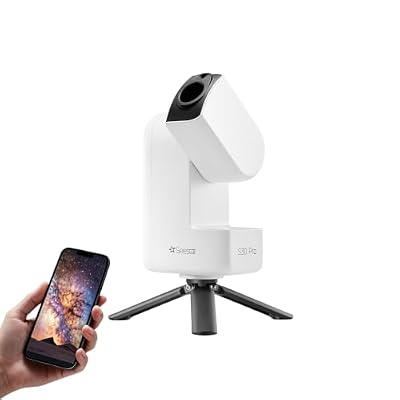
ZWO Seestar S30 Pro Smart Telescope, App-Controlled Astrophotography
Included for 'Best Telescopes for Astrophotography' because the listing specifies App-Controlled Astrophotography, details this guide uses to compare options.
View on AmazonThe Seestar S30 Pro suits the imager who has decided that deep-sky photography is the goal and wants the least friction between deciding to image and actually imaging. It is a strong fit for city dwellers, for people who shoot from a balcony or a back garden with limited sky, and for anyone who wants a second, lighter setup alongside a larger telescope for nights when setting up the big rig is not worth it. ZWO’s background is in astronomy cameras and imaging software, and that lineage shows in how the app handles framing, stacking and file output.
Key specs
- Type: smart telescope with integrated optics, sensor and motorised mount
- Aperture: 30 mm class — small, fast and wide rather than long and narrow
- Mount: motorised alt-az with automatic target acquisition and tracking
- Imaging: integrated CMOS sensor; live stacking in the app; dual-band light-pollution filtering for emission targets
- Control: phone or tablet app over Wi-Fi
- Power: internal rechargeable battery for a full session
- Storage: onboard memory plus app-side library
- Portability: compact enough for a backpack; sets up in minutes without tools
The strengths are in the software as much as the glass. Target framing is automatic, so a beginner does not need to learn star-hopping or plate-solving settings; the app finds the object, centres it and begins stacking. Because the sensor is small and the focal length short, the field is wide enough to fit large nebulae and star fields whole, which is exactly the kind of target that survives light pollution and short sub-exposures. The alt-az mount again limits individual frames to short exposures, and the software compensates by stacking many of them — the result is a clean image after an hour of integration rather than a technically perfect single frame.
Pros
- Purpose-built deep-sky workflow from a manufacturer with a deep imaging pedigree
- Compact, tool-free setup that survives being used often
- Internal battery and Wi-Fi control remove the cable problem entirely
- Dual-band filtering makes emission nebulae viable from suburban skies
- Files output in formats suitable for further processing on a computer
Cons
- Small aperture rules out faint galaxies and most planetary detail
- Closed system — the sensor and lens cannot be swapped or upgraded
- Field rotation limits sub-exposure length, so bright stars can still show minor elongation
- Premium tier price for a 30 mm-class instrument
- App dependency means software updates shape the experience
Against the DWARFLAB Dwarf 3, the choice comes down to workflow versus flexibility. The Seestar S30 Pro is the more single-minded deep-sky machine, and its app is built around the imaging loop rather than around live viewing. The Dwarf 3 offers two focal lengths in one body and a slightly more exploratory feel. If you want one instrument that simply produces good nebula images with the least intervention, the Seestar is the safer bet; if you want to frame wide and tight on the same night without extra kit, the Dwarf 3 wins. Buyers who intend to move to a full equatorial rig later should treat either as a parallel hobby rather than a stepping stone, because nothing here transfers to a larger system.
3. MEEZAA 150EQ Newtonian – Best for Learning a Manual Equatorial Mount

MEEZAA Telescope, 150EQ Newtonian Reflector Telescope for Adults Astronomy Beginners, Professional Astronomical Telescopes with Equatorial Mount, Tripod, Phone Adapter, Moon Filter and Large Carry Bag
Included for 'Best Telescopes for Astrophotography' because the listing specifies Professional Astronomical Telescopes with Equatorial Mount and Tripod, details this guide uses to compare options.
View on AmazonThe 150EQ suits the imager who wants to understand the machinery rather than skip it. A 150 mm Newtonian on an equatorial mount is the classic first serious telescope: enough aperture to show structure in bright nebulae and resolve globular clusters, and a mount whose motions map directly onto the celestial coordinate system. It fits a patient adult beginner with a garden, a dark-ish sky and the willingness to spend an evening learning balance, alignment and collimation. It is not the right first telescope for a child, a balcony, or anyone who wants an image on the first night.
Key specs
- Design: Newtonian reflector, 150 mm aperture — the mid-size class that gathers meaningfully more light than a 114 mm or 130 mm instrument
- Mount: equatorial, with slow-motion control on both axes and a counterweight to balance the tube
- Optics: parabolic-class mirror set typical of the 150 mm f/5 to f/8 range, depending on configuration
- Focuser: accepts standard 1.25-inch eyepieces and, with an adapter, a camera body
- Included: full tripod, counterweight and eyepieces as supplied
- Collimation: user-adjustable primary and secondary mirrors — a maintenance task, not a defect
- Weight: a two-trip, two-hands setup rather than a grab-and-go one
The appeal is aperture and honesty. Six inches of mirror collects roughly twice the light of a 114 mm reflector, which turns faint fuzz into something with visible shape, and it does so without the chromatic aberration that dogs inexpensive refractors. An equatorial mount, once polar aligned, tracks a target by turning a single slow-motion knob, and that same alignment is the foundation every serious imaging rig uses later. The trade-offs are real: the tube needs collimating after transport, the mount needs balancing whenever you change eyepieces or add a camera, and the whole assembly takes several trips to move outside. The premium tier here reflects the size of the package — a large mirror plus a full equatorial mount — rather than exotic glass.
Pros
- 150 mm of aperture shows deep-sky objects as objects rather than smudges
- Equatorial tracking teaches the alignment skills a full imaging rig requires
- No chromatic aberration, unlike comparably priced refractors
- Accepts eyepieces and, with adapters, a camera for lunar and planetary work
- Mirrors do not suffer from the false colour that limits cheap refractors
Cons
- Requires collimation and balancing, which frustrates impatient beginners
- Heavy and bulky — a poor fit for apartments or balcony-only skies
- Manual slow-motion tracking is not accurate enough for long deep-sky exposures
- Newtonian tubes need time to reach thermal equilibrium before sharp viewing
- No motor drive or GoTo at this tier, so finding targets is a skill you must learn
Compared with the SOLOMARK 130 mm reflector, the 150EQ is the bigger, heavier, more capable instrument. Both are Newtonians on complete mounts; the SOLOMARK’s shorter 650 mm focal length gives a wider field and a faster f/5 ratio, which is friendlier for wide-field framing and short-exposure imaging, while the MEEZAA’s larger mirror pulls in more light for visual observing. Choose the MEEZAA if visual aperture and equatorial mechanics are the point of the purchase; choose the SOLOMARK if you want a wider field, a lighter tube, and a slightly gentler learning curve.
4. MEEZAA 90 mm Refractor – Best for Lunar and Planetary Imaging on a Budget

MEEZAA Telescope, Telescope for Adults High Powered Professional, 90mm Aperture 800mm Refractor Telescopes for Astronomy Beginners Stargazing Fully Multi-Coated with Tripod & Phone Adapter & Carry Bag
Included for 'Best Telescopes for Astrophotography' because the listing specifies Telescope for Adults High Powered Professional, details this guide uses to compare options.
View on AmazonThis 90 mm refractor suits the beginner who wants clean, high-contrast views of the Moon, Jupiter and Saturn, and who would rather look at something recognisable on the first night than hunt for faint nebulae. The long 800 mm focal length delivers useful magnification from a modest aperture, and a refractor’s sealed tube means no collimation and no mirror to drift out of alignment. It is a good fit for a family telescope, a small garden, or a beginner who wants a complete package that arrives with everything needed to start.
Key specs
- Design: refractor — sealed optical tube, no collimation required
- Aperture: 90 mm, the class that comfortably resolves lunar craters and Saturn’s rings
- Focal length: 800 mm, giving an f/9 focal ratio — a comparatively forgiving ratio for eyepieces and for simple cameras
- Mount: complete alt-az or equatorial mount and tripod as supplied with the package
- Optics: multi-coated glass; expect a well-corrected achromatic doublet at this tier rather than an apochromat
- Use: visual observing first, with afocal phone imaging and short-exposure planetary capture possible
- Weight: light enough for one person to move outside in a single trip
The strengths are contrast and convenience. A refractor at f/9 puts up a steady image, tolerates inexpensive eyepieces reasonably well, and holds focus without the thermal wobble of an open-tube Newtonian. On the Moon the 90 mm objective shows the major crater walls and mare boundaries at magnification, and on the gas giants it separates the equatorial belts and the rings. For imaging, the long focal length is a genuine advantage for planets: you want a large image scale, not a wide field, and the same ratio that makes the tube narrow also makes it easier to reach a useful pixel scale with a small planetary camera or a phone held to the eyepiece. Deep-sky imaging, by contrast, is limited by the f/9 ratio, which is slow for faint nebulae.
Pros
- No collimation and no open tube, so maintenance is minimal
- Long focal length gives good image scale for the Moon and planets
- High contrast with no central obstruction to soften detail
- Complete package — mount, tripod and optics arrive together
- Light and quick to set up compared with a 150 mm reflector
Cons
- 90 mm of aperture is limited on faint deep-sky objects
- f/9 is slow, so deep-sky sub-exposures need long integration time
- Achromatic optics show some colour fringing on bright objects
- The supplied mount is generally not accurate enough for long-exposure imaging
- Not an upgradeable platform — the tube is the tube
Its closest relative in this list is the EACONN 80 mm refractor. The MEEZAA is the larger, longer instrument: 90 mm against 80 mm, 800 mm against 600 mm, and a higher price tier to match. The EACONN is lighter and more portable, which matters if the telescope lives in a cupboard and comes out for twenty minutes at a time; the MEEZAA gives more resolution and more magnification for lunar and planetary work. If your interest is the Moon and the planets, spend the extra; if your interest is simply having a telescope that gets used, the lighter tube wins more often than specifications suggest.
5. Askar 71F – Best Premium Optical Tube for Advanced Deep-Sky Work

Askar 71F Flat-Field Telescope, 71mm Aperture F6.9 ED Glass Refractor OTA, Quadruplet air-Spaced APO, 230mm Vixen Dovetail Plate for Deep Sky Astrophotography and Visual Astronomy
Included for 'Best Telescopes for Astrophotography' because the listing specifies 71mm Aperture F6.9 ED Glass Refractor OTA and Quadruplet air-Spaced APO, details this guide uses to compare options.
View on AmazonThe Askar 71F is for the imager who already owns a tracking mount and a camera and now wants optics that stop being the limiting factor. It suits the intermediate-to-advanced astrophotographer chasing round stars to the corners of an APS-C frame, and the visual observer who wants a compact, colour-free refractor for wide-field sweeping. It is not a complete telescope: there is no mount, no tripod and no camera, so it is a deliberate purchase for someone who has already built the rest of the rig.
Key specs
- Design: quadruplet air-spaced apochromatic refractor with ED glass elements
- Aperture: 71 mm — modest light grasp, but a fast, wide field
- Focal ratio: f/6.9, which works out to roughly 490 mm focal length
- Field correction: flat-field design, so stars stay round into the corners of an APS-C sensor without a separate flattener
- Mounting: 230 mm mounting bar for a standard equatorial saddle
- Camera compatibility: threaded and standard connections for astronomy cameras and mirrorless bodies; back-focus spacing must be set with the correct adapters
- Package: optical tube only — no mount, tripod, eyepiece or camera included
The case for the 71F is optical quality per millimetre of aperture. A quadruplet air-spaced design with ED glass corrects both chromatic aberration and field curvature, which are the two faults that make inexpensive refractors frustrating for imaging: colour fringing around bright stars, and stars that smear into commas at the edge of the frame. Because the field is already flat, you do not need to buy and space a separate field flattener, and because the ratio is f/6.9, sub-exposures collect light quickly. At roughly 490 mm of focal length the scope is naturally suited to large emission nebulae, open clusters and wide star fields, and it pairs well with modern small-pixel astronomy cameras that would be badly over-sampled on a longer instrument.
Pros
- Flat, colour-corrected field to the corners of an APS-C sensor
- No separate flattener to buy, space or align
- Fast f/6.9 ratio suits short sub-exposures and modest mounts
- Compact and light for its optical class, so it strains a mid-size mount less
- Upgrade path is open — camera, mount and filters can all change independently
Cons
- Optical tube only; the total cost of a working setup is much higher
- 71 mm of aperture is small for galaxies, planetary nebulae and visual deep-sky work
- Requires a tracking mount with good periodic error performance to shine
- Needs correct back-focus spacing and adapters, which is a real learning task
- Premium tier price for the tube alone
Within this list its natural foil is the MEEZAA 90 mm refractor, and the comparison is instructive: the MEEZAA gives more aperture and more focal length for a mid-range price, while the Askar gives a corrected flat field, ED glass and an open upgrade path. That difference is invisible in daylight and obvious in a stacked image. If your goal is a good lunar and planetary view at low cost, the MEEZAA is the sensible buy. If your goal is deep-sky imaging with round stars and no colour fringing, the Askar is the tube you build around, and it will still be the right tube after you have replaced the mount and the camera twice.
6. SOLOMARK 130 mm – Best for Fast Wide-Field Reflector Imaging

SOLOMARK 130mm Professional Astronomical Telescope, High Powered 650mm Focal Length Telescopes for Adults & Beginners, Alt-Az Mount with Fine Adjustment, Dual Phone Adapters,Moon Filter
Included for 'Best Telescopes for Astrophotography' because the listing specifies Alt-Az Mount with Fine Adjustment and Dual Phone Adapters, details this guide uses to compare options.
View on AmazonThe SOLOMARK 130 mm suits the beginner or intermediate observer who wants more light grasp than a small refractor but a shorter, more manageable tube than a full-size Newtonian. It is a good fit for a dark-sky garden, for a teenager moving up from a starter scope, and for anyone who wants a single instrument that does reasonably well both visually and with a camera. The 650 mm focal length is the defining feature: it keeps the field wide enough to frame large objects whole, which is what most beginners actually want to photograph.
Key specs
- Design: reflector, 130 mm aperture — the class that gathers noticeably more light than a 90 mm refractor
- Focal length: 650 mm, giving a fast f/5 ratio
- Field of view: wide for its aperture, which suits large nebulae, clusters and the Moon in full
- Mount: complete mount and tripod supplied with the package
- Focuser: accepts standard eyepieces and, with adapters, a camera body
- Collimation: user-adjustable mirrors, as with any Newtonian
- Weight: one or two trips outside, depending on how the tube and mount separate
At f/5 this telescope is fast, and speed is the single most useful property for anyone imaging without a top-tier mount. A fast ratio means the same faint nebula reaches a given brightness in less total exposure time, which directly reduces how long your tracking has to hold. The 130 mm mirror also gives genuinely better views of globular clusters and the brighter galaxies than a 90 mm refractor, and the absence of chromatic aberration means bright stars stay white rather than ringed with colour. The costs are the usual Newtonian ones: collimation after transport, a tube that needs to cool before it performs, and an open optical path that collects dust and needs occasional cleaning.
Pros
- Fast f/5 ratio shortens the exposure time needed for faint targets
- 130 mm of aperture gives real light grasp for a mid-range price
- Wide field frames large nebulae and clusters comfortably
- No chromatic aberration
- Accepts cameras with the right adapters, so it can grow with the user
Cons
- Requires collimation and cool-down time before it performs at its best
- Mirror-based optics need periodic cleaning and careful handling
- Supplied mount is unlikely to track accurately enough for long deep-sky sub-exposures
- Field curvature and coma are visible toward the edges with larger sensors
- Not as portable as an 80 mm refractor of similar price
Against the MEEZAA 150EQ, the SOLOMARK is the lighter, wider, faster instrument and the MEEZAA is the larger, slower, more visually capable one. The SOLOMARK’s f/5 ratio and 650 mm focal length make it the friendlier choice for a beginner who wants to attach a camera and see something quickly, while the MEEZAA’s extra 20 mm of aperture and equatorial mount reward someone who wants to observe faint objects and learn alignment. If wide-field imaging and portability drive the decision, the SOLOMARK is the better fit; if aperture and mount mechanics do, the MEEZAA is.
7. ToyerBee 70 mm – Best for an Ultra-Light First Scope

Telescope for Adults & Kids, 70MM Aperture FMC Optics Telescopes for Astronomy Beginners, 300MM Refractor Telescope (15X-150X) with Phone Adapter and Tripod, Travel Gifts for Moon, Jupiter and Star
Included for 'Best Telescopes for Astrophotography' because the listing specifies 70MM Aperture FMC Optics Telescopes for Astronomy Beginners and Travel Gifts for Moon, details this guide uses to compare options.
View on AmazonThe ToyerBee 70 mm suits the youngest beginners and the most space-constrained households. At 300 mm of focal length it is a short, light refractor that shows the Moon in detail, resolves the phases of Venus and splits the brighter double stars, and it is small enough that a child can carry it outside unaided. It also works as a travel telescope for an adult who wants something in a suitcase rather than in a shed. It is not an astrophotography instrument, and it is worth being honest about that before buying.
Key specs