Last updated: October 7, 2026
The best RV toilets depend on your available clearance, camping frequency, tolerance for emptying waste, and whether you want a household-style flush: choose a cassette toilet for the best all-around balance, a composting toilet for long off-grid stays, a portable toilet for low-cost simplicity, or a flush RV toilet when comfort matters most and you have a permanent black tank.
Quick picks by camping situation
| Your situation | Best toilet type | Why it fits | Main compromise |
|---|---|---|---|
| Small van, occasional weekend trips | Portable cassette | Low purchase cost, no plumbing, easy storage | Small waste tank and more frequent emptying |
| Frequent off-grid use with no black tank | Composting or urine-diverting toilet | Minimal water use and large solids capacity | Requires ventilation, separation, and regular liquid management |
| Two or more people using a compact bathroom | Large cassette toilet | Separate removable waste tank and predictable operation | Tank must be carried to a dump point |
| Family RV with a fixed bathroom and sewer hookup | Flush RV toilet | Largest, most familiar bowl and easiest daily use | Needs water, plumbing, a black tank, and adequate installation space |
| Emergency, backup, or very limited budget | Portable bucket-style or cassette toilet | Fastest and least expensive installation | Less odor control and less comfortable for extended use |
Head-to-head comparison
See also: Best Black Friday Dresser Deals • Best Wooden Train Sets for Toddlers and Kids
The figures below are typical ranges rather than universal specifications. Exact dimensions vary by model, and the available clearance around the toilet is often more important than the toilet’s footprint alone.
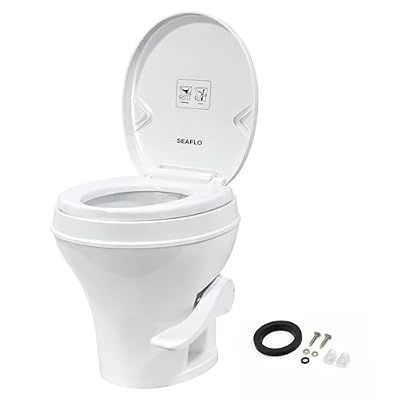
SEAFLO RV Toilet – 18.4" Residential Height, Gravity Flush Foot Pedal, 4-Year Warranty, Fits Most RVs (9.5" Rough-In), Soft Close Seat, 2-Bolt Mount, for Camper Travel Trailer Motorhome SFRTPH-01-01
Included for 'Best RV Toilets for Comfort and Easy Maintenance' because the listing specifies 18.4" Residential Height and Gravity Flush Foot Pedal, details this guide uses to compare options.
View on Amazon
Dometic Model 410 Complete RV Toilet – Round Porcelain Bowl, Universal Fit & 2-Bolt Mount, 18" Chair Height Residential-Style, Gravity Flush Toilet with Soft-Close Seat, White (9610008259)
Included for 'Best RV Toilets for Comfort and Easy Maintenance' because the listing specifies Round Porcelain Bowl and Universal Fit & 2-Bolt Mount, details this guide uses to compare options.
View on Amazon
Thetford Aqua-Magic® VI High Profile, White
Included for 'Best RV Toilets for Comfort and Easy Maintenance' because the listing specifies White, details this guide uses to compare options.
View on Amazon
SEAFLO Porcelain RV Toilet with Elongated Bowl, 19” Residential Height, Gravity Flush, Foot Pedal Flush, Soft Close Seat, Easy Install, Camper Toilet, 4-Year Warranty, SFRTCH-02-01
Included for 'Best RV Toilets for Comfort and Easy Maintenance' because the listing specifies 19” Residential Height and Gravity Flush, details this guide uses to compare options.
View on Amazon| Toilet type | Typical seat height | Typical bowl size | Water use | Waste capacity | Installation clearance | Emptying effort |
|---|---|---|---|---|---|---|
| Portable cassette | 12–17 in | Small to medium | 0.1–0.5 L per flush, or none | 4–6 gal | About 20–24 in wide and 18–24 in deep | Carry removable tank; usually easy but frequent |
| Composting or urine-diverting | 17–21 in | Medium, usually elongated | Almost none for flushing | Solids container commonly 2–5 gal; liquid bottle 1–3 gal | About 20–24 in wide and 19–28 in deep, plus vent routing | Separate liquid emptying and solids handling |
| Portable flush toilet | 12–17 in | Small | Uses a freshwater tank, typically 0.1–0.4 L per flush | 2.6–5.5 gal | Similar to a portable cassette | Lift and empty the tank; chemical treatment is usually needed |
| Flush RV toilet | 14–19 in | Medium to full-size | About 0.3–1.0 gal per flush | Fixed black tank, commonly 20–50 gal | Roughly 20–24 in wide and 24–30 in deep, with floor plumbing | Least manual handling, but requires a dump station or sewer connection |
Cassette toilets: the practical middle ground
A cassette toilet has a permanent upper bowl and a removable lower waste tank. Some models are fully portable, while others are installed through an exterior service door. Thetford Porta Potti models are common examples of the portable format; installed cassette systems such as the Thetford C220 or C260 are designed around a dedicated bathroom compartment.
This type usually offers the best compromise between comfort, odor control, and installation complexity. A sealed slide valve separates the bowl from the waste tank, so odors are contained better than with an open bucket. The removable tank typically includes a pour-out spout and vent button, reducing splashing during emptying.
The limitation is capacity. A 5-gallon tank used by two people at roughly 0.75 gallons of combined waste and flush water per person per day could require emptying after about three days. That estimate changes substantially with urine-only use, flush habits, and whether the toilet is used overnight.
Choose a cassette toilet when you want a real seat, controlled odors, and no permanent black-tank installation. Check the tank handle and carrying path before buying: a full 5-gallon tank can weigh more than 40 pounds, so a toilet that is easy to remove may still be awkward to transport.
Composting toilets: best for water conservation and long stays
Composting and urine-diverting toilets separate liquid from solids rather than flushing both into one tank. Nature’s Head and Air Head are established examples of this category. Most use a small fan, vent hose, and dry cover material such as coconut coir or peat-free medium.
The large advantage is water independence. A two-person couple may use several gallons of water each day with a conventional flush toilet, while a properly configured separating toilet uses little or no flush water. Its solids container may last several weeks, although the liquid bottle often needs emptying every one to three days.
These toilets are not maintenance-free. The fan must run whenever the toilet is occupied, the vent must terminate outside the living space, and the liquid separator needs regular rinsing. Incorrect leveling, excess urine in the solids container, or insufficient cover material can cause odor quickly. “Composting” also does not mean waste can be handled carelessly; follow the manufacturer’s disposal instructions and local regulations.
A composting toilet is a strong choice for extended boondocking, but it needs more vertical room than many cassette toilets. Measure the seat height against your bed platform, and allow space behind or beside the unit for the vent outlet, fan wiring, and container removal.
Portable toilets: lowest installation cost
Portable toilets are useful when a van has no built-in bathroom. Basic models use a lower waste tank and a manual or battery-powered flush; simpler bucket-style designs use a liner and absorbent material. Prices range from roughly $50–$250 for basic portable units and around $100–$300 for better-sealed cassette-style models.
Their small footprint makes them easy to store under a bed or bench. The trade-off is bowl size and seat height. Many compact units feel closer to a child-sized toilet, and their 2.6–3-gallon tanks fill quickly for two adults.
For odor control, keep the bowl valve closed when not in use, use only the treatment approved for that toilet, and do not mix household bleach with chemical waste treatments. A separate lidded transport box is useful if the toilet must travel through the living area to a disposal point.
Flush RV toilets: the comfort winner
Flush RV toilets most closely resemble residential toilets. The Dometic 310 and 320, along with Thetford Aqua-Magic models, are examples of fixed RV toilets with foot-pedal or hand-operated flushing. They usually have a larger ceramic or molded-plastic bowl, a more stable seat, and a taller option for easier standing and sitting.
They make the most sense in a motorhome, trailer, or large van with a permanent black tank. Water consumption can be managed with a short flush, but using too little water can leave solids stuck in the tank. A useful operating rule is to maintain enough liquid in the black tank to keep waste from drying on the sensors and tank walls.
Installation is more demanding than the other categories. The toilet needs a correctly positioned floor flange, a water supply, a seal, structural support, and access to the black tank. Verify the flange position and rough-in dimensions before cutting anything. A full-size bowl can also interfere with a sliding bathroom door or reduce legroom in a narrow wet bath.
What to check before choosing
Seat height and bowl geometry
Measure from the finished floor, not the subfloor. A 17–19-inch seat is more chair-like, while a 12–15-inch portable toilet saves vertical space. Bowl width at the rim and the distance from the front edge to the back wall determine usable comfort more than the advertised height alone.
Clearance for removal and service
Leave enough room to open a cassette tank latch, remove a composting solids container, or access a flush toilet’s water valve. A toilet that fits on paper may be unusable if a cabinet blocks the tank handle. Mark the complete service path with cardboard before installation.
Odor control
Sealed valves, a working vent, a tight lid, and correct chemical or dry-medium use matter more than the toilet category. Flush toilets can smell when the black-tank vent is blocked. Composting toilets smell when liquid enters the solids chamber. Portable toilets smell when the tank is overfilled or the valve is left open.
Materials and wear points
Plastic bowls are lighter and less likely to crack from vibration; ceramic bowls feel more residential but add weight. The components that commonly wear first are blade seals, flush-pedal linkages, vent fans, pump diaphragms, tank caps, and seat hinges. Confirm that replacement seals and fans are available before buying an unfamiliar design.
Recommended decision
For most van conversions, start with a cassette toilet if you can accept carrying a waste tank. Select a composting toilet when water conservation and long off-grid periods outweigh the need for simple emptying. Choose a portable unit when the toilet will be occasional or removable. Choose a flush RV toilet only when you already have the space, water system, black tank, and installation structure to support it.
Before committing, calculate both capacity and carrying weight. For example, a 5-gallon cassette tank filled to 80% holds about 4 gallons. At approximately 8.3 pounds per gallon, the liquid alone weighs about 33 pounds, before adding the tank. That number often determines whether a supposedly convenient toilet is practical for your particular van.